

I manage digital content across multiple specialized websites. My mornings in Rio de Janeiro usually begin with intense mental labor. I draft complex educational guides about foreign language vocabulary retention and grammar simplification. The work requires absolute mental clarity. Before I sit down to map out those heavy linguistic concepts, I walk into my kitchen to brew coffee.
For a very long time, that morning coffee was a massive source of frustration.
I owned all the correct equipment. I used a precision digital scale. I bought a heavy manual burr grinder. I paid a premium price for light roasted Ethiopian Guji beans. I followed the exact mathematical ratios I found online. But the liquid inside my ceramic mug was always slightly broken.
It was never perfect. Some days it tasted sharply sour and thin. Other days it tasted muddy, heavy, and harshly bitter. The sweet, floral notes printed on the beautiful foil bag felt like a massive marketing lie. The morning I finally got a coffee that tasted just right felt like unlocking a heavy bank vault. I realized that a perfect cup is not a lucky accident. It is the exact moment when physics, chemistry, and patience perfectly align on your kitchen counter.
The Preparation of the Workspace
The breakthrough happened on a quiet Thursday. The city traffic outside my apartment was still light. I decided I was going to stop rushing. I was going to treat the brewing process with the exact same strict discipline I use when writing code for my websites.
I approached the kitchen counter. I cleared away the clutter. I placed my digital scale completely flat on the surface.
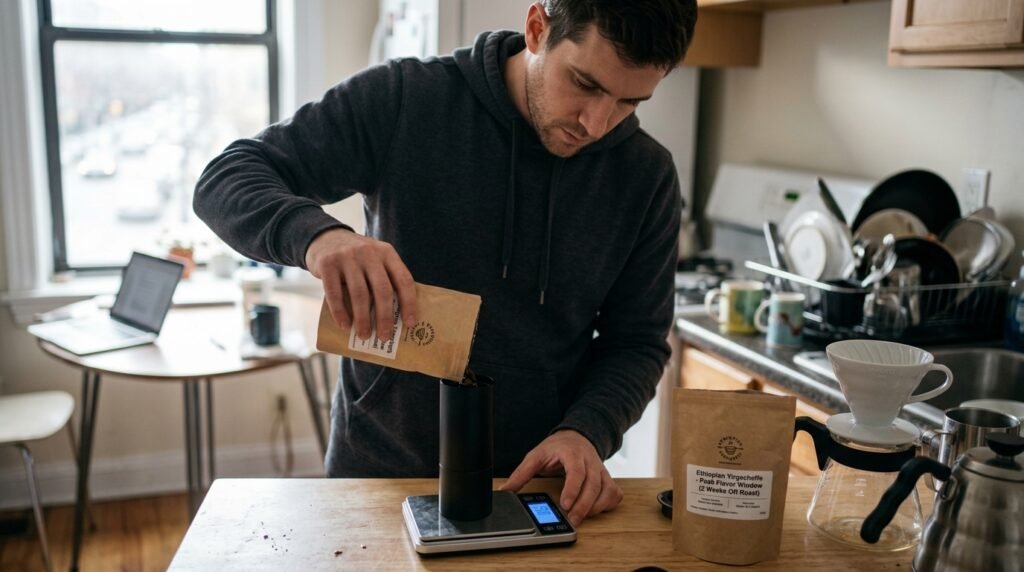
I grabbed my bag of Ethiopian coffee. The beans were exactly fourteen days off roast. This is the absolute peak of the flavor window. The volatile carbon dioxide gas had safely dissipated, but the delicate fruit lipids were still perfectly intact and protected from oxidation.
The Aromatic Confirmation
I opened the heavy zipper of the bag. I brought the opening directly to my nose and took a deep breath.
The aroma was absolutely staggering. The smell of sweet peach and bright blooming jasmine filled the kitchen instantly. Experiencing this explosive volatile aroma was a massive shift from my past habits What Happened When I Stopped Buying Pre-Ground Coffee because the intact cellular structure of the whole seed protects the fragile oils from the humid tropical air.
I placed my manual grinder on the scale. I carefully poured exactly fifteen grams of the hard African seeds into the top chamber. I did not guess the weight. I verified the math on the digital screen.
The Physical Effort of the Grind
I attached the metal crank handle to the top of the grinder. I planted my feet firmly on the kitchen floor and started turning.
Light roasted specialty coffee is incredibly dense. The seeds are grown at high altitudes. They mature very slowly, creating a tight, hard cellular structure. Crushing these seeds requires genuine physical effort. I felt the heavy resistance in my shoulder. I listened to the sharp, satisfying sound of the ceramic burrs slicing the beans into uniform pieces.
I unscrewed the bottom catch bin. I looked at the dark brown grounds under the kitchen lights.
The particle distribution was visually flawless. There was no microscopic, powdery dust. There were no massive, jagged boulders. Every single piece of coffee looked exactly like a coarse grain of sea salt. This mechanical consistency is the absolute baseline for a successful extraction.
The Thermal Foundation
I placed my dark plastic V60 cone on top of a heavy glass carafe. I inserted a fresh white paper filter.
I picked up my electric gooseneck kettle. The water inside was boiling violently. The digital thermometer read exactly two hundred and twelve degrees Fahrenheit.
I poured a massive splash of boiling water directly over the empty paper filter. This step washes away the dry, cardboard flavor of the paper. It also serves a critical thermal purpose. The boiling water heats the plastic cone and the thick glass carafe. It preheats the entire physical environment.
I dumped the hot rinse water into the sink. I poured the fifteen grams of perfect coffee grounds into the wet filter. I tapped the plastic cone gently against the counter to create a perfectly flat, level bed.
The Execution of the Bloom
I placed the entire brewing setup back onto the digital scale. I zeroed the numbers. I grabbed the boiling kettle.
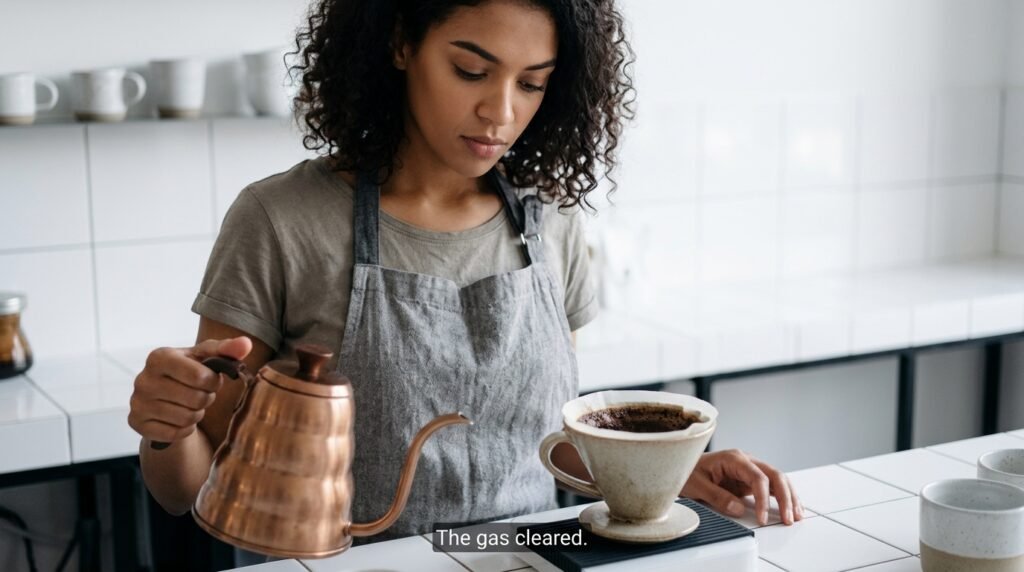
I lowered the curved metal spout until it was barely an inch above the flat coffee bed. I tilted my wrist. A smooth, glassy rod of water exited the kettle. I poured exactly forty grams of water in a tight circle.
The coffee reacted instantly. The hot solvent penetrated the dense particles. The remaining carbon dioxide gas erupted. The entire coffee bed swelled upward into a beautiful, dark dome.
I set the heavy kettle down on the stove. I stood completely still. Giving the coffee bed time to release the trapped gas became my most important rule The First Time I Brewed Coffee Slowly Instead of Rushing because impatiently pouring more water over an active bloom guarantees chaotic channeling and a bitter finish. I watched the clock tick. I waited exactly forty five seconds.
The Concentric Discipline
The gas cleared. The dome settled. I picked the kettle back up.
I started the main extraction pour. This is where I usually made my mistakes. In the past, I would pour aggressively. I would splash water high against the white paper walls. I would dig deep craters into the coffee bed.
This morning, I maintained absolute physical discipline.
I kept the spout incredibly low. I moved my wrist in a slow, steady spiral. I started in the dark center of the slurry and moved outward. I stopped my circle a quarter of an inch away from the paper filter. I never let the hot stream of water touch the exposed paper. I forced every single drop of solvent to travel directly through the coffee mass.
The Fluid Dynamics
I watched the digital numbers climbing steadily on the scale. One hundred grams. One hundred and fifty grams. Two hundred grams.
The fluid dynamics were perfectly stable. The water was draining through the coffee bed at the exact same speed I was pouring it. The slurry remained perfectly flat. There was no stalling. There was no choking.
The scale hit exactly two hundred and forty grams. I tilted my wrist back instantly. The water flow stopped perfectly on the target number.
The Visual Diagnosis
I set the kettle aside. I watched the final drawdown phase.
The dark red liquid drained smoothly into the glass carafe. When the very last drop fell from the bottom of the plastic cone, I looked closely at the spent coffee grounds inside the filter.
The visual diagnosis was spectacular. The coffee bed was a perfectly flat, level puck. There was no dark mud sitting on the surface. There were no high walls of dry coffee stuck to the paper. The flat puck proved mathematically that the hot water had passed through every single particle of coffee with equal force and equal time.
The Chemical Unification
I removed the plastic brewer and set it in the sink.
I looked at the hot liquid inside the glass carafe. The extraction layers were separated. The heavy sugars were sitting at the bottom, and the diluted water was sitting at the top.
I picked up the carafe by its glass handle. I swirled the liquid aggressively three times. This violent motion homogenized the chemistry. It forced the bright organic acids and the heavy fruit sugars to blend completely together. A massive cloud of floral aromatics released into the kitchen air.
I poured the unified dark red liquid into my favorite heavy ceramic mug.
The Mandatory Waiting Period
The brewing process was finished. But the most important step was just beginning.
I carried the hot ceramic mug into my living room. I set it down on my wooden coffee table. I did not take a sip. Drinking coffee at nearly two hundred degrees is a massive sensory mistake. The extreme thermal energy completely blinds the human tongue. It masks the delicate fruit flavors and only leaves a sensation of generic, dark heat.
You have to wait. You must allow the extreme heat to bleed out into the room.
I pulled a heavy art book off my shelf. I opened it to a complex diagram of Japanese Irezumi serpent scales. I forced myself to study the black ink lines. I used the art as an analog anchor to keep my brain occupied while the coffee cooled down.
The First Proper Sip
I waited five full minutes. I touched the outside of the ceramic mug. It was comfortably warm. The thermal barrier was finally gone.
I picked up the mug. I brought it to my face and took a deep breath. The smell was incredibly sweet. It lacked any hint of sharp ash or burnt wood.
I took a slow, deliberate sip. I let the warm liquid coat my entire palate.
The Sensory Explosion
The flavor completely paralyzed me. I stopped breathing for a second.
The confusing, muddy bitterness that usually ruined my mornings was entirely absent. The sharp, under extracted sourness was completely gone. The liquid felt incredibly clean and vibrantly alive on my tongue.
The flavor resolution was absolutely staggering. A sharp, brilliant wave of crisp lemon acidity hit the very front of my palate. It acted as a perfect introduction. Within a millisecond, that acidity melted seamlessly into a massive, heavy, syrupy wave of sweet peach.
The Lingering Finish
The most shocking part was the finish.
Usually, my coffee left a dry, chalky, astringent feeling in the back of my throat. It tasted like an old tea bag.
This morning, the finish was endlessly smooth. It did not dry my mouth out at all. As I swallowed the liquid, a distinct flavor of blooming jasmine flowers lingered in the back of my throat for nearly a full minute.
Picking apart this complex profile of peach and jasmine was an incredible sensory shift How I Started Noticing Flavor Notes in Coffee because the absence of harsh tannins finally allowed the delicate agriculture to speak clearly. I was not just drinking caffeine. I was tasting the specific soil and the specific altitude of the Ethiopian farm.
The Validation of the Craft
I sat on my couch and drank the entire cup slowly. Every single sip remained perfectly consistent as the coffee continued to cool down.
I realized in that exact moment that the rules actually matter.
When you read about coffee chemistry online, it sounds incredibly pretentious. It sounds like overcomplicated nonsense. But when you finally align the physical variables in your own kitchen, the science proves itself immediately.
The flat coffee bed matters. The boiling water matters. The exact gram weight matters. The slow pouring technique matters.
The Eradication of Luck
The greatest reward of that specific morning was not just the delicious flavor. The greatest reward was the absolute confidence that followed.
I did not achieve that perfect cup by accident. I did not get lucky. I engineered the result. I controlled the fluid dynamics. I managed the thermal energy. I dictated the extraction.
Because I understood exactly what I did to achieve the perfect cup, I knew I could replicate it. I knew I could wake up the next morning, execute the exact same mechanical steps, and experience the exact same massive sweetness.

Do Not Accept Mediocrity
If you are currently drinking bitter, confusing, muddy coffee every morning, you must stop accepting the mediocrity.
Do not blame the expensive coffee beans. The heavy peach sweetness and the bright floral aromatics are already inside the bag sitting on your counter. They are waiting for you to extract them properly.
Clean your equipment. Buy a digital scale. Crush the seeds uniformly. Pour the boiling water with absolute, slow precision. Wait for the bloom. Wait for the extreme heat to leave the mug.
When you finally stop rushing the process and start respecting the physical laws of the extraction, the heavy fog will lift from your palate. You will experience the profound joy of a flawless cup, and you will never settle for bitter water again.

Hi, I’m the coffee enthusiast behind Coffee Nerd Lab.
Like many people, I started drinking coffee simply because it helped me wake up in the morning. Over time, that daily habit turned into a genuine interest in understanding what makes a great cup of coffee. I began experimenting with different beans, brewing methods, grinders, and coffee gear, learning through trial and error along the way.
This blog is where I document that journey. Every article is inspired by real experiences, discoveries, and lessons I’ve learned while exploring the world of coffee. From brewing guides and equipment reviews to practical tips and coffee basics, my goal is to share useful information in a way that’s easy to understand and enjoyable to read.
Thanks for stopping by, and I hope Coffee Nerd Lab helps you enjoy your next cup a little more than the last.