
The morning air in Rio de Janeiro was already thick and humid. I was sitting at my kitchen table trying to wake up. My partner walked over to the table and handed me a ceramic mug of freshly brewed pour over coffee.
She placed the empty coffee bag on the table next to my mug.
I looked at the label. It was a naturally processed Ethiopian coffee. The label featured three specific tasting notes printed in bold black letters. It said the coffee tasted like ripe blueberry, dark chocolate, and black tea.
I stared at the words and scoffed. For a very long time, I believed that flavor notes were a massive scam. I thought specialty coffee roasters just printed random, pretentious adjectives on their bags to justify charging more money. I assumed that coffee just tasted like coffee.
I took a sip from the mug. I expected to taste hot, bitter water.
Instead, a massive wave of sweet fruit hit my palate. It did not taste vaguely like fruit. It tasted exactly like a handful of fresh blueberries. The resemblance was so accurate it completely shocked me. I put the mug down and stared at the dark liquid.
That humid morning completely shattered my skepticism. It proved that the flavor descriptions on the bag were not a marketing trick. They were a literal roadmap. Learning how to follow that roadmap took practice. How I started noticing flavor notes in coffee was not a magic trick. It was a deliberate physical exercise that completely changed my palate.
The Biological Reality of the Seed
To understand flavor notes, I had to change my fundamental definition of the ingredient.
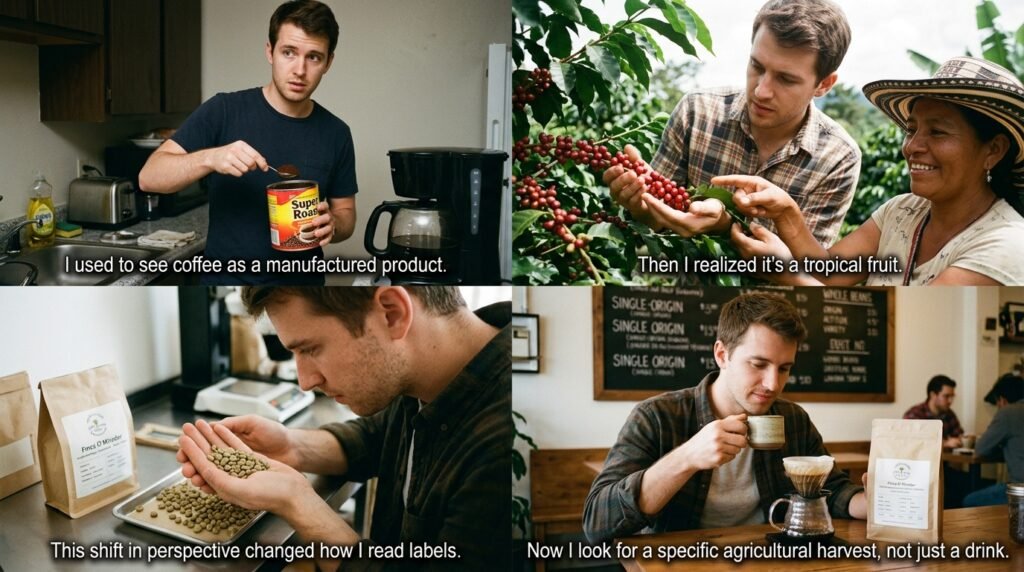
I grew up thinking of coffee as a manufactured product. I viewed it the same way I viewed a can of soda or a box of cereal. I thought the flavor was created in a factory.
That is entirely false. Coffee is agriculture.
The brown bean you put in your grinder is the pit of a tropical fruit. It is the seed of a cherry. When a farmer grows coffee, the plant pulls nutrients from the soil. The fruit develops complex organic acids and dense natural sugars.
When you roast and brew that seed, you are simply extracting those natural acids and sugars into water. Why would it be strange for the seed of a tropical fruit to taste like fruit?
Accepting this biological reality was the very first step. This fundamental shift in perspective was exactly What I Noticed When I Started Paying Attention to Coffee Labels and reading the agricultural data. I stopped looking for a generic beverage and started looking for a specific agricultural harvest.
The Temperature Barrier
Even after I accepted that coffee could taste like fruit, I still struggled to actually taste it. I would buy expensive bags of single origin beans, brew them carefully, and taste absolutely nothing but generic roasted coffee.
I finally realized I was making a massive mechanical error. I was drinking the coffee entirely too hot.
Human taste buds are incredibly sensitive to extreme temperatures. When you drink a liquid that is nearly two hundred degrees Fahrenheit, your tongue physically panics. Your pain receptors override your flavor receptors. The extreme heat acts like a sensory blanket, smothering all the delicate nuances of the beverage.
I started brewing my coffee and forcing myself to wait.
I would let the mug sit on the kitchen counter for at least five minutes. I waited until the liquid was pleasantly warm, not aggressively hot.
The difference was staggering. As the temperature dropped, the heavy, dark flavors receded into the background. The bright fruit acids and the delicate floral sugars stepped forward. Managing this thermal reality was the core lesson in How I Learned Coffee Temperature Changes Flavor during my daily routine. You cannot taste nuance if your tongue is burning.
The Power of Retronasal Olfaction
The second massive breakthrough involved basic human anatomy. I learned that flavor does not actually happen on the tongue.
The human tongue can only identify five basic tastes. It can detect sweet, sour, salty, bitter, and umami. That is the absolute limit of your mouth.
The vast majority of what we experience as flavor actually happens in the nose. It is a process called retronasal olfaction. When you swallow a liquid, the aromatic compounds travel up the back of your throat and into your nasal cavity. Your brain combines the basic taste from your tongue with the complex aroma from your nose to create a specific flavor note.
If you want to taste blueberries in your coffee, you have to be able to smell blueberries.
The Aromatic Warm Up
I started changing my physical approach to the mug.
Before I ever took a sip of liquid, I engaged my nose. I would hold the warm ceramic mug right under my chin. I would close my eyes and take a very deep, slow breath through my nose.
I tried to isolate the scent. I asked myself specific questions. Did the steam smell heavy and dark, or did it smell light and bright? Did it smell like wood, or did it smell like flowers?
I repeated this process before every single sip. I was actively training my olfactory bulb to search for complex compounds. The aromatic power of the dry and wet grounds is incredible. Discovering this practice was exactly The First Time I Smelled Freshly Roasted Coffee Beans and realized the beans were actively communicating with me.
Building a Mental Library
I quickly encountered another frustrating roadblock. I could smell and taste complex things in the coffee, but I did not have the vocabulary to describe them.
I would take a sip and think, “This tastes sweet and sharp.” But I could not name the specific fruit.
You cannot identify a flavor note in a cup of coffee if you do not have a strong memory of that flavor in real life. If you never eat fresh raspberries, your brain will never be able to recognize a raspberry note in your mug. Your mental flavor library is empty.
I had to actively build my library.
I started paying intense attention to everything I ate. When I went to the grocery store, I bought fruits I rarely ate. I bought fresh plums, green apples, and dark cherries. Before I ate them, I smelled them deliberately. I memorized their specific acidity. I memorized their specific sweetness.
I expanded my culinary vocabulary. This allowed my brain to finally attach accurate words to the sensations happening in my coffee mug.

The Categorization Technique
To make the tasting process less overwhelming, I developed a simple mental categorization technique.
When I took a sip of a new coffee, I did not immediately try to find a highly specific note like “toasted hazelnut.” That is too difficult. Instead, I started very broad.
I asked myself one simple question. Does this coffee belong in the bakery, the fruit stand, or the flower shop?
If the coffee tasted heavy, rich, and comforting, I put it in the bakery category. Once it was in the bakery, I narrowed it down. Does it taste like chocolate or pastry? If it is chocolate, is it sweet milk chocolate or bitter dark chocolate?
If the coffee tasted bright, acidic, and juicy, I put it in the fruit stand category. Once it was in the fruit stand, I narrowed it down. Does it taste like a citrus fruit or a berry? If it is a citrus fruit, is it a sour lemon or a sweet orange?
Starting broad and slowly narrowing the focus made identifying flavor notes incredibly easy and highly systematic.
The Value of Contrast
The fastest way to train your palate is to use direct contrast. It is very hard to evaluate a single cup of coffee in a vacuum. Your brain needs a point of reference.
I started brewing two different coffees at the same time.
I would brew a heavy, earthy coffee from Brazil in one mug. I would brew a bright, floral coffee from Ethiopia in another mug. I lined them up on the kitchen table.
I took a sip of the heavy Brazilian coffee. I let the dark chocolate and peanut flavors coat my tongue. Then, I immediately took a sip of the Ethiopian coffee.
The contrast was explosive. Because my palate was just coated in heavy chocolate, the bright peach and jasmine notes of the African coffee felt incredibly sharp and obvious. The differences were magnified a hundred times over.
If you want to understand acidity, drink something bitter right before it. Contrast highlights the invisible notes.
The Partner Blind Test
The final step in my sensory training was eliminating the placebo effect.
The human brain is highly suggestible. If you read the word “strawberry” on a coffee bag, your brain will actively search for strawberries. You might convince yourself you are tasting fruit just because the label told you to.
I asked my partner to help me run blind taste tests.
I would buy three different bags of single origin coffee. On a quiet weekend morning, she would brew one of the bags without telling me which one she chose. She would hand me the mug completely blind.
I had to use my categorization technique. I had to smell the steam. I had to wait for the liquid to cool. I had to trust my own palate.
I would write down my guess. I would write “Fruit stand. Berries. Blueberry.”
When she finally revealed the bag, and the label perfectly matched my blind notes, the feeling of victory was incredible. It proved that the flavor was an objective physical reality in the cup, not a marketing suggestion in my head.
Do Not Overthink It
It is very easy to become obsessed with flavor notes. You can fall down a rabbit hole of pretension. You can start stressing out if you cannot taste the exact note printed on the bag.
You must avoid this trap entirely.
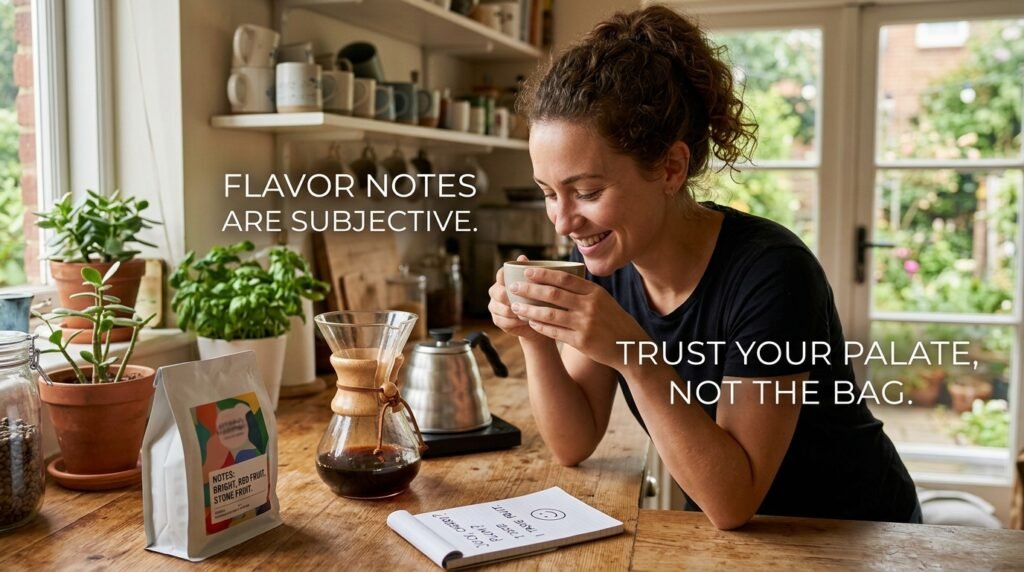
Flavor notes are entirely subjective. They are just a roaster’s best attempt to describe a complex chemical reaction. If the roaster tastes ripe cherries, but you taste red plums, nobody is wrong. You both detected a bright, red, stone fruit acidity. Your brain simply used a different memory to categorize it.
Do not treat the label on the bag as a strict mathematical law. Treat it as a friendly suggestion.
The Reward of Attention
Taking the time to learn how to taste coffee completely transformed my morning routine.
It turned a mindless, functional habit into a highly engaging daily ritual. I no longer drink coffee just to wake up. I drink coffee to explore a geographical map. I drink it to challenge my senses.
Every new bag of beans is a fresh puzzle to solve.
You do not need to be a certified professional to experience this joy. You already have all the necessary equipment. You have a nose, you have a tongue, and you have a brain.
Tomorrow morning, do not rush. Pour your coffee into a ceramic mug. Let it sit on the counter for five minutes. Hold it close to your face and take a deep breath. Take a slow sip and ask yourself if it belongs in a bakery or a fruit stand. Stop drinking your coffee blindly, and start paying attention to the incredible agricultural story hiding inside your mug.
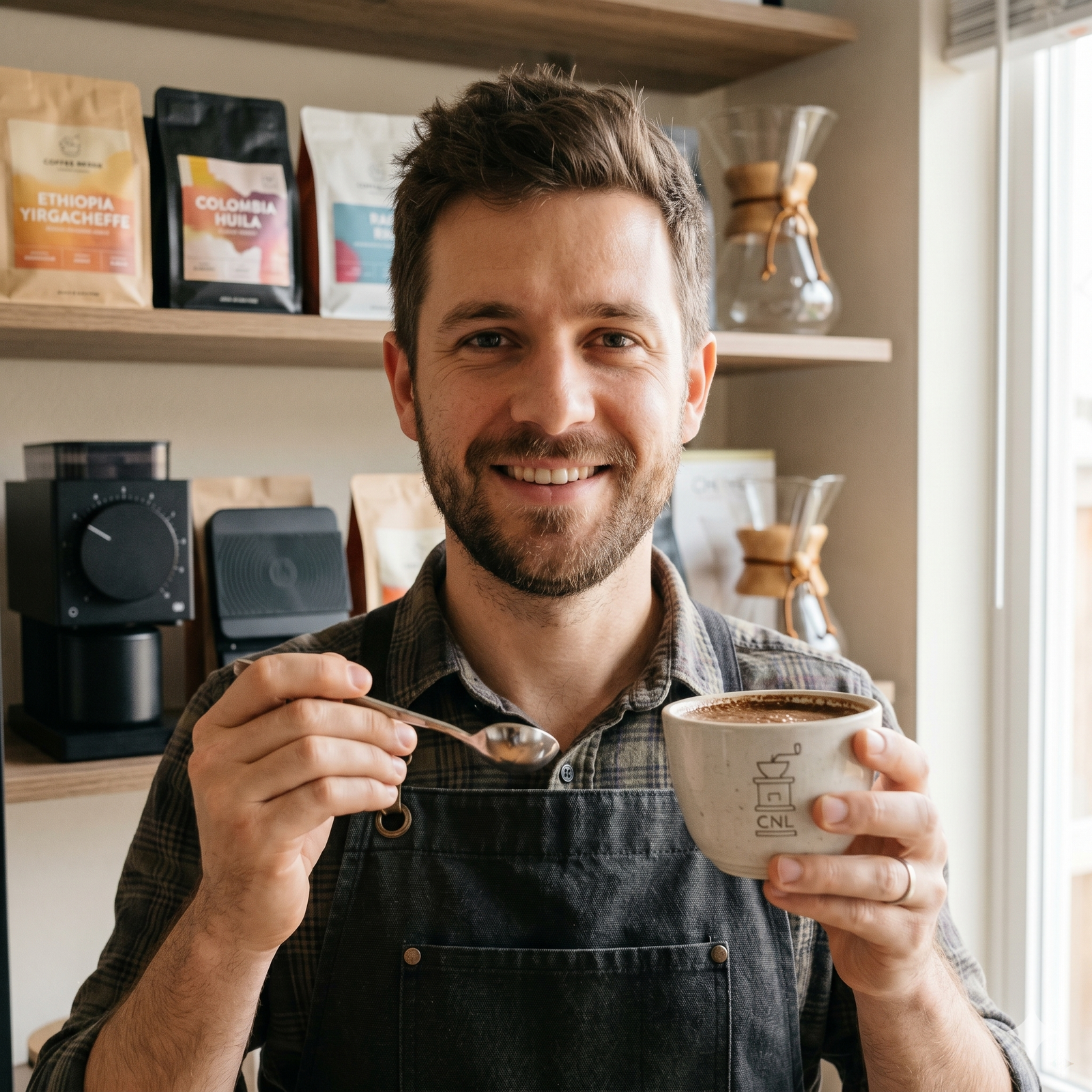
Hi, I’m the coffee enthusiast behind Coffee Nerd Lab.
Like many people, I started drinking coffee simply because it helped me wake up in the morning. Over time, that daily habit turned into a genuine interest in understanding what makes a great cup of coffee. I began experimenting with different beans, brewing methods, grinders, and coffee gear, learning through trial and error along the way.
This blog is where I document that journey. Every article is inspired by real experiences, discoveries, and lessons I’ve learned while exploring the world of coffee. From brewing guides and equipment reviews to practical tips and coffee basics, my goal is to share useful information in a way that’s easy to understand and enjoyable to read.
Thanks for stopping by, and I hope Coffee Nerd Lab helps you enjoy your next cup a little more than the last.