I analyze professional basketball metrics. During the playoff season, I spend hours looking at first action statistics. I track rebounds, assists, and scoring percentages to build accurate forecasting models. My entire methodology relies on comparing two different sets of data. You cannot know if a player is performing well unless you compare his current numbers to his historical average. You need a baseline. You need a direct contrast.
I use this strict analytical logic every single day in my apartment in Rio de Janeiro. But for years, I completely failed to apply this logic to my morning coffee.
I drank whatever coffee was available. I assumed all brown powder tasted roughly the same. I thought the concept of coffee freshness was just an arrogant marketing trick invented by expensive cafes. The first time I compared fresh coffee to old beans completely shattered my ignorance. I ran a strict physical experiment on my kitchen counter. I brewed a stale supermarket bag and a fresh specialty bag at the exact same time. The visual and chemical differences were so violent that they permanently changed how I spend my money.
Setting Up the Experiment
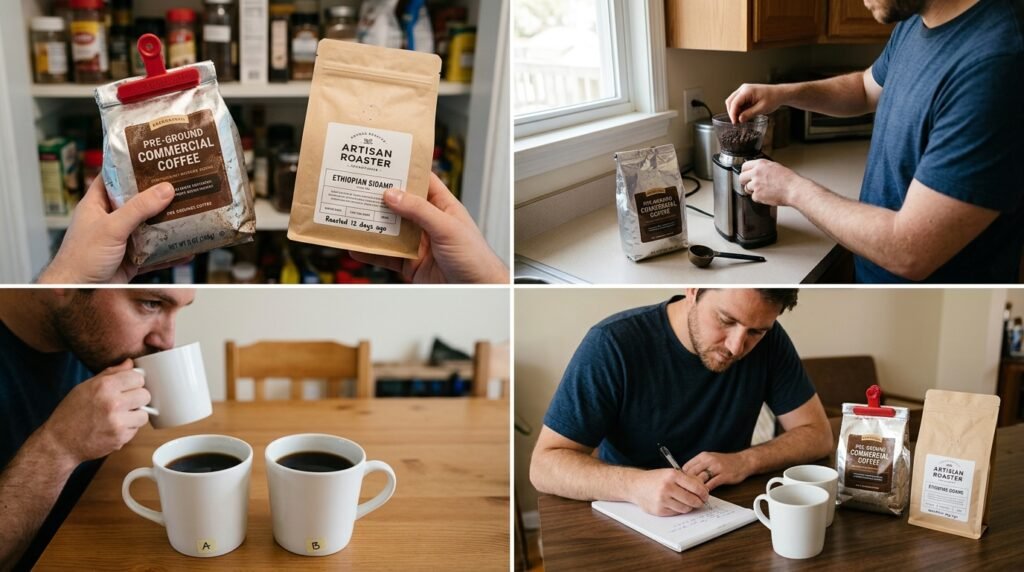
The experiment started by total accident. I was cleaning out the back of my kitchen pantry. I found an old, massive foil bag of pre ground commercial coffee. I had purchased it at a local grocery store at least six months ago. The bag was folded over and held closed by a cheap plastic clip.
On that exact same afternoon, a small cardboard box arrived in the mail.
It was a delivery from an independent coffee roaster. Inside the box was a beautiful paper bag of whole bean Ethiopian Sidamo. The label had an ink stamp on the back. It stated the coffee had been roasted exactly twelve days ago.
I held the heavy, dead brick of commercial coffee in my left hand. I held the light, sealed bag of African coffee in my right hand. I decided to run a blind comparison. Setting up this specific baseline test was the core idea of The Day I Compared Two Different Coffee Beans Side by Side because I knew I could not trust my memory. I had to taste them side by side.
The Olfactory Baseline
I opened the old bag of commercial coffee first. I brought the foil opening directly to my nose and took a deep breath.
The smell was entirely flat. It smelled like dry cardboard, old wood, and stale dust. There was a faint background note of burnt ash. It did not smell like food. It smelled like an abandoned warehouse. The aromatic compounds had completely evaporated into the atmosphere months ago.
Then, I opened the bag of Ethiopian Sidamo.
The difference was completely staggering. The explosive smell hit my brain before the bag even reached my face. It was violently fragrant. The kitchen instantly filled with the heavy aroma of sweet peach, ripe strawberries, and bright jasmine flowers. The raw agricultural product was vibrantly alive.
The Physical Density Test
The physical differences became even more obvious when I started preparing the brewing equipment.
I needed to grind the fresh Ethiopian beans. I grabbed my manual hand grinder. I weighed exactly fifteen grams of the fresh whole beans and dropped them into the top chamber. I attached the metal handle and started turning.
The physical resistance was massive. The fresh, light roasted African seeds were incredibly dense. The cellular structure was tightly packed and full of natural moisture. The ceramic burrs had to fight to slice through the hard material.
The pre ground commercial coffee required no effort at all. It was already crushed into a dry, lifeless powder. The moisture and the natural lipids were entirely gone.
Preparing the Twin Brewers
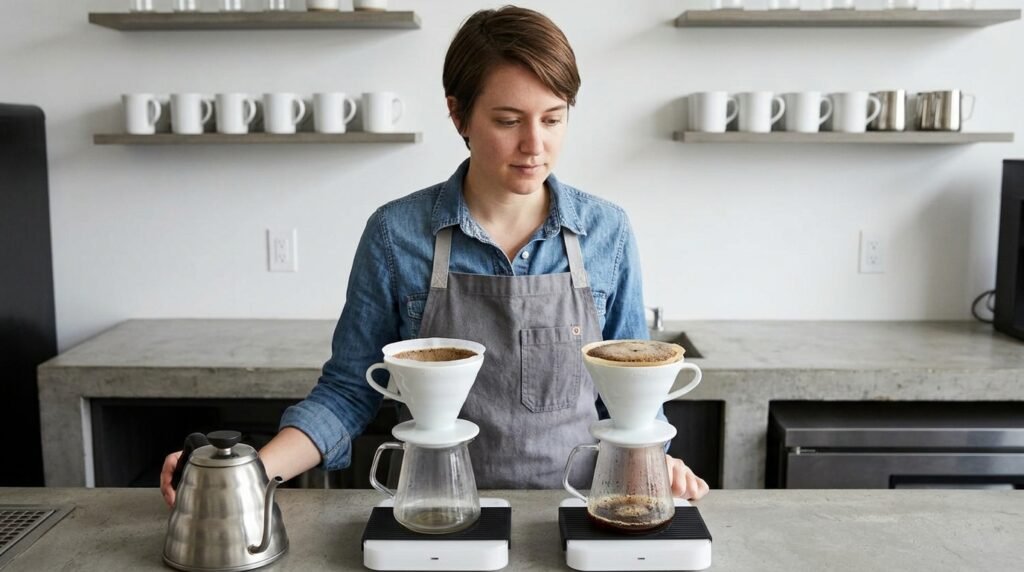
I set up two identical plastic V60 cones on my kitchen counter. I placed a fresh white paper filter inside each cone. I placed a ceramic mug under each brewer.
I poured fifteen grams of the stale commercial powder into the left brewer. I poured fifteen grams of the freshly ground Ethiopian coffee into the right brewer.
I tapped both plastic cones gently against the counter to create two perfectly flat, level beds of coffee. I wanted the fluid dynamics to be exactly the same for both extractions. I filled my electric gooseneck kettle with filtered water and brought it to a violent, rolling boil.
The Chemistry of the Bloom
This is where the physical experiment yielded its most important data.
I started with the stale coffee on the left. I poured exactly forty grams of boiling water over the dry powder. I watched the physical reaction closely.
Absolutely nothing happened. The water hit the powder and instantly turned it into dark, wet mud. The surface remained completely flat. There was no movement. There was no chemical activity. The coffee just sat there like wet sand on a dead beach.
Then, I moved my kettle to the right brewer. I poured exactly forty grams of boiling water over the freshly ground Ethiopian coffee.
The Eruption of the Fresh Seed
The fresh coffee reacted instantly. It fought back against the boiling water.
The entire coffee bed swelled aggressively upward. It doubled in physical size. Massive bubbles formed and popped across the surface of the dark slurry. It looked like a tiny, active volcano.
This eruption is called the bloom phase. Freshly roasted coffee contains massive amounts of carbon dioxide gas trapped inside the tight cellular walls. When hot water hits the cells, the gas escapes violently. Witnessing this chemical eruption was the turning point of The Day I Finally Understood Why Fresh Coffee Beans Matter because it provided undeniable visual proof that the coffee was alive.
The stale coffee on the left had no gas left. It had all leaked out months ago in the back of my pantry. The fresh coffee on the right was actively degassing right in front of my eyes.
The Fluid Dynamics of the Pour
I waited forty five seconds. I resumed my pour on both brewers. I poured water in slow, concentric circles until both scales reached two hundred and forty grams.
The stale coffee on the left drained with chaotic speed. Because there was no carbon dioxide gas to create physical resistance, the water fell straight through the mud. It bypassed the coffee completely. The total extraction time was barely ninety seconds.
The fresh coffee on the right behaved beautifully. The escaping gas created a natural, physical barrier. The water drained slowly and evenly. The extraction took exactly two minutes and forty five seconds. The water had the proper time to dissolve the complex fruit sugars.
The Visual Difference in the Mugs
I removed both plastic brewers and placed them in the kitchen sink. I looked at the two ceramic mugs sitting on my counter.
Even the color of the liquid was entirely different.
The stale commercial coffee on the left was pitch black. It looked opaque and heavy, like crude oil. There was no light passing through it.
The fresh Ethiopian coffee on the right was a deep, translucent red. It looked like a heavy ruby resting inside the mug. It possessed a beautiful visual clarity. You could see the bottom of the ceramic mug through the liquid.
The Thermal Delay
I knew I could not taste the coffee immediately. Boiling hot water completely masks the delicate flavors of the beverage. It blinds the human tongue.
I left both mugs sitting on the kitchen counter. I walked into my home office and checked my basketball analytics spreadsheets. I reviewed the rebounding data for the previous night’s game. I waited exactly five full minutes.
I walked back into the kitchen. The extreme thermal energy had bled out into the room. Both cups were now comfortably warm. The physical experiment was ready for the final sensory data collection.
Tasting the Stale Baseline
I picked up the mug on the left. This was the stale, pre ground commercial coffee.
I took a deliberate sip. I let the liquid coat my entire palate.
The flavor was aggressively unpleasant. It was completely hollow. There was no sweetness. There was no acidity. It tasted exactly like burnt toast soaked in dirty water. The worst part was the finish. It left a highly astringent, dry feeling in the back of my throat. It felt like I was chewing on dry cardboard.
I had to drink a glass of cold water just to cleanse my palate. This was the beverage I had been blindly accepting for years.
Tasting the Living Seed
I picked up the mug on the right. This was the fresh, twelve day old Ethiopian Sidamo.
I brought it to my lips and took a slow sip. The contrast was so extreme that it felt like an entirely different category of beverage.
The fresh coffee was incredibly vibrant. A bright, sharp wave of crisp lemon acidity hit the very front of my tongue. It acted as a perfect, clean introduction. Immediately, that acidity melted into a massive, heavy, syrupy wave of sweet peach and strawberry. The flavor coated my mouth completely.
The finish was entirely smooth. There was no dry cardboard feeling. There was no burnt ash. The liquid faded away and left a lingering taste of blooming jasmine flowers.
The Reality of Oxidation
The massive flavor difference was not just about the quality of the farm. It was about the brutal chemistry of oxidation.
When you roast a coffee bean, the natural oils become highly vulnerable. If you grind that bean and leave it sitting in a supermarket warehouse for six months, oxygen attacks the oils. The oxygen causes the delicate fruit lipids to spoil and go completely rancid.
The commercial coffee tasted like dust because it was literally rotting. Grasping this specific chemical decay was the core message of How I Discovered Coffee Freshness Matters More Than I Thought because it proved that coffee is a highly perishable item. You cannot store it forever.
The Supermarket Trap
This experiment completely destroyed my trust in the grocery store aisle.
Supermarkets treat coffee like canned soup or dry pasta. They put a fake expiration date on the bag that is usually one year in the future. They want you to believe the product is stable.
The product is absolutely not stable. It is a fresh agricultural crop.
You would never buy a peach that had been sitting on a shelf for six months. You would never drink milk that was processed a year ago. Yet, millions of people buy stale, dead coffee every single week and wonder why they need to add massive amounts of white sugar just to swallow it.
Redefining the Budget
Running this baseline test also changed my financial perspective on the beverage.
I used to think specialty coffee was too expensive. Paying twenty dollars for a small bag of fresh Ethiopian beans felt like a luxury. Buying the massive foil bag at the supermarket felt like a smart financial decision.
The taste test proved my financial logic was entirely flawed.
Buying the stale coffee was a total waste of money. I was paying for burnt, dead plant fiber that provided zero culinary pleasure. I was paying for an unpleasant chore. The twenty dollar bag of fresh coffee provided a massive, vibrant, beautiful sensory experience every single morning. The value proposition of the fresh seed was infinitely higher.
The New Supply Chain
I completely altered my supply chain after that morning. I never bought another bag of coffee from a supermarket.
I started treating my coffee exactly like I treat fresh bread. I only buy exactly what I can consume within a strict two week window. I find local roasters who print the exact roast date on the label. If the bag does not have a roast date, I refuse to purchase it.
I store the fresh whole beans in a dark, airtight container. I only grind them the exact second before the boiling water touches them. I protect the volatile aromatics with absolute paranoia.
Run Your Own Test
You cannot simply read about this difference. You have to experience the violence of the contrast on your own tongue.
If you usually drink pre ground coffee from the grocery store, do not throw it away just yet. Go to a local specialty cafe. Buy a small bag of fresh, light roasted whole beans. Ensure they were roasted less than two weeks ago.
Wait until tomorrow morning. Set up two brewers on your kitchen counter. Brew your old coffee and the fresh coffee at the exact same time. Use the exact same water temperature and the exact same ratio.
Watch the fresh coffee erupt. Watch the old coffee sit there like dead mud. Wait five minutes for the heat to bleed away. Taste the old liquid, and then immediately taste the fresh liquid. The chemical reality will shock you. You will permanently abandon the stale dust, and you will finally understand the massive, sweet potential of the living seed.
Hi, I’m the coffee enthusiast behind Coffee Nerd Lab.
Like many people, I started drinking coffee simply because it helped me wake up in the morning. Over time, that daily habit turned into a genuine interest in understanding what makes a great cup of coffee. I began experimenting with different beans, brewing methods, grinders, and coffee gear, learning through trial and error along the way.
This blog is where I document that journey. Every article is inspired by real experiences, discoveries, and lessons I’ve learned while exploring the world of coffee. From brewing guides and equipment reviews to practical tips and coffee basics, my goal is to share useful information in a way that’s easy to understand and enjoyable to read.
Thanks for stopping by, and I hope Coffee Nerd Lab helps you enjoy your next cup a little more than the last.