
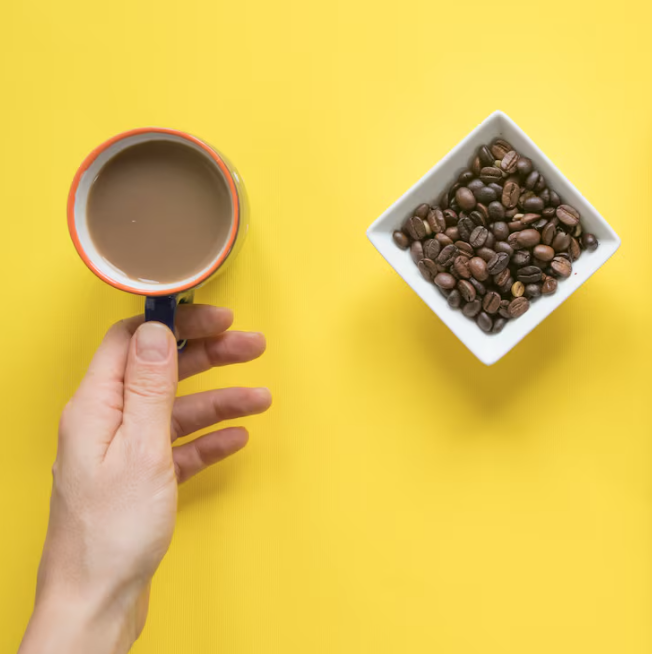
I spilled them all over the counter. It was a completely clumsy accident involving two half-empty bags of coffee, a severely rushed morning, and a poorly placed elbow while reaching for my grinder.
There, scattered across the white quartz of my kitchen island, were two distinct piles of coffee beans that had bled into one another. Up until that very second, I had always thought of “coffee beans” as a singular, uniform entity. In my mind, a bean was simply a bean. They were all brown, they all smelled like mornings, and they all went into the coffee maker to do the exact same job.
But seeing them mixed together under the bright overhead kitchen lights, that long-held illusion was instantly shattered.
One bag had contained beans that were tiny, dense, light-brown ovals looking almost like roasted peanuts. The other bag had contained massive, dark, oily beans that were nearly twice the size and completely different in shape. They didn’t even look like they came from the same plant family.
I stood there, pausing my frantic morning routine, just staring at the visual contrast on my countertop. That clumsy spill was my awakening. It was the exact moment I realized not all coffee beans are the same, and it sent me on a fascinating global expedition to understand exactly what was ending up in my mug every day.
The Apple Orchard Analogy
When I first started trying to understand why these beans looked so vastly different, a local barista gave me an analogy that completely rewired my brain.
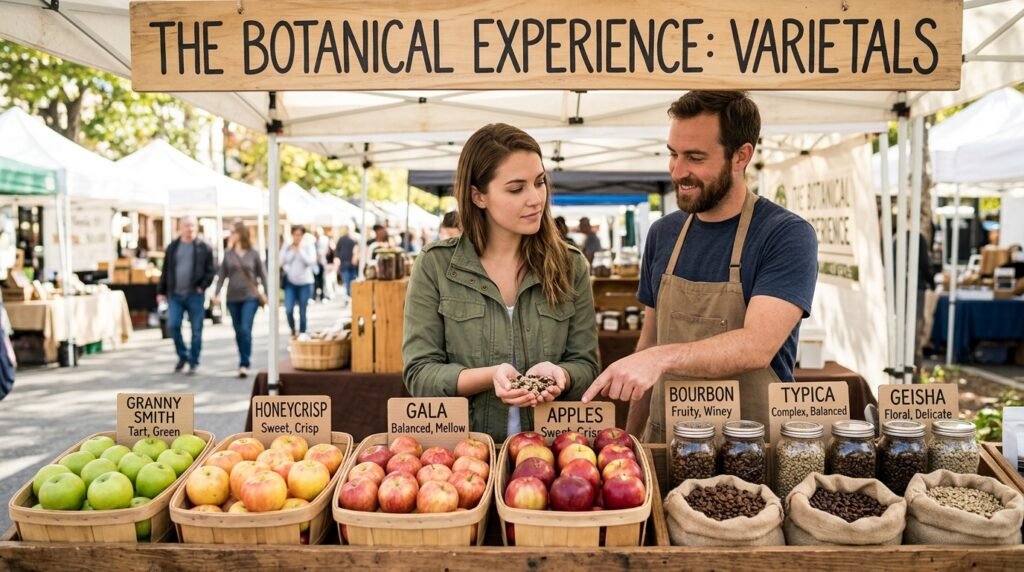
He asked me to think about apples. If you walk into a grocery store and ask for “an apple,” you are faced with a massive wall of choices. There are Granny Smiths, which are bright green, hard, and incredibly tart. There are Honeycrisps, which are massive, red, and explosively sweet. There are Fujis, Galas, and Pink Ladies.
They are all apples. They all grow on apple trees. But their genetics, their sizes, their colors, and most importantly, their flavors, are entirely distinct from one another.
Coffee works the exact same way.
The term “coffee bean” is just a blanket category. Beneath that umbrella, there is a sprawling, complex family tree of botanical varieties (often called varietals in the coffee world). Once I realized that coffee has just as much genetic diversity as an apple orchard or a vineyard, my entire approach to buying coffee changed. I wasn’t just buying “coffee” anymore; I was buying a specific botanical experience.
The Ethiopian Heirloom
The tiny, dense, light-brown beans that I had spilled on my counter that morning were from Ethiopia.
When you buy coffee from Ethiopia, the label often lists the variety simply as “Heirloom.” This is because coffee actually originated in the wild forests of Ethiopia. There are thousands of naturally occurring, undocumented varieties of coffee growing wild in the Ethiopian highlands.
These beans are typically very small. They are dense, tightly packed little seeds that have evolved to survive in high-altitude environments. Because of their dense genetic makeup, they hold onto complex, delicate flavors.
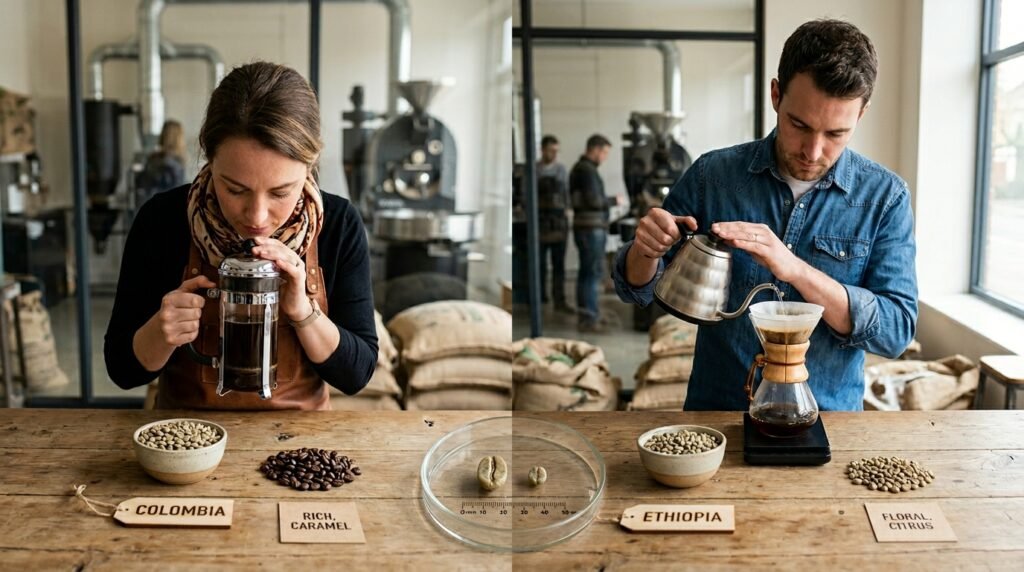
When I finally brewed those tiny beans, the flavor profile was mind-bending. It didn’t taste like the heavy, chocolatey diner coffee I grew up with. It tasted like jasmine flowers, bergamot tea, and blueberries. It was incredibly light and aromatic. The physical appearance of the bean—small, tight, and complex—perfectly mirrored the bright and intricate flavors it produced in the cup.
The Colombian Supremo
The other beans on my counter—the massive, uniform ones—were from Colombia.
Colombia is famous for growing specific varieties of coffee, most notably Typica and Bourbon, which have been carefully cultivated for generations. The beans are often graded by size, with “Supremo” being the largest and most visually impressive beans the harvest has to offer.
Comparing a massive Colombian Supremo bean to a tiny Ethiopian Heirloom bean is like comparing a Great Dane to a Chihuahua. They are the same species, but they are entirely different beasts.
The Colombian beans I had that morning produced a completely different beverage. The coffee was heavy, rich, and intensely comforting. It tasted like melted caramel, toasted nuts, and dark cocoa. It was the quintessential “classic” coffee flavor, but elevated to a magnificent degree.
Discovering how deeply the country of origin dictates the physical bean and the final flavor was a turning point, which I explored thoroughly in my article detailing What I Learned After Trying Coffee from a Different Country. I realized that traveling the world through my coffee grinder was entirely possible.
The Magic of Terroir
As I dug deeper into why these beans were so different, I encountered a French winemaking term that has been heavily adopted by the specialty coffee industry: Terroir (pronounced ter-wahr).
Terroir essentially means “the taste of the place.” It is the idea that the unique environment where an agricultural product is grown will permanently imprint its character onto the final product.
Even if you took the exact same coffee seed and planted one in Colombia and one in Ethiopia, the resulting beans would taste completely different.
The volcanic, mineral-rich soil of Guatemala imparts a deeply satisfying, smoky, and spicy chocolate note to the beans grown there. The red, loamy dirt and extreme altitudes of Ethiopia create beans that burst with bright, citric acidity and floral notes. The lush, shaded mountain ranges of Colombia produce beans with unparalleled sweetness and caramel balance.
The beans aren’t just different because of their genetics; they are different because they are literal sponges, soaking up the rain, the soil, and the sunshine of their specific microclimates.
The Elephant Bean and the Peaberry
Once my eyes were opened to the physical differences in coffee beans, I started actively seeking out the weird, the rare, and the unusual.
That is how I discovered the Maragogype (often called the Elephant Bean). This is a natural mutation of the coffee plant that produces beans so comically massive they barely fit into a standard hand grinder. They look like smooth, brown almonds. Despite their intimidating size, Elephant beans are famous for producing an incredibly delicate, mild, and smooth cup of coffee.
On the completely opposite end of the spectrum is the Peaberry.
Normally, a coffee cherry grows two flat-sided beans facing each other (like two halves of a peanut). But in about 5% of the global coffee crop, a natural mutation occurs. Only one single, round bean develops inside the cherry. Because this single bean doesn’t have to share nutrients with a twin, it absorbs all the goodness of the fruit.
Peaberries are tiny, perfectly round, and incredibly dense. They are highly sought after because they are believed to roast more evenly and produce a brighter, sweeter, and more concentrated flavor than standard flat beans. The first time I successfully brewed a batch of Peaberries was a revelation, an experience I chronicled in How I Accidentally Bought the Best Coffee Beans I’ve Ever Tried. It proved to me that sometimes, the strangest-looking beans hold the most incredible flavors.
The Hand of the Roaster
While genetics and geography play a massive role in why coffee beans look and taste different, there is one final, human element that drastically alters the physical state of the bean: the roaster.
Before coffee is roasted, it is a hard, dense, pale green seed that smells vaguely like fresh grass. It is completely undrinkable.
When you apply heat to that green seed, it undergoes a violent chemical transformation. The moisture inside the bean evaporates, causing the bean to physically expand and crack open. The natural sugars inside caramelize, turning the bean from green to yellow, to light brown, and eventually to dark, oily black.
This is why some beans look matte and dry, while others look wet and shiny.
A light roast bean is removed from the heat early. It retains its dense structure, its dry surface, and the unique, bright flavors of its terroir.
A dark roast bean is left in the heat much longer. The cellular structure breaks down, and the natural oils are forced out to the surface of the bean, making it look shiny and black. The longer you roast, the more you burn away the unique flavors of the farm, replacing them with the heavy, bitter flavor of the roast itself.
Understanding how heat physically alters the bean was the final puzzle piece for me, completely shifting my buying habits, which I explained in detail in The Day I Discovered the Difference Between Light and Dark Roast. I stopped blaming the beans for tasting burnt and started paying attention to the roast profile.
The Beauty of Diversity
Looking back at that morning spill on my kitchen counter, I am incredibly grateful for my own clumsiness.
If I hadn’t seen those two contrasting beans lying side-by-side, I might have spent the rest of my life blindly drinking generic, mass-produced coffee blends, completely unaware of the vibrant, diverse world hiding inside those bags.
Realizing that not all coffee beans are the same is the most empowering step you can take in your coffee journey. It transforms you from a passive consumer into an active explorer.
You start to realize that every time you buy a bag of single-origin coffee, you are buying a tiny, roasted piece of a specific country. You are experiencing the hard work of a farmer who cultivated a specific variety, the minerals of a specific mountain range, and the careful artistry of a roaster who coaxed out those hidden flavors.
A Challenge for Your Next Cup
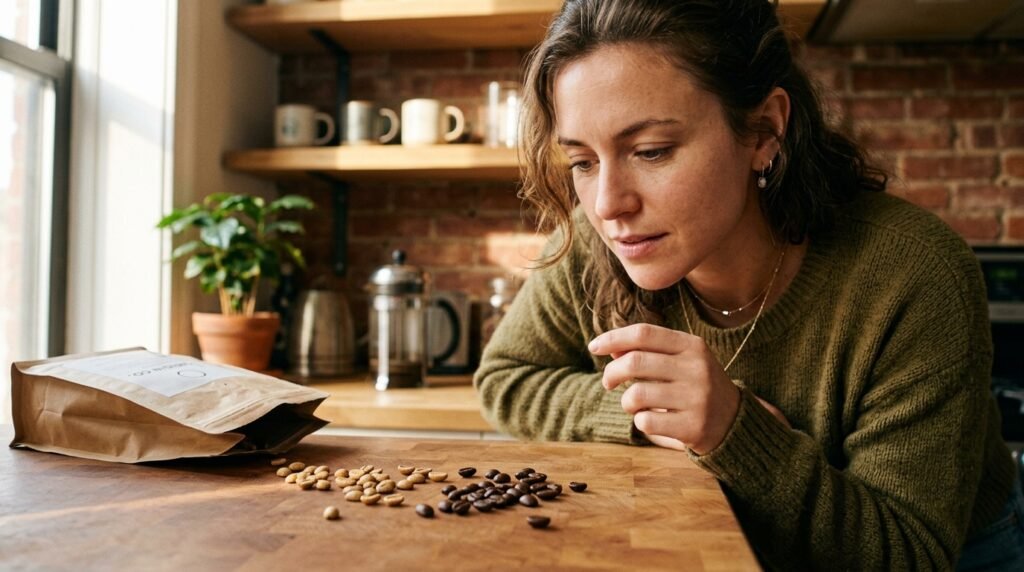
If you are reading this and you still view coffee as just a generic, brown morning fuel, I want to challenge you to conduct your own visual and sensory experiment.
The next time you need to buy coffee, don’t buy your usual brand. Go to a local specialty café or look up a reputable roaster online. Buy one bag of a washed coffee from Ethiopia, and one bag of a washed coffee from Colombia or Guatemala.
Pour a handful of both beans onto a white plate. Look at them under a bright light. Notice the difference in size, shape, and color. Smell them side-by-side.
Then, brew them on consecutive mornings. Pay attention to how the Ethiopian bean dances on your tongue with bright, tea-like fruitiness. Pay attention to how the Latin American bean blankets your palate with rich, comforting chocolate and caramel.
Once you actively see and taste the difference, the illusion of the generic “coffee bean” will be shattered forever. You will finally understand that the world of coffee isn’t a monochrome painting; it is a massive, brilliant, and infinitely delicious mosaic. And the best part is, you get to drink it.

Hi, I’m the coffee enthusiast behind Coffee Nerd Lab.
Like many people, I started drinking coffee simply because it helped me wake up in the morning. Over time, that daily habit turned into a genuine interest in understanding what makes a great cup of coffee. I began experimenting with different beans, brewing methods, grinders, and coffee gear, learning through trial and error along the way.
This blog is where I document that journey. Every article is inspired by real experiences, discoveries, and lessons I’ve learned while exploring the world of coffee. From brewing guides and equipment reviews to practical tips and coffee basics, my goal is to share useful information in a way that’s easy to understand and enjoyable to read.
Thanks for stopping by, and I hope Coffee Nerd Lab helps you enjoy your next cup a little more than the last.