

I manage multiple websites for clients in Rio de Janeiro. Because I work in digital media, my friends know I am obsessed with building efficient systems. They also know I am deeply obsessed with specialty coffee.
Almost every single month, a friend sends me a text message asking for advice. They want to start making better coffee at home.
They usually send me a link to a massive, shiny espresso machine. The machine costs five hundred dollars. It has a beautiful chrome finish and complex digital buttons. They ask me if they should buy it to start their new morning routine.
I always give them the exact same answer. I tell them to empty their digital shopping cart immediately.
I tell them to keep their five hundred dollars in the bank. I tell them to go to a local supermarket and spend twenty dollars instead. The first coffee equipment I recommend to beginners is not a machine. It is not a brewer. It is not even a grinder.
The absolute first tool you must buy is a basic digital kitchen scale. It is the most boring piece of equipment in the kitchen, but it is the only tool that actually guarantees a perfect beverage.
The Aesthetic Trap
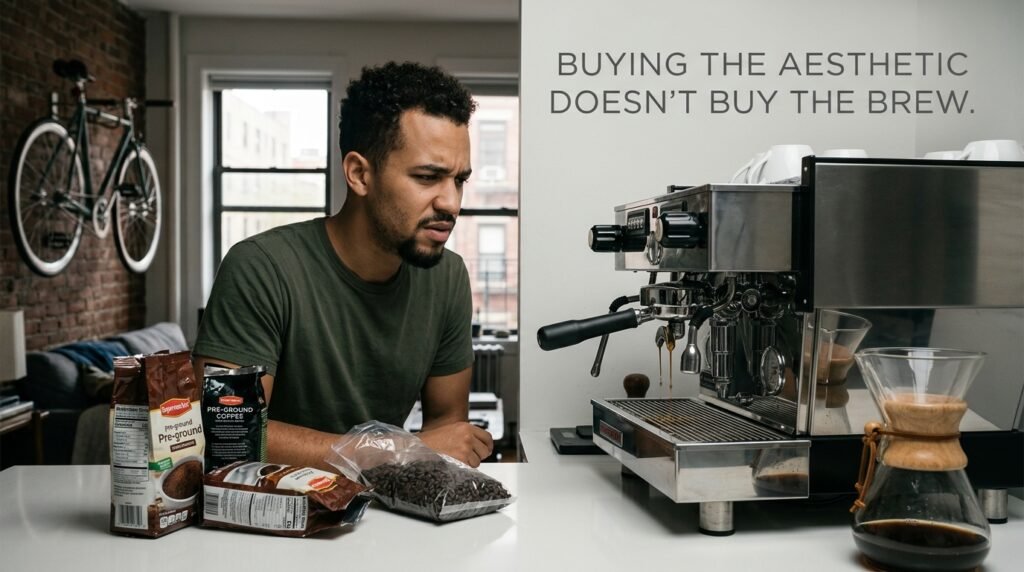
Beginners always fall into the exact same trap. They want to buy the aesthetic.
They see professional baristas working on massive Italian espresso machines. They see beautiful glass pour over carafes on social media. They think buying the beautiful hardware will automatically transfer the barista skill directly into their own kitchen.
Falling for this visual illusion was exactly The Equipment Mistake I Made When I Started Brewing Coffee and it cost me a massive amount of wasted money.
A coffee machine does absolutely nothing. It is a passive object. It just holds hot water and ground beans. The machine cannot fix bad data. If you feed garbage data into a thousand dollar brewer, the machine will confidently produce a thousand dollar cup of garbage.
The Illusion of the Scoop
The worst data you can possibly feed into a coffee setup comes from a plastic spoon.
Every cheap coffee maker on the market includes a small plastic scoop in the box. We are trained from a very young age to trust this piece of plastic. We read the manual. The manual says to use two scoops of coffee for every mug of water.
This system is completely broken. It relies entirely on volume. Volume is a terrible way to measure agricultural products.
A plastic scoop only measures physical space. It tells you absolutely nothing about the actual density, mass, or weight of the organic material sitting inside that space. Measuring coffee by volume is a fundamental chemical error.
The Physics of Bean Density
To understand why the plastic scoop is a liar, you have to look at the roasting process.
I prefer to drink light roasted African coffees. I buy Ethiopian Guji beans. The roaster stops the heat very early. This protects the delicate floral notes. Because the heat stops early, the cellular structure of the seed remains incredibly tight. The beans are very small, dense, and heavy.
If you fill a plastic scoop with light roasted Ethiopian beans, you are packing a massive amount of dense material into that physical space.
Now look at a dark roasted commercial coffee. The roaster applies extreme heat for a long time. The beans violently puff up. They expand. They become completely hollow and highly brittle. They lose massive amounts of water weight.
If you fill the exact same plastic scoop with dark roasted beans, you are mostly scooping empty air.
The Margin of Error
I tested this exact physical discrepancy in my own kitchen.
I placed a glass bowl on my digital scale. I pulled one level scoop of dense Ethiopian beans and dumped it into the bowl. The screen read thirteen grams.
I dumped the bowl out. I grabbed a bag of old, dark roasted Brazilian beans. I pulled one level scoop and dumped it onto the scale. The screen read eight grams.
My visual estimation system had a margin of error of nearly fifty percent.
Discovering this terrifying numerical reality was exactly What I Learned About Coffee Measurement Accuracy because it proved my human eyes were completely useless. I realized I was extracting wildly different amounts of actual coffee mass every single morning.
Building the Chemical Baseline
Coffee extraction is not a magical art form. It is a strict chemical reaction.
You use a hot solvent to dissolve organic compounds. The hot water is the solvent. The roasted coffee is the organic material. To achieve a perfectly balanced beverage, you need a highly specific mathematical relationship between the two.
The specialty coffee industry calls this the brew ratio.
A standard pour over ratio is one to sixteen. You need one gram of coffee mass for every sixteen grams of water mass. This exact balance ensures the hot water pulls out the sweet, heavy fruit sugars without over extracting the harsh, dry, bitter tannins hidden deep inside the core of the seed.
Eliminating the Input Guesswork
You cannot achieve a one to sixteen ratio if you do not know your starting numbers.
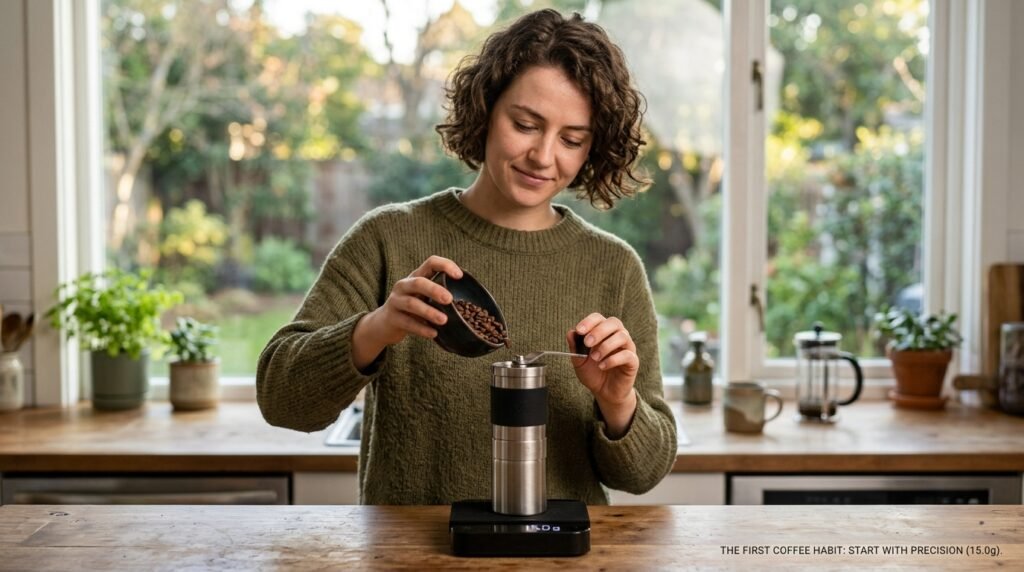
The digital scale solves the first half of the equation immediately. You place your manual burr grinder on the scale. You press the zero button. You pour your whole coffee beans into the top chamber until the screen hits exactly fifteen grams.
There are no rounded scoops. There are no visual estimations. You have exactly fifteen grams of solid agricultural mass.
Establishing this strict numerical rule is The First Coffee Habit I Recommend to Beginners because it instantly removes luck from the kitchen counter. You lock the input data securely into place.
Eliminating the Output Guesswork
Once the coffee is ground and placed in the filter, the scale solves the second half of the equation.
Before I bought a scale, measuring the water was a complete disaster. I would boil a heavy pot on the stove. I would pour the hot water over the coffee grounds until my ceramic mug looked reasonably full.
I never accounted for the massive amount of water trapped permanently inside the wet coffee grounds. I never accounted for steam evaporation.
With the digital scale, the guesswork completely vanishes.
If I have fifteen grams of coffee, I multiply that number by sixteen. The result is two hundred and forty. I need exactly two hundred and forty grams of hot water.
Executing the Data
I place my glass V60 cone and my heavy ceramic mug directly onto the digital scale. I press the zero button.
I grab my gooseneck kettle. I start pouring the boiling water over the dry coffee bed. I completely ignore the visual level of the liquid rising inside the mug. I keep my eyes locked exclusively on the bright digital numbers on the scale.
The numbers climb quickly. One hundred grams. Two hundred grams. I slow my pouring speed down.
Two hundred and thirty. Two hundred and thirty five. When the screen hits exactly two hundred and forty grams, I stop pouring instantly. I do not add a single extra drop. The chemical ratio is perfectly fulfilled.
The Power of Replication
The digital scale guarantees a great cup of coffee on the first day. But the true power of the scale is what happens on the second day.
If you guess your measurements and accidentally brew a spectacular cup of coffee, you will never be able to replicate it. You will wake up the next morning, guess again, and brew bitter mud.
The scale allows you to build a reliable, repeatable system.
If I brew a flawless cup of Ethiopian coffee using exactly fifteen grams of beans and two hundred and forty grams of water, I simply memorize those numbers. The next morning, I use the exact same data. The resulting beverage tastes entirely identical to the day before.
I successfully remove the chaotic casino from my kitchen. I guarantee absolute perfection every single morning.
The Power of Intentional Adjustment
The scale also gives you a new superpower. It allows you to manipulate the flavor profile intentionally.
Let us assume you brew your standard one to sixteen ratio. You take a sip. The coffee tastes slightly weak. It lacks body.
Without a scale, you would just blindly throw more beans into the grinder tomorrow and hope for the best. With a scale, you make a surgical adjustment.
The next morning, you use the exact same fifteen grams of coffee. But you reduce the water from two hundred and forty grams to two hundred and twenty five grams. You shift the ratio to one to fifteen.
The resulting beverage is instantly heavier, richer, and more concentrated. You controlled the chemistry perfectly.
Validating the Future Upgrades
I demand that beginners buy a scale first because it validates every single future purchase they make.
Eventually, you will want to buy a premium manual burr grinder. You want perfect particle uniformity. But a two hundred dollar grinder is completely useless if you randomly guess how many particles you put into the filter. The extraction will still fail.
Eventually, you will want to buy a stainless steel gooseneck kettle. You want perfect laminar flow. But the controlled pouring speed does not matter if you dump a random, unmeasured volume of water over the coffee bed.
The twenty dollar digital scale provides the strict mathematical boundaries required for all your other expensive tools to function correctly.
The Reality of the Hobby
When my friends text me asking for advice, I tell them the hard truth about specialty coffee.
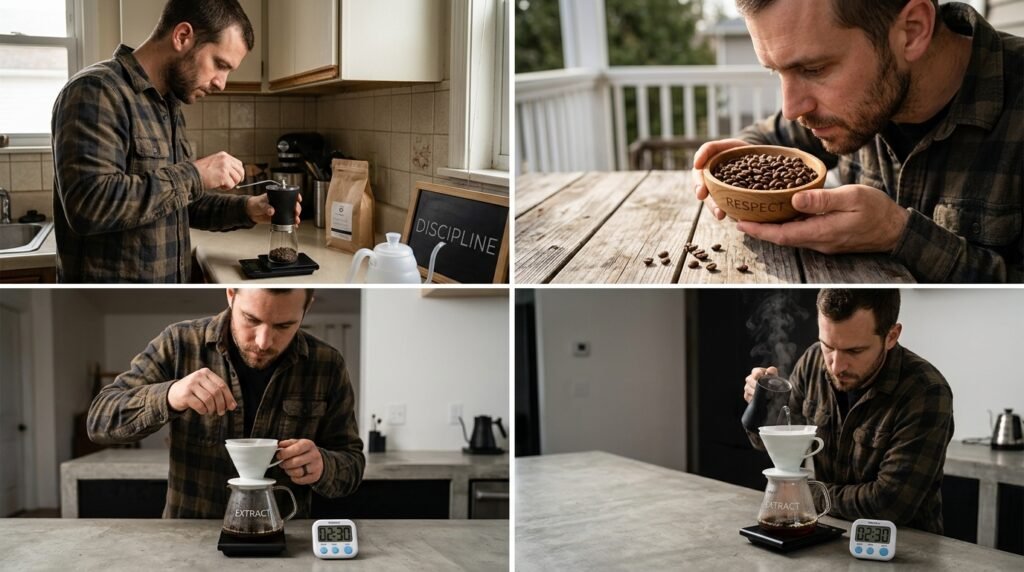
Making incredible coffee at home does not require an expensive machine. It does not require a beautiful glass beaker. It simply requires discipline.
You are taking a dense, roasted fruit seed and dissolving it in hot water. You are managing a delicate chemical extraction. You have to respect the raw ingredients. You cannot respect the ingredients if you treat them like sloppy dirt.
Start with the Math
If you are a beginner looking to improve your morning routine, close the tabs on your web browser. Stop looking at Italian espresso machines. Stop looking at automated drip brewers with bluetooth connectivity.
Go to the store today and buy a flat plastic digital scale. Make sure it measures in single grams.
Tomorrow morning, throw your plastic scoop into the trash can. Weigh your whole beans. Do the basic multiplication. Place your mug on the scale and weigh your pouring water.
The process will feel strange at first. It will feel overly analytical. But when you finally take a sip of a mathematically balanced extraction, the confusion disappears entirely. You will taste the sweet, vibrant clarity of the farm. You will realize that great coffee is not an art. It is just clean, strict data.

Hi, I’m the coffee enthusiast behind Coffee Nerd Lab.
Like many people, I started drinking coffee simply because it helped me wake up in the morning. Over time, that daily habit turned into a genuine interest in understanding what makes a great cup of coffee. I began experimenting with different beans, brewing methods, grinders, and coffee gear, learning through trial and error along the way.
This blog is where I document that journey. Every article is inspired by real experiences, discoveries, and lessons I’ve learned while exploring the world of coffee. From brewing guides and equipment reviews to practical tips and coffee basics, my goal is to share useful information in a way that’s easy to understand and enjoyable to read.
Thanks for stopping by, and I hope Coffee Nerd Lab helps you enjoy your next cup a little more than the last.