
I spend a large portion of my professional life thinking about visual design. When I build a new website for a client in Rio de Janeiro, I obsess over the user interface. I want the colors to balance. I want the typography to look clean and modern. I want the final product to look visually stunning.
A beautiful design creates an immediate emotional connection. It makes the user trust the product.
When I first decided to take specialty coffee seriously, I applied this exact same visual logic to my kitchen. I looked at photographs of professional coffee bars online. I saw polished wood, shining copper, and thick, elegant glass. I wanted my kitchen counter to look like a high end photography studio.
I bought the most beautiful coffee equipment I could find. I was incredibly proud of how my setup looked.
Then I tried to actually make a beverage. The coffee tasted like toxic waste. The equipment mistake I made when I started brewing coffee was prioritizing the visual aesthetic over the physical mechanics. I bought a beautiful piece of glass, but I completely ignored the tools that actually extract the flavor. I built a stunning website with absolutely zero backend code to make it function.
The Allure of the Glass Vessel
My massive mistake started with a pour over brewer.
I ignored the cheap plastic cones. I ignored the basic ceramic drippers. I spent a significant amount of money on a massive, elegant glass vessel. It looked exactly like a chemistry beaker. It had a beautiful wooden collar tied with a leather strap. It was a genuine piece of art.
I placed it directly in the center of my kitchen counter. It elevated the entire aesthetic of the room.
I assumed that buying an expensive, beautiful brewing vessel would automatically result in beautiful coffee. I thought the glass itself contained some sort of culinary magic. I thought the elegant shape of the beaker would gently coax the delicate flavors out of the beans.

The Missing Foundation
Because I spent all of my coffee budget on the beautiful glass vessel, I had to cut corners everywhere else.
I did not buy a burr grinder. I continued using a cheap, loud plastic blender with a spinning metal blade. I did not buy a digital scale. I continued using a small plastic spoon to measure my beans. I did not buy a gooseneck kettle. I continued pouring boiling water directly out of a heavy cooking pot.
I completely ignored the input tools. I only cared about the output stage.
I took my new setup for a test drive. I opened a bag of expensive, light roasted Ethiopian Guji beans. I was incredibly excited to taste the famous floral notes and the bright peach acidity.
The First Catastrophic Brew
I threw three random plastic scoops of the dense Ethiopian seeds into my blade grinder. I pushed the button and held it down until the noise stopped.
I dumped the chaotic mixture of massive coffee boulders and microscopic coffee dust into the thick paper filter sitting inside my elegant glass vessel. I grabbed my heavy cooking pot off the stove. The water was violently boiling.
I tilted the pot. A massive, heavy waterfall crashed into the fragile coffee bed.
The hot water violently churned the chaotic coffee grounds. It drilled a deep crater directly into the center of the paper filter. I had absolutely no control over the flow rate. The water dumped in wildly, splashing up the sides of the beautiful glass walls.
The Mechanics of Failure
I watched the dark liquid drain into the bottom of the beaker. It looked terrible.
Because the blade grinder produced so much microscopic coffee dust, the thick paper filter clogged instantly. The water simply stopped moving. A dark, muddy puddle formed on top of the grounds. It took nearly seven minutes for the water to finally force its way through the mud.
Evaluating this specific physical failure was exactly My First Experience With a Manual Pour Over Setup and it taught me a brutal lesson. The glass vessel looked beautiful on the counter, but it possessed absolutely zero mechanical ability to fix the bad data I fed into it.
Tasting the Disaster
I poured the dark liquid from the elegant glass beaker into my ceramic mug. I sat at my table and took a sip.
It was the worst cup of coffee I had ever consumed. It was a complete sensory disaster.
Because the heavy waterfall drilled a crater in the center, the grounds in the middle were violently over extracted. They released harsh, dry, aggressive bitterness. Because the microscopic dust clogged the paper filter and stalled the water for seven minutes, the entire batch tasted like burnt wood and chewed aspirin.
The bright peach acidity was completely destroyed. The delicate jasmine aroma was incinerated. I had taken an incredible agricultural product from Africa and turned it into bitter mud.
The Harsh Reality of the Brewer
I sat in my kitchen and stared at the beautiful glass vessel. I finally understood its true nature.
A coffee brewer is a completely passive object. It does not do any work. It does not crush the beans. It does not measure the ratios. It does not control the water temperature.
A pour over brewer is literally just a physical holder for a paper filter. That is its entire job.
You can put a paper filter inside an expensive glass beaker, or you can put a paper filter inside a cheap plastic cone. If you feed the exact same coffee grounds and the exact same water into both filters, the resulting liquid will taste entirely identical. The glass does not change the chemistry.
Recognizing the Active Tools
The actual extraction is governed entirely by the active tools in your kitchen.
The active tools are the grinder, the scale, and the kettle. These three tools dictate the physical mechanics of the extraction. They are the backend code that makes the entire system function.
If you have a terrible grinder, you will have a chaotic particle distribution. If you have no scale, you will have a broken chemical ratio. If you have a terrible kettle, you will have chaotic fluid dynamics.
No brewing vessel on the planet can fix broken input data. You cannot buy your way out of bad mechanics with pretty glass.
The Shift to Data
I put the beautiful glass beaker in my cabinet and closed the door. I had to completely rebuild my routine from scratch. I had to stop caring about visual aesthetics and start caring about hard data.
I needed to know exactly how much coffee I was using.
Internalizing this simple concept was exactly What I Learned About Coffee Measurement Accuracy and it completely changed my approach to the kitchen. I stopped relying on volume entirely. I stopped using plastic spoons. I bought a basic digital kitchen scale.
I weighed exactly fifteen grams of my Ethiopian beans. I knew the exact mass. I calculated exactly two hundred and forty grams of water to achieve a perfect one to sixteen brew ratio.
The Shift to Precision
I also needed to fix the particle distribution. I threw the plastic blade grinder into the trash.
I bought a heavy, industrial looking manual hand grinder. It was built from matte steel. It was not elegant. It was a brutal, highly efficient mechanical tool. It used sharp ceramic burrs to slice the dense coffee seeds into perfectly uniform pieces.
Finally, I bought a stainless steel gooseneck kettle. The long, curved spout provided perfect laminar flow. It allowed me to pour a slow, gentle, highly controlled stream of water exactly where I wanted it.
The Ugly Setup
I placed my new tools on the kitchen counter.
I bought a cheap, dark plastic V60 cone to replace the expensive glass beaker. The new setup did not look like a high end photography studio. It looked like a small, highly functional mechanical workshop. It was built purely for utility.
Implementing this highly functional approach was exactly How I Built My Simple Coffee Setup at Home and it stripped away all the unnecessary visual distractions. I focused entirely on controlling the variables.
The Second Attempt
I tested the new, ugly setup the next morning.
I weighed the fifteen grams of beans. I ground them perfectly in the metal hand grinder. I placed the cheap plastic cone on my digital scale. I poured the hot water slowly and gently from the precision gooseneck kettle.
The extraction was flawless. Because the grounds were perfectly uniform, the water flowed smoothly. Because the pour was gentle, the coffee bed remained flat and undisturbed. The extraction finished in exactly three minutes.
The Reward of Function
I removed the plastic cone and picked up my mug. I took a slow sip.
The transformation was absolute. The harsh, aggressive bitterness was completely gone. A massive, vibrant wave of sweet peach acidity washed over my palate. It tasted incredibly clean and articulate. The heavy, floral jasmine notes filled my nose as I swallowed.
The cheap plastic cone produced a spectacular cup of coffee because the active tools provided perfect data.
The grinder ensured even extraction. The scale ensured the perfect chemical balance. The kettle ensured gentle agitation. The plastic cone just sat there and held the paper filter.
Advice for the Beginner
When you first enter the world of specialty coffee, you will be bombarded by targeted advertising.
You will see videos of massive espresso machines shining in the sunlight. You will see beautiful glass carafes with leather straps. You will see expensive, highly designed tampers and distribution tools.
The industry wants you to spend your money on the visual aesthetic. They want you to buy the shiny objects.
I strongly advise you to ignore the shiny objects entirely. Do not make the exact same equipment mistake I made. Do not prioritize the front end design over the back end mechanics.
Buy the Boring Tools First
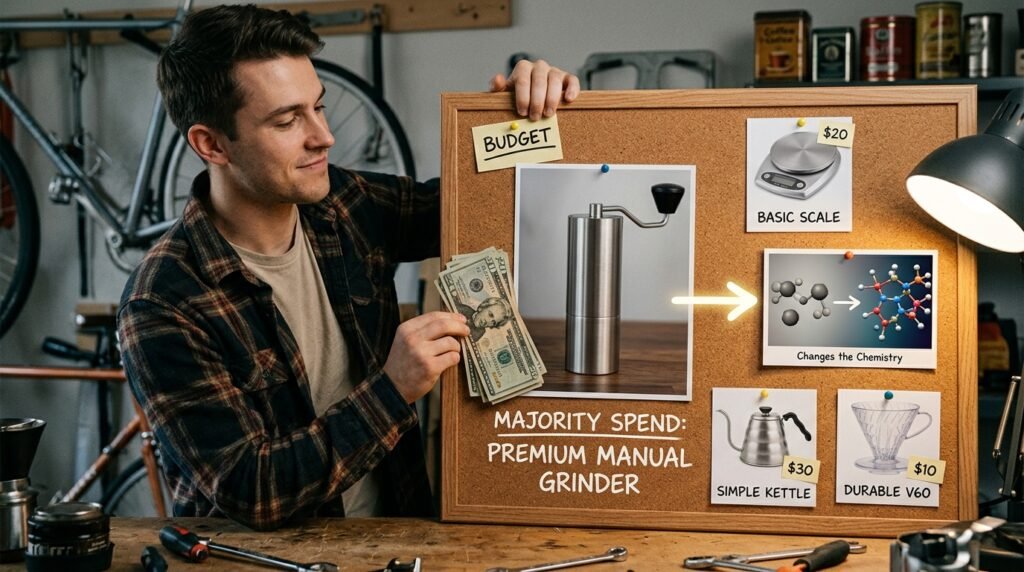
You have a limited budget. You must spend that budget on the tools that actually change the chemistry of the water.
Spend the majority of your money on the absolute best burr grinder you can afford. A premium manual grinder is the single greatest investment you can make in your coffee journey. It dictates the physical ceiling of your flavor profile.
Spend twenty dollars on a basic digital scale. Spend thirty dollars on a simple stove top gooseneck kettle.
For the actual brewer, spend ten dollars on a basic plastic V60 cone. It is durable, it holds heat incredibly well, and it requires absolutely zero maintenance.
Respect the Raw Material
Coffee is a highly sensitive agricultural product. The farmers in Ethiopia and Brazil work incredibly hard to produce complex, beautiful flavors.
You cannot respect their hard work with a plastic blade grinder and a random cooking pot. You respect their work by applying precise mechanical control in your kitchen.
Build an ugly, highly functional setup. Master the variables. Master your pour rate. Master your grind size. When you finally taste the absolute clarity of a perfectly extracted cup of coffee, you will never care what the equipment looks like on your counter ever again. The only aesthetic that matters is the clarity in the mug.

Hi, I’m the coffee enthusiast behind Coffee Nerd Lab.
Like many people, I started drinking coffee simply because it helped me wake up in the morning. Over time, that daily habit turned into a genuine interest in understanding what makes a great cup of coffee. I began experimenting with different beans, brewing methods, grinders, and coffee gear, learning through trial and error along the way.
This blog is where I document that journey. Every article is inspired by real experiences, discoveries, and lessons I’ve learned while exploring the world of coffee. From brewing guides and equipment reviews to practical tips and coffee basics, my goal is to share useful information in a way that’s easy to understand and enjoyable to read.
Thanks for stopping by, and I hope Coffee Nerd Lab helps you enjoy your next cup a little more than the last.