I used to buy coffee the exact same way I used to buy wine in my early twenties: by looking exclusively at the artwork on the front of the bottle and hoping for the best.
If a bag of coffee had a cool, minimalist font, a rustic drawing of a mountain range, or a stamp that looked vaguely official, I tossed it into my shopping cart. If the bag boldly claimed to be a “Master Roaster’s Gourmet Blend,” I felt like I was making a highly sophisticated choice. I trusted the marketing department to tell me what tasted good.
I rarely turned the bag around to read the back. Why would I? It was just coffee.
But as my obsession with brewing a better morning cup began to grow, my blind trust in shiny packaging started to fade. I realized that my coffee was wildly inconsistent. One week, my morning brew would be deeply satisfying, and the next week—buying a different brand with equally cool packaging—it would taste like burnt popcorn and stale dirt.
I needed to figure out why. So, the next time I went to restock my beans, I didn’t just look at the front of the bag. I picked it up, turned it over, and actually started reading the fine print.
What I noticed when I started paying attention to coffee labels completely shattered my illusion of the grocery store coffee aisle. It was like learning to read a secret language, and once I deciphered it, I could never go back to buying blindly again.
The Myth of “Gourmet” and “Premium”
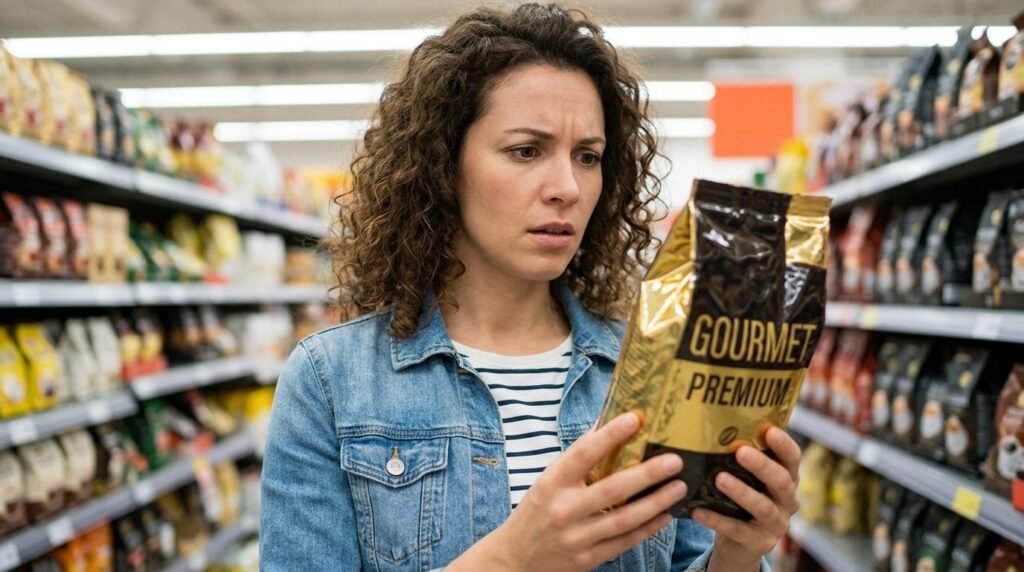
The very first thing I noticed when I started actively analyzing coffee labels was the overwhelming amount of meaningless adjectives.
Words like “Gourmet,” “Premium,” “Artisan,” and “Hand-Crafted” are splashed across almost every commercial bag of coffee on the market. For years, I legitimately thought these words meant something. I assumed there was some sort of coffee board or regulatory agency that only allowed the best beans to carry the “Gourmet” title.
I was completely wrong.
There is absolutely no legal or agricultural regulation for those terms in the coffee industry. A massive corporation can sweep the lowest-grade, most defective coffee beans off a warehouse floor, roast them until they are charred black, throw them in a shiny bag, and legally print “Premium Artisan Blend” in huge gold letters.
These words are fluff. They are designed to make you feel good about spending your money, but they tell you absolutely nothing about what is actually inside the bag. Once I realized this, I immediately stopped looking at the adjectives. I started looking for hard data instead.
The “100% Arabica” Baseline
The next piece of marketing magic I decoded was the phrase “100% Arabica.”
If you walk down a coffee aisle right now, you will see this phrase everywhere. I used to view it as a badge of honor, a guarantee that I was buying a top-tier product.
However, as I started reading more labels from high-end, specialty coffee roasters, I noticed something strange. The absolute best coffees I was buying—the ones that cost a premium and tasted incredible—rarely boasted about being “100% Arabica” on the front of the bag.
Why? Because in the specialty coffee world, being Arabica isn’t a bragging right. It is the absolute bare minimum requirement.
As I learned during my coffee journey, Arabica is simply the species of coffee plant known for better flavors, as opposed to the cheaper, harsher Robusta species. Saying your coffee is “100% Arabica” is like a restaurant bragging that their meals are made with “100% Real Food.” It is a good thing, yes, but it doesn’t mean the food is actually going to taste good. It just means they didn’t cut corners with the cheapest possible alternative.
Noticing this shifted my perspective. I stopped treating “100% Arabica” as a sign of luxury and started treating it as a basic starting line.
The Mystery of the “Blend”
For most of my life, I drank “Breakfast Blends” or “House Blends.” The label never specified where the coffee actually came from. It might just vaguely say “A blend of South American and African beans.”
When I finally started paying attention to the labels from specialty roasters, I noticed a stark contrast. Instead of a mysterious blend, the labels read like a geography lesson. They listed the country, the specific region, the farm, and sometimes even the name of the individual farmer who grew the crop.
This level of transparency completely changed how I experienced the beverage, which I documented extensively in my article about Why Single-Origin Coffee Changed the Way I Drink Coffee. I realized that a blend is often used by massive companies to hide inconsistencies.
If a large commercial roaster buys a cheap batch of beans from Brazil that tastes a bit boring, and a cheap batch from Vietnam that tastes a bit harsh, they can mix them together, roast them dark, and call it their “Signature Blend.” The goal of a commercial blend is uniformity year after year.
But coffee is a crop. It changes with the seasons, the rainfall, and the soil. By paying attention to labels that specified a single origin, I was finally able to taste the unique characteristics of the land where the coffee was grown, rather than just tasting the roaster’s attempt to make everything taste exactly the same.
The Elevation Equation (MASL)
As I graduated from supermarket aisles to browsing bags at local, independent cafés, I started noticing a very specific metric that I had never seen before: MASL.
It usually looked something like this: Altitude: 1,600 MASL.
MASL stands for Meters Above Sea Level. Initially, I thought this was just an incredibly pretentious piece of trivia. Why on earth would I care how high up the mountain my coffee was grown? Was I supposed to taste the altitude?
It turns out, you absolutely can.
Coffee plants that are grown at higher elevations face harder living conditions. The air is cooler, and the nights are chilly. Because of this, the coffee cherries ripen much, much slower. This extended, agonizing ripening process allows the seed (the coffee bean) to develop incredibly complex, dense, and vibrant sugars.
When you see a high altitude on a coffee label (usually anything above 1,300 meters), it is a very strong indicator that the coffee will have bright, complex acidity and distinct fruity or floral notes.
Conversely, coffee grown at lower altitudes ripens much faster. These beans are less dense and tend to produce a milder, smoother, and earthier cup of coffee, often with heavy chocolate or nutty notes.
Once I understood what MASL meant, I could look at a label and instantly predict the general profile of the coffee before I even opened the bag. If I wanted a bright, punchy morning cup, I looked for high elevation. If I wanted a mellow, comforting afternoon cup, I looked a bit lower. It felt like I had unlocked a cheat code.
The Processing Revelation
The most confusing word I encountered when I started closely reading labels was “Washed” or “Natural.”
I remember staring at a bag of Ethiopian coffee that proudly proclaimed it was “Naturally Processed.” I scoffed. I assumed all coffee was natural. It grows on trees, doesn’t it? What is the alternative? Artificial coffee?
It took some deep diving to realize that these terms don’t refer to whether the coffee is organic. They refer to what happens to the coffee cherry after it is picked from the tree. This realization was so vital to my brewing success that I wrote a dedicated breakdown about What I Learned About Coffee Processing Methods.
The processing method is arguably the most important piece of information on a specialty coffee label because it drastically alters the final flavor.
If a label says Washed, it means the fruity flesh of the cherry was stripped off the bean immediately after harvesting, and the bean was washed clean in tanks of water before drying. This results in a very clean, crisp, and tea-like cup of coffee where the inherent flavor of the bean shines through.
If a label says Natural, it means the entire coffee cherry was left intact and laid out in the sun to dry like a raisin. As it dries, the sugary, fruity juices of the cherry ferment and absorb directly into the bean. These coffees are wild, heavily bodied, and famously taste like fresh berries or fruit jam.
Knowing this single piece of information changed my buying habits overnight. I stopped rolling the dice and started buying exactly the flavor profile I was in the mood for.
Tasting Notes Are Not Ingredients
Perhaps the most embarrassing misconception I had to overcome involved the tasting notes printed on the bags.
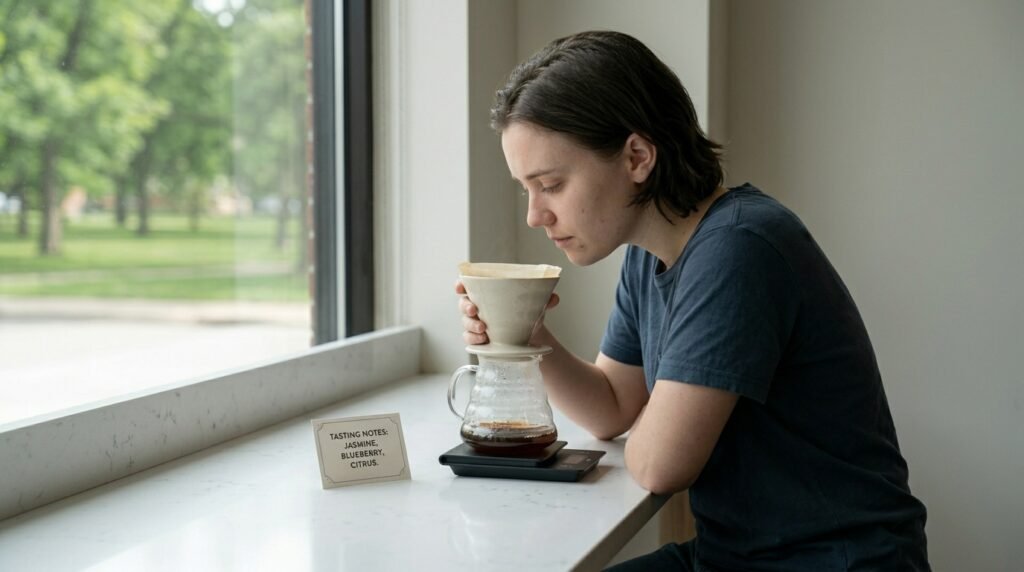
When I first started venturing into better coffee, I picked up a bag from a highly respected local roaster. The label said: Tasting Notes: Milk Chocolate, Ripe Peach, and Honey.
I immediately put the bag back on the shelf. I was outraged. I wanted black coffee, not some artificially flavored dessert drink pumped full of synthetic peach syrup.
It wasn’t until I started talking to the baristas that I realized my mistake. The tasting notes on a bag of specialty coffee are not added ingredients. The coffee is 100% pure coffee. The notes are simply a guide to the natural flavors that the roaster coaxed out of the bean during the roasting process.
Because coffee is one of the most chemically complex foods on the planet—containing over a thousand aromatic compounds—it naturally mimics other flavors found in nature. A certain chemical compound in an Ethiopian bean might be structurally identical to the compound found in a blueberry.
Learning to trust and explore these natural flavor profiles was an incredible journey, one that I outlined in The Roaster That Showed Me Coffee Has Personality. When I finally bought that bag with the peach notes and brewed it correctly, I actually tasted the peach. It wasn’t artificial; it was a beautiful, natural illusion. The label wasn’t lying; I just hadn’t known how to read it.
The Ultimate Truth: The Roast Date
After all the details about altitude, origin, and processing, the final thing I noticed on high-quality coffee labels was something that commercial grocery store coffee actively tries to hide.
The roast date.
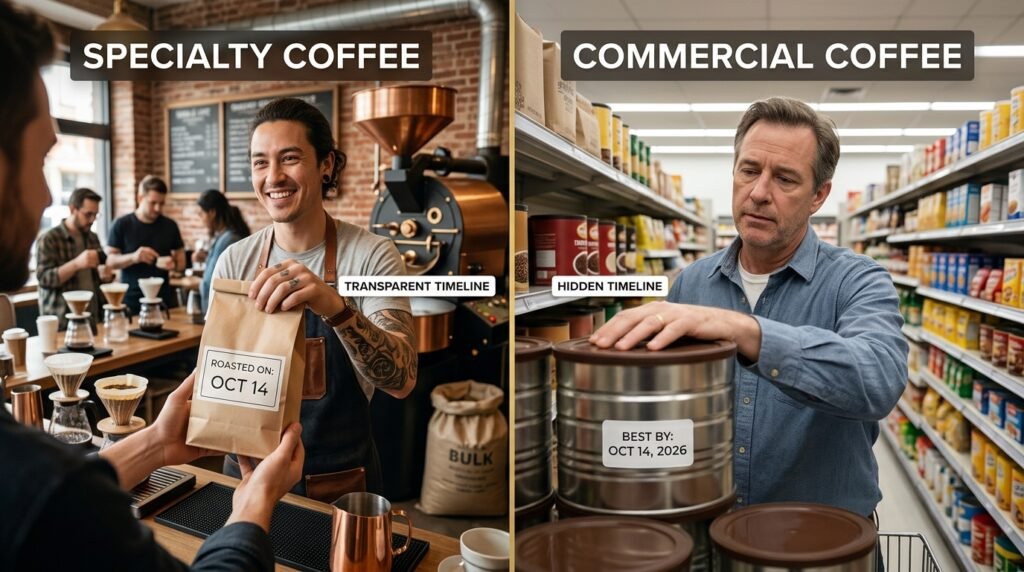
Supermarket coffee will always give you a “Best By” date, usually set a year or two into the future. It makes the consumer feel safe. But coffee is a fresh agricultural product. The moment it leaves the roaster, it begins to oxidize and lose its flavor.
When I started paying attention, I noticed that every single reputable specialty roaster completely ignores the “Best By” date. Instead, they stamp the bag with the exact day the coffee was roasted. Roasted On: October 14th. This is the ultimate sign of transparency. The roaster is handing you the timeline and letting you make the call. They know that to get the absolute best out of those beans, you should consume them within three to four weeks of that date.
A More Intentional Morning
Starting to pay attention to coffee labels was like putting on a pair of glasses after years of squinting.
It removed the mystery and the frustration from my morning routine. I no longer stand in the coffee aisle feeling overwhelmed by marketing jargon and shiny packaging. I ignore the words “Premium” and “Gourmet.” I bypass the opaque, dark-roasted blends with expiration dates in the next decade.
Instead, I look for transparency. I look for the country, the farm, the altitude, and the processing method. I look for the specific day the beans came out of the roasting machine.
Paying attention to these details isn’t about being a coffee snob. It is simply about being an informed consumer. It is about understanding the incredible amount of human labor, geography, and science that goes into producing a single cup of coffee. Once you start noticing the details on the label, you start noticing the details in the cup. And trust me, those details are delicious.
Hi, I’m the coffee enthusiast behind Coffee Nerd Lab.
Like many people, I started drinking coffee simply because it helped me wake up in the morning. Over time, that daily habit turned into a genuine interest in understanding what makes a great cup of coffee. I began experimenting with different beans, brewing methods, grinders, and coffee gear, learning through trial and error along the way.
This blog is where I document that journey. Every article is inspired by real experiences, discoveries, and lessons I’ve learned while exploring the world of coffee. From brewing guides and equipment reviews to practical tips and coffee basics, my goal is to share useful information in a way that’s easy to understand and enjoyable to read.
Thanks for stopping by, and I hope Coffee Nerd Lab helps you enjoy your next cup a little more than the last.