

I was sitting on the floor of my living room on a quiet Sunday afternoon, drinking a mug of black coffee, while my seven-year-old nephew furiously spun a dusty, vintage globe we had found in the attic.
He stopped the globe with his index finger, pointing to a random spot in the middle of the Pacific Ocean. Then, he looked at my mug and asked a question that only a child would ask with such blunt curiosity.
“Uncle, where does that brown water come from?”
I laughed, put my mug down, and walked over to the globe. I spun it until I found the equator. I traced my finger along a thick, invisible band circling the earth, stretching from Central America across to Africa and all the way over to Indonesia.
“It comes from right here,” I told him. “Almost all the coffee in the world grows in this thick belt around the middle of the earth.”
He looked at the globe, then looked back at my mug, completely unimpressed. To him, coffee was just a powder that came out of a plastic tub in his parents’ pantry. To most adults, if we are being completely honest, it isn’t much more than that. We treat it as a utility. It is a biological tool we use to wake up, endure meetings, and survive long commutes.
But as I tried to explain the journey of that dark liquid to my nephew, I had a sudden, profound realization. The sheer scale, the intensive human labor, and the geographical miracles required to produce a single cup of coffee are absolutely staggering. When you actually stop and look at the supply chain, it feels like a mathematical impossibility that coffee only costs a few dollars a cup.
This is what most people don’t realize about the coffee they drink every day.
The Myth of the Manufactured Bean
The fundamental disconnect begins with how we visualize the product. Because we buy coffee in sealed foil bags, shiny tins, or vacuum-packed bricks, our brains subconsciously categorize it alongside manufactured goods.
We think of it like cereal, or soda, or potato chips. We assume there is a massive factory somewhere with conveyor belts pressing brown powder into little pellets.
But coffee is not manufactured. It is grown. It is an incredibly delicate, temperamental agricultural product.
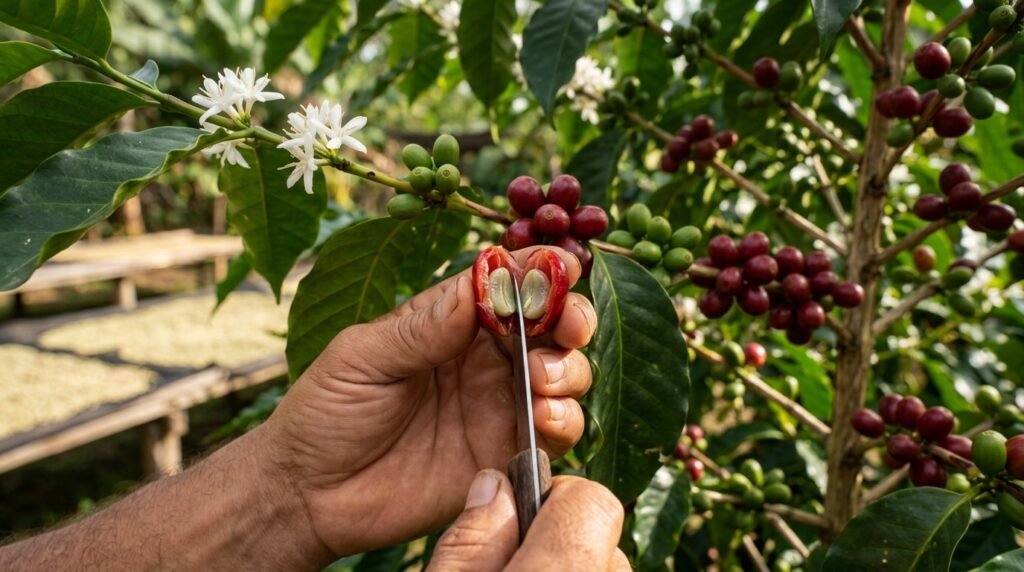
What we call a “coffee bean” is actually the seed of a tropical fruit. It grows on a beautiful, leafy tree with white, jasmine-scented flowers. After the flowers bloom and fall off, small, hard green berries appear on the branches. Over the course of nearly nine months, these berries slowly ripen under the tropical sun until they turn a vibrant, deep shade of crimson red.
These ripe fruits are called coffee cherries. They are sweet, sticky, and completely full of natural sugars. Hidden inside the center of that sweet cherry are two small, pale green seeds facing each other.
Those two tiny seeds are your future cup of coffee.
The Staggering Scale of Human Labor
Once you understand that coffee is a fruit, you have to look at how it is harvested. This is where the reality of the industry becomes truly humbling.
If you look at wheat or corn, you see massive tractors and mechanical combines harvesting hundreds of acres in a single afternoon. Because of this automation, those crops are incredibly cheap to produce.
Specialty coffee cannot be harvested by machines.
The best coffee in the world grows at extremely high altitudes, often on the steep, jagged slopes of volcanic mountains. Tractors cannot drive up these mountains. Furthermore, coffee cherries on the exact same branch do not ripen at the same time. You might have one perfectly ripe red cherry sitting right next to a hard, unripe green one.
If a machine strips the whole branch, the unripe cherries will ruin the flavor of the entire batch.
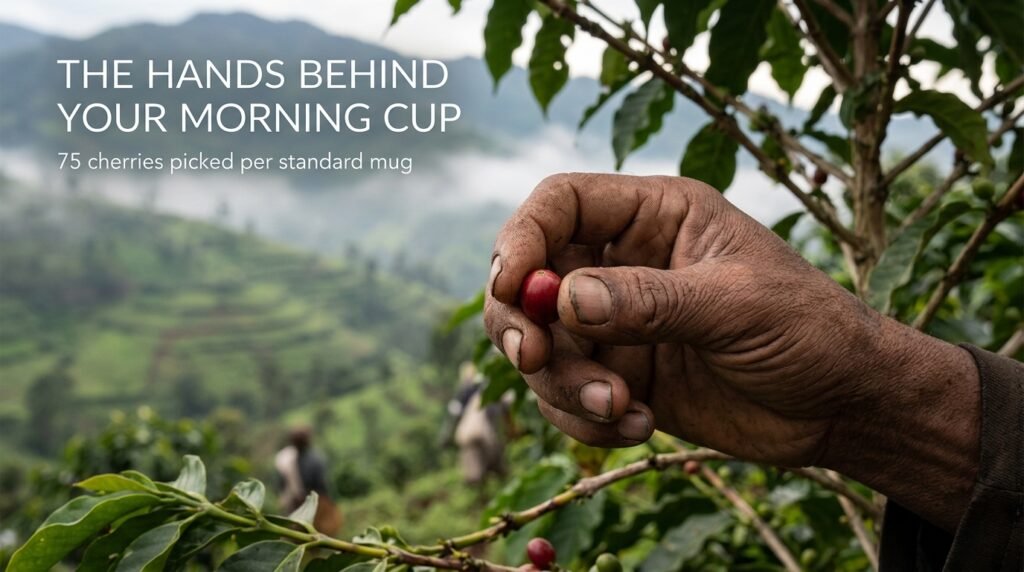
Therefore, almost every single high-quality coffee bean you have ever consumed was picked by a human hand. Farmers and seasonal workers have to hike up incredibly steep, dangerous terrain, carrying heavy baskets strapped to their waists. They have to visually inspect every single branch, carefully plucking only the cherries that are perfectly ripe, and leaving the rest for the next pass.
The Math Inside Your Morning Mug
Let’s break down the math of that human labor, because it puts the entire beverage into a startling perspective.
To brew one standard, 12-ounce mug of coffee at home, you need roughly 20 grams of roasted coffee beans.
If you were to physically count them, 20 grams equals approximately 150 individual coffee beans. Because there are two beans inside every cherry, that means it took 75 perfectly ripe coffee cherries to make your single morning cup.
Think about that for a second.
A human being, standing on the side of a mountain in Colombia, Ethiopia, or Guatemala, had to reach out and individually pluck 75 separate pieces of fruit from a tree, just so you could have your morning caffeine before heading to the office.
When you realize the sheer volume of manual labor involved, the geographical scale suddenly becomes awe-inspiring. I remember doing a deep dive into The Coffee Origin That Completely Surprised Me and realizing that entire rural economies are entirely propped up by this meticulous, hand-harvested crop. It is an industry built entirely on the calloused hands of generational farmers.
The Danger of the Processing Phase
But picking the fruit is only the very first step of an incredibly precarious journey.
Once the red cherries are collected in the baskets, they have to be processed immediately. If the cherries sit in the hot tropical sun for too long, they will begin to rot, and the entire harvest will be destroyed.
The farmers must remove the sticky, sweet fruit flesh from the seeds. This is often done by running the cherries through a mechanical pulper, which strips the skin away. But even after the skin is gone, the seeds are covered in a thick, sugary mucilage.
To remove this sticky layer, the beans are soaked in massive concrete fermentation tanks. This is a highly delicate scientific process. If the farmer ferments the beans for too long, they will taste like vinegar. If they don’t ferment them long enough, the sugars will rot during the drying phase.
Once the beans are finally washed clean, they have to be dried. They are spread out on massive concrete patios or raised mesh beds. For weeks, farmers have to manually rake and turn the beans every single hour under the blazing sun to ensure they dry evenly. If a sudden rainstorm rolls in, they have to frantically cover the entire crop to prevent mold from taking hold.
The Trans-Atlantic Voyage
If the coffee survives the growing, the hand-picking, the fermenting, and the drying, it is finally ready to leave the farm. But it is still completely undrinkable. At this stage, it is a dense, pale green, rock-hard seed.
These green seeds are packed tightly into heavy burlap sacks, weighing roughly 132 pounds (60 kilograms) each.
These sacks are loaded onto trucks, driven down winding, treacherous mountain roads, and eventually loaded into massive metal shipping containers at the port.
For weeks, or sometimes months, your future morning coffee slowly crosses the ocean on a massive cargo ship. It fights against humidity, temperature fluctuations, and the salty ocean air. The logistics required to safely transport this volatile agricultural product from a rural farm in East Africa all the way to a warehouse in North America or Europe are nothing short of an absolute modern miracle.
The Alchemist in the Warehouse
Eventually, those heavy burlap sacks arrive at a coffee roastery in your city. This is the moment the green seed finally transforms into the brown bean you recognize.
But roasting coffee is not like baking a frozen pizza. You cannot just throw the beans into an oven, set a timer, and walk away.
The coffee roaster has the heaviest burden of the entire supply chain. They are holding a product that took a farmer nearly a year to grow, process, and ship. The roaster has the power to either beautifully highlight that farmer’s hard work, or completely incinerate it in a matter of minutes.
Watching this transformation was mesmerizing, which is exactly what happened with The First Bag of Coffee Beans That Made Me Curious About Roasting when I finally visited a local warehouse. I saw the roaster constantly monitoring the temperature, listening for the exact moment the beans cracked, and frantically adjusting the airflow to prevent the delicate sugars from turning into ash.
In roughly twelve to fifteen minutes, the roaster uses extreme thermal energy to unlock the hundreds of dormant aromatic compounds hidden inside the seed. They turn the green rock into a fragile, porous, and highly volatile flavor sponge.
The Final Mile: Your Kitchen
This massive, global relay race finally ends in your kitchen.
The farmer spent months growing and picking it. The processors spent weeks washing and drying it. The sailors spent weeks shipping it. The roaster spent a highly stressful fifteen minutes cooking it.
And then, the baton is passed to you.
This is the part that most people don’t realize, and it is the tragedy of the commercial coffee industry. We take this incredible, labor-intensive, globally transported agricultural miracle, and we treat it with absolute disrespect.
We buy it pre-ground, allowing all the delicate flavors the farmer worked so hard to cultivate to evaporate into the supermarket air. We dump it into a cheap, plastic coffee maker that hasn’t been cleaned in three years. We burn it with violently boiling water. We let it sit on a hot heating plate for four hours until it tastes like battery acid.
And then, when it inevitably tastes terrible, we blame the coffee. We dump a quarter cup of artificial vanilla creamer and three packets of refined sugar into the mug just to make it palatable.
We completely erase the terroir of the mountain, the sweat of the farmer, and the skill of the roaster, all because we are in a rush to get to work.
Changing the Paradigm
Sitting on the living room floor with my nephew that Sunday afternoon, looking at the immense distance between his finger on the globe and the mug in my hand, my entire perspective shifted.
When you truly internalize the journey of the coffee bean, you can no longer view it as a cheap utility. You start to view it as a luxury.
You begin to realize that paying $18 for a bag of freshly roasted, ethically sourced, single-origin coffee isn’t a rip-off. In fact, it is arguably the greatest culinary bargain on the planet. You are paying a few dollars for the culmination of thousands of hours of international manual labor.
This realization forces you to change your behavior in the kitchen.
You stop rushing. You buy a decent burr grinder so you can protect the flavors until the very last second. You buy a digital scale so you can respect the recipe. You start brewing with intention, and this newfound respect eventually became The Coffee Routine That Helped Me Slow Down every single morning.
You start treating the brewing process not as a chore to be completed, but as the final, respectful honoring of a massive global chain of events.

A Call for Morning Gratitude
Tomorrow morning, when you stumble into your kitchen to make your daily cup, I want you to pause for just ten seconds before you hit the power button on your machine.
Look at the brown beans or the dark grounds sitting in your filter.
Think about the steep volcanic mountains of Colombia, the red soil of Ethiopia, or the dense rainforests of Sumatra. Think about the human hands that individually selected every single cherry that makes up your portion. Think about the massive cargo ships crossing the ocean in the dark.
Coffee is not a factory-made powder. It is an agricultural survivor. It is a world traveler.
When you finally take that first warm sip, taste it without the milk and the sugar. Try to find the sweet, natural fruit notes hiding beneath the roast. Let the warmth spread through your chest, and take a moment to be genuinely grateful for the impossible logistics that brought that specific liquid into your specific kitchen.
Once you realize what it actually takes to fill your mug, your morning coffee will never taste ordinary again. It will taste like the global miracle that it truly is.

Hi, I’m the coffee enthusiast behind Coffee Nerd Lab.
Like many people, I started drinking coffee simply because it helped me wake up in the morning. Over time, that daily habit turned into a genuine interest in understanding what makes a great cup of coffee. I began experimenting with different beans, brewing methods, grinders, and coffee gear, learning through trial and error along the way.
This blog is where I document that journey. Every article is inspired by real experiences, discoveries, and lessons I’ve learned while exploring the world of coffee. From brewing guides and equipment reviews to practical tips and coffee basics, my goal is to share useful information in a way that’s easy to understand and enjoyable to read.
Thanks for stopping by, and I hope Coffee Nerd Lab helps you enjoy your next cup a little more than the last.