
It happened on a random Tuesday morning in early spring. I walked into my kitchen, went through my standard brewing motions, and poured myself a mug of pour over coffee.
I took a sip while looking out the window. My eyes immediately widened.
The coffee was spectacular. It was a washed Ethiopian bean. The flavor was a brilliant explosion of sweet peach and bright jasmine. The texture was perfectly smooth. There was absolutely zero bitterness. It was the elusive perfect cup. Coffee enthusiasts often call this the “God Cup.” It is a magical alignment of water, temperature, and beans.
I was thrilled. I finished the mug and went to work in a fantastic mood.
The next morning, I woke up excited. I walked into the kitchen ready to experience that exact same magic. I grabbed the same bag of coffee. I used the same water. I used the same glass cone. I brewed the cup and eagerly took a sip.
It was a complete disaster.
The magic was entirely gone. The bright peach flavor had vanished. The coffee tasted harsh, hollow, and aggressively bitter. It tasted like I had brewed a handful of burnt twigs.
I stood in my kitchen feeling incredibly frustrated. I had all the right equipment. I had a digital scale. I had a precision grinder. Yet my results were wildly unpredictable. I realized my process was deeply flawed. I was treating every morning like a brand new guessing game. That frustrating Wednesday was the catalyst for a massive change. The brewing habit that made my coffee more consistent had nothing to do with buying new gear. It was all about creating a physical paper trail.
The Arrogance of Human Memory
The reason my coffee failed on Wednesday was very simple. I could not remember exactly what I did on Tuesday.
Coffee extraction is a highly sensitive chemical equation. A tiny change in your setup creates a massive change in your mug.
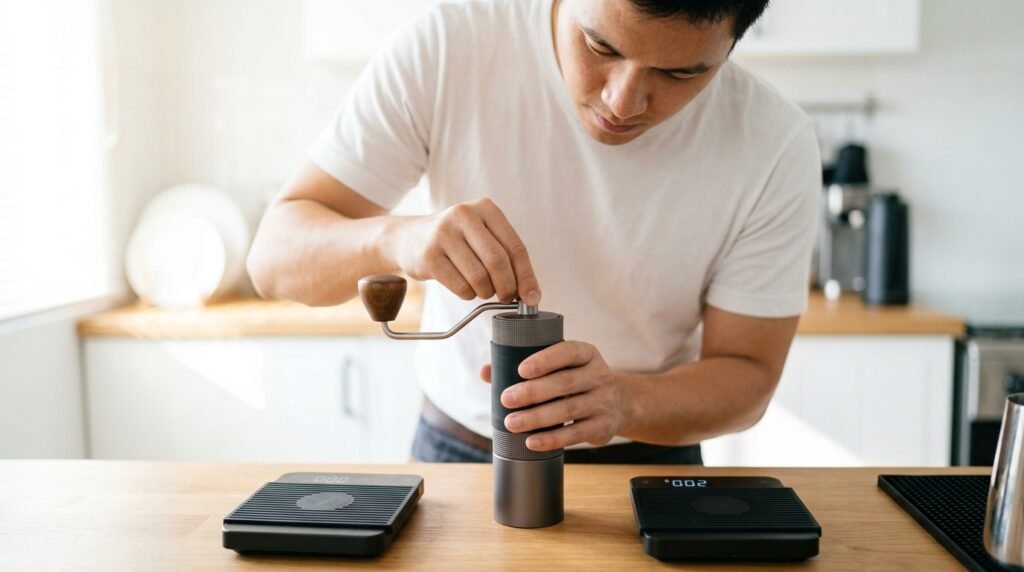
On Tuesday, I had adjusted my manual hand grinder. I twisted the dial slightly because the beans looked a little dense. But I did not pay attention to exactly how many clicks I moved it. I also poured the water slightly faster than usual because I was running late.
I thought I would naturally remember these tiny adjustments. I trusted my memory.
Trusting your memory at six in the morning is a terrible strategy. Your brain is tired. You are operating on autopilot. You will completely forget the subtle turn of a grinder dial. Relying purely on memory was exactly The Simple Coffee Mistake I Made Every Morning for Years and it cost me hundreds of dollars in wasted specialty beans.
The Index Card Solution
I realized I needed a system. I needed to document my variables.
I walked into my home office and grabbed a stack of blank white index cards and a black marker. I placed them on my kitchen counter directly next to my digital coffee scale.
I created a strict new rule for myself. I was not allowed to grind a single coffee bean until I wrote down my parameters on the index card.
I kept the data collection very simple. I wrote down the date. I wrote down the name of the coffee roaster. I wrote down the exact weight of the dry coffee. I wrote down the exact weight of the water.
Most importantly, I wrote down my exact grinder setting. My grinder uses a clicking dial. I wrote down the number of clicks.
This took exactly fifteen seconds of my time. But those fifteen seconds completely revolutionized my morning routine.
The Feedback Loop
Writing the numbers down was only the first half of the new habit. The second half required active tasting.
After I brewed the coffee, I would take a sip. Then I would grab the black marker and write a very brief note on the index card. I forced myself to leave a review of my own work.
I kept the notes incredibly brief. If the coffee tasted great, I wrote “Perfect. Sweet.” If the coffee tasted dry and astringent, I wrote “Too bitter.” If the coffee tasted weak and grassy, I wrote “Sour. Too fast.”
I created a direct feedback loop.
The next morning, I did not have to guess. I just looked at the index card. If the card said the coffee was too bitter yesterday, I knew exactly what to do. I had the physical data. I knew my grinder was set to eighteen clicks. To fix the bitterness, I needed a coarser grind. I adjusted the dial to nineteen clicks and wrote the new number on a fresh line.
The Power of One Variable
The index card habit forced me to adopt a highly scientific approach to my kitchen. It forced me to isolate my variables.
When you make a bad cup of coffee, the instinct is to change everything all at once. You change the water temperature. You change the ratio. You change the grind size. You panic and scramble the entire equation.
If you change three things at once, you will never know which change actually fixed the problem.
Because I was writing everything down, I practiced restraint. If the coffee was sour, I kept my water weight identical. I kept my temperature identical. I only changed the grind size. Documenting this specific isolation process completely informed What I Learned After Brewing Coffee More Carefully as my skills developed. I learned to steer the flavor profile with surgical precision.
Tracking the Aging Process
The index card habit revealed a fascinating biological reality about roasted coffee.
Coffee beans are not static objects. They are porous, organic seeds. From the moment they leave the roasting oven, they are constantly evolving. They release trapped carbon dioxide gas. They slowly oxidize.
A bag of coffee will taste completely different on day five than it does on day fifteen.
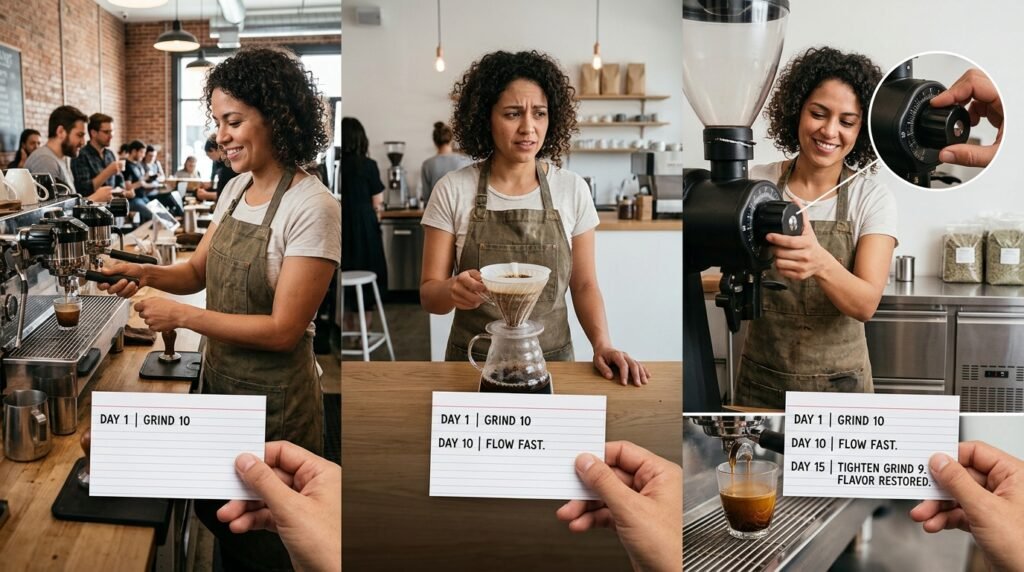
Before I started tracking my brews, this aging process drove me crazy. I would dial in a coffee perfectly on a Monday. By Friday, the exact same recipe would taste slightly hollow and weak. I thought I was losing my mind.
The index card proved I was not crazy. It showed me the timeline.
As the coffee aged and lost its gas, the water passed through the grounds much faster. The faster flow rate caused a weak extraction. Because I was tracking the dates on my card, I learned to anticipate this physical change. By week two of a fresh bag, I knew I had to tighten my grind setting by one click to maintain the perfect flavor.
The Masking Tape Alternative
I used the index card method for several months. It worked flawlessly. But eventually, the stack of cards on my counter became slightly cluttered.
I refined the habit into an even more minimalist system.
I threw the index cards away. I bought a roll of blue painter’s tape.
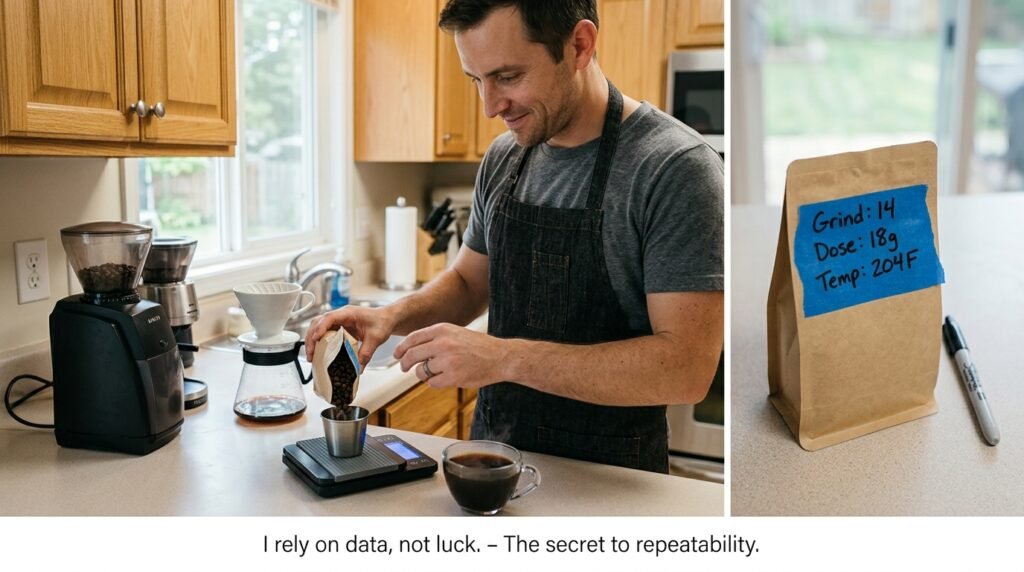
Now, whenever I buy a new bag of coffee, I tear off a piece of blue tape and stick it directly onto the back of the coffee bag. I write my baseline recipe directly on the tape.
Every morning, I just look at the back of the bag. If I need to change a variable, I cross out the old grinder setting and write the new one below it. The physical bag becomes its own living document.
When the bag is empty, the data goes into the recycling bin with it. My kitchen counter remains completely spotless. The tape method is highly efficient. It is the exact premise of The Tip That Helped Me Brew Consistently Every Morning and I recommend it to absolutely everyone.
Escaping the Roaster Roulette
This simple habit of writing things down cured a very expensive problem. It stopped me from constantly throwing coffee beans in the trash.
In the past, if I bought a new bag of expensive single origin coffee and my first two cups tasted bad, I would blame the roaster. I would assume I bought a terrible batch of beans. I would push the bag to the back of the pantry and go buy a different brand.
I was playing roaster roulette. I was wasting a massive amount of money.
The truth is, bad coffee beans are actually quite rare if you buy from reputable specialty shops. The beans are almost always good. The extraction is usually bad.
By tracking my variables, I stopped giving up on difficult beans. If a new bag of Ethiopian coffee tasted overly acidic on day one, I did not throw it away. I looked at the tape. I tightened the grind. I raised the water temperature. I fought the beans until they surrendered their sweetness.
The habit gave me the confidence to extract the true potential out of any coffee I purchased.
A Morning of Absolute Certainty
The psychological benefit of this tracking habit is monumental.
We wake up every day facing a barrage of stressful decisions. We have to navigate traffic. We have to manage complex projects at work. We have to balance family responsibilities.
Your morning coffee should not be a stressful decision. It should not be a gamble. It should be a quiet, comforting anchor at the very beginning of your day.
When you have your variables written down on a piece of blue tape, you eliminate the gamble. You walk into your kitchen with absolute certainty. You know exactly what the digital scale needs to read. You know exactly where the grinder dial needs to sit.
You can execute the physical motions effortlessly. You can let your mind wander. You can watch the sunrise outside your window because you know the math is already handled.
The End of the God Cup
That frustrating Wednesday morning taught me a harsh truth. A perfect cup of coffee is totally useless if you cannot repeat it.
Accidental perfection is just a parlor trick. True culinary skill is the ability to produce excellence on command, regardless of how tired you are or how distracted you might be.
I no longer believe in the magical “God Cup.” I do not rely on the stars aligning in my kitchen.
I rely on data. I rely on my digital scale, my burr grinder, and my black marker.
If I drink a spectacular cup of coffee on a Tuesday, I do not just smile and hope for the best tomorrow. I look at the blue tape on the back of the bag. I confirm the exact weight. I confirm the exact grind setting. I lock the parameters into my brain.
Start Your Own Log Tomorrow
You do not need to buy any new, expensive brewing equipment to drastically improve your morning cup. You already have everything you need. You just need to organize your approach.
Go to your desk. Find a sticky note. Find a pen. Put them next to your coffee maker tonight.
Tomorrow morning, write down your starting numbers. Write down how much coffee you used. Write down your grinder setting.
Taste your coffee critically. Do not just swallow it for the caffeine. Pay attention to the texture. Does it dry your mouth out? Is it violently sour? Write a two word review on your sticky note.
The next day, use that sticky note to make one single adjustment.
If you commit to this tiny, fifteen second habit, your frustrating mornings will end. You will stop chasing ghosts in your kitchen. You will build a reliable, foolproof system. Your coffee will transition from a chaotic daily gamble into a perfectly consistent, highly customized luxury. Write it down, track the data, and take control of your mug.

Hi, I’m the coffee enthusiast behind Coffee Nerd Lab.
Like many people, I started drinking coffee simply because it helped me wake up in the morning. Over time, that daily habit turned into a genuine interest in understanding what makes a great cup of coffee. I began experimenting with different beans, brewing methods, grinders, and coffee gear, learning through trial and error along the way.
This blog is where I document that journey. Every article is inspired by real experiences, discoveries, and lessons I’ve learned while exploring the world of coffee. From brewing guides and equipment reviews to practical tips and coffee basics, my goal is to share useful information in a way that’s easy to understand and enjoyable to read.
Thanks for stopping by, and I hope Coffee Nerd Lab helps you enjoy your next cup a little more than the last.