
It is late Saturday morning in Rio de Janeiro. I am standing in my kitchen looking at the empty counter space. I build and manage digital websites for a living. In my profession, clutter is the enemy. If a website has too many heavy plugins, flashing widgets, and unnecessary graphics, the code breaks down. The site becomes slow and completely unusable.
I apply this exact same minimalist logic to my physical environment.
A few years ago, my kitchen counter looked like an electronics store. I had a massive automatic drip machine. I had a loud, screaming plastic blade grinder. I had a bulky espresso toy that never actually worked. My kitchen was full of physical bloatware.
I decided to delete all the broken hardware. I threw the cheap plastic machines into the trash. I stripped my daily routine down to the absolute bare minimum. I wanted a workstation that functioned perfectly every single day without taking up unnecessary space. How I built my simple coffee setup at home was a process of ruthless elimination. I stopped buying massive appliances and focused entirely on the raw mechanics of extraction.
Deleting the Bloatware
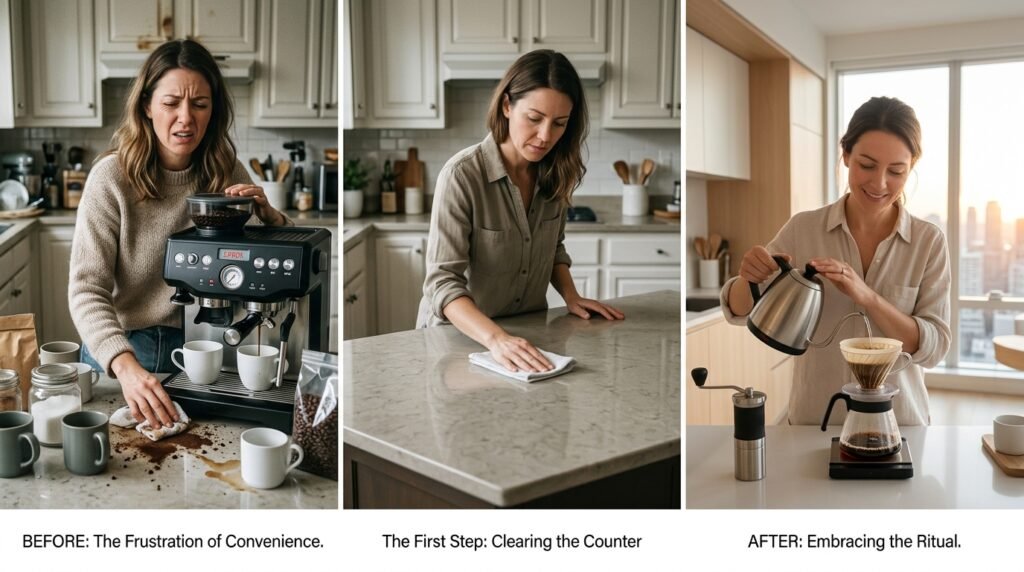
The first step was removing the illusion of convenience.
We buy massive coffee machines because we think they will save us time. We want to push a single button and walk away. But those complex machines hide terrible mechanics. They heat the water unevenly. They trap rancid coffee oils in plastic tubes you can never reach to clean. They break constantly.
I realized I was sacrificing the actual flavor of my expensive specialty coffee just to avoid doing five minutes of manual labor.
I cleared the counter entirely. I wiped the stone surface clean. I decided that every new tool I introduced to this space had to justify its existence. It had to perform a highly specific mechanical function. It could not hide behind a plastic shell or a digital screen.
The Foundation of Data
The very first tool I placed on the empty counter was a digital scale.
In website management, you cannot fix a server problem if you do not have accurate data. You have to monitor the exact metrics. Coffee extraction requires the exact same strict mathematical respect.
I bought a flat, basic digital kitchen scale. It does not connect to my smartphone. It just accurately measures physical weight down to the single gram.
This twenty dollar piece of plastic is the absolute foundation of my entire kitchen. It eliminates the chaos of visual guessing. I never use plastic scoops. I never estimate the water level in my mug. The scale forces me to establish a perfect, reliable chemical ratio between the solid coffee seeds and the hot water.
Investing in the Processing Power
The second tool I added to the counter was the most expensive.
You cannot brew clear, articulate coffee if your beans are shattered into a chaotic mixture of massive boulders and microscopic dust. You need perfect particle uniformity.
I refused to buy a cheap electric blade grinder. Making that specific hardware error early on was exactly The Equipment Mistake I Made When I Started Brewing Coffee and it taught me that terrible input data ruins the entire beverage. I needed absolute precision.
I bought a premium manual hand grinder. It is built entirely from heavy stainless steel and matte aluminum. It houses incredibly sharp ceramic burrs. It requires zero electricity. I use my own physical strength to turn the heavy metal handle. It produces a flawless, uniform distribution of coffee particles every single morning.
The Delivery Mechanism
The third piece of hardware was dedicated to fluid dynamics.
You cannot extract coffee evenly if you dump boiling water out of a chaotic plastic pitcher. You need a steady, controlled solvent.
I bought a stainless steel gooseneck kettle. It sits neatly on my stove. The long, sweeping curved spout is an engineering requirement. It forces the turbulent boiling water to align perfectly. It creates a smooth, glassy rod of laminar flow.
When I hold the heavy handle, I have absolute command over the water delivery. I can pour incredibly slow, tight concentric circles. I can gently wash the coffee bed without digging deep, destructive craters into the delicate grounds.
The Passive Brewer
With the scale, the grinder, and the kettle in place, I had successfully secured the active tools. I had secured the input data, the processing power, and the delivery mechanism.
The final piece of the puzzle was the brewer itself.
People spend hundreds of dollars on beautiful glass carafes and shiny metal stands. I completely ignore the visual aesthetics of the brewer. A manual coffee brewer is a passive object. Its only job is to hold a paper filter.
I bought a dark plastic V60 cone. It cost less than ten dollars. It is completely indestructible. If I accidentally knock it off the counter, it bounces on the floor. Plastic is also a brilliant thermal insulator. It traps the massive heat of the boiling water inside the coffee slurry, ensuring a highly efficient extraction.
The Secondary Automation
My V60 setup was perfect for slow mornings, but I needed a secondary tool for busy workdays.
I bought an AeroPress. It is essentially a thick plastic syringe. It sits quietly next to the V60 on my counter.
When I have an urgent client crisis and cannot stand still to pour water for three minutes, I use the AeroPress. I dump the grounds and the water inside the plastic chamber. I let it steep automatically for two minutes while I answer emails. Then I push the plunger down.
It delivers incredible, heavy body coffee in a fraction of the time. It provides high quality immersion brewing without the dirty, gritty sludge of a traditional French press.
Managing the Static Friction
My primary setup was incredibly clean, but I noticed a small workflow problem.
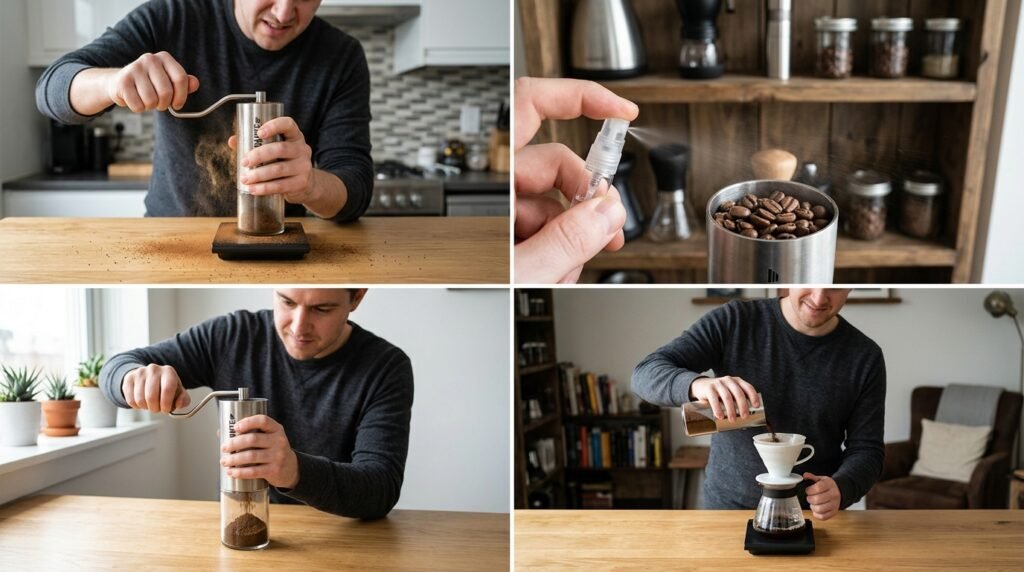
Because I use a manual metal grinder, the intense friction of crushing hard coffee beans created massive static electricity. Coffee dust flew everywhere. It coated my clean digital scale. It made a daily mess on my pristine counter.
I found a brilliant, microscopic solution. I bought a tiny glass spray bottle from a local pharmacy. I filled it with filtered water.
Before I grind my beans, I spray one single mist of water onto the seeds. The tiny drop of moisture instantly kills the static charge. Adopting this cheap atomizer trick was exactly How a Small Tool Improved My Home Coffee Experience and completely eliminated the annoying cleanup process. The grounds fall perfectly into the catch bin without a single flying particle.
Organizing the Raw Material
With the hardware finalized, I had to organize the software. The software is the roasted coffee bean.
I buy expensive, light roasted Ethiopian Guji and Sidamo beans. These high altitude African coffees are incredibly delicate. They degrade rapidly when exposed to oxygen.
I could not leave half open paper bags cluttering my minimalist counter.
I bought a small wooden block that holds twelve sealed glass test tubes. On Sunday night, I weigh exactly fifteen grams of coffee into each glass tube and push the heavy silicone caps tight. The wooden block sits neatly in the corner of my workstation.
The Visual Harmony
I step back and look at the completed setup on this quiet Saturday.
The physical footprint is incredibly small. The metal hand grinder, the flat digital scale, the plastic V60, the AeroPress, and the wooden block of glass tubes all fit comfortably on a single corner of the counter.
There are no power cords stretching across the wall. There are no blinking digital clocks. There are no massive plastic water reservoirs growing mold in the dark.
It looks like a precision analog workstation. It looks deliberate. Every single object has a strict mathematical purpose. The visual harmony brings a deep sense of calm to my kitchen.
The Execution of the System
The true beauty of this setup is not how it looks. The true beauty is how it operates.
When I wake up on a busy Monday morning, I do not have to think. The system guides my hands automatically.
I grab a pre measured glass tube of Ethiopian beans from the wooden block. I mist them with the tiny spray bottle. I dump the clean seeds into the metal hand grinder. I use my own physical strength to crush the hard seeds. I feel the density of the agriculture in my shoulders.
I place the plastic cone on the scale. I pour the hot water from the gooseneck kettle in slow, measured circles. I watch the red liquid drain.
The Analog Escape
My entire professional life exists on a digital screen. I write lines of code that dictate virtual actions. I cannot physically touch the websites I build.
This simple coffee setup is my daily anchor to physical reality.
I have to touch the heavy steel. I have to smell the explosive aroma of the shattered fruit seeds. I have to control the exact flow of the boiling water. Internalizing the massive value of this physical labor was exactly The Morning I Realized Coffee Could Be a Ritual and it completely changed my relationship with the beverage.
I am not just pushing a button to receive a generic utility drink. I am actively participating in a chemical extraction.
The Absolute Clarity
Because every tool in my simple setup performs a perfect mechanical function, the resulting coffee is spectacular.
I do not hide the flavor behind milk or sugar. I drink the coffee completely black.
When I take a sip of the Ethiopian Guji, the bright lemon acidity is razor sharp. The heavy peach sweetness coats my palate. The delicate jasmine aroma lingers in the back of my throat. I can taste the exact volcanic dirt of the African farm.
This level of absolute clarity is impossible to achieve with a cheap plastic drip machine. You can only unlock the true potential of the roasted seed when you control every single variable with precision tools.
Avoid the Appliance Trap
If you are currently frustrated with your coffee routine, look closely at your kitchen counter.
Are you surrounded by massive machines that promise convenience but deliver muddy, bitter flavor? Are you fighting with dirty plastic reservoirs and chaotic blade grinders?
You need to ruthlessly delete the bloatware from your life.
Stop looking at expensive electric espresso machines. Stop buying heavy appliances. You do not need them to brew professional quality coffee at home. You just need to respect the fundamental laws of extraction chemistry.
Building Your Own Workstation
You can build this exact same setup for a fraction of the cost of a high end machine.
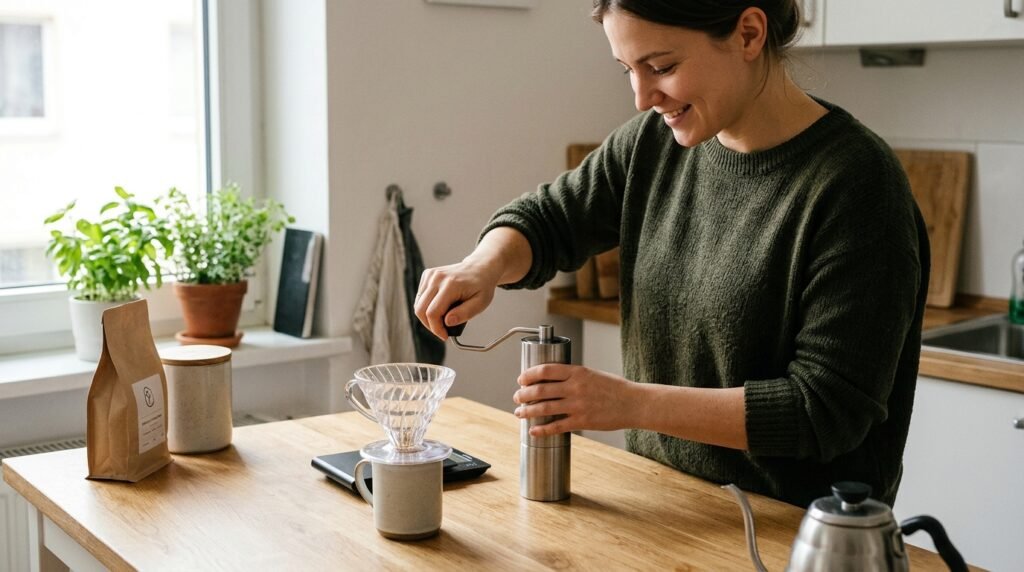
Invest your money heavily in a premium manual burr grinder. That is the engine of your kitchen. Buy a twenty dollar digital scale to lock in your mathematical data. Buy a basic stove top gooseneck kettle to control your fluid dynamics. Buy a ten dollar plastic cone to hold the paper filter.
Keep it simple. Keep it modular. Keep it analog.
When you strip away the digital screens and the automated pumps, you finally expose the raw, beautiful mechanics of the brewing process. You build a highly efficient workstation that never breaks, never clutters your counter, and consistently delivers the most articulate cup of coffee you have ever tasted.

Hi, I’m the coffee enthusiast behind Coffee Nerd Lab.
Like many people, I started drinking coffee simply because it helped me wake up in the morning. Over time, that daily habit turned into a genuine interest in understanding what makes a great cup of coffee. I began experimenting with different beans, brewing methods, grinders, and coffee gear, learning through trial and error along the way.
This blog is where I document that journey. Every article is inspired by real experiences, discoveries, and lessons I’ve learned while exploring the world of coffee. From brewing guides and equipment reviews to practical tips and coffee basics, my goal is to share useful information in a way that’s easy to understand and enjoyable to read.
Thanks for stopping by, and I hope Coffee Nerd Lab helps you enjoy your next cup a little more than the last.