My hands were actually shaking. It wasn’t a subtle, barely noticeable tremor, either. I was sitting at my kitchen island, trying to hold a ceramic mug, and I could physically feel the caffeine vibrating through my forearms. My heart was thumping a chaotic rhythm against my ribs, and my mouth tasted faintly of burnt rubber and damp earth.
I stared down at the dark, sludgy liquid remaining in my cup, utterly bewildered.
I hadn’t drank a massive pot of coffee. I had only consumed one standard-sized mug. Yet, my body was reacting as if I had just chugged three energy drinks back-to-back.
The beans I had used weren’t my usual light-roast specialty pick. I had run out of coffee the night before, panicked, and grabbed a random, inexpensive bag of “Intense Italian Espresso Blend” from the corner bodega just to get me through the morning.
I pulled the brightly colored bag out of the trash can and started scanning the fine print. There, buried on the back panel beneath a block of marketing text, was a single, revealing sentence: A bold blend of premium Arabica and carefully selected Robusta beans.
Robusta. I had heard the word thrown around in coffee commercials before, usually as something to be avoided. But I had never actually understood what it meant, what it tasted like, or what it did to your body. That jittery, heart-pounding morning was the catalyst for a deep dive into coffee botany. It was the exact moment I realized that “coffee” isn’t just one monolithic plant.
The Tale of Two Siblings
If you are like I used to be, you probably think a coffee bean is just a coffee bean. You assume the differences in flavor simply come down to where the farm is located or how dark the roaster decided to burn the batch.
But the truth goes much deeper than that. It goes all the way down to the genetic species of the plant.
While there are over a hundred different species of coffee growing in the wild, the global coffee industry is almost entirely dominated by just two: Coffea Arabica and Coffea Canephora (which is universally referred to as Robusta).
Think of them as two siblings in the same family. They share some basic DNA, they look somewhat similar from a distance, but their personalities, their preferences, and the way they behave in the real world could not be more wildly different.
Before that jittery morning, I had lived my entire life blissfully unaware of the Robusta sibling. I had been drinking Arabica almost exclusively without even knowing it. Once I figured out there was a second, much stronger player in the game, I needed to understand exactly what set them apart.
Arabica: The Demanding Prima Donna
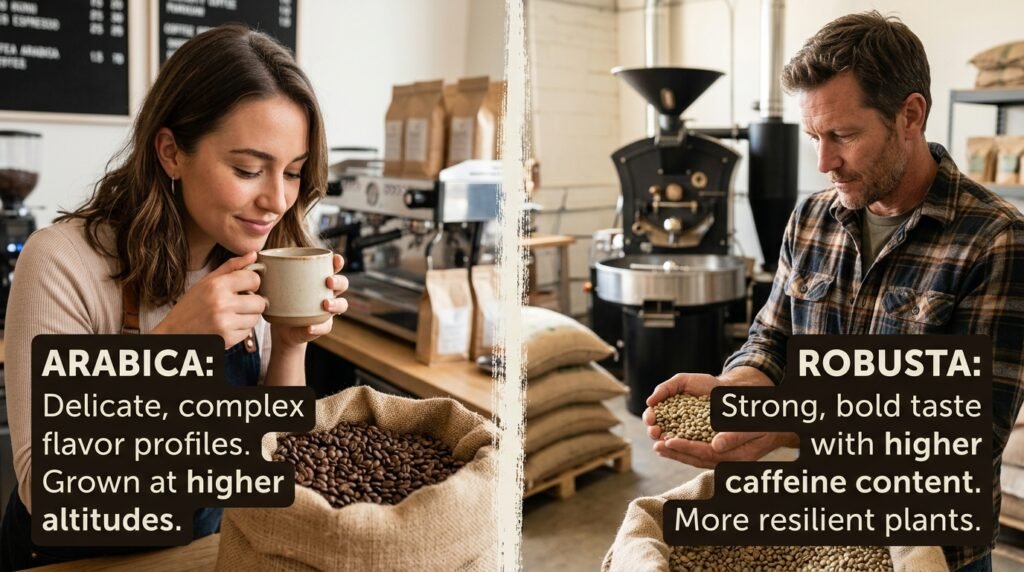
If the coffee world were a theater production, Arabica would be the lead actor. It is demanding, it is fragile, it requires very specific conditions to thrive, but when treated right, it delivers a stunning, complex performance.
Arabica represents about 60% to 70% of all coffee produced globally. It is the species that makes up the entirety of the specialty coffee market. When you go to an artisan café and order a pour-over that tastes like jasmine, blueberry, or milk chocolate, you are drinking Arabica.
But Arabica is a botanical diva.
It refuses to grow just anywhere. It demands high altitudes—usually between 2,000 and 6,000 feet above sea level. It needs cool, consistent temperatures, and it absolutely despises direct, harsh sunlight. Furthermore, Arabica plants are incredibly susceptible to diseases, pests, and climate fluctuations. Farming Arabica is a high-risk, labor-intensive labor of love.
So, why do farmers bother? Why do roasters obsess over it?
Because of the chemistry. Arabica beans contain almost twice the concentration of natural sugars and about 60% more lipids (fats) than Robusta beans. These sugars and lipids are the building blocks of flavor. When you roast an Arabica bean, those compounds caramelize and react, creating that vast, beautiful spectrum of sweet, fruity, and floral tasting notes.
Robusta: The Unkillable Survivor
If Arabica is the prima donna, Robusta is the gritty, blue-collar survivor. It is the rugged younger sibling who can take a punch and keep on standing.
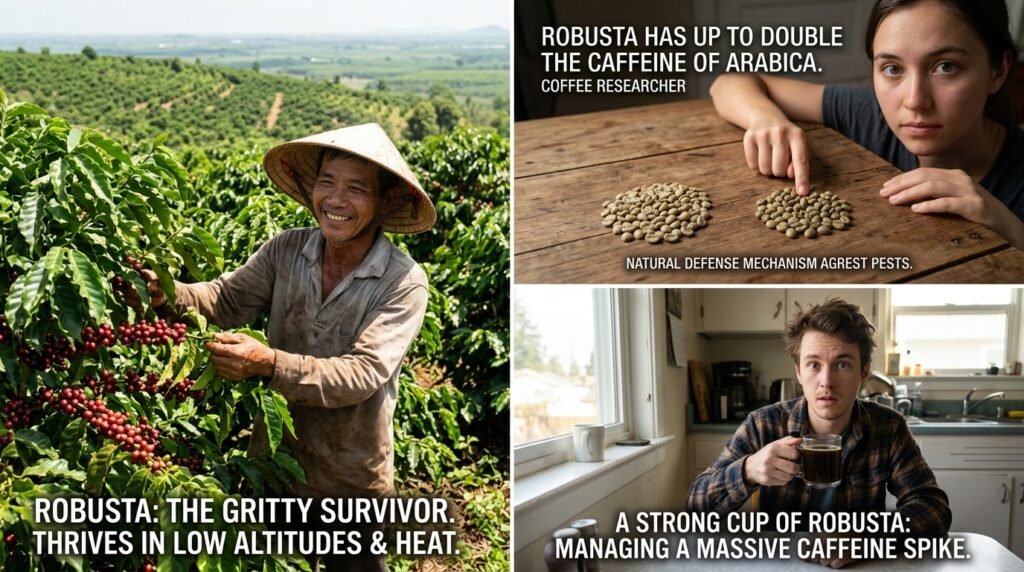
Robusta plants are tough. They don’t need high mountain peaks or cool mists. They can thrive at low altitudes, right down to sea level. They love sweltering heat. They can survive heavy rainfall, and most importantly, they are incredibly resistant to pests and diseases that would wipe out an entire farm of Arabica.
For a long time, I wondered why Robusta was so naturally immune to bugs. The answer, it turns out, is the exact reason I was shaking in my kitchen that morning.
Robusta beans contain up to twice as much caffeine as Arabica beans.
In nature, caffeine isn’t a morning pick-me-up; it is a highly toxic chemical defense mechanism. It is a natural pesticide. Because the Robusta plant produces such a massive amount of caffeine, insects that try to eat the leaves or the cherries are poisoned and deterred.
This high concentration of caffeine is great for the plant’s survival, but it has a drastic effect on the human body. The physical toll of consuming that much caffeine in a single cup was jarring, and it prompted me to thoroughly document How I Learned Coffee Strength Affects My Mood. I quickly realized that brewing a strong cup of Robusta wasn’t just about waking up; it was about managing a massive chemical spike.
The Astringent Truth About Flavor
Of course, the high caffeine content isn’t the only thing that makes Robusta unique. The flavor profile is notoriously polarizing.
Remember how I mentioned Arabica is packed with sugars and lipids? Robusta is severely lacking in both. Instead, it is packed with chlorogenic acid, which, despite the name, contributes heavily to a bitter, harsh taste when roasted.
When I finally managed to calm my nerves that day, I realized I needed to conduct a proper experiment. I wanted to taste the two species side-by-side, without the distraction of a “blend.” I tracked down a bag of pure, unblended Robusta from Vietnam and brewed it right next to my favorite light-roast Ethiopian Arabica.
It was a completely eye-opening sensory experiment, and I wrote a whole breakdown about The Day I Compared Two Different Coffee Beans Side by Side. The contrast was night and day.
The Arabica was bright, delicate, and smelled like a bakery.
The pure Robusta was heavy, dense, and aggressive. The flavor notes were almost entirely savory. It tasted like roasted nuts, dark wood, and—I am not exaggerating—burnt rubber tires. It was incredibly thick and coated my tongue like syrup. There was absolutely no sweetness to be found. It wasn’t necessarily “bad,” but it was so vastly different from what my brain categorized as “coffee” that it felt like drinking a completely different botanical beverage.
The Supermarket Marketing Trick
Once I understood this fundamental difference between the two species, a very common supermarket marketing tactic suddenly made perfect sense.
For years, I had walked down the grocery store aisles and seen bags of coffee proudly boasting “100% Arabica!” in bold, gold letters. I always assumed this was just a generic buzzword, like “Premium” or “Gourmet.”
I didn’t realize it was actually a specific, legal botanical claim.
Because Robusta is much easier to grow, much harder to kill, and produces a higher yield per tree, it is significantly cheaper to buy on the commodity market than Arabica. For decades, massive commercial coffee corporations have used Robusta as a “filler” bean. They would take a small amount of decent Arabica, mix it with a large amount of cheap, bitter Robusta, roast the whole batch extremely dark to mask the harsh flavors, and sell it to the masses.
When a brand prints “100% Arabica” on their packaging, they aren’t necessarily promising that the coffee is amazing. They are simply promising you that they didn’t cut costs by sneaking cheap, bitter Robusta filler into the bag.
This realization completely shifted how I shop. It forced me to stop looking at the shiny logos and start analyzing the actual information provided by the roaster, a habit I explored in depth when writing about Why I Started Reading Labels Before Buying Coffee Beans. Knowing the species is the absolute baseline for knowing what you are putting in your body.
In Defense of the Underdog
Now, after reading all of this, it is very easy to villainize Robusta. It sounds like the cheap, bitter, overly caffeinated bad guy of the coffee world. For a long time, the specialty coffee industry treated it exactly like that. Robusta was viewed as an inferior weed, unfit for serious consumption.
But as I continued my coffee education, I learned that dismissing Robusta entirely is a mistake. It has a specific role, and in certain cultures, it is absolutely essential.
Take Italian espresso, for example. If you go to an old-school café in Naples and order a shot of espresso, you will likely be served a blend that contains a significant percentage of Robusta.
Why? Because of the crema.
Robusta beans produce a significantly thicker, more stable, and richer crema (the golden foam on top of an espresso shot) than Arabica beans. The lower oil content in Robusta allows the bubbles in the crema to hold their structure longer. Furthermore, the harsh, woody, and nutty flavors of Robusta cut through milk beautifully. A cappuccino made with a pure, delicate, floral Arabica can sometimes taste weak and milky. A cappuccino made with a Robusta blend punches right through the dairy, delivering that classic, bold “coffee” flavor.
The Vietnamese Tradition
Robusta also holds the throne in Vietnam, which is the second-largest coffee-producing country in the entire world, falling only behind Brazil. The vast majority of the coffee grown in Vietnam is Robusta.
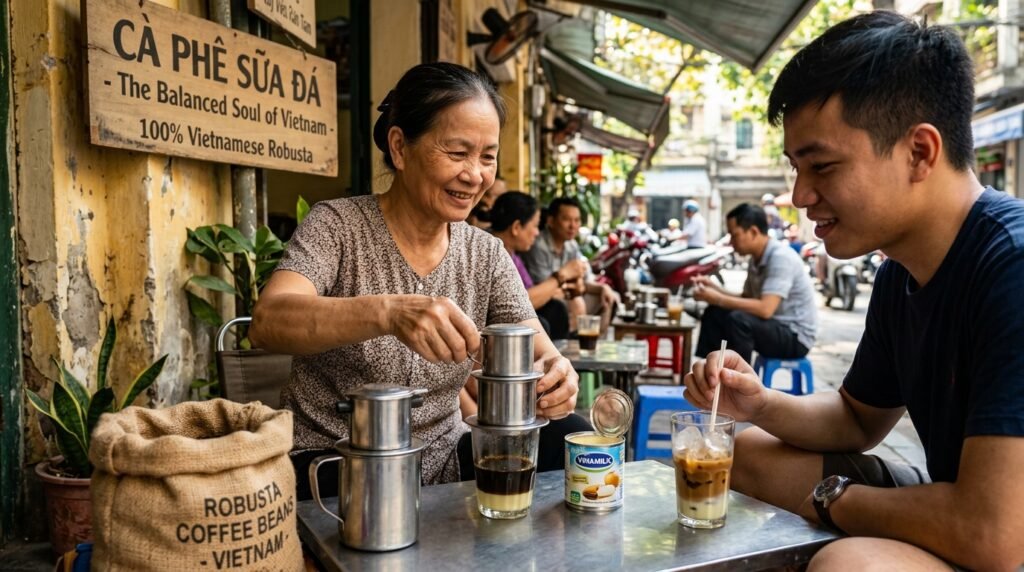
If you have ever had a traditional Vietnamese iced coffee (cà phê sữa đá), you have experienced the magic of Robusta used correctly.
The coffee is brewed incredibly strong using a metal phin filter, and then it is poured over a generous layer of sweetened condensed milk and ice. If you tried to make this drink with a delicate, fruity Arabica, the condensed milk would completely overpower the coffee. It would taste like a sugary glass of milk.
But the aggressive, bitter, heavy-bodied nature of Robusta acts as the perfect counterbalance. The harshness of the bean wrestles with the extreme sweetness of the condensed milk, resulting in a perfectly balanced, decadent, and intensely caffeinated dessert beverage. It is a masterpiece of culinary context.
The Rise of Fine Robusta
The coffee world is currently going through a fascinating evolution. As climate change threatens the high-altitude, cool-weather environments that Arabica relies on, farmers and scientists are starting to look at the unkillable Robusta plant with newfound respect.
A movement known as “Fine Robusta” is slowly gaining traction. Farmers are taking Robusta plants and applying the same rigorous, careful harvesting and processing techniques usually reserved for specialty Arabica. They are proving that when Robusta isn’t treated like a cheap commodity filler, it can actually produce a clean, fascinating cup of coffee. It might never taste like a delicate blueberry pastry, but it can offer incredible notes of dark cocoa, warm spices, and rich malt.
A More Informed Morning
Looking back at that jittery morning in my kitchen, I don’t regret buying that cheap espresso blend. That terrible, heart-racing cup of coffee forced me to wake up—both literally and intellectually.
Learning the difference between Arabica and Robusta was like learning the primary colors. It is the foundational knowledge required to understand why your coffee tastes the way it does.
Today, my coffee shelf is heavily curated. I know that when I want a slow, mindful Sunday morning savoring complex fruity notes, I reach for a single-origin washed Arabica. But I also know that if I am making a heavy, milk-based drink, or if I just need a serious, unadulterated punch of caffeine to get through a grueling workday, a high-quality Robusta blend might be exactly what the doctor ordered.
You don’t have to become a botanist to enjoy your morning cup. But knowing exactly which sibling you are inviting into your kitchen can save you from a lot of unexpected bitterness, and perhaps a few trembling hands.

Hi, I’m the coffee enthusiast behind Coffee Nerd Lab.
Like many people, I started drinking coffee simply because it helped me wake up in the morning. Over time, that daily habit turned into a genuine interest in understanding what makes a great cup of coffee. I began experimenting with different beans, brewing methods, grinders, and coffee gear, learning through trial and error along the way.
This blog is where I document that journey. Every article is inspired by real experiences, discoveries, and lessons I’ve learned while exploring the world of coffee. From brewing guides and equipment reviews to practical tips and coffee basics, my goal is to share useful information in a way that’s easy to understand and enjoyable to read.
Thanks for stopping by, and I hope Coffee Nerd Lab helps you enjoy your next cup a little more than the last.