

I was standing in my kitchen in Rio de Janeiro on a busy Wednesday morning. I had just finished grinding my Ethiopian Heirloom coffee beans. The water in my gooseneck kettle was perfectly hot. I was ready to start my manual pour over.
I needed to time my extraction. I reached into my pocket and pulled out my smartphone.
I opened the clock application to start the stopwatch. The exact second I touched the screen, a massive notification banner dropped down. One of the client websites I manage was experiencing a severe server error. Two urgent emails arrived simultaneously.
My heart rate instantly spiked. My mind completely abandoned the kitchen. I quickly poured the boiling water over the coffee grounds while staring at the error message on my phone screen. I did not watch the scale. I did not control the flow rate. I rushed the entire process so I could get back to my computer desk.
The resulting coffee tasted like bitter ash and weak water. The simple coffee equipment that changed my routine completely solved this catastrophic workflow failure. It was not an expensive mechanical grinder or a beautiful glass brewer. It was a five dollar magnetic kitchen timer. It taught me that keeping a digital leash in the kitchen actively destroys the culinary process.
The Smartphone Trap
Almost every single person who brews specialty coffee at home uses their smartphone as a timer. It seems like a logical choice. The device is always in your pocket. It has a highly accurate digital stopwatch built directly into the operating system.
Using the phone is a massive psychological trap.
A smartphone is not a kitchen tool. A smartphone is a communication hub. It is designed specifically to capture and hold your attention. It is designed to interrupt you with alerts, messages, and breaking news.
When you place your smartphone next to your coffee scale, you invite the entire chaotic world directly into your brewing sanctuary. You combine a highly sensitive chemical extraction with the stress of your professional obligations.

The Cost of Distraction
Coffee extraction requires absolute focus. You are managing multiple strict variables simultaneously.
You have to watch the physical weight of the water on your digital scale. You have to control the exact physical movement of your pouring hand. You have to monitor the clock to ensure the water stays in contact with the coffee for the correct amount of time.
If your phone screen lights up with a text message, your eyes naturally dart away from the scale.
In that single second of distraction, you ruin the chemistry. You accidentally pour thirty extra grams of boiling water. You dilute the brew ratio. You miss the precise window to start your second pour. The coffee bed dries out and the extraction completely stalls.
Seeking an Analog Solution
I realized my phone was actively ruining my mornings. I needed to physically banish the device from my kitchen.
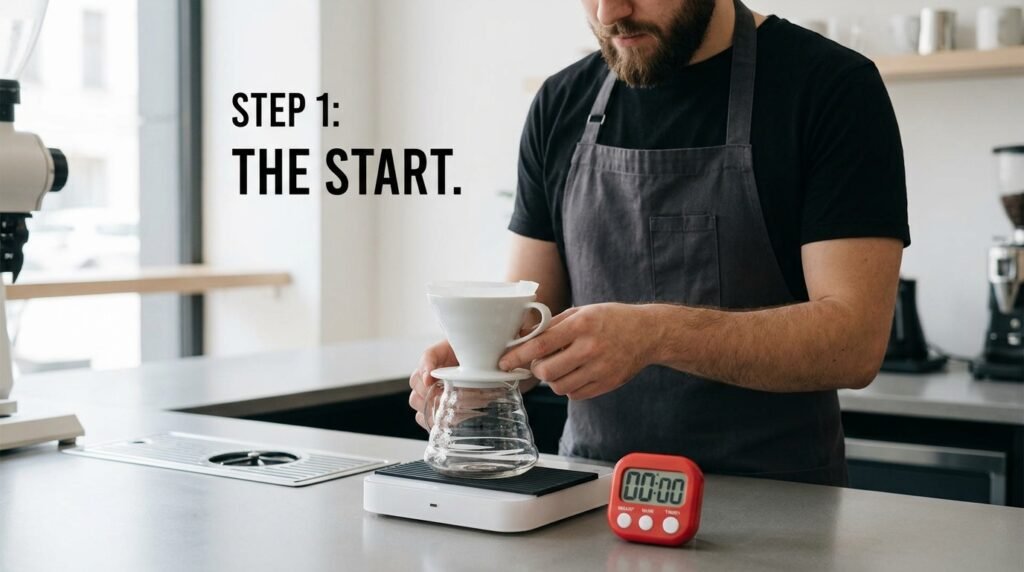
I went to a local hardware store. I bought a cheap, plastic digital kitchen timer. It had a magnet on the back. It had three physical rubber buttons on the front. One button for minutes. One button for seconds. One button to start and stop the clock.
There was no bluetooth connection. There was no internet access. The tool possessed one singular function.
I placed the timer on the metal frame of my stove directly above my coffee station. I made a strict rule for myself. My smartphone was no longer allowed in the kitchen while I brewed coffee.
The First Protected Morning
The next morning, I woke up and left my phone on the charger in my bedroom. I walked into the kitchen.
My partner was sitting in the living room watching a Vasco football match. The apartment was filled with the sounds of the game. I stood at my counter in complete peace. There were no digital alerts vibrating in my pocket.
I ground fifteen grams of my dense Ethiopian seeds in my manual burr grinder. I poured the fragrant grounds into the paper filter. I reached up and pressed the rubber start button on the magnetic timer.
Establishing this physical boundary was exactly The Coffee Habit That Improved My Daily Routine because it protected my mental bandwidth. I was completely present. My eyes were locked exclusively on the coffee bed and the digital scale.
Mastering the Bloom Phase
The dedicated timer completely changed how I executed the actual brewing mechanics. It allowed me to lock in my pouring structure perfectly.
The first stage of any pour over is the bloom phase. Fresh coffee holds a massive amount of trapped carbon dioxide gas. You must release this gas before you extract the sugars.
I pour forty grams of hot water gently over the dry grounds. I watch the timer.
The standard bloom phase lasts exactly forty five seconds. This is a critical mathematical window. If you only wait twenty seconds, the gas will violently disrupt your extraction later. If you wait sixty seconds, the coffee bed will dry out completely and the temperature will plummet.
With the dedicated timer ticking right in front of my face, I never miss the window. At exactly forty five seconds, I resume my pour.
Structuring the Intervals
A perfect pour over is not a single, continuous dump of water. It is a highly structured series of smaller pours.
Dividing the water into specific intervals provides perfect agitation. It ensures the coffee particles tumble evenly in the hot solvent.
I use the cheap magnetic timer to dictate these intervals strictly. Executing this strict schedule was the core of How I Learned to Time My Coffee Pour Perfectly and it removed all the chaotic guesswork from the fluid dynamics.
At the forty five second mark, I pour water until the scale reads one hundred and fifty grams. I stop and wait. I watch the timer. When the clock hits one minute and thirty seconds, I pour the final volume of water until the scale hits two hundred and forty grams.
The Unforgiving Metric
The timer does not just tell me when to pour. The final number on the clock tells me exactly how the coffee extracted.
Time is the ultimate physical indicator of your grind size. If you keep your pouring speed consistent, the only variable that dictates how fast the water drains is the physical size of the coffee particles.
I target a total brew time of exactly three minutes.
If the timer hits two minutes and the water has completely drained through the filter, I have a massive problem. The coffee particles are too large. The water rushed through the gaps like a fast river. The resulting beverage will taste incredibly weak and highly sour.
Diagnosing the Grind Size
If the timer hits four minutes and the water is still sitting in a muddy puddle on top of the filter, I have the opposite problem.
The coffee particles are too small. The microscopic dust clogged the microscopic pores of the paper filter. The water stalled completely. The resulting beverage will taste like burnt wood and dry, harsh tannins.
The timer acts as a diagnostic tool. If the brew is too fast, I reach for my manual hand grinder and turn the dial one click finer for tomorrow. If the brew is too slow, I turn the dial one click coarser.
I use the simple clock to calibrate the complex ceramic burrs perfectly.
The Tactile Satisfaction
There is a deep psychological satisfaction in using single purpose physical tools.
When you use a smartphone, every action feels identical. You tap a flat piece of glass to start a timer. You tap the exact same piece of glass to send an email. The physical feedback is completely monotonous.
The magnetic timer provides distinct tactile feedback. I have to physically press the rubber button. It clicks loudly under my finger. When the time is up, the alarm is not a gentle, curated ringtone. It is a harsh, highly functional electronic beep.
Embracing this analog feedback was exactly The Coffee Routine That Helped Me Slow Down because it forced me to interact with the physical world. It forces you to operate like a mechanic in a workshop, not a programmer at a keyboard.
Eliminating the Screen Glare
Using a dedicated timer also changes the visual environment of the kitchen.
When I wake up early, my kitchen is dark. I turn on a single, warm light above the stove. I do not want bright, harsh light hitting my eyes before I have consumed caffeine.
A smartphone screen is an aggressive light source. Even on the lowest brightness setting, it emits harsh blue light. It completely shatters the calm atmosphere of the morning.
The magnetic timer has an LCD screen. It does not emit light. It just displays simple black numbers on a gray background. It respects the visual peace of the room. It gives me the strict mathematical data I need without screaming for my visual attention.
Protecting the Raw Material
I spend a significant amount of money on light roasted African coffee. The farmers work incredibly hard to develop the complex floral notes inside the soil.
I have a responsibility to extract those flavors properly.
If I ruin a twenty dollar bag of Ethiopian coffee because I was reading a text message while pouring boiling water, I am insulting the agricultural product. I am throwing the farmer’s hard work directly into the trash.
The cheap digital timer protects my expensive financial investments. It forces me to respect the raw material. It forces me to put my professional ego aside and focus entirely on the culinary task sitting on the counter.
The Ultimate Kitchen Rule
If you want to brew incredible specialty coffee at home, you have to control your variables. You need a good scale. You need a good burr grinder. You need a gooseneck kettle.
But none of those tools matter if your brain is not present in the room.
You have to enforce strict boundaries. Your kitchen counter must become a sanctuary. The preparation of the coffee must become a protected ritual.

Banish the Phone Today
Look at your own morning routine tomorrow.
Where is your smartphone? Is it sitting right next to your coffee scale? Are you scrolling through social media while waiting for your water to boil? Are you checking your work calendar during the bloom phase?
You are actively sabotaging your own peace. You are guaranteeing a chaotic extraction.
Go to a local hardware store or look online. Spend five dollars on a basic, ugly, highly functional magnetic kitchen timer. Stick it to your refrigerator or your stove.
Tomorrow morning, leave your smartphone in the bedroom. Do not bring it into the kitchen.
Use the rubber buttons to measure your extraction. Watch the physical numbers change. Focus entirely on the explosive aroma of the wet coffee grounds. When you finally taste the absolute clarity of a perfectly timed, perfectly focused extraction, you will never bring a digital screen into your brewing sanctuary again. The cheapest tool in your house will permanently protect your most valuable time of day.

Hi, I’m the coffee enthusiast behind Coffee Nerd Lab.
Like many people, I started drinking coffee simply because it helped me wake up in the morning. Over time, that daily habit turned into a genuine interest in understanding what makes a great cup of coffee. I began experimenting with different beans, brewing methods, grinders, and coffee gear, learning through trial and error along the way.
This blog is where I document that journey. Every article is inspired by real experiences, discoveries, and lessons I’ve learned while exploring the world of coffee. From brewing guides and equipment reviews to practical tips and coffee basics, my goal is to share useful information in a way that’s easy to understand and enjoyable to read.
Thanks for stopping by, and I hope Coffee Nerd Lab helps you enjoy your next cup a little more than the last.