
My alarm goes off at six in the morning. I immediately pick up my smartphone. I open my productivity apps and look at my schedule for the day. I manage multiple websites. I have to check server statuses, review content schedules, and fix broken links. My digital life moves incredibly fast.
I need caffeine immediately to keep up with the pace.
For a very long time, my morning coffee routine was a massive point of friction. I had a severe conflict of interest in my kitchen. I wanted to drink highly complex, expensive specialty coffee. I loved bright, floral Ethiopian beans. But I also needed my coffee ready in three minutes so I could get back to my computer screen.
Quality and speed rarely exist in the same place. I spent months buying different pieces of equipment. I tested different brewing methods. I wasted a lot of money and drank a lot of bad coffee. How I found the coffee maker that fit my routine was a process of elimination. I had to test every piece of hardware until I found the perfect mechanical workflow.
The Automated Drip Disaster
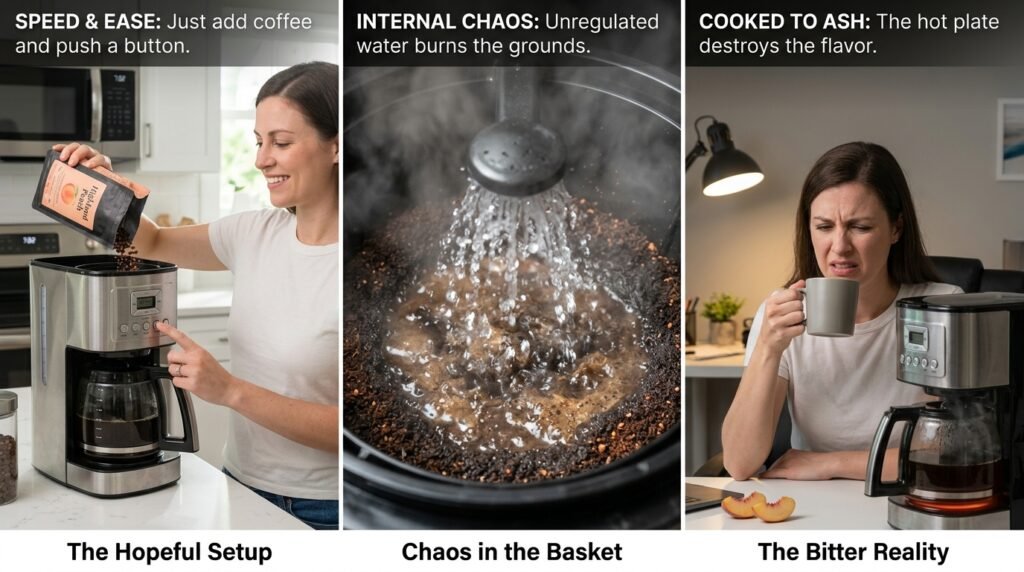
My first attempt at speed was the standard automatic drip coffee maker. Everyone has one of these plastic machines sitting on their counter.
The logic made sense. I could put the coffee in the plastic basket, push a single button, and walk back to my home office. The machine would do all the work. Five minutes later, I would have a massive pot of hot coffee waiting for me.
The reality was a complete culinary disaster.
The automated machine completely destroyed my expensive Ethiopian coffee beans. The internal heating element was entirely unregulated. It sprayed boiling, chaotic water aggressively over the center of the coffee bed. It violently over extracted the middle of the grounds and completely ignored the edges.
Worse, the machine featured a hot metal plate at the bottom to keep the glass carafe warm. That hot plate literally cooked the brewed coffee. It turned the bright, delicate peach notes into bitter, muddy ash.
Seeking Manual Control
I quickly realized I could not automate the brewing process if I wanted absolute clarity. I had to ditch the plastic machine entirely.
Deciding to abandon that terrible appliance was exactly Why I Switched from a Drip Coffee Maker to Pour Over and took manual control of the hot water. I bought a glass V60 cone and a gooseneck kettle.
The pour over method fixed the flavor problem instantly. By pouring the water myself in slow, concentric circles, I achieved a perfectly uniform extraction. The bright lemon acidity and the sweet jasmine aromas of my African coffee returned brilliantly. The flavor was spectacular.
But the pour over completely failed my productivity test.
The Time Sink of the Pour
A proper manual pour over requires your absolute, undivided attention.
You cannot walk away from the glass cone. You have to stand perfectly still and hold the heavy metal kettle for three solid minutes. You have to watch the digital scale constantly. You have to carefully manage the flow rate of the water.
If I received an urgent server alert on my phone, I could not answer it. If I stopped pouring water to check a website error, the coffee bed would dry out. The extraction would stall. The entire cup would be ruined.
The pour over is a beautiful, meditative ritual. It is perfect for a lazy Sunday morning. It is absolutely terrible for a highly stressed Tuesday morning when my digital workflow demands my attention.
The Immersion Experiment
I needed a coffee maker that provided the flavor quality of a manual pour over, but allowed me to step away for a few minutes. I decided to try immersion brewing.
I went to a local store and bought a traditional glass French press.
The mechanism was incredibly simple. You dump coarse coffee grounds into the glass beaker. You pour hot water directly over them. You let the coffee steep for four minutes, just like a cup of tea. Then, you push a metal mesh filter down to separate the liquid from the grounds.
It solved the attention problem perfectly. I could pour the water, walk over to my computer to answer an email, and walk back to the kitchen four minutes later.
The Muddy Reality
The workflow was great, but the physical reality of the beverage was terrible.
The metal filter on a French press is completely ineffective. It stops the large coffee boulders, but it allows all the microscopic coffee dust to pass straight through the mesh. That dust ends up entirely inside your mug.
Learning to navigate this dirty extraction was exactly My First Attempt at Brewing Coffee with a French Press and it left me highly disappointed. The coffee felt thick and gritty on my tongue. The microscopic dust created a heavy, bitter blanket that completely smothered the delicate fruit notes of my Ethiopian beans.
The Nightmare of the Sink
The flavor was bad, but the cleanup was significantly worse.
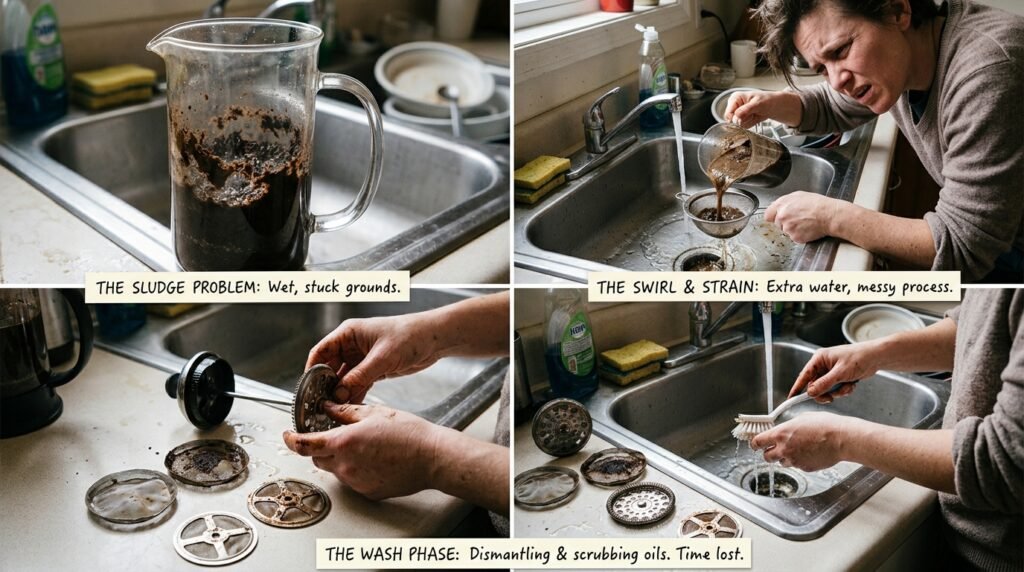
Cleaning a glass French press is a mechanical nightmare. At the bottom of the beaker sits a massive, wet pile of coarse coffee sludge. You cannot simply dump it into the trash can. The wet sludge sticks to the glass walls.
You have to run water into the beaker, swirl the muddy water around, and dump it into a metal strainer in your sink. Then you have to dismantle the metal filter and scrub the trapped coffee oils out of the mesh.
It took me five minutes just to clean the tool. I was saving time on the brewing phase, but losing twice as much time on the washing phase. My productivity system was completely broken.
Finding the Plastic Cylinder
I was frustrated. I was ready to give up and just drink bad coffee. Then, my partner recommended a strange piece of equipment.
It was called an AeroPress. It did not look like a premium culinary tool. It looked like a massive plastic syringe. It was made entirely of thick polycarbonate plastic. It came with tiny circular paper filters.
I was highly skeptical. It looked like camping gear. It did not look like something that belonged in a serious kitchen. But the reviews online were spectacular, so I decided to test it.
The Physics of the Plunger
The AeroPress combines the best elements of every other brewing method into a single plastic tube.
It uses full immersion. You pour the coffee grounds and the hot water into the main plastic chamber. You stir them together. The coffee steeps entirely submerged in the water, just like a French press. This ensures a perfectly even extraction without requiring the delicate, sustained pouring technique of a V60.
Then, you screw a plastic cap onto the bottom. Inside the cap sits a tiny paper filter.
You place the entire device over your ceramic mug. You insert the plastic plunger into the top of the chamber, and you push down using your own body weight.
The Magic of Pressure
That downward push changes everything.
You are physically forcing the hot water through the dense coffee grounds and through the paper filter. The pressure accelerates the chemical extraction. It forces the heavy fruit sugars out of the dense African seeds in a fraction of the time.
More importantly, the paper filter catches absolutely everything. It traps the microscopic coffee dust. It traps the heavy, bitter oils.
The liquid that exits the bottom of the plastic cylinder is completely pristine. It has the heavy, rich body of an immersion brew, but it retains the crystal clear transparency of a delicate pour over.
Dialing in the Variables
My first cup with the plastic syringe was surprisingly good, but I knew I could make it better. The brilliant thing about the AeroPress is the absolute control it gives you over the variables.
Because the coffee sits inside a sealed chamber, water flow is no longer a problem. You can use an extremely fine grind size without worrying about clogging the filter. You can steep the coffee for one minute, or you can steep it for ten minutes. The device is infinitely flexible.
I spent a few days tweaking my formula. Finding that specific balance was exactly The Morning I Finally Got My AeroPress Recipe Right and it locked my routine into place. I used fifteen grams of finely ground Ethiopian coffee. I used two hundred grams of boiling water. I stirred vigorously for ten seconds, steeped for exactly two minutes, and plunged slowly.
The Perfect Mug
I finished plunging the coffee into my heavy ceramic mug. I walked over to my desk and sat down.
I took a sip while looking at my monitor. The flavor was spectacular. The bright, juicy peach acidity of the Ethiopian Guji was perfectly intact. The delicate jasmine aroma filled my nose. The liquid was clean, sweet, and perfectly balanced.
There was no mud at the bottom of the cup. There was no bitter ash from a burning hot plate. I had successfully extracted the high altitude soil of the farm.
The Ten Second Cleanup
The flavor sold me on the device. But the cleanup process is what permanently cemented it into my daily routine.
With a traditional pour over, you have to carefully lift a soggy paper filter out of a glass cone and walk it to the trash. With a French press, you have to scrub wet sludge out of a glass beaker.
With the AeroPress, you simply take the plastic cylinder to the trash can. You unscrew the plastic cap. You push the plunger one final inch.
The compressed puck of dry coffee grounds and the small paper filter shoot out of the cylinder directly into the trash with a satisfying pop. You rinse the rubber gasket under the faucet for two seconds. You are entirely finished.
The entire cleanup process takes exactly ten seconds.
The Productivity Match
This strange plastic tool was the exact missing piece in my workflow.
It takes me less than three minutes to boil the water, grind the beans, and push the plunger. The coffee steeps on its own, allowing me to check my phone or read a quick email. The cleanup is completely negligible. It requires almost zero mental bandwidth.
Most importantly, it delivers absolute premium clarity. I do not have to compromise on the quality of my expensive specialty beans just to save time.
The AeroPress fits my specific life. It is durable. I can accidentally drop it on the kitchen tile, and the thick plastic simply bounces. It is highly repeatable. I get the exact same flavor profile every single morning.
Evaluate Your Own Routine
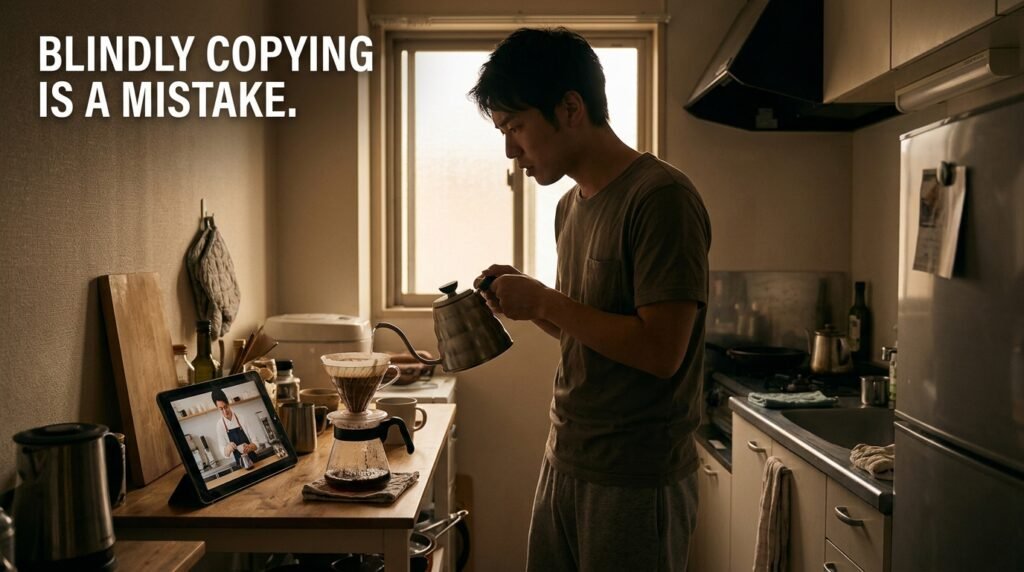
The biggest mistake you can make when building a coffee setup is copying someone else blindly.
If you watch a professional barista on the internet carefully pouring water over a glass V60 for five minutes, it looks beautiful. But that barista is at work. That is their entire job. You have a different job. You have different morning stress levels.
You have to evaluate your actual mechanical routine.
If you have thirty free minutes every morning and you enjoy a slow, meditative ritual, buy a beautiful glass pour over cone. Buy a specialized gooseneck kettle. Enjoy the slow pace.
If you need coffee for three different people at the exact same time, buy a massive French press. Just accept the annoying cleanup process as the cost of volume.
Find Your Friction
Look closely at where your kitchen routine breaks down.
If you constantly burn your coffee on a hot plate, you need to abandon the automated machine. If you hate standing still to pour water, you need an immersion brewer. If you hate washing complex parts, you need a simple mechanism.
For me, the friction was time and clarity. The plastic syringe eliminated both of those problems entirely.
Stop fighting your equipment. Your coffee maker should work for you. It should seamlessly integrate into your daily workflow without causing frustration. Once you find the specific tool that matches your personal speed, your morning caffeine habit stops being a chore and finally becomes a reliable, satisfying system.

Hi, I’m the coffee enthusiast behind Coffee Nerd Lab.
Like many people, I started drinking coffee simply because it helped me wake up in the morning. Over time, that daily habit turned into a genuine interest in understanding what makes a great cup of coffee. I began experimenting with different beans, brewing methods, grinders, and coffee gear, learning through trial and error along the way.
This blog is where I document that journey. Every article is inspired by real experiences, discoveries, and lessons I’ve learned while exploring the world of coffee. From brewing guides and equipment reviews to practical tips and coffee basics, my goal is to share useful information in a way that’s easy to understand and enjoyable to read.
Thanks for stopping by, and I hope Coffee Nerd Lab helps you enjoy your next cup a little more than the last.