
It was a chaotic Sunday morning, and my kitchen counter was a disaster zone of flour, eggshells, and half-empty bottles of maple syrup. I was hosting a few close friends for a weekend brunch. As I was pulling a batch of pancakes off the griddle, my friend Sarah walked through the front door, slightly late, holding a shiny, foil-lined bag as a peace offering.
“I know you are a massive coffee nerd,” she announced proudly, setting the bag on the counter. “So I got you the absolute strongest, boldest stuff I could find at the store. It’s a French Roast.”
I smiled, thanked her genuinely, and picked up the bag. I placed it right next to the coffee I was already preparing to serve: a lightly roasted, single-origin bean from Kenya.
Sarah looked at my pale, matte-brown beans sitting in the grinder hopper, and then looked at the dark, oily black beans she had just brought. “Yours looks kind of weak,” she noted with a teasing grin. “Are you sure that’s going to wake us up?”
That simple, harmless comment sparked a massive debate around my kitchen table. It was a conversation that forced me to unpack years of marketing myths, and it reminded me of my own initial confusion when I first started brewing. That morning brunch turned into an impromptu sensory experiment, and it was the perfect real-world demonstration of how I discovered the importance of coffee roast levels.
The Myth of “Strong” Coffee
Before we dive into the science of roasting, we have to address the biggest misconception in the coffee world—the exact misconception my friend Sarah brought into my kitchen that morning.
For decades, coffee commercials have conditioned us to associate the color of the bean with the strength of the beverage. We have been taught that dark, black, oily beans produce a “strong, bold” cup of coffee, while lighter brown beans produce a “weak” cup. We inherently associate a dark roast with a massive jolt of caffeine.
This is entirely false.
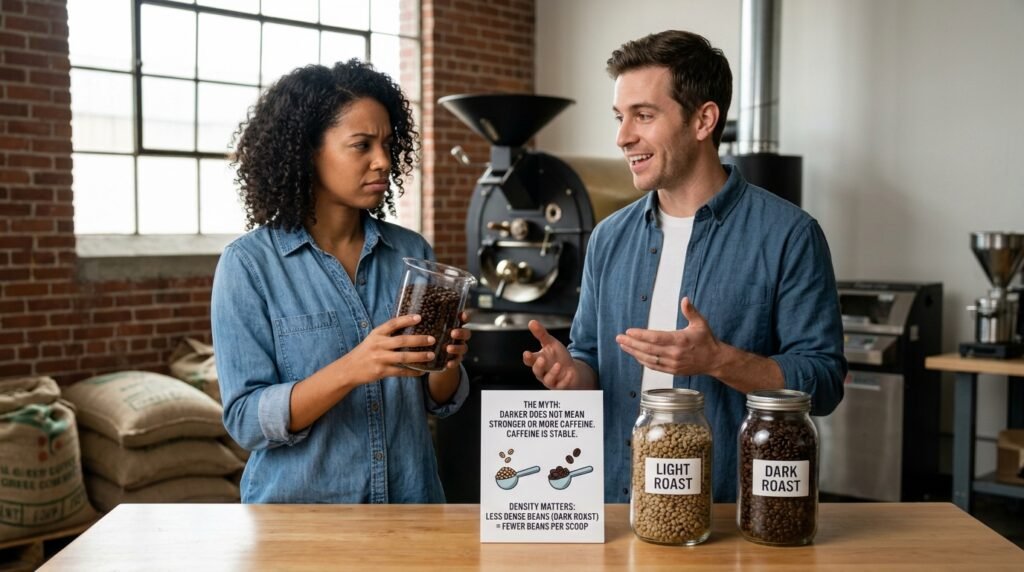
“Strong” is a word that describes the ratio of coffee to water, not the roast level. If I take a light roast coffee and brew it using a massive amount of grounds and very little water, it will be incredibly strong. If I take Sarah’s dark French Roast and brew it with a tiny amount of grounds and a gallon of water, it will be incredibly weak.
Furthermore, the roasting process does not add caffeine to the bean. In fact, caffeine is an incredibly stable chemical compound. The intense heat of the roasting drum barely affects it.
If anything, dark roasts can sometimes result in slightly less caffeine in your morning mug depending on how you measure your beans, because dark roasted beans expand and become significantly less dense. You physically fit fewer dark beans into a measuring scoop than you do dense, light beans.
The Visual Contrast
To settle the debate at the brunch table, I decided we needed to do a blind taste test. I took two white ceramic plates and poured a handful of my light Kenyan beans on one, and a handful of Sarah’s dark French Roast beans on the other.
Seeing them side-by-side under the bright kitchen lights was jarring. It was the perfect visual representation of The Day I Discovered the Difference Between Light and Dark Roast, brought to life for my guests.
The light roast beans looked like tiny, dry, pale peanuts. They had a matte finish. When you smelled them, they didn’t smell like “coffee” in the traditional sense. They smelled like dried fruit, sweet hay, and honey.
The dark roast beans looked like they had been coated in a layer of glossy lip balm. They were massive, shiny, and nearly jet-black. When you smelled them, the aroma was aggressive. It smelled like campfire smoke, dark cocoa, and charred wood.
How could these two completely different objects belong to the exact same agricultural family? The answer lies entirely in the application of heat.
The Science of the Roaster
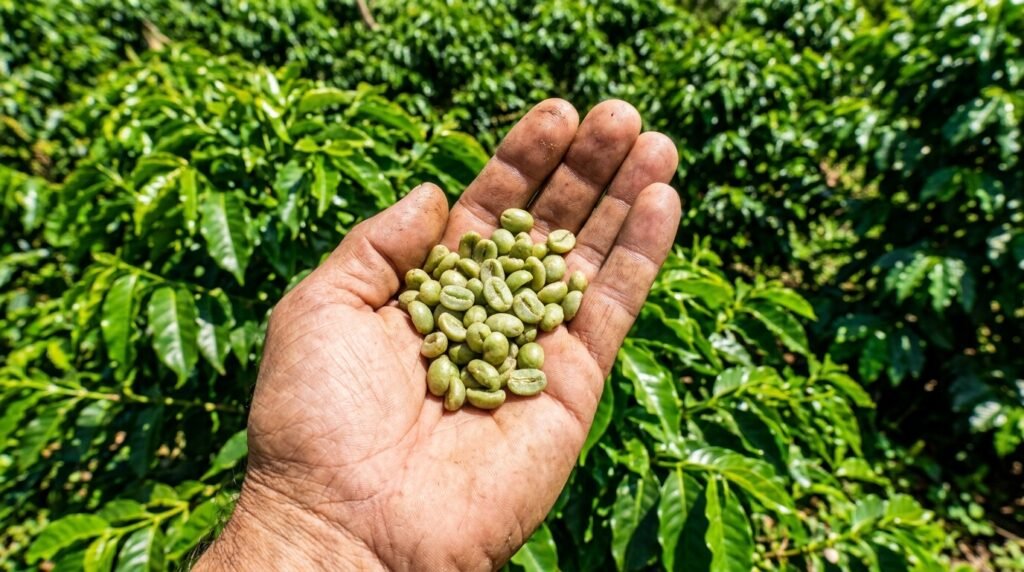
Every single coffee bean in the world starts its life as a green, rock-hard, unbrewable seed. It smells like grass and tastes like raw vegetables. To make it drinkable, a roaster must apply thermal energy to fundamentally alter its chemistry.
When a green bean goes into a roasting machine, the moisture trapped inside begins to boil and turn into steam. The bean turns yellow and starts to smell like baking bread.
Eventually, the pressure of the steam inside the bean becomes too much, and the bean violently fractures. This is called the “First Crack.” It sounds like popcorn popping. At this precise moment, the complex sugars inside the bean begin to caramelize, and the hundreds of aromatic compounds are unlocked.
If the roaster pulls the coffee out of the machine right after this first crack, you have a Light Roast. The bean has been cooked just enough to become soluble in water, but it retains all of the unique, delicate flavors of the specific farm where it was grown.
If the roaster leaves the beans in the machine, the heat continues to break down the cellular structure. The natural sugars burn past the point of caramelization. Eventually, the bean undergoes a “Second Crack.”
This second fracture is much quieter, sounding like Rice Krispies popping in milk. At this point, the intense heat forces the natural oils inside the bean to migrate to the surface. If you pull the coffee out now, you have a Dark Roast.
The Flavor Eraser
As I ground both batches of beans for my guests, I tried to explain what the heat actually does to the flavor.
I like to think of the roasting process as a heavy, dark curtain slowly being pulled across a window.
The “window” represents the terroir of the coffee—the unique characteristics imparted by the soil, the altitude, and the climate of the farm.
With a light roast, the curtain is wide open. You can taste the origin. You can taste the bright, citric acidity of an African bean, or the deep, sweet caramel of a South American bean. The roast is merely a vehicle to deliver the farm’s hard work to your cup. Understanding this dynamic was the exact catalyst for How I Started Noticing Flavor Notes in Coffee, because I was finally drinking beans that hadn’t had their natural flavors burned away.
With a dark roast, however, the heavy curtain is pulled entirely shut. The intense heat of the roaster incinerates the delicate floral and fruity notes. The origin of the bean ceases to matter. A dark roast from Ethiopia will taste almost identical to a dark roast from Brazil.
You are no longer tasting the farm. You are tasting the roasting machine. You are tasting carbon, smoke, and charred plant matter.
The Taste Test
I brewed both coffees using identical pour-over drippers, ensuring the water temperature and the brew ratios were exactly the same. I poured the resulting black liquids into small tasting cups and handed them out to the table.
First, we tasted the dark French Roast.
It was heavy. It coated the tongue with a thick, syrupy body. The flavor was intensely bold, dominated by notes of dark baker’s chocolate, toasted walnuts, and a lingering, ashy bitterness on the back of the throat. It was the classic, undeniable taste of a traditional diner or a massive commercial coffee chain. It demanded a splash of cream to soften the harsh edges.
Then, we tasted the light Kenyan roast.
The contrast caused actual physical reactions around the table. Sarah’s eyes widened in confusion.
The light roast was completely devoid of bitterness. It was vibrant, bright, and juicy. It had a clean, crisp finish that tasted remarkably like black tea with a squeeze of grapefruit and a spoonful of raw sugar. It felt light on the palate and went down incredibly smoothly without a single drop of milk.
“This doesn’t even taste like coffee,” one of my friends remarked.
“No,” I replied. “It tastes like the fruit it came from.”
The Beautiful Middle Ground
Now, it is very easy for specialty coffee enthusiasts to become snobs and declare that dark roasts are “bad” and light roasts are “superior.” For a long time, I fell into that trap. I refused to drink anything that didn’t taste like a basket of mixed berries.
But I eventually realized that coffee is highly subjective. Not everyone wants a bright, acidic, tea-like beverage at six in the morning. Sometimes, you just want a comforting, heavy, chocolatey mug to wrap your hands around.
This is where the beauty of the Medium Roast comes into play.
A skilled roaster can hit a magnificent sweet spot right between the first and second crack. The medium roast is the ultimate compromise. It cooks the bean long enough to develop a rich, heavy body and deep chocolate notes, but it stops the heat just before those aggressive, smoky, carbon flavors take over.
A great medium roast retains a hint of the origin’s unique character while delivering that deeply satisfying, classic “coffee” comfort. It is the absolute perfect daily driver, and it represents the philosophy of What a Coffee Roaster Once Told Me That Changed My Morning Cup—the idea that the roaster’s job is to elevate the bean, not obliterate it.
How Roast Level Changes Your Brewing
The most practical lesson I learned about roast levels wasn’t just about flavor; it was about how the roast physically changes how you must operate in the kitchen. You cannot treat a light roast and a dark roast the same way.
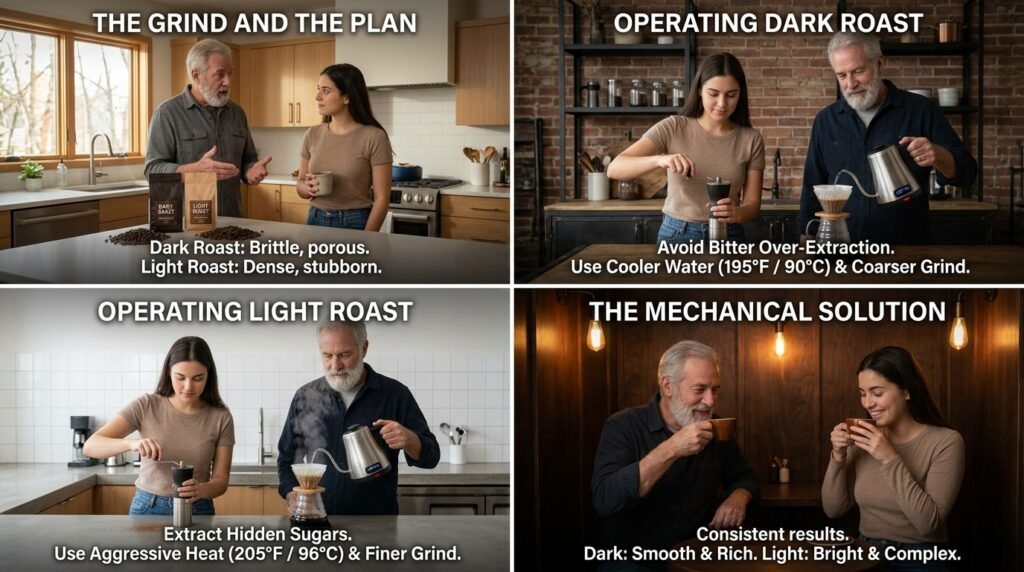
Because dark roasts have been in the heat much longer, their cellular structure is incredibly brittle and porous. They give up their flavors very, very easily.
If you brew a dark roast with boiling-hot water, you will over-extract it instantly, pulling out a wave of harsh bitterness. To brew a dark roast properly, you need to use cooler water (around 195°F or 90°C) and a slightly coarser grind size.
Light roasts are the exact opposite. Because they spent less time in the roaster, they are dense, hard, and stubborn. They do not want to give up their hidden sugars easily.
To properly extract a light roast, you have to hit it with aggressive heat. You need water that is fresh off the boil (around 205°F or 96°C) and a slightly finer grind size to help the water penetrate the dense cellular walls.
Understanding this mechanical difference solved years of frustrating, inconsistent mornings for me.
The End of the Brunch Debate
By the time the pancakes were gone and the plates were cleared, the debate in my kitchen had been thoroughly settled.
Sarah didn’t magically stop liking her dark French Roast. She appreciated the heavy, smoky comfort it provided. But she finally understood that “strong” wasn’t a flavor profile, and that a lighter bean wasn’t a weaker beverage.
We had experienced two completely different expressions of the exact same agricultural product, manipulated purely by the application of heat and time.
Discovering the importance of roast levels is the most empowering step you can take in the coffee aisle. It allows you to stop looking at marketing buzzwords and start predicting exactly what a bag of beans will taste like before you even open it.
If you want bright, juicy fruit notes, look for a light roast. If you want sweet caramel and balanced chocolate, hunt for a medium. If you want heavy, smoky, unadulterated boldness that can punch through a heavy pour of milk, grab a dark roast.
The power is entirely in your hands. You just have to decide how far you want the roaster to pull back the curtain.
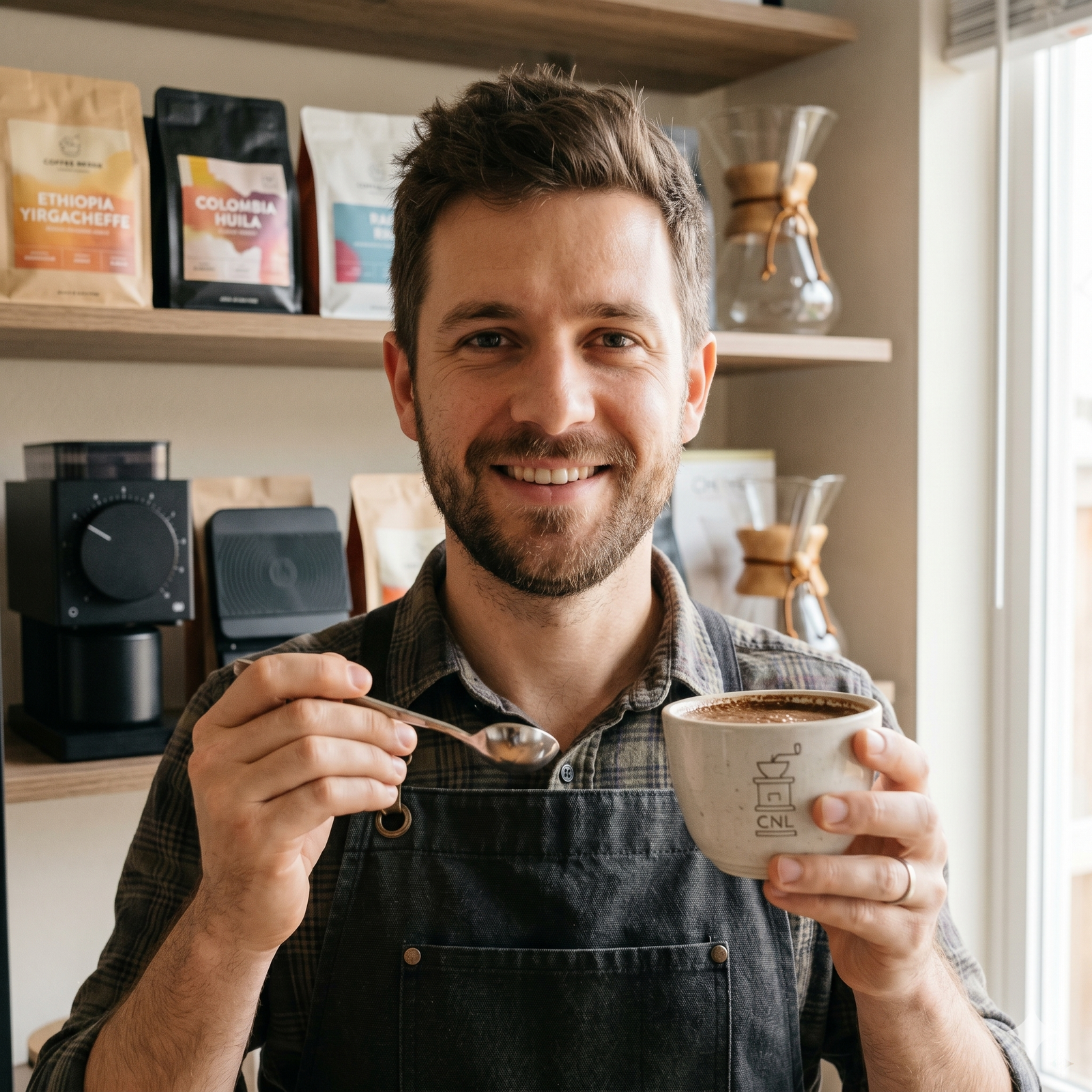
Hi, I’m the coffee enthusiast behind Coffee Nerd Lab.
Like many people, I started drinking coffee simply because it helped me wake up in the morning. Over time, that daily habit turned into a genuine interest in understanding what makes a great cup of coffee. I began experimenting with different beans, brewing methods, grinders, and coffee gear, learning through trial and error along the way.
This blog is where I document that journey. Every article is inspired by real experiences, discoveries, and lessons I’ve learned while exploring the world of coffee. From brewing guides and equipment reviews to practical tips and coffee basics, my goal is to share useful information in a way that’s easy to understand and enjoyable to read.
Thanks for stopping by, and I hope Coffee Nerd Lab helps you enjoy your next cup a little more than the last.