
I was standing in the middle of a drafty, concrete-floored industrial park on the outskirts of the city. I had parked my car in front of a massive, unmarked metal roll-up door, double-checking the address on my phone.
I was looking for a highly praised local coffee roastery, but there was no cozy seating area, no soft indie music playing, and absolutely zero latte art in sight.
When I finally pulled open the heavy steel side door, I was hit by a wall of intense heat and a deafening roar. In the center of the massive warehouse stood a towering, cast-iron machine that looked like a vintage steam locomotive. It was churning, hissing, and radiating thermal energy.
A guy in a faded band t-shirt, covered in a fine layer of brown dust, was intensely staring at a laptop screen connected to the side of the massive machine. He didn’t look like a pretentious coffee snob; he looked like a mechanic.
He noticed me standing awkwardly by the door, wiped his hands on his jeans, and walked over with a massive smile. This was the head roaster.
I had emailed him earlier that week, simply asking if I could stop by to buy some beans directly from the source. What was supposed to be a quick five-minute transaction turned into a two-hour masterclass. Stepping behind the curtain and seeing how the sausage—or in this case, the bean—was made, completely shattered everything I thought I knew about my morning beverage.
The Smell of the “Raw” Ingredient
The very first thing that confused me about the warehouse was the smell.
I was expecting the entire building to smell like a cozy Sunday morning. I expected that rich, comforting, dark chocolate and roasted nut aroma that usually aggressively wafts out of coffee shops.
But it didn’t smell like that at all. It smelled earthy. It smelled incredibly sweet, slightly grassy, and distinctly agricultural. It reminded me of a barn filled with fresh hay and dried fruit.
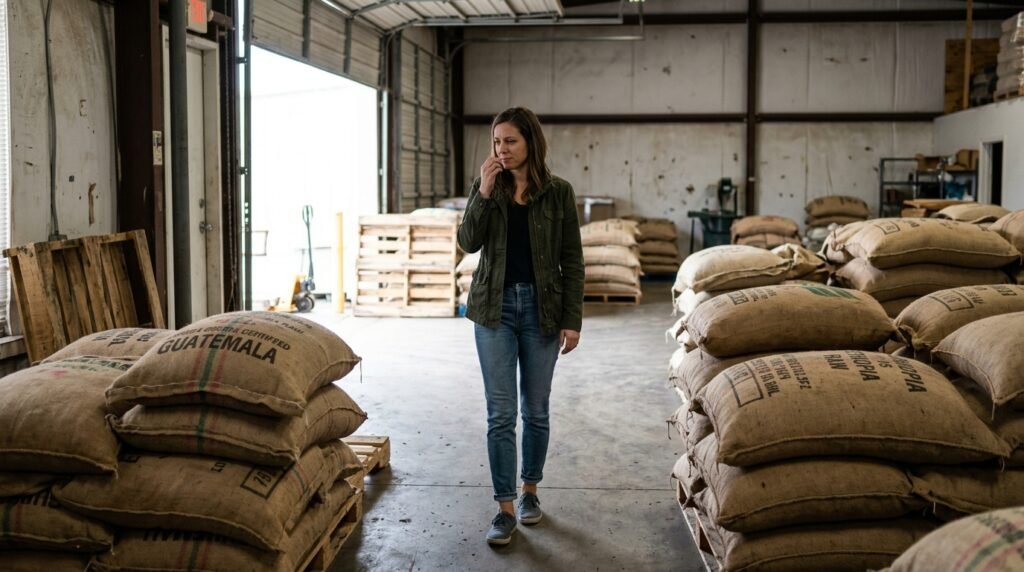
The roaster noticed my confusion. He walked over to a massive burlap sack sitting on a wooden pallet, scooped his hands into it, and pulled out a pile of pale, greenish-yellow seeds.
“This is coffee,” he said, holding them out to me. “This is what it looks like before I get my hands on it.”
I picked up one of the green beans. It was incredibly hard. It felt like a tiny pebble or a dried piece of popcorn kernel. If you tried to put these green seeds into a grinder, you would instantly shatter the ceramic burrs. You couldn’t brew them, and you certainly couldn’t drink them.
He explained that my job at home—brewing the coffee—was only the very last step in a massive chain. His job was to take this dense, rock-hard, grassy agricultural product and apply precise amounts of thermal energy to fundamentally alter its chemical structure.
The Illusion of the Dark Roast
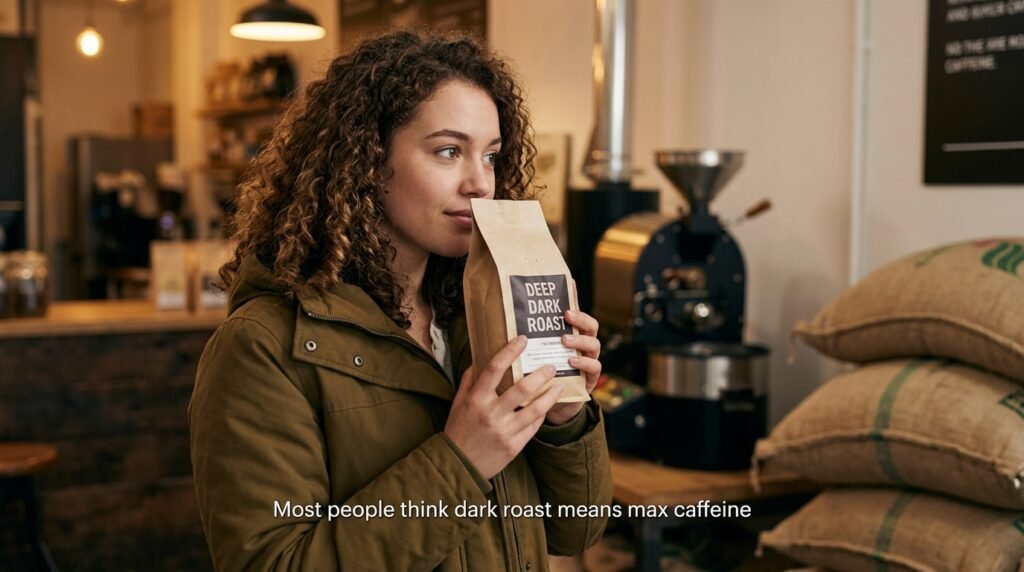
As we stood next to the massive roasting machine, I asked him a question that I thought would make me sound knowledgeable. I asked him if he had any really dark, oily roasts because I needed a “strong” coffee to get me through the workday.
He chuckled, leaning against a stack of empty burlap sacks. “That is the biggest myth in the entire coffee industry,” he said.
He explained that roasting coffee is a delicate balancing act between highlighting the natural flavor of the bean and imparting the flavor of the roast itself.
When you roast a coffee bean lightly, you preserve the unique geographical footprint of the farm. You can taste the soil, the altitude, and the specific variety of the plant. But as you continue to push the heat higher and roast the bean darker, you begin to physically burn those delicate agricultural compounds away.
Eventually, if you roast it dark enough, the origin of the coffee ceases to matter. A deeply dark-roasted bean from Ethiopia will taste almost exactly identical to a deeply dark-roasted bean from Brazil. They just taste like roasted carbon.
This completely changed my perspective, a shift I later wrote about when detailing The Day I Discovered the Difference Between Light and Dark Roast. I realized that buying dark roast wasn’t buying “stronger” coffee; it was just buying burnt coffee.
The Truth About Caffeine
But the roaster didn’t stop there. He went on to destroy my preconceived notions about caffeine.
“People always ask for dark roast when they want a caffeine jolt,” he said, shaking his head. “But caffeine is actually an incredibly stable chemical compound. The heat of the roaster doesn’t really destroy it.”
However, the heat does destroy the mass of the bean.
As a coffee bean roasts, the water inside of it evaporates. The bean puffs up, physically expanding in size, but it loses a significant amount of its weight. A dark roast bean is physically much larger but significantly lighter than a light roast bean.
Because of this, if you measure your morning coffee by scooping it with a spoon (by volume), a scoop of dark roast actually contains fewer beans—and therefore less caffeine—than a scoop of dense, heavy light roast beans.
If you want the maximum amount of caffeine in your cup, and the maximum amount of unique flavor, you should actually be reaching for the lightest roast on the shelf. It was a completely counter-intuitive revelation that made me rethink my entire shopping strategy.
The Drama of the “First Crack”
While we were talking, the roaster kept glancing at his laptop screen, watching a wildly complex graph with red and blue lines spiking and dipping. He was monitoring the internal temperature of the rotating metal drum.
Suddenly, a loud, distinct POP echoed from inside the machine. It sounded exactly like a piece of popcorn exploding in a microwave.
“There it is,” the roaster smiled, pointing at the machine. “First crack.”
He explained the incredible physics of what was happening inside that steel drum. As the dense green beans absorb heat, the moisture trapped deep inside their cellular structure turns into steam. The pressure builds and builds until the rigid structure of the seed can no longer contain it.
The bean physically fractures. It cracks open, violently releasing the steam and expanding to nearly double its original size.
This moment, the “first crack,” is the critical turning point in the roasting process. The bean goes from being a rock-hard, unbrewable seed to a fragile, porous, and highly soluble sponge. All of the complex sugars inside caramelize, and the hundreds of aromatic compounds that make coffee taste like coffee are suddenly unlocked.
It was fascinating to realize that the difference between a sour, underdeveloped cup of coffee and a perfectly sweet, vibrant cup is often decided by mere seconds during this volatile cracking phase.
The Secret of the One-Way Valve
After the beans finished roasting, the machine dumped them into a massive, circular cooling tray. Mechanical arms swept the smoking, beautiful brown beans in circles while a powerful fan sucked the heat away, halting the cooking process instantly.
The smell that erupted from that cooling tray was intoxicating. It was the absolute pinnacle of fresh coffee aroma.
I eagerly pulled out my wallet and asked him to bag up a pound of those exact beans for me to take home. I wanted to brew them the second I got back to my kitchen.
“I can sell them to you,” he said, grabbing a bag. “But if you go home and brew these right now, they are going to taste terrible.”
I stared at him. How could coffee that was literally minutes out of the roaster taste bad? Isn’t freshness the ultimate goal?
He pointed to a tiny, circular plastic piece embedded in the front of the empty coffee bag. “Do you know what this is?” he asked.
“It’s the smelling hole, right?” I replied. “So you can squeeze the bag at the grocery store and smell the beans?”
He laughed out loud. “No. That is a one-way degassing valve. And it is the most important piece of packaging in this building.”
The Science of Degassing
He explained that during the violent chemical reactions of the roasting process, a massive amount of carbon dioxide (CO2) is created and trapped inside the newly expanded cellular structure of the coffee bean.
For the first few days after roasting, the beans rapidly “exhale” this trapped gas.
If a roaster were to put freshly roasted beans into a completely sealed bag without that little plastic valve, the bag would slowly inflate like a balloon over the next 48 hours until it eventually exploded on your kitchen counter. The valve allows the CO2 to escape without letting oxygen (which ruins coffee) sneak inside.
But this degassing process also heavily impacts the brewing process.
If you try to pour hot water over coffee beans that were roasted hours ago, the beans will aggressively release so much carbon dioxide that the water physically cannot touch the coffee grounds. The gas repels the water. You will end up with a watery, sour, and completely uneven extraction.
This was a massive lightbulb moment for me. I realized that “fresh” doesn’t mean “immediate.” It requires patience, a concept I explored thoroughly in my post about The First Time I Smelled Freshly Roasted Coffee Beans. To get the absolute best flavor, you have to let the coffee rest in the bag for at least three to seven days after the roast date. You have to let it breathe.
The Sourcing Reality
As he bagged up a different batch of beans—ones that had properly rested for a week—our conversation shifted from the chemistry of the roaster to the geography of the farm.
I had always viewed coffee roasters as the ultimate creators of the beverage. I thought they were like chefs, inventing flavors in their warehouses.
“I don’t invent anything,” the roaster corrected me, looking at the label he was printing. “I am just a translator.”
He told me about the incredible lengths specialty roasters go to source their green coffee. He talked about traveling to high-altitude farms in Colombia and navigating language barriers in rural Ethiopia. He explained how the farmers spend months meticulously pruning trees, hand-picking perfectly ripe cherries, and carefully fermenting and drying the seeds on raised beds.
Thousands of hours of back-breaking, highly skilled agricultural labor go into producing a single burlap sack of high-quality green coffee.
“If the farmer does a bad job,” he said, “there is nothing I can do with my roasting machine to fix it. I can’t roast good flavor into a bad bean. My only job is to apply enough heat to translate the farmer’s hard work into your cup without ruining it.”
This profound respect for the agricultural side of the industry completely altered how I shop. I stopped looking for cool logos and started looking for transparency, a buying philosophy I detailed in What I Learned After Buying Coffee from a Small Roastery. I wanted to buy coffee from roasters who proudly printed the names of the farmers on their bags, rather than hiding behind generic blend names.
The Cupping Table Calibration
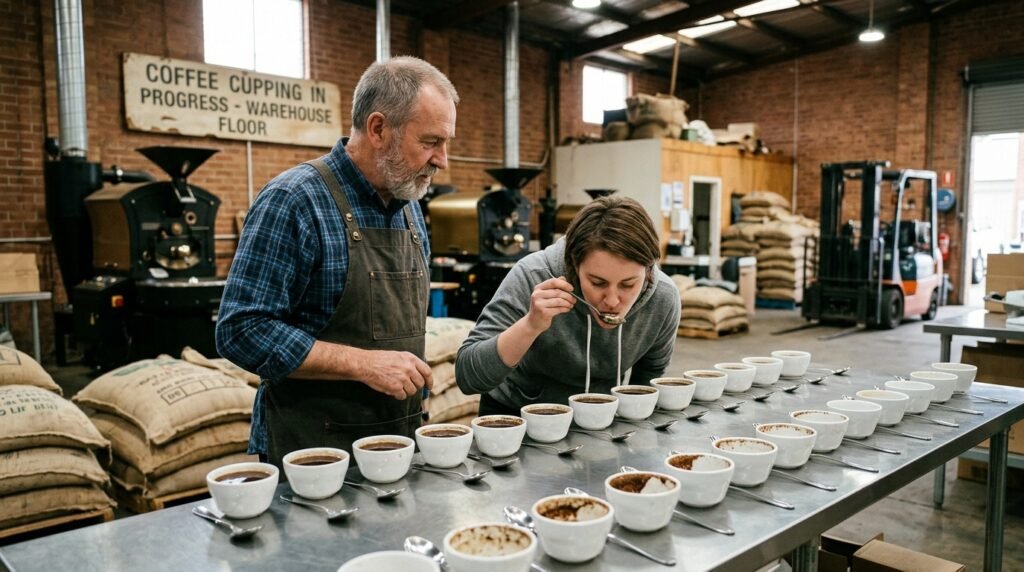
Before I left the warehouse, the roaster invited me over to a long metal table set up in the back corner. It was covered in dozens of identical, small ceramic bowls.
“This is how we taste,” he said. “It’s called cupping.”
There were no fancy pour-over drippers or espresso machines. He simply weighed out exactly 12 grams of coarsely ground coffee into each bowl, poured boiling water directly over the grounds, and let them steep for four minutes.
Then, he took a silver spoon, broke the crust of grounds floating on top of the bowl, and leaned his nose mere inches from the liquid, inhaling deeply.
He handed me a spoon and told me to taste it. He instructed me to slurp the coffee as loudly and aggressively as possible. Slurping atomizes the liquid, spraying it across the entire palate and into the back of the throat, allowing you to taste all the subtle nuances.
I leaned over, dipped my spoon, and slurped loudly.
Standing there in that hot, loud warehouse, sipping coffee out of a bowl with a spoon, I tasted things I had never experienced in a mug. I tasted notes of strawberry candy, dark molasses, and black tea. I tasted the difference between a high-altitude African bean and a low-altitude South American bean side-by-side.
A Changed Perspective
I walked out of that industrial park two hours later with a single bag of perfectly rested, lightly roasted Ethiopian coffee.
My clothes smelled faintly of smoke and sweet, grassy green coffee. But more importantly, my entire perspective on the beverage I consumed every single morning had been permanently altered.
Talking to a coffee roaster for the first time pulled back the curtain. It removed the mystery and the marketing fluff that surrounds the coffee industry.
I realized that a coffee bean is not a uniform, manufactured product that magically appears on grocery store shelves. It is a highly volatile, chemically complex, and deeply agricultural seed. It requires the precise, scientific application of thermodynamics to unlock its potential, and it demands patience before it can be properly enjoyed.
If you ever have the opportunity to visit a local roasting facility, don’t just grab a bag off the retail shelf and leave. Ask questions. Look at the massive, raw burlap sacks. Smell the intense, exploding aroma of the cooling tray.
Once you understand the chaotic, beautiful, and incredibly technical journey that bean took to reach your kitchen, you will never casually gulp down a cup of morning coffee ever again. You will savor every single sip.
