Underneath one of the mugs was a small piece of blue painter’s tape. Underneath the other was a piece of red tape. My wife was standing on the other side of the table, holding a clipboard and looking at me with a highly skeptical, slightly amused expression.
We had made a bet the night before.
For the past few months, I had been slowly falling down the specialty coffee rabbit hole. I was spending what she considered to be a completely unreasonable amount of money on small bags of freshly roasted beans from local artisanal cafes.
She was convinced that I was falling for a massive marketing scam. She believed that “coffee is just coffee,” and that if she brewed my expensive beans right next to a bag of generic, bulk-bin supermarket beans, I wouldn’t actually be able to taste the difference.
She challenged me to a blind taste test. If I couldn’t correctly identify my expensive coffee, I had to agree to stop buying it and go back to the cheap stuff.
The stakes were incredibly high. My pride—and my future mornings—were on the line. I didn’t just want to win the bet; I needed to prove that my newfound hobby was actually based on objective reality. What happened over the next twenty minutes didn’t just win me the wager. It completely shattered my understanding of flavor, and it was the ultimate lesson in what I learned when I compared two different coffee beans side by side.
The Setup of the Experiment
To ensure the experiment was completely fair, I acted as the barista, but my wife acted as the blind adjudicator.
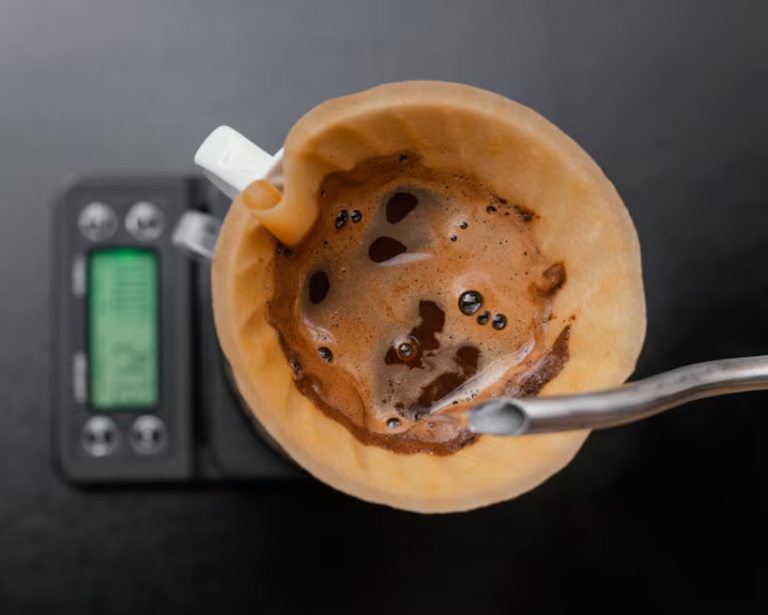
We used the exact same brewing equipment. I pulled out my two glass French presses so we could brew both coffees simultaneously. I boiled a large kettle of filtered water to ensure the temperature for both batches was completely identical.
Then, we brought out the two contenders.
Contender A was my wife’s choice: a massive, two-pound plastic bag of dark roast “French Blend” that she had bought on sale at the local wholesale club.
Contender B was my choice: a tiny, 12-ounce bag of lightly roasted, naturally processed beans from the Yirgacheffe region of Ethiopia.
I knew the Ethiopian beans were complex, but I was suddenly terrified that the aggressive, bold flavor of the supermarket beans would completely overwhelm my palate. Before we even ground the coffee, I realized the lesson was already beginning.
The Visual Contrast
Before my wife hid the bags and randomized the mugs, I poured a small handful of both beans onto a white paper towel. I wanted her to look at them under the bright kitchen lights.
It was a staggering physical contrast.
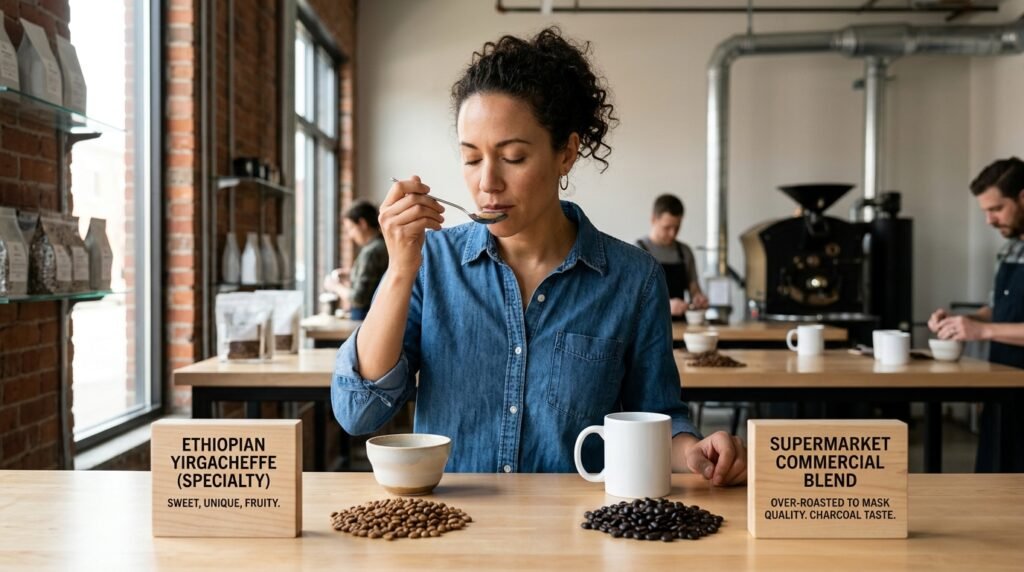
The supermarket beans (Contender A) were massive. They were swollen, brittle, and almost entirely black. Their surface was slick with a heavy, shiny coating of natural oils that had been forced out during a brutal roasting process. They looked like they had been dipped in motor oil.
My Ethiopian beans (Contender B) looked like they belonged to a completely different botanical species. They were tiny, dense, and tightly packed. Their color was a soft, pale, matte cinnamon-brown. There wasn’t a single drop of oil visible on their surface.
This visual difference wasn’t just aesthetic; it was a physical manifestation of the cooking process. It was a visual lesson in How I Learned the Subtle Differences Between Roasts, right there on my dining table. One bean had been roasted to the point of incineration to mask its poor quality, while the other had been lightly toasted to preserve its delicate agricultural character.
The Aromatic Collision
Next came the grinding phase.
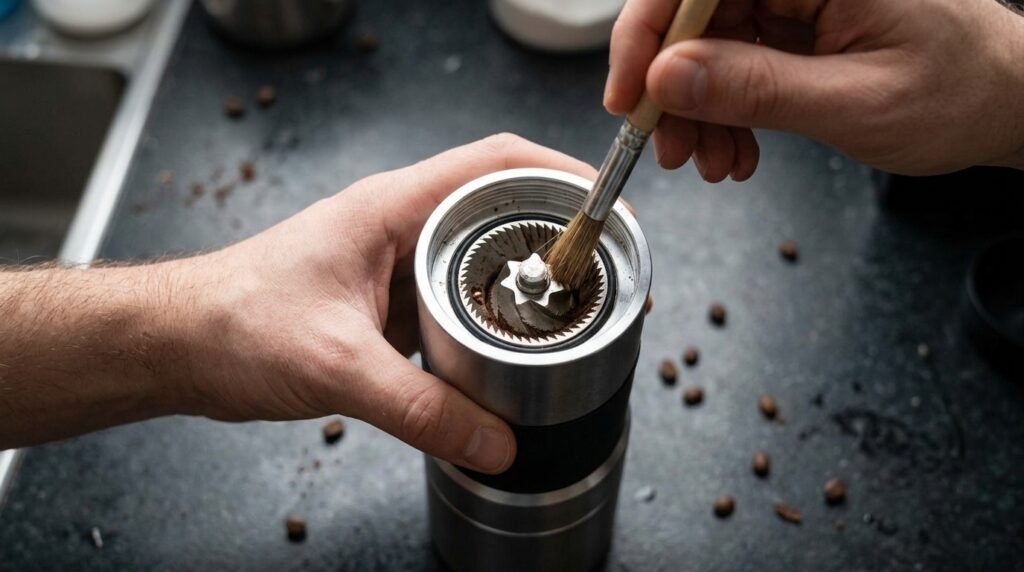
I cleaned my hand grinder meticulously between batches so there would be no cross-contamination. First, I ground the supermarket beans. The dry fragrance that erupted from the grinder was heavy, harsh, and pungent. It smelled like campfire smoke, burnt rubber, and stale dirt. It was the generic, aggressive smell of a corporate breakroom.
Then, I ground the Ethiopian beans.
The change in the air was so dramatic that my wife actually leaned forward to get a better smell. The kitchen was suddenly filled with a bright, explosive sweetness. It didn’t smell like coffee at all. It smelled like a freshly opened jar of strawberry jam mixed with black tea and jasmine flowers.
The sheer difference in the dry fragrance alone gave me a massive boost of confidence. I knew exactly which coffee was mine. Now, I just had to prove I could find it in the dark liquid.
The Blind Taste Test
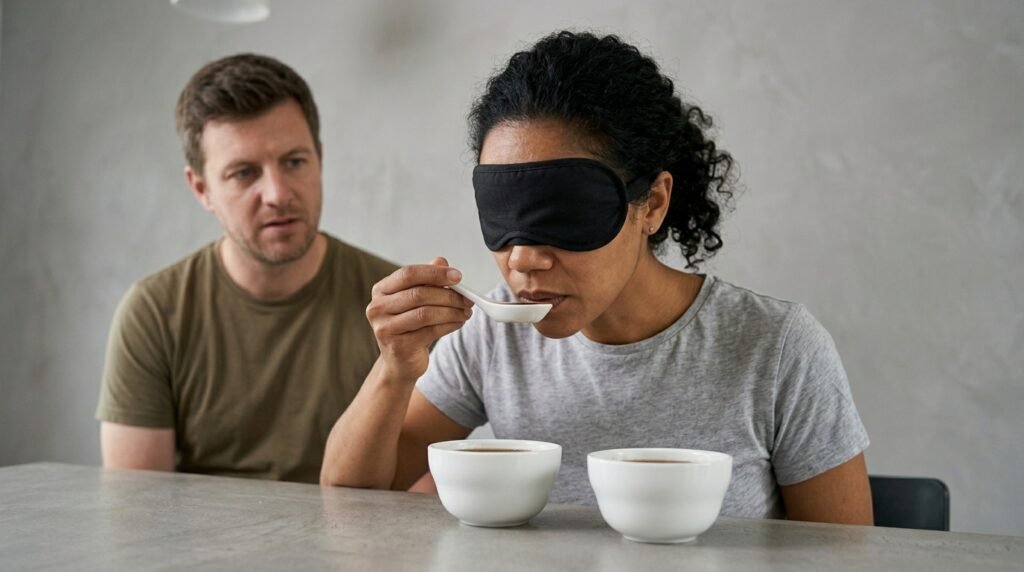
I brewed both French presses for exactly four minutes, plunged them simultaneously, and poured the liquids into the two identical white mugs. My wife made me turn around and face the living room while she shuffled the mugs around, placing the blue tape under one and the red tape under the other.
“Alright,” she said, sitting down with her clipboard. “Taste them and tell me which one is the expensive stuff.”
I turned back around. Both liquids were dark. Both were steaming. Visually, in the cup, they looked nearly identical.
I picked up the mug on the left. I brought it to my lips, inhaled the steam, and took a slow, deliberate sip. I let the hot liquid roll over my tongue and swallowed.
It was heavy. It was intensely bitter. It coated the back of my throat with an ashy, dry sensation that made me want to immediately reach for a glass of water. There was a hollow, flat flavor to it that tasted like scorched wood.
I put the mug down. “That is the supermarket coffee,” I declared confidently.
My wife kept her poker face perfectly intact. “Taste the other one before you make your final guess.”
I picked up the mug on the right. I took a sip.
The Shock of the Contrast
The contrast was so extreme that my brain almost short-circuited.
After my palate had just been assaulted by the bitter ash of the first mug, the liquid in the second mug felt like a completely different beverage. It was incredibly light. There was absolutely zero bitterness. Instead, a wave of bright, juicy acidity washed over my tongue, followed by a profound, syrup-like sweetness.
It tasted exactly like eating a handful of ripe blueberries, finishing with a lingering note of milk chocolate.
“The mug on the right is the Ethiopian,” I said, putting it down. “And I will bet my life on it.”
My wife lifted the mugs. The mug on the right had the blue tape—the code we had established for my specialty beans. I had won the bet. But more importantly, my wife picked up the mug on the right, took a sip of the Ethiopian coffee herself, and her eyes went wide. She finally understood.
Why Contrast is the Ultimate Teacher
Winning the bet was satisfying, but the real value of that Saturday morning was the educational breakthrough I experienced.
Up until that day, I had only been drinking my specialty coffee in a vacuum. I would brew it, drink it, and think, “Wow, this is good.” But human tastebuds are incredibly adaptable. If you only drink high-quality coffee every single day, your brain establishes that as the new normal baseline. You start taking it for granted. You forget how good it actually is.
You cannot truly understand what “good” tastes like until you place it directly adjacent to “bad.”
Drinking that bitter, ashy supermarket coffee right next to the sweet, complex Ethiopian coffee acted as a massive sensory magnifying glass. The bad coffee highlighted the flaws I used to accept, while simultaneously elevating the delicate fruit notes of the good coffee.
It was an incredible realization, which perfectly illustrates Why Single-Origin Coffee Changed the Way I Drink Coffee in the first place. When you drink coffee from a single farm side by side with a mass-produced blend, you stop tasting a manufactured beverage and start tasting the actual geography of the earth.
The Illusion of the “Coffee Flavor”
The side-by-side comparison also destroyed a long-held myth I carried in my head.
I used to believe that there was a singular, universal “coffee flavor.” I thought all coffee beans basically tasted the same, and that roasters just added artificial syrups or flavorings to make them taste different.
But when I compared those two beans, I realized that “coffee” is not a flavor. It is a massive, sprawling category of flavors.
Saying something tastes like “coffee” is like saying a beverage tastes like “wine.” A heavy, dry Cabernet Sauvignon from France tastes absolutely nothing like a crisp, sweet Riesling from Germany. They are both made from grapes, but they are completely different experiences.
My Ethiopian beans and the supermarket beans were both technically coffee. But their genetic makeup, the soil they grew in, the altitude of the farm, the way the fruit was processed, and the temperature of the roasting drum created two entirely distinct culinary realities.
This side-by-side tasting was an experience that cemented How I Learned Coffee Profiles Are Like Wine Notes in my mind forever. It proved that the tasting notes printed on bags of specialty coffee aren’t pretentious lies; they are scientifically accurate descriptions of agricultural diversity.
The Anatomy of a Bad Bean
The comparison didn’t just teach me why my specialty coffee was good; it taught me why the supermarket coffee tasted so terrible.
When you drink bad coffee in isolation, you just assume that bitterness is a natural part of the morning routine. You dump cream and sugar into the mug to fix it, and you move on with your day.
But when I drank it right after the sweet Ethiopian cup, the flaws were glaringly obvious. I could taste the “Robusta” filler—the cheap, highly caffeinated, disease-resistant plant species that commercial roasters use to cut costs. I could taste the stale, cardboard-like oxidation because the beans had been sitting in a plastic bag on a warehouse shelf for eight months.
Most importantly, I could taste the severe over-roasting. I realized that massive commercial companies intentionally burn their beans. If you take cheap beans from fifty different farms around the world and mix them together, they will taste chaotic and bad. But if you roast them all until they are charred black, they will all taste the exact same: like charcoal.
The dark roast isn’t a flavor preference; it is a corporate strategy to mask terrible quality.
How to Conduct Your Own Tasting
If you are currently drinking coffee and wondering if your palate is refined enough to taste the difference between a cheap bag and a premium bag, I highly encourage you to try this experiment in your own home.
You do not need to be a certified barista or a professional food critic to do this. You just need two mugs and a little bit of curiosity.
Step 1: Buy the Extremes. Go to the grocery store and buy the cheapest, darkest bag of coffee you can find. Then, go to a local specialty coffee roaster and buy a light roast, preferably a naturally processed African coffee (like Ethiopian or Kenyan).
Step 2: Brew Them Identically. Do not give one coffee an unfair advantage. Use the same water temperature, the same grind size, and the same brewing method for both.
Step 3: The Blind Taste. Have someone else pour the coffees into identical mugs. Do not look at the color of the liquid.
Step 4: The Slurp. Take a sip of the cheap coffee first. Let it coat your tongue. Acknowledge the heavy, bitter, ashy flavors. Then, immediately take a sip of the specialty coffee.
The collision of flavors on your palate will be a mind-bending experience. You will not have to search for the subtle notes; they will aggressively introduce themselves to you.
The Permanent Shift
I won the bet with my wife that Saturday morning, and she never once complained about my coffee budget again. In fact, she stopped drinking the supermarket stuff entirely and started stealing my Ethiopian beans when I wasn’t looking.
But the real victory was what I gained as a consumer.
Comparing two different coffee beans side by side removed the blindfold. It gave my brain a reference point. It taught me that coffee is a highly complex, beautifully diverse fruit that demands respect.
Once you actively force your palate to recognize the difference between a heavily processed, stale commodity and a fresh, carefully crafted agricultural product, your mornings will never be the same. You stop drinking coffee out of habit, and you start drinking it out of pure, unadulterated joy.
Hi, I’m the coffee enthusiast behind Coffee Nerd Lab.
Like many people, I started drinking coffee simply because it helped me wake up in the morning. Over time, that daily habit turned into a genuine interest in understanding what makes a great cup of coffee. I began experimenting with different beans, brewing methods, grinders, and coffee gear, learning through trial and error along the way.
This blog is where I document that journey. Every article is inspired by real experiences, discoveries, and lessons I’ve learned while exploring the world of coffee. From brewing guides and equipment reviews to practical tips and coffee basics, my goal is to share useful information in a way that’s easy to understand and enjoyable to read.
Thanks for stopping by, and I hope Coffee Nerd Lab helps you enjoy your next cup a little more than the last.