
It is Friday afternoon. I am sitting in my home office in Rio de Janeiro. I just finished updating a massive batch of website plugins and resolving database errors. My eyes are completely tired from staring at lines of code. I walk into the kitchen to make my second cup of coffee for the day.
There is a heavy stainless steel cylinder sitting on my counter. It is my manual burr grinder.
I look at that heavy metal tool with a deep sense of respect. It is the most important piece of culinary equipment I own. It produces perfectly uniform coffee particles. It unlocks bright fruit notes and delicate floral aromas. I love this tool now.
But I need to be completely honest. When I first bought it, I absolutely hated it.
The internet is filled with coffee professionals telling you to buy a burr grinder. They promise it will instantly fix all your brewing problems. They make it sound like a magic wand. My honest experience switching to a burr grinder was not a fairy tale. It was a frustrating, confusing mechanical struggle. It forced me to learn the actual physics of extraction the hard way.
The Deceptive Unboxing
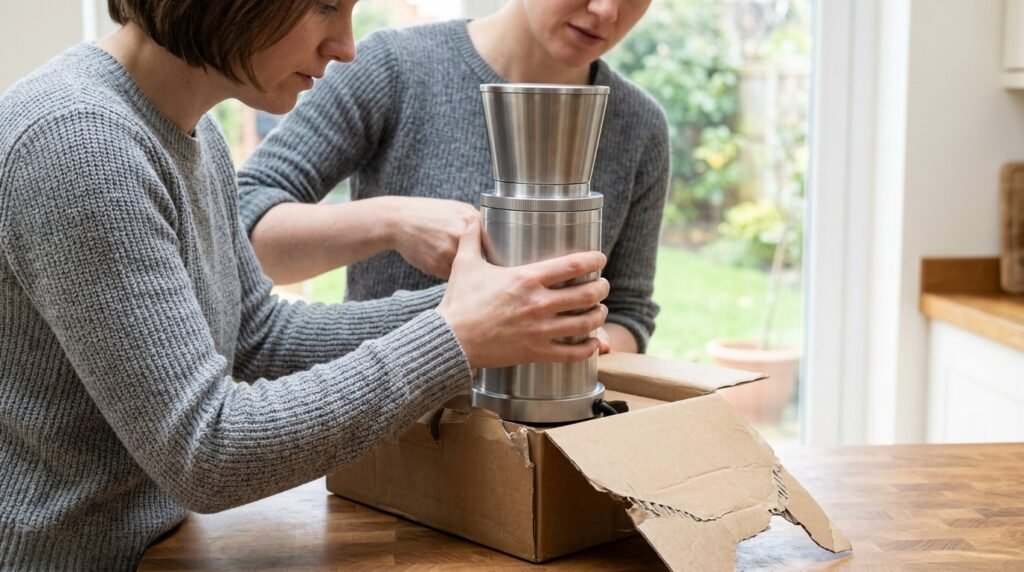
I remember the day the package arrived. I tore open the cardboard box.
I pulled the grinder out. The physical weight of the object was stunning. It was machined from solid aluminum and stainless steel. It felt like a heavy piece of aerospace engineering. The ceramic burrs inside were incredibly sharp. The central axle spun smoothly on dual steel ball bearings.
I threw my old, cheap plastic blade grinder directly into the trash.
I was incredibly excited. I assumed that simply owning this premium tool would guarantee a perfect cup of coffee. Buying a high-end device and expecting it to do the thinking for you is exactly The Equipment Mistake I Made When I Started Brewing Coffee and it cost me a lot of unnecessary frustration. A precision tool is completely useless if the operator does not understand how to calibrate it.
The First Terrible Cup
I opened a fresh bag of light roasted Ethiopian Sidamo. I wanted to taste the famous peach and jasmine notes.
I poured twenty grams of the hard, dense beans into the top of the new grinder. I attached the metal handle and started turning. I did not look at the adjustment dial on the bottom. I just wanted to grind the coffee.
I dumped the grounds into my glass V60 pour over cone. I boiled my gooseneck kettle.
I poured the hot water. The coffee bed completely choked. The water simply stopped moving. It sat on top of the grounds like a dark, muddy puddle. The extraction took nearly seven minutes to finish dripping into the mug.
I took a sip. It was violently bitter. It tasted like dry ash and chewed aspirin. The beautiful Ethiopian beans were completely ruined.
Understanding the Mechanism
I dumped the bitter liquid down the sink. I realized I had to actually read the manual. I had to understand the mechanism inside the metal cylinder.
My old blade grinder was just a blender. It chopped beans randomly. The new burr grinder worked completely differently. It featured two sharp metal gears. One gear remained perfectly still. The other gear rotated.
The coffee beans fell into the gap between those two gears. The burrs crushed the beans down to a highly specific size.
The absolute magic of the tool was the adjustment dial. By turning a small knob at the bottom, I could physically move the rotating gear closer to the stationary gear. This changed the size of the gap. The size of the gap dictated the exact size of the final coffee particle.
The Confusion of the Clicks
The dial on my new grinder worked on a click system. Every tiny adjustment produced a tactile click.
The manual said to start at twenty clicks for a standard pour over. I turned the dial all the way to zero, locking the burrs completely tight. Then, I carefully counted twenty individual clicks outward.
I ground another twenty grams of the Ethiopian beans. I looked at the particles on a white plate. They looked perfectly uniform. They looked like coarse sea salt.
I brewed the coffee again. This time, the water drained incredibly fast. The water rushed through the coarse grounds with absolutely zero resistance. The entire brew finished in ninety seconds.
I tasted the liquid. It was violently sour. It tasted like sharp lemon juice and raw vegetables. The water moved too fast to dissolve the heavy fruit sugars. It only washed the sharp acids off the surface of the coarse particles.
The Narrow Window of Success
I was incredibly frustrated. I had spent a significant amount of money on this tool, and my coffee tasted worse than ever.
I realized I was dealing with a highly sensitive scientific variable. The difference between a bitter, muddy cup and a sour, weak cup was just a few microscopic millimeters of space between two metal gears.
I had to find the exact middle ground. I had to dial the grinder in.
I started making tiny, incremental adjustments. I moved the dial to eighteen clicks. The coffee was still slightly sour. I moved the dial to sixteen clicks. The coffee started to taste sweeter, but it lacked heavy texture.
The Danger of Microscopic Dust
I decided to push the grinder further. I wanted a heavier body. I moved the dial down to thirteen clicks.
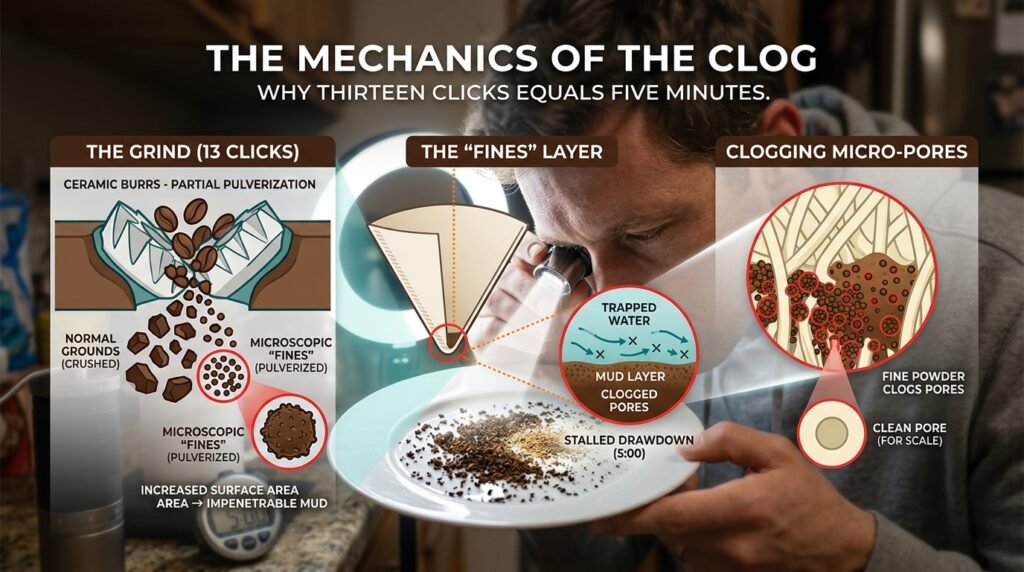
I ground the beans and brewed the V60. The water stalled again. The drawdown time spiked to five minutes. The bitterness returned.
I could not understand what was happening. Thirteen clicks did not look that much smaller than sixteen clicks.
I poured the dry grounds onto my plate and looked very closely under a bright light. The burrs were so close together that they were no longer just crushing the beans. They were pulverizing a small percentage of the beans into a microscopic powder.
This mechanical failure was exactly What I Discovered About Grinding Coffee Too Fine because those tiny particles turn into an impenetrable layer of mud. The powdery fines sink to the bottom of the paper filter. They clog the microscopic pores of the paper. They trap the water completely.
Finding the Sweet Spot
I wiped the grinder clean. I knew thirteen clicks was too fine. I knew sixteen clicks was too coarse.
I set the dial exactly on fifteen clicks.
I weighed out my twenty grams of Ethiopian Sidamo. I boiled my kettle. I poured the hot water slowly and carefully.
The extraction was absolutely flawless. The water flowed through the uniform coffee bed at a perfect, steady pace. The drawdown finished at exactly three minutes. The spent grounds at the bottom of the filter formed a perfectly flat, clean bed of sand. There was no mud.
I picked up the mug and took a sip. My brain completely stopped.
The Reward of Patience
The flavor was spectacular. The heavy, muddy bitterness was entirely gone. The sharp, sour bite was entirely absent.
A massive wave of sweet peach acidity hit the front of my palate. It tasted incredibly juicy and vibrant. That bright fruit note melted into a heavy, syrupy body that coated my tongue. A delicate, lingering flavor of jasmine flowers rested in the back of my throat.
It was the best cup of coffee I had ever made in my life.
The heavy metal tool sitting on my counter was not broken. It was not a scam. It was just an incredibly precise instrument. It required patience, testing, and a fundamental understanding of water flow. Once I provided the correct input, the tool delivered absolute clarity.
The Physical Reality of Manual Grinding
Dialing in the click setting was only the first hurdle. The second hurdle was physical reality.
When you buy a manual hand grinder, you are committing to a daily physical workout.
If you drink dark roasted commercial coffee, hand grinding is very easy. The extreme heat of the roasting oven destroys the cellular structure of dark beans. They become hollow and brittle. The ceramic burrs slice through them effortlessly.
I do not drink dark roasts. I drink light roasted African coffees.
Light roasts are incredibly dense. Because the roaster stops the heat early to protect the floral notes, the seed remains rock hard. Grinding twenty grams of light roasted Ethiopian coffee requires genuine physical strength.
Sweating in the Kitchen
I quickly learned to adjust my physical stance.
You cannot grind light roasted coffee with a weak grip. The heavy metal handle will violently jerk in your hand. The burrs will bind up and freeze on the hard seeds.
I have to hold the metal cylinder tightly against my chest. I have to brace my feet on the kitchen floor. I have to use my shoulder and my back to force the handle in a smooth, continuous circle.
On a hot summer morning in Rio de Janeiro, this process actually makes me sweat. It takes about forty five seconds of intense physical labor to crush the beans.
At first, I hated this physical chore. I missed the lazy convenience of pushing a button on my old electric machine. I felt like I was working entirely too hard just to make a morning beverage.
Earning the Beverage
My perspective on the physical labor slowly changed.
I sit at a desk all day. I type on a keyboard. I click a mouse. My professional life is completely devoid of physical resistance.
The manual coffee grinder became my daily anchor to the physical world. I started to appreciate the resistance. I started to enjoy the heavy, satisfying crunch of the metal burrs destroying the dense seeds.
I realized that I was actively participating in the culinary process. I was not just a passive consumer. I was using my own physical energy to unlock the potential of the farm. The coffee tasted significantly better because I had actually earned it.
The Daily Cleaning Ritual
Owning a precision tool also requires strict maintenance.
My old blade grinder was a disgusting piece of plastic. I never cleaned it. The bottom of the chamber was coated in a thick, rancid layer of old coffee oil.
You cannot treat a precision burr grinder like a trash can. If old coffee oils build up on the metal gears, they will ruin the flavor of your fresh expensive beans. The old oils turn rancid and add a stale, cardboard taste to the extraction.
Every single Sunday, I disassemble my hand grinder. I unscrew the central axle. I carefully remove the sharp metal burrs. I use a stiff brush to sweep away all the microscopic coffee dust. I wipe the interior chamber completely clean.
This maintenance takes exactly five minutes. Realizing the value of this daily routine is exactly How a Small Tool Improved My Home Coffee Experience and grounded my chaotic mornings. Taking care of my equipment ensures my equipment takes care of my coffee.
Adapting to New Beans
The most important lesson I learned is that the perfect click setting is never permanent.
Coffee is an agricultural product. It changes constantly. When I finish my bag of Ethiopian Sidamo and buy a new bag of washed Colombian coffee, the physical density of the beans changes. The moisture content changes.
If I keep the grinder locked at fifteen clicks, the Colombian coffee might stall the filter. It might drain too fast.
Every new bag of coffee requires a minor recalibration. I have to pay close attention to the drawdown time on the very first brew. I have to taste the liquid critically. If it is slightly sour, I tighten the burrs by one click. If it is slightly bitter, I loosen the burrs by one click.
The grinder forces me to stay engaged. I cannot go on autopilot.
The Ultimate Culinary Upgrade
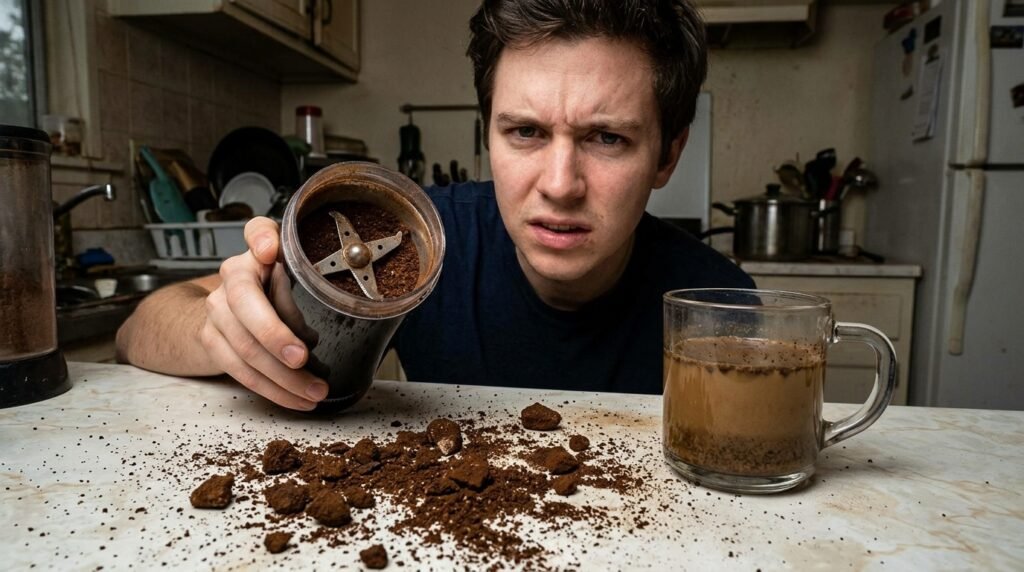
If you are currently using a cheap plastic blade grinder, you are ruining your coffee. You are mixing massive boulders with microscopic dust. You are building a chaotic, muddy extraction.
You need to switch to a burr grinder.
But I want you to be fully prepared for the reality of the upgrade. Buying the tool will not magically fix your morning routine on day one. You will likely brew a terrible cup of coffee on your first attempt. You will likely turn the dial the wrong way.
If you buy a manual grinder, your arm will get tired. You will have to fight the dense, light roasted seeds. You will have to clean the metal gears.
Embrace the Learning Curve
Do not let this learning curve intimidate you. Embrace the friction.
When you finally understand the relationship between the click setting and the flow of the water, everything changes. When you finally experience a perfectly uniform extraction, the heavy bitterness disappears completely. The bright, sweet fruit notes shine through with absolute clarity.
You will finally taste the specific volcanic dirt of the farm. You will taste the careful processing of the cherry. You will stop fighting the brewing process and start controlling it. The transition is frustrating, but the final reward in your mug is absolutely worth the struggle.
