
I sat quietly at my computer desk on a quiet Thursday evening. I was trying to finish a massive digital project, but my brain was completely stalled. I needed a distraction.
I picked up an empty bag of specialty coffee sitting next to my keyboard. I had finished brewing the beans earlier that morning. It was a fantastic Ethiopian coffee from the Guji zone.
I looked closely at the back of the bag. Below the tasting notes and the roast date, I saw a string of numbers. They were latitude and longitude coordinates.
I opened a new tab on my web browser. I went to Google Earth and typed the exact coordinates into the search bar.
The digital globe spun rapidly. The camera zoomed in past the continent of Africa. It pushed past the capital city of Addis Ababa. It kept zooming down until it hovered over a steep, densely green mountainside. I switched to the satellite view. I could actually see the small dirt roads. I could see the thick canopy of trees shading the coffee plants.
I stared at my computer monitor for ten minutes. That digital satellite image completely broke my brain. Why I started reading about coffee origins began in that exact moment. Seeing the physical farm from space forced me to realize my morning drink was intimately tied to a real, vibrant piece of the planet.
Escaping the Factory Mindset
Before I typed those coordinates into my computer, I viewed coffee in a very abstract way.
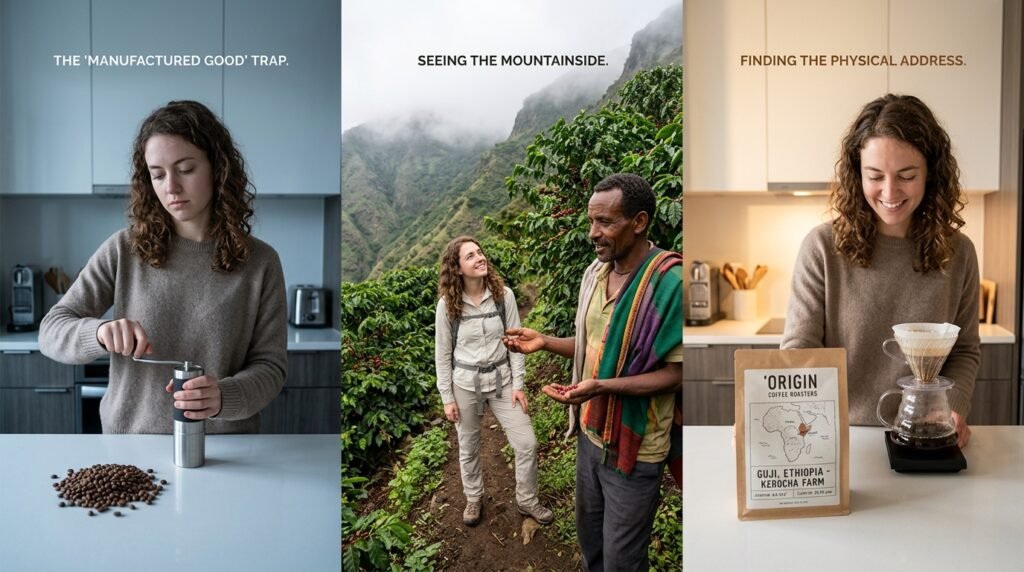
Even though I knew coffee was a plant, I still treated it like a manufactured good. I thought of it the same way I thought of a digital software product. I assumed someone simply formulated the recipe in a sterile laboratory and shipped it to my local cafe.
Seeing the steep Ethiopian mountainside destroyed that factory mindset.
I realized that the brown seed I crushed in my hand grinder every morning came from that specific patch of dirt. The flavor in my mug was a direct physical reaction to the rain falling on those specific trees. Recognizing this deep agricultural truth was precisely What I Noticed When I Started Paying Attention to Coffee Labels and why I stopped buying anonymous commercial blends. I wanted a product with a physical address.
The Global Coffee Belt
I wanted to know more. I started buying books about agricultural geography. I started reading academic articles about botany.
The first massive concept I learned was the existence of the Coffee Belt.
Coffee is an incredibly fragile tropical plant. It cannot survive freezing temperatures. It requires a highly specific balance of intense sunlight and heavy rainfall. Because of these strict biological demands, coffee only grows in a tight band around the equator.
This band stretches between the Tropic of Cancer and the Tropic of Capricorn. It encompasses Central America, South America, Central Africa, East Africa, and parts of the Asian Pacific.
If you live in North America or Europe, you cannot grow coffee in your backyard. Every single cup of coffee you drink is an imported exotic good. It is a product of global trade.
The Birthplace of the Bean
My reading quickly brought me back to the exact country I saw on Google Earth. Ethiopia is not just another country inside the Coffee Belt. It is the absolute center of the coffee universe.
Ethiopia is the ancient biological birthplace of the Arabica coffee plant.
This historical fact completely changes the agricultural landscape of the country. In other parts of the world, farmers plant organized rows of genetically identical hybrid clones. In Ethiopia, the coffee grows wild in deep, ancient forests.
There are thousands of undocumented genetic mutations growing side by side in the Ethiopian dirt. Botanists refer to this massive genetic diversity as Heirloom or Landrace varieties. It is a wild, chaotic genetic soup.
Connecting Genetics to Flavor
Reading about this genetic chaos finally explained the flavors in my mug.
I always wondered how an Ethiopian coffee could taste so vibrantly sweet. I wondered how a simple brown seed could produce notes of ripe blueberry, jasmine flowers, and bergamot.
The answer was the wild genetics. Because Ethiopian farmers harvest a mix of thousands of different ancient plant mutations, the resulting flavor profile is wildly complex. You cannot replicate that floral flavor profile by planting hybrid clones in a greenhouse. You can only get it from the ancient African forest.
Understanding this botanical history made my morning routine infinitely more exciting. It was the driving force behind The Day I Explored Ethiopian Coffee for the First Time because I finally understood the science behind the sweetness.
The Influence of the Volcano
As I read more about the origins of coffee, I discovered the intense power of dirt.
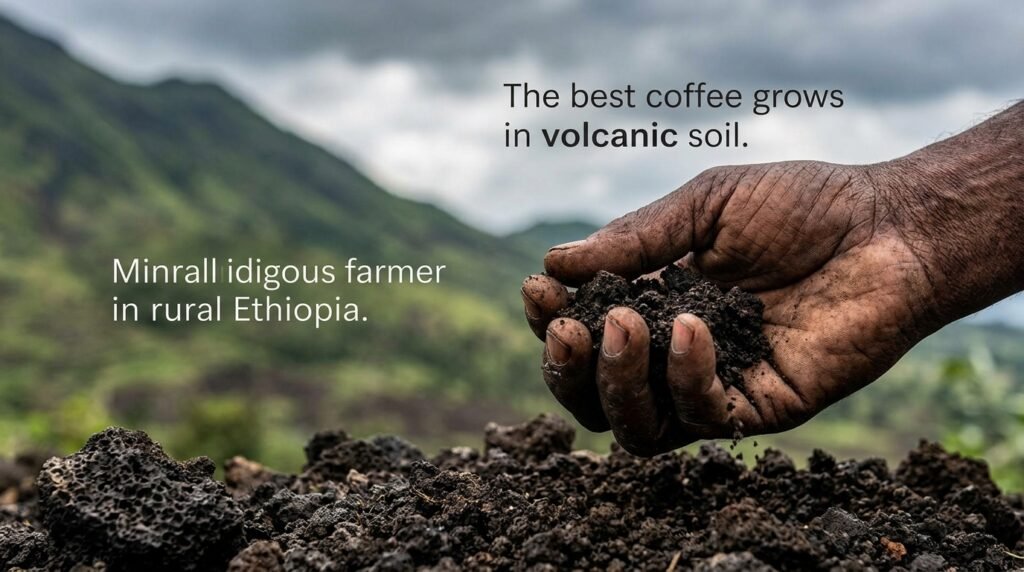
The soil composition dictates the ceiling of the coffee flavor. The best coffee in the world almost always grows in volcanic soil.
Volcanic soil is a biological superpower for tropical plants. It is incredibly porous. It provides flawless drainage, which prevents the coffee tree roots from rotting during the heavy rainy season.
More importantly, volcanic soil is packed with heavy minerals. It contains high levels of phosphorus, potassium, and calcium. The coffee tree acts like a sponge. It absorbs these heavy minerals and pushes them directly into the developing fruit. The sweet fruit acids in your cup are a direct liquid translation of the ancient volcanic ash.
The South American Contrast
I wanted to understand how different environments changed the plant. I started reading about Brazil.
Brazil is the largest producer of coffee on the planet. But the geography of Brazil is entirely different from the steep, high altitude mountains of East Africa.
Many of the massive coffee farms in Brazil are located on relatively flat terrain at much lower altitudes. The climate is warmer and more stable. The soil composition is different.
Because the coffee trees are not stressed by extreme cold nights or extreme high altitudes, the cherries mature much faster. The physical beans are softer and less dense.
This geographical reality perfectly explains the classic Brazilian flavor profile. Brazilian coffees rarely taste like bright flowers or sharp lemons. They taste heavy, rich, and deeply comforting. They taste like dark chocolate, toasted peanuts, and brown sugar. The flat terrain produces a flat, heavy comfort.
The Asian Archipelago
My reading eventually took me to Southeast Asia. I learned about the coffee farms in Indonesia, specifically on the island of Sumatra.
The climate in Sumatra is incredibly humid and wet. It rains constantly. This extreme weather forced the local farmers to invent a completely unique processing method called wet hulling. They remove the protective parchment layer of the coffee seed while the bean is still highly wet and swollen.
They do this simply to speed up the drying process before the beans rot in the jungle humidity.
This harsh processing method fundamentally alters the chemistry of the seed. Sumatran coffees taste incredibly distinct. They are heavy, savory, and aggressively earthy. They taste like tobacco, cedar wood, and dark spice.
Finding unexpected profiles like this was exactly The Coffee Origin That Completely Surprised Me during my tasting journey. I realized the weather dictates the human behavior, and the human behavior dictates the flavor.
The Historical Journey
Reading about coffee origins also taught me a fascinating history lesson. I learned how the seed traveled across the globe.
The coffee plant started in Ethiopia. It crossed the Red Sea into Yemen. From Yemen, traders smuggled the seeds into India. From India, colonial empires transported the seeds to the island of Java in Indonesia.
Eventually, a single coffee plant was transported to a botanical garden in France. Cuttings from that single plant were carried across the Atlantic Ocean to the Caribbean and South America.
Nearly all of the coffee grown in Latin America today traces its genetic lineage back to a tiny handful of original seeds.
When you drink a cup of coffee, you are participating in a massive historical chain. You are drinking the result of centuries of global trade, botanical smuggling, and agricultural empire building.
The Human Reality of Farming
The most important thing I learned from reading about coffee origins was the human element.
Books and articles about geography eventually lead to books and articles about economics. I learned about the harsh financial reality of the coffee commodity market.
Coffee farming is incredibly difficult physical labor. Farmers work on steep, dangerous mountainsides. They fight unpredictable weather. They fight aggressive crop diseases like coffee leaf rust. They harvest thousands of cherries entirely by hand.
Despite this intense labor, the global commodity market often pays farmers less than the actual cost of production. Massive commercial coffee companies buy cheap beans to maximize their corporate profits, leaving the farmers in severe poverty.
The Importance of Transparency
Reading about this economic imbalance changed my buying habits permanently.
I refuse to buy anonymous coffee from massive grocery store chains. I refuse to give my money to a system that hides the origin to exploit the farmer.
I only buy coffee from independent specialty roasters who practice strict transparency. I look for roasters who print the name of the farm and the name of the farmer directly on the bag. These roasters bypass the anonymous commodity market. They pay a massive premium directly to the farming communities based on the quality of the crop.
Knowing the origin is not just about finding the best flavor. Knowing the origin is an ethical responsibility. It ensures the people doing the hardest work are actually paid a living wage.
Building a Mental Map
Today, my morning coffee routine is a geographical exercise.
When I buy a new bag of beans, I do not just look at the tasting notes. I look at the country. I look at the region. I look at the altitude.
I try to build a mental map in my head. I visualize the steep volcanic mountains of Colombia. I visualize the dense, humid jungles of Sumatra. I visualize the wild, ancient forests of Ethiopia.
When I finally pour the hot water and take my first sip, I try to taste that specific environment. I look for the heavy chocolate of the lowlands. I look for the bright floral notes of the extreme altitudes.

Travel Through Your Mug
We often view our morning coffee as a functional tool. We drink it to wake up. We drink it to survive a long meeting. We completely ignore the miracle sitting inside the mug.
You have access to the most complex agricultural product on earth.
I highly encourage you to start reading about the origins of your food. The next time you buy a bag of specialty coffee, look at the country printed on the label. Open your computer. Type the name of the region into a search engine. Look at pictures of the landscape. Read about the local climate.
When you understand the dirt, the weather, and the history behind the bean, the flavor completely transforms. It becomes infinitely more vibrant and exciting. You will stop drinking a generic dark liquid. You will start drinking a liquid map of the world. Open a book, look at a globe, and let your morning mug take you somewhere entirely new.

Hi, I’m the coffee enthusiast behind Coffee Nerd Lab.
Like many people, I started drinking coffee simply because it helped me wake up in the morning. Over time, that daily habit turned into a genuine interest in understanding what makes a great cup of coffee. I began experimenting with different beans, brewing methods, grinders, and coffee gear, learning through trial and error along the way.
This blog is where I document that journey. Every article is inspired by real experiences, discoveries, and lessons I’ve learned while exploring the world of coffee. From brewing guides and equipment reviews to practical tips and coffee basics, my goal is to share useful information in a way that’s easy to understand and enjoyable to read.
Thanks for stopping by, and I hope Coffee Nerd Lab helps you enjoy your next cup a little more than the last.