
I jumped for a rebound during a casual weekend basketball game. I landed awkwardly on another player’s foot. I heard a loud pop, followed immediately by a sharp wave of pain.
I spent the rest of my Saturday in an urgent care clinic. I left with a severely sprained ankle and a pair of aluminum crutches.
The next morning, I woke up feeling miserable. My ankle was throbbing. I hobbled out of my bedroom and made my way into the kitchen. I desperately needed a cup of coffee to lift my spirits.
Normally, my morning coffee routine was a fast, fluid process. I would dance around the kitchen. I would grab my beans, boil my water, and pour my cup while simultaneously checking my phone and looking out the window. I moved quickly and thoughtlessly.
The crutches completely destroyed that routine.
My kitchen suddenly felt like a dangerous obstacle course. Balancing on one good leg while trying to manipulate a kettle full of boiling water was terrifying. If I moved too fast, I risked losing my balance and severely burning myself. I had to plant my good foot firmly on the floor. I had to focus entirely on the objects directly in front of me.
I had no choice but to slow down. I had to execute every single physical movement with extreme caution. That minor sports injury forced me to change my behavior entirely. What I learned from brewing coffee more carefully completely transformed the flavor in my cup and rewrote my entire approach to the kitchen.
The Danger of Rushing
Before my injury, I thought I was making good coffee. I bought expensive beans. I owned a digital scale. I owned a nice gooseneck kettle.
But I lacked respect for the process. I rushed the steps.
I would dump my coffee beans into the grinder without checking the exact weight. I would splash the hot water aggressively into the paper filter. I would frequently bump the kitchen counter with my hip, sending vibrations through the digital scale and ruining the weight reading.
I treated the brewing process like a chore that needed to be completed as fast as humanly possible. I relied on the quality of my expensive equipment to fix my sloppy behavior.
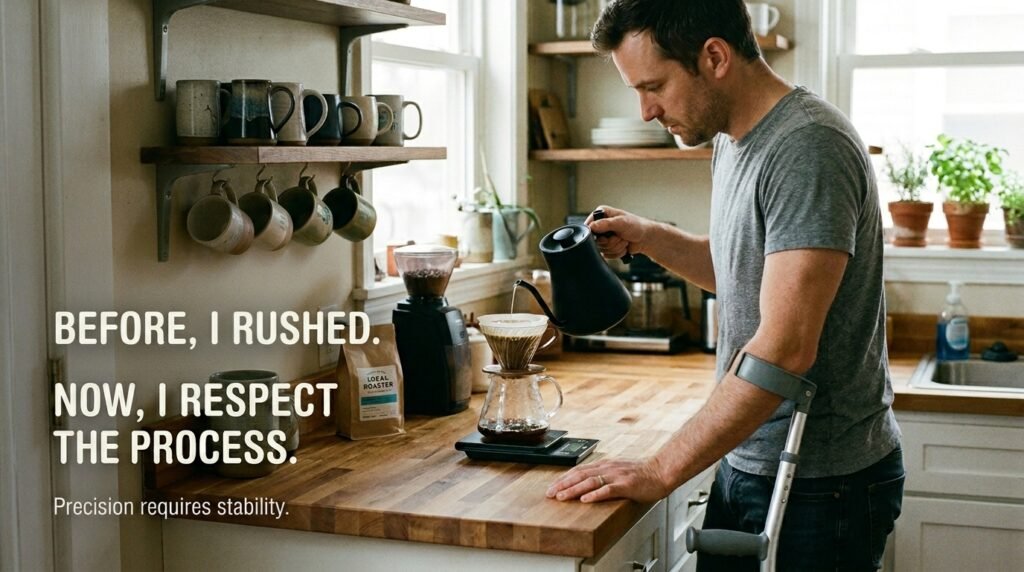
Standing on one foot, gripping the counter for support, I realized my equipment could not save me. Precision requires stability. Precision requires focus.
The Physical Act of Stillness
I placed my glass pour over cone on top of my digital scale. I measured exactly twenty grams of coffee.
Because I could not pace around the kitchen, I just stood perfectly still. I watched the numbers on the digital display. I noticed that if I leaned my weight heavily against the counter, the scale would fluctuate by two or three grams.
The scale was incredibly sensitive. My rushing and bumping in the past had undoubtedly caused me to brew with wildly inaccurate measurements.
I took a deep breath. I stabilized my body. I made sure the scale read exactly twenty grams before I moved to the next step. This forced physical stillness completely altered my mental state. It brought my racing thoughts to a complete halt. This mandatory pause eventually became The Coffee Routine That Helped Me Slow Down long after my ankle finally healed. I realized that stillness is the foundation of accuracy.
Preparing the Filter Properly
I grabbed my hot kettle to rinse the paper filter.
In my old routine, I would carelessly splash a massive wave of water into the cone. The water would fold the edges of the paper over. It would create a messy, uneven surface for the coffee grounds.
This time, I had to be careful. I held the kettle with both hands to keep it steady. I poured a very thin, slow stream of hot water exactly along the top edge of the paper filter. I watched the paper stick perfectly to the glass walls. There were no folds. There were no air pockets.
I poured the dry coffee grounds into the damp filter. Because the paper was perfectly smooth, the coffee bed settled into a flawless, even circle.
I tapped the side of the glass gently to level the grounds. I was setting up a perfect physical environment for the extraction.
The Slowest Bloom
I took the kettle off the stove again. It was time to start the brewing process.
The first step of a pour over is the bloom phase. You pour a small amount of water to saturate the dry grounds and release the trapped carbon dioxide gas.
Normally, I would dump fifty grams of water in three seconds and walk away.
Balancing on my good leg, I poured the water with surgical precision. I let a tiny, thread like stream of water fall from the curved spout. I traced a slow circle, making sure every single dark particle of coffee turned wet. I stopped pouring exactly when the scale hit forty grams.
The coffee bed swelled upward beautifully. I did not walk away. I stood right there and watched the bubbles pop. I watched the color of the coffee change from pale brown to dark, rich mahogany. I could literally smell the complex sugars releasing into the air.
Controlling the Flow Rate
After forty five seconds, the bloom phase ended. The coffee grounds relaxed.
It was time for the main extraction. This is the stage where my careless habits usually destroyed the flavor. I used to pour the water violently. I used to create massive turbulence inside the glass cone.
Violent turbulence is the enemy of sweet coffee.
When you splash water aggressively, you churn up the coffee bed. You force the heavy coffee grounds to stick to the high sides of the paper filter. The water then rushes down the middle, bypassing the coffee entirely. You get a weak, sour, highly uneven extraction.
I gripped the handle of my kettle tightly. I braced my elbow against my ribcage for extra stability. I began to pour.
I poured the slowest, most delicate circle of my life. I kept the spout of the kettle incredibly close to the surface of the water. I did not let the water splash. I did not let the water dig craters into the coffee bed. I maintained a perfectly steady water level inside the glass cone.

The Perfect Drawdown
I watched the digital scale climb slowly. I reached my target weight of three hundred grams. I stopped pouring and placed the kettle back on the stove.
I looked down into the glass cone. The water was draining perfectly.
Because I had poured so carefully, there were no coffee grounds stuck to the high walls of the paper filter. The dark liquid moved downward in a uniform, flat line.
When the last drop of water fell into my ceramic mug, I inspected the spent coffee grounds. They formed a perfectly flat, level bed at the bottom of the cone. It looked like a smooth beach after the tide rolls out.
A flat coffee bed is the ultimate visual proof of a perfect extraction. It means the water passed through every single particle of coffee at the exact same rate. Nobody taught me this visually. Discovering this simple physical indicator felt like unlocking a major secret. It was precisely The Coffee Guide I Wish I Had Read Earlier because it offered immediate proof of success or failure.
Tasting the Clarity
I carefully carried my ceramic mug to the kitchen table. I sat down and rested my throbbing ankle on a spare chair.
I took a deep breath and brought the mug to my lips. I took a slow sip.
The flavor completely stopped me in my tracks.
It was the exact same bag of washed Colombian coffee I had been drinking all week. But it tasted like a completely different beverage. The previous cups had been okay, but they always carried a slightly sharp, bitter edge.
This cup had absolutely zero bitterness. It was astonishingly smooth. The clarity of the flavor was brilliant. I could taste bright, sweet notes of red cherry. I could taste a heavy, lingering finish of milk chocolate. The flavors were not muddled together. They were distinct and separated.
The texture of the coffee was soft and syrupy. It coated my palate perfectly.
The Science of Carefulness
Sitting at the table, I realized exactly why the coffee tasted so incredible. It was not magic. It was basic chemistry.
Coffee is an incredibly volatile ingredient. It reacts aggressively to kinetic energy.
When you rush the brewing process, you introduce chaotic kinetic energy into the filter. You force the water to extract flavor unevenly. You pull out the sweet sugars from some particles, and you pull out the harsh, bitter tannins from others. You mix them all together into a messy, average cup.
When you brew carefully, you eliminate the chaos.
By pouring slowly and gently, I allowed the hot water to act as a precise solvent. The gentle flow gently dissolved the fruit acids and the complex sugars without agitating the bitter plant fibers. I controlled the chemical reaction entirely through my physical movements.
Respecting the Supply Chain
Drinking that perfect cup of coffee made me feel a sudden wave of guilt.
I thought about the journey those coffee beans had taken. A farmer in Colombia spent years cultivating the soil. Farm workers spent weeks hand picking the ripe cherries. A roaster in my city spent hours meticulously monitoring thermal energy to perfect the roast profile.
Dozens of people put extreme care into creating that small bag of brown seeds.
And I had been taking their hard work and ruining it in the final three minutes. I had been disrespecting the entire global supply chain through sheer laziness and impatience.
Brewing coffee carefully is not just about getting a better tasting beverage. It is an act of respect. It honors the agricultural product. It honors the labor of the people who grew it.
Creating a Permanent Rule
My ankle remained swollen for two more weeks. I had to use the crutches every single day.
During those two weeks, I practiced my slow, deliberate brewing routine every single morning. I perfected my pouring speed. I learned exactly how to stabilize my body. I learned how to read the visual cues of the coffee bed.
Eventually, my ankle healed. I returned the crutches to the closet. I could walk normally again. I could dance around my kitchen and rush through my morning if I wanted to.
But I refused to go back to my old habits.
The slow, careful routine became a permanent law in my house. I realized that taking your time is the most important variable in the entire process. Cultivating this level of patience is The First Coffee Habit I Recommend to Beginners before they ever spend a single dollar on expensive brewing equipment. A cheap plastic cone used carefully will always beat a hundred dollar brewer used carelessly.
How to Brew More Carefully Tomorrow
You do not need to sprain your ankle to learn this lesson. You can choose to change your behavior tomorrow morning.
You just have to set a few rigid physical boundaries for yourself.
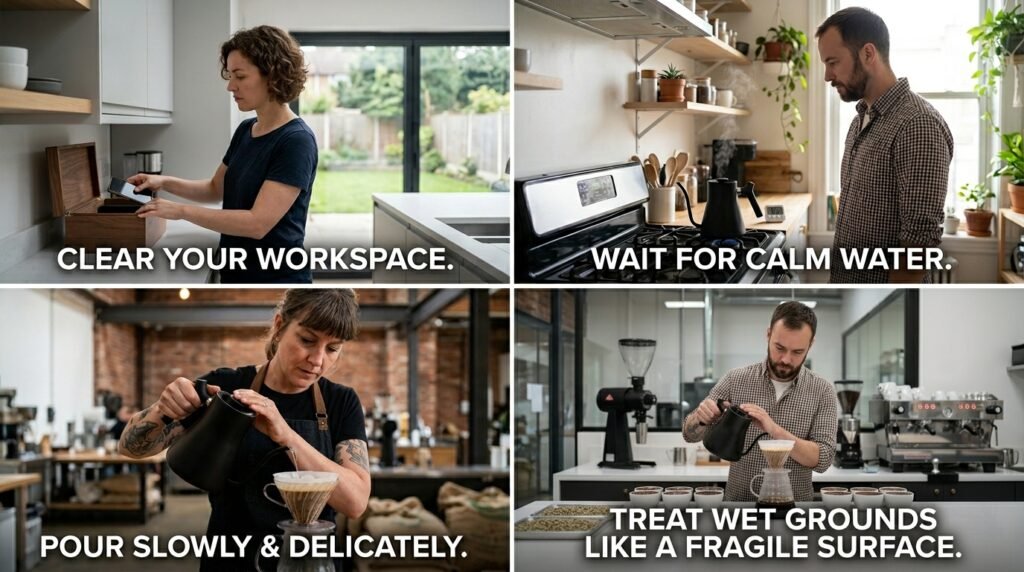
First, clear your workspace. Put your phone in another room. Do not try to cook breakfast while you make coffee. Give the beverage your absolute, undivided attention for five minutes.
Second, watch your water. Do not let your kettle boil violently and immediately pour it. Turn the heat off. Wait a full minute. Let the water calm down. Aggressive water creates aggressive flavor.
Third, control your hands. Grip your kettle firmly. Brace your arm against your body if you need extra stability. Pour the water as slowly and as close to the coffee grounds as physically possible.
Do not let the water splash. Do not dig craters into the coffee bed. Treat the wet grounds like a fragile surface.
The Reward of Focus
We spend most of our lives rushing from one task to the next. We automate our mornings to save time.
But saving three minutes in the kitchen is not worth drinking a bitter, terrible cup of coffee.
When you slow down and brew carefully, you gain a massive psychological reward. You create a tiny pocket of absolute focus in the middle of a chaotic world. You engage your senses. You watch the bloom. You smell the aroma. You control the flow of the water.
You stop acting like a machine, and you start acting like a craftsman.
The next time you walk into your kitchen to make coffee, pretend you are balancing on one leg. Pretend you cannot make any sudden movements. Plant your feet. Focus your eyes. Pour slowly. The vibrant, sweet clarity waiting for you in the mug will completely validate your patience.
