

I spend my professional life writing documentation and fixing broken code. When a client in Rio de Janeiro hands me a massive, failing website, I do not panic. I have a strict diagnostic checklist. I check the server health. I check the database logic. I check the visual framework. I solve the problem systematically.
When I first started brewing manual specialty coffee, I had no checklist. I was completely lost in a sea of contradictory information.
I spent hundreds of hours reading obscure internet forums. I watched chaotic videos of barista championships. I bought random pieces of equipment hoping they would magically fix the bitter, muddy liquid in my cup. I wasted massive amounts of time and money simply because I did not understand the foundational rules of the beverage.
The coffee guide I wish I had read earlier is the strict diagnostic manual I eventually had to write for myself. It ignores the pretentious marketing. It ignores the confusing jargon. It focuses entirely on the physical laws of agricultural chemistry. If you are a beginner struggling to brew a decent cup of coffee, stop reading forums. Stop buying new glass cones. Follow this exact sequence of logical rules.
Rule One: Audit the Raw Material
You cannot write brilliant software using a corrupted programming language. You cannot brew brilliant coffee using dead agricultural seeds.
The biggest mistake a beginner makes is focusing entirely on the brewing hardware while completely ignoring the actual ingredient. They buy a premium gooseneck kettle and then fill their filter with stale, pre-ground dirt from the local supermarket.
Grocery store coffee is chemically dead. The heavy fruit sugars and volatile floral oils oxidize and vanish mere weeks after the coffee leaves the roasting drum. If a bag of coffee has a “Best Before” date printed on it, leave it on the shelf. That date is a massive industrial lie.

Sourcing the Live Seed
You must find a local specialty roaster. You must buy whole bean coffee. You must look for a specific “Roasted On” date stamped in ink on the label.
Buy a bag of light roasted African coffee. Light roasting preserves the organic acids and the natural sweetness of the farm.
Experiencing the vibrant reality of this specific agriculture was exactly The Day I Explored Ethiopian Coffee for the First Time because it proved that coffee is a complex fruit, not a burnt piece of wood. Do not open the bag immediately. Let it rest in a dark cabinet for fourteen days. You must allow the aggressive carbon dioxide gas to escape safely before you try to brew the seeds.
Rule Two: Buy a Milling Engine
Once you have secured fresh, living ingredients, you need a way to process them. You must stop using cheap blade grinders.
A blade grinder is just a blender. It spins a metal propeller at high speeds. It chops the coffee beans violently and randomly. It produces massive, chunky boulders and microscopic, powdery dust at the exact same time. This chaotic particle distribution guarantees a terrible extraction. The boulders will taste sour. The dust will taste harshly bitter.
You need to buy a precision burr grinder.
The Value of the Hand Grinder
Do not spend five hundred dollars on an electric machine. Buy a heavy, manual hand grinder with sharp ceramic or steel burrs.
A manual burr grinder does not chop the coffee. It pulls the beans through two sharp, interlocking gears. It crushes the seeds into uniform, mathematically identical particles. It requires physical effort, but it delivers professional grade consistency for a fraction of the price.
Understanding the absolute necessity of this physical consistency was exactly What I Learned After Switching to a Burr Grinder because my extractions stabilized instantly. The water could finally extract the sugars evenly from every single particle.
Rule Three: Embrace the Metric System
You must throw your plastic measuring scoops directly into the garbage. Volume is a massive liar.
Coffee beans possess wildly different densities. A scoop of dense Ethiopian coffee weighs significantly more than a scoop of hollow, dark roasted Brazilian coffee. If you use a plastic scoop, your chemical ratio will fluctuate violently every single morning.
You must buy a flat, digital kitchen scale that measures in single grams. You must treat your kitchen counter like a chemistry laboratory.
Locking the Variables
The scale allows you to lock your input data permanently.
You need exactly one gram of coffee for every sixteen grams of hot water. This is the golden one to sixteen ratio.
I weigh exactly fifteen grams of coffee beans every single morning. I multiply fifteen by sixteen. My target water weight is exactly two hundred and forty grams. The math is absolute. It never changes. Because my input variables are permanently locked, any change in flavor is solely dictated by the physical size of my coffee grounds.
Rule Four: Sanitize the Solvent
Coffee is ninety eight percent water. The water is the solvent that carries the flavor. If your solvent is dirty, your painting is ruined.
Do not use municipal tap water. Tap water is heavily treated with harsh chlorine to kill bacteria. If you boil chlorinated water and pour it over delicate specialty coffee, the chemical completely incinerates the floral aromatics. The coffee will taste like a bitter swimming pool.
Tap water is also packed with heavy calcium and magnesium. These minerals act like tiny hooks that pull the flavor out of the bean. If your water has too many minerals, it will over extract the coffee and create a muddy, chalky texture.

The Blank Canvas
You must filter your water. At the bare minimum, use a standard carbon filter pitcher to remove the heavy chlorine odors.
If you want absolute perfection, buy pure distilled water. Distilled water contains zero minerals. It is a completely blank canvas. Then, buy specialized coffee mineral packets online. Mix the precise laboratory powder into the distilled jug.
You will create customized, mathematically perfect brewing water. It will extract the sweet peach notes and the bright lemon acidity flawlessly. It will also protect your expensive kettle from developing hard calcium scale.
Rule Five: Maximize Thermal Energy
There is a terrible myth constantly repeated by beginners. They claim that boiling water burns coffee.
This is physically impossible. The coffee bean was roasted at four hundred degrees. You cannot burn it with water that is only two hundred and twelve degrees.
If you buy light roasted specialty coffee, the cellular walls are incredibly tight and dense. You need absolute maximum thermal energy to penetrate the vault and dissolve the heavy sugars. If you use cool water, you will only extract the sharp, sour acids on the surface.
Bring your kettle to a violent, rolling boil. Do not wait for it to cool down. Pour the aggressively hot water directly over the coffee grounds. Trust the physics.
Rule Six: Manage the Fluid Dynamics
When you actually start pouring the water, you must control your physical mechanics. You cannot act like a chaotic waterfall.
Place your V60 cone on the scale. Dump your fifteen grams of ground coffee inside. Pick up the plastic cone and tap it gently against the counter. This creates a perfectly flat bed of coffee. A flat bed guarantees that the water faces even physical resistance.
Grab your gooseneck kettle. Bring the metal spout very close to the surface of the coffee. You want a smooth, glassy rod of water. You do not want a violent, splashing mess.
The Discipline of the Pour
Pour exactly forty grams of hot water gently in a tight circle. Stop pouring.
Watch the coffee bed swell upward. This is the bloom phase. The trapped gas is escaping. Wait exactly forty five seconds for the dome to collapse.
Resume your pour. Move your wrist in slow, steady concentric circles. Watch the digital numbers climb on the scale. Keep your stream of water away from the white paper filter walls. Force the solvent to travel directly through the dark coffee mass. When the scale hits two hundred and forty grams, stop perfectly.
Rule Seven: Homogenize the Layers
When the final drops of liquid fall into your ceramic mug, the coffee is not ready to drink.
The hot water extracted the compounds at different speeds. The heavy, sour syrup sank to the very bottom of the mug. The sweet sugars settled in the middle. The weak, bitter water sits at the very top.
If you take a sip right now, you will drink a watery, bitter lie.
You must grab a clean metal spoon. Lower it to the bottom of the mug and stir the liquid aggressively three times. This physical motion violently mixes the separated layers. It unifies the sharp acids and the heavy sugars into a single, cohesive, perfectly balanced beverage.
Rule Eight: Enforce the Thermal Delay
This is the hardest rule to follow. You must walk away.
Do not drink the hot coffee. Extreme thermal energy completely blinds the human tongue. If you drink a liquid at one hundred and ninety degrees, your sensory receptors shut down to protect themselves. You will only taste generic, dark bitterness.
You have to let the heat bleed out into the room. You must wait at least five full minutes.
The Analog Anchor
I carry my ceramic mug into my living room. I leave my smartphone in the kitchen.
I sit on the couch. I pull out my heavy paper sketchbook and a black ink pen. I draw complex Japanese Kitsune masks while the coffee cools down. The drawing focuses my mind and completely lowers my heart rate.
Establishing this quiet waiting period was exactly The Morning I Realized Coffee Could Be a Ritual because it forced me to detach from my stressful digital workload. The coffee requires patience. It acts as an absolute barrier against the panic of the morning.
The Final Sensory Test
After five minutes, I touch the outside of the ceramic mug. It is comfortably warm.
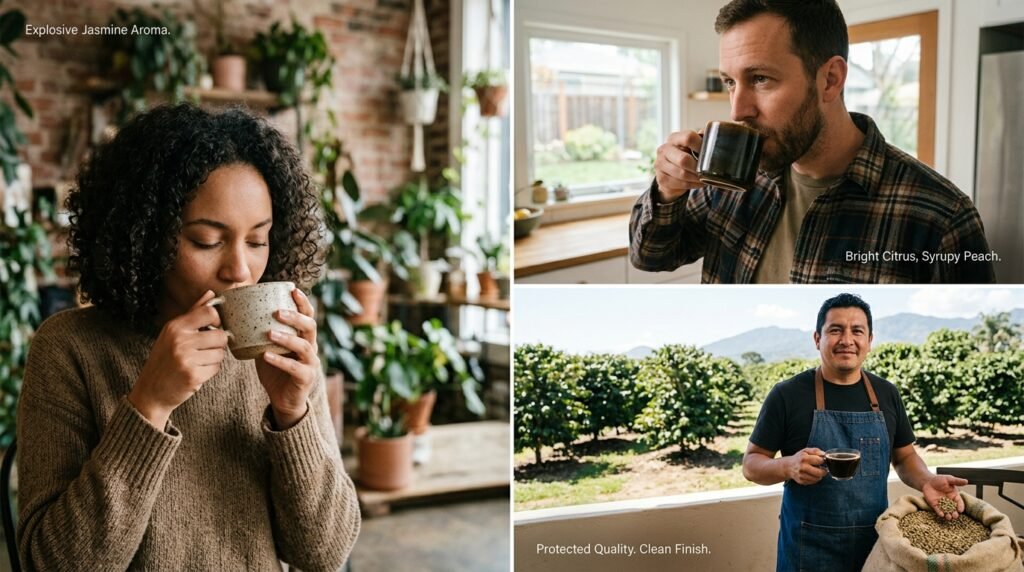
I bring the cup to my face. I take a deep breath. Because the temperature has dropped, the volatile aromatics are finally accessible. The smell of fresh jasmine is explosive.
I take a slow, deliberate sip. The coffee is incredibly clean. The bright citrus acidity hits my palate, melting seamlessly into a heavy, syrupy peach body. The finish is long and sweet. There is absolutely no chalky astringency. There is no sharp sourness.
The raw agricultural product has been successfully protected from the farm to the final sip.
The Complete System
Brewing perfect coffee is not an abstract art form. It is a strict system of variables.
You must control the freshness. You must control the particle size. You must control the mass. You must control the solvent chemistry. You must control the thermal energy. You must control the fluid dynamics.
If you respect these physical laws, you do not need a thousand dollar machine. You do not need to read confusing internet forums. You just need a scale, a hand grinder, a simple kettle, and absolute discipline.
Audit your kitchen tomorrow morning. Throw away your plastic scoops. Throw away your stale supermarket dirt. Stop rushing the kettle. Stop drinking the coffee while it is boiling hot. Follow the rules of the system. You will permanently banish the bitter frustration from your mornings, and you will finally unlock the pristine, heavy sweetness that has been hiding from you all these years.

Hi, I’m the coffee enthusiast behind Coffee Nerd Lab.
Like many people, I started drinking coffee simply because it helped me wake up in the morning. Over time, that daily habit turned into a genuine interest in understanding what makes a great cup of coffee. I began experimenting with different beans, brewing methods, grinders, and coffee gear, learning through trial and error along the way.
This blog is where I document that journey. Every article is inspired by real experiences, discoveries, and lessons I’ve learned while exploring the world of coffee. From brewing guides and equipment reviews to practical tips and coffee basics, my goal is to share useful information in a way that’s easy to understand and enjoyable to read.
Thanks for stopping by, and I hope Coffee Nerd Lab helps you enjoy your next cup a little more than the last.