I was sitting at a crowded dining room table, surrounded by the quiet clinking of wine glasses and the low hum of weekend conversation. I was at a dinner party hosted by a mutual friend, surrounded by people I was meeting for the very first time.
Inevitably, the conversation shifted to the standard icebreaker question. The woman sitting across from me politely asked, “So, what do you do for fun? Do you have any hobbies?”
It is a simple question, but my mind went completely blank. I thought about saying reading, or hiking, or watching movies. But none of those felt entirely accurate.
Before I could filter myself, the honest answer slipped out. “I am absolutely obsessed with coffee beans.”
The table went slightly quiet. A few people smiled politely, clearly a bit confused. One guy chuckled and said, “Coffee isn’t a hobby. It’s a survival tool. It’s just caffeine.”
I didn’t argue with him. In fact, I completely understood where he was coming from, because for the vast majority of my adult life, I held the exact same opinion. I viewed coffee as a utility. It was a dark, bitter liquid that I poured down my throat to cure morning grogginess. The idea of studying it, or reading books about it, seemed as ridiculous as reading a book about gasoline.
But as I drove home from that dinner party, I realized something profound. The moment I stopped treating coffee like a manufactured product and started learning about its agricultural reality, my entire sensory experience changed.
The knowledge didn’t just make me smarter; it actually made the beverage taste better. Here is exactly why learning about coffee beans made me enjoy coffee more, and why I believe education is the ultimate flavor enhancer.
The Death of the “Magic Powder” Illusion
The biggest hurdle I had to overcome in my coffee journey was my own subconscious conditioning.
If you grow up in a modern society, you are conditioned to view coffee as a dry good. You see it sitting in massive plastic tubs on the bottom shelf of the supermarket. You see it scooped into industrial paper filters in office breakrooms. It looks like dirt. It behaves like a manufactured powder.
Because we interact with it in this dry, processed state, we completely disconnect it from nature.
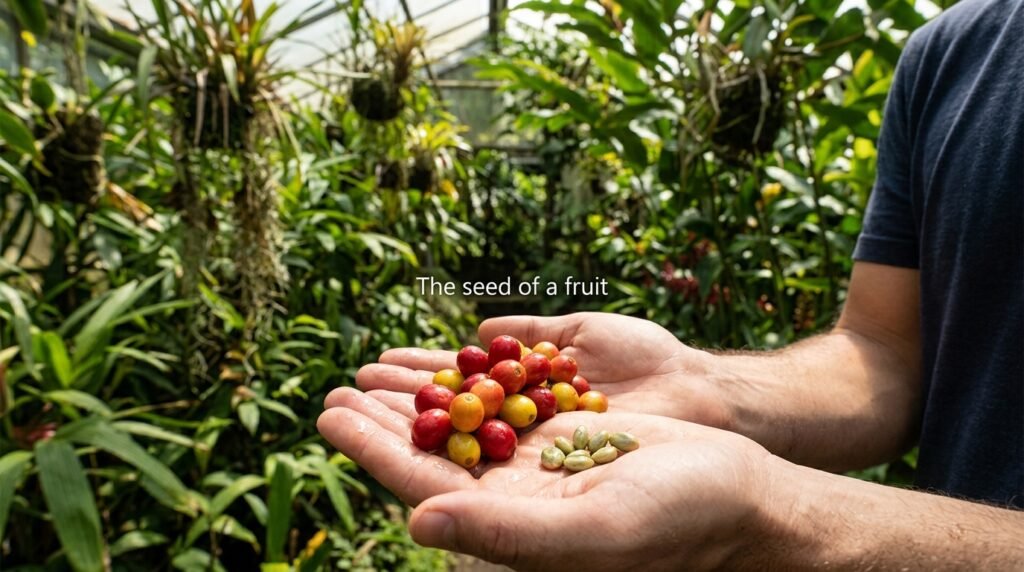
The first time I opened a book about coffee biology, that illusion was violently shattered. I saw photographs of lush, tropical trees. I saw bright, beautiful, jasmine-scented white flowers. I saw clusters of bright red and yellow cherries growing on branches.
Learning that a coffee bean is actually the seed of a sweet, sticky tropical fruit completely rewired my brain. It was a paradigm shift.
Suddenly, I wasn’t just dumping a generic brown powder into a machine. I was handling the pit of a fruit. This simple biological fact changed what my palate expected. Because I knew it came from a fruit, I subconsciously gave my tastebuds permission to start looking for fruity flavors. I stopped searching for “bitterness” and started searching for “sweetness.”
Traveling Through the Cup
Once you realize that coffee is an agricultural product, the next logical step is to look at where it grows. This is where the world of coffee completely opened up for me.
Before I started learning about the beans, I thought the country of origin printed on a bag was just a marketing gimmick. I assumed “Colombian” or “Ethiopian” were just fancy words used to justify a higher price tag.
Then, I started studying geography. I learned about the “Coffee Bean Belt,” the thick band around the equator where the climate is perfectly suited for coffee trees. I learned about a concept called terroir—the idea that the soil, the altitude, and the weather of a specific farm permanently imprint their unique signature onto the seed.
This knowledge turned my morning routine into a daily geography lesson.
I learned that the volcanic, mineral-rich soil of Central America often produces beans that taste deeply of dark chocolate, toasted nuts, and sweet caramel. Conversely, the extreme altitudes and red dirt of East Africa produce beans that explode with bright, tea-like floral notes and sharp citrus.
Knowing this information fundamentally changed the way I experienced the beverage, which is exactly What I Learned After Trying Coffee from a Different Country for the very first time. I wasn’t just drinking a generic dark liquid anymore. I was tasting the climate of a specific mountain range. I was tasting the soil of a different continent. The cup became a passport.
Building Deep Empathy for the Farmer
There is a strange psychological phenomenon that happens when you learn how difficult something is to produce. You automatically treat it with more respect.
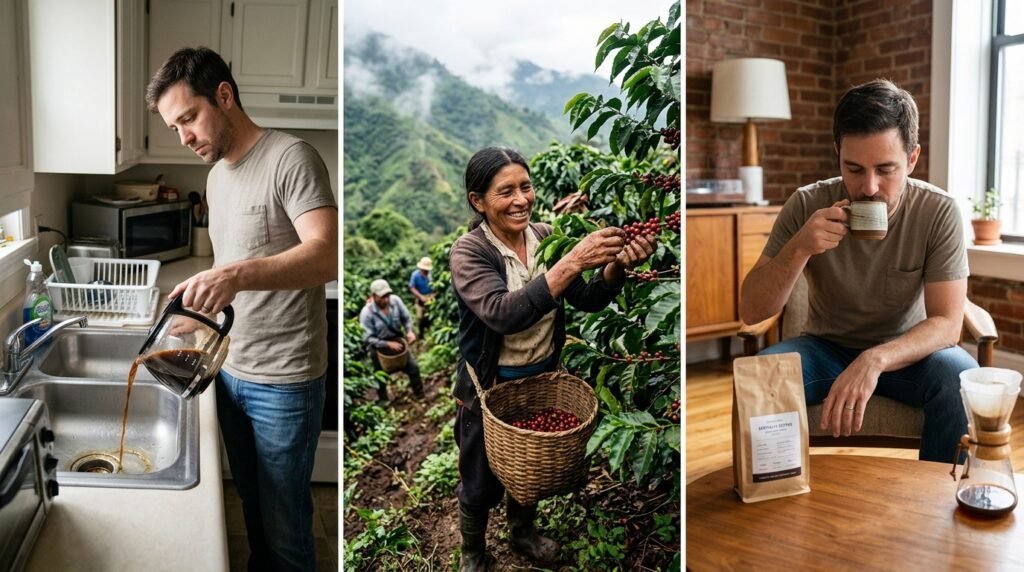
When I viewed coffee as a cheap supermarket utility, I treated it terribly. I would brew a massive 12-cup pot every morning. I would drink one or two mugs, leave the rest to burn on the hot plate all afternoon, and then carelessly pour the remaining half-pot down the kitchen sink without a second thought.
It was cheap, so it was disposable.
But then I watched a documentary about the coffee harvesting process. I watched generational farmers navigating incredibly steep, treacherous, and muddy mountain slopes. I watched them carry massive woven baskets strapped to their waists.
I learned that specialty coffee cannot be harvested by massive machines. Because coffee cherries ripen at different speeds, a machine would strip the unripe green cherries alongside the ripe red ones, ruining the harvest. Therefore, every single high-quality coffee bean you consume was visually inspected and plucked from the branch by a human hand.
I did the math. I realized that a single cup of coffee requires roughly 75 coffee cherries.
That means someone, standing on a mountainside thousands of miles away, had to reach out and individually pluck 75 separate pieces of fruit just so I could have my morning mug.
This realization hit me like a ton of bricks. It built an intense, unwavering empathy for the farmers. I immediately stopped pouring old coffee down the drain. I stopped complaining about the price of a bag of specialty beans.
When you understand the staggering amount of back-breaking manual labor required to produce the ingredient, you savor every single sip. The coffee tastes better because it is steeped in gratitude.
The Alchemy of the Roaster
My education didn’t stop at the farm. I eventually had to learn how that pale, green, rock-hard seed turned into the dark, aromatic bean in my kitchen.
Learning about the chemistry of the roasting process was like peeking behind the curtain of a magic show.
I learned about the Maillard reaction—the exact same chemical reaction that causes a steak to brown on a grill or a loaf of bread to form a golden crust. I learned how the intense heat of the roasting drum causes the moisture inside the green coffee bean to vaporize, creating massive internal pressure until the bean violently cracks open.
I realized that the coffee roaster is essentially a thermal translator. Their job isn’t to create flavor, but to apply just enough heat to unlock the delicate sugars and complex aromatic compounds that the farmer worked so hard to cultivate.
If they roast it too lightly, the coffee tastes sour and grassy. If they roast it too dark, they incinerate the farmer’s hard work, leaving behind nothing but the taste of carbon and ash.
Discovering this delicate balance was the catalyst for The First Bag of Coffee Beans That Made Me Curious About Roasting. I stopped blindly buying bags based on the color of the label and started seeking out roasters who treated the beans with absolute scientific precision. I was able to taste their craftsmanship, which made the coffee infinitely more enjoyable.
The Chemistry of the Kitchen
The final piece of my coffee education happened in my own kitchen.
For years, I blamed my coffee machine for my bad mornings. I assumed that making good coffee was a mysterious art form that only tattooed baristas in trendy cafes could master.
But then I started reading about extraction theory.
I learned that coffee brewing isn’t magic; it is simply chemistry. It is the use of a solvent (hot water) to dissolve soluble compounds hidden inside the roasted beans.
I learned that some of those compounds taste bright and fruity, some taste sweet and heavy, and some taste violently bitter and astringent. I learned that the water dissolves the fruity notes first, the sweet notes second, and the bitter notes last.
This simple piece of scientific knowledge completely revolutionized my mornings.
If my coffee tasted too sour, I knew exactly what was wrong: I hadn’t extracted enough. I needed to grind the beans finer or use hotter water to pull out the sugars.
If my coffee tasted too bitter, I knew I had extracted too much. I was pulling out the harsh compounds at the very end of the cycle. I needed to grind the beans coarser or use slightly cooler water.
Knowledge gave me control. It removed the anxiety and the mystery from the morning routine. I was no longer crossing my fingers and hoping for a good cup; I was mathematically engineering it.
The Mind Influences the Palate
There is a famous study in the world of wine tasting. Researchers took an inexpensive, average bottle of white wine, dyed it red with food coloring, and served it to a panel of wine experts.
The experts, seeing the red color, completely bypassed the actual flavor of the wine. They confidently described tasting notes of dark cherries, heavy tannins, and bold red fruits—things that did not exist in the glass. Their brains expected a red wine, so their palates tasted a red wine.
The human brain is incredibly powerful. It dictates what we experience.
Before I learned about coffee, my brain expected a bitter, dark, generic morning fuel. And for years, that is exactly what I tasted.
But as I filled my brain with knowledge—as I learned about the Ethiopian highlands, the volcanic soil of Guatemala, the meticulous hand-picking process, and the delicate chemistry of the roasting drum—my expectations completely shifted.
My brain started anticipating complexity. It started expecting floral notes, chocolatey finishes, and vibrant fruit acidity. And miraculously, because I was expecting those things, my palate finally started finding them.
A Slower, Better Morning
Ultimately, learning about coffee beans didn’t just change how the beverage tasted; it changed how I lived my mornings.
When you understand the massive, global journey that a coffee bean undertakes just to reach your kitchen counter, you can no longer rush the process. You can’t just push a button on a plastic machine and walk away. You have to treat the ingredient with the respect it deserves.
This shift in perspective is exactly what led to The Morning I Realized Coffee Could Be a Ritual.
The knowledge forced me to slow down. I started weighing my beans with a digital scale. I started grinding them by hand, listening to the satisfying crunch of the burrs. I started pouring the hot water slowly, watching the fresh grounds bloom and swell as the trapped gases escaped.
The act of making coffee became a ten-minute period of forced mindfulness. It became a quiet, deliberate meditation before the chaos of the workday began.

The Ultimate Flavor Enhancer
If you are currently feeling bored with your morning coffee, I urge you to resist the temptation to go out and buy a brand-new, expensive espresso machine. Do not assume that new gear will fix a lack of enthusiasm.
Instead, spend twenty dollars on a good book about the history of coffee. Watch a documentary about coffee farmers in Central America. Read an article about the difference between washed and natural processing methods.
Fill your brain with the staggering reality of this agricultural miracle.
Once you understand what a coffee bean actually is, where it comes from, and the immense human effort required to keep it alive, your entire sensory experience will transform. You will stop tasting a generic morning habit, and you will start tasting the world.
And trust me, the world tastes absolutely incredible.
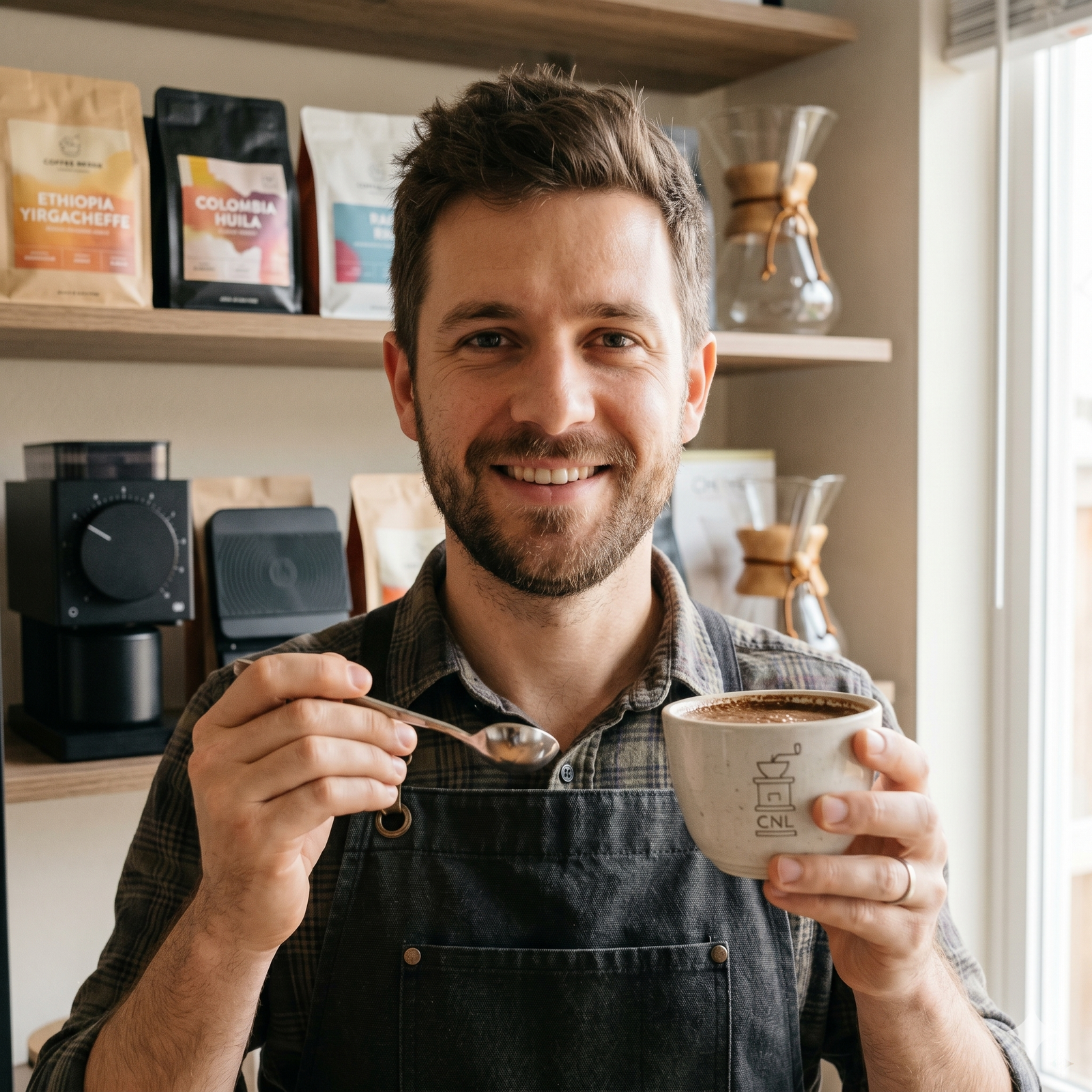
Hi, I’m the coffee enthusiast behind Coffee Nerd Lab.
Like many people, I started drinking coffee simply because it helped me wake up in the morning. Over time, that daily habit turned into a genuine interest in understanding what makes a great cup of coffee. I began experimenting with different beans, brewing methods, grinders, and coffee gear, learning through trial and error along the way.
This blog is where I document that journey. Every article is inspired by real experiences, discoveries, and lessons I’ve learned while exploring the world of coffee. From brewing guides and equipment reviews to practical tips and coffee basics, my goal is to share useful information in a way that’s easy to understand and enjoyable to read.
Thanks for stopping by, and I hope Coffee Nerd Lab helps you enjoy your next cup a little more than the last.