
I was wandering through a dusty outdoor flea market on a crisp Sunday morning. I was not looking for anything in particular. I was just killing time, walking past folding tables covered in old records, tarnished silverware, and antique lamps.
Near the back of the lot, I stopped at a table filled with random kitchen supplies. Sitting right in the middle of a stack of old ceramic plates was a beautiful, strange piece of glass.
It looked like an hourglass. It was made of thick, clear glass, featuring a wide bottom and a flared top. Around the narrow neck of the glass was a polished wooden collar, tied tightly with a leather cord.
I picked it up. It felt heavy and incredibly elegant. I asked the vendor what it was. He told me it was a Chemex, a classic coffee brewer invented by a chemist in the 1940s. He wanted five dollars for it. I handed him a crumpled bill, put the glass vessel in my backpack, and walked home.
I did not know it at the time, but that five dollar flea market purchase was about to completely derail my morning routine. I had been happily using the same heavy metal French press for years. I thought my routine was perfect. But bringing that glass hourglass into my kitchen forced me to break my habits. What happened when I changed my coffee brewing method completely rewrote my understanding of flavor, chemistry, and culinary control.
The Comfort of the Mud
To understand the magnitude of this change, you have to understand my previous baseline.
For nearly five years, I was a dedicated French press user. The French press is an immersion brewer. You dump coarse coffee grounds into a glass beaker, add boiling water, and let them sit together for four minutes. Then, you push a metal mesh filter down to separate the grounds from the liquid.
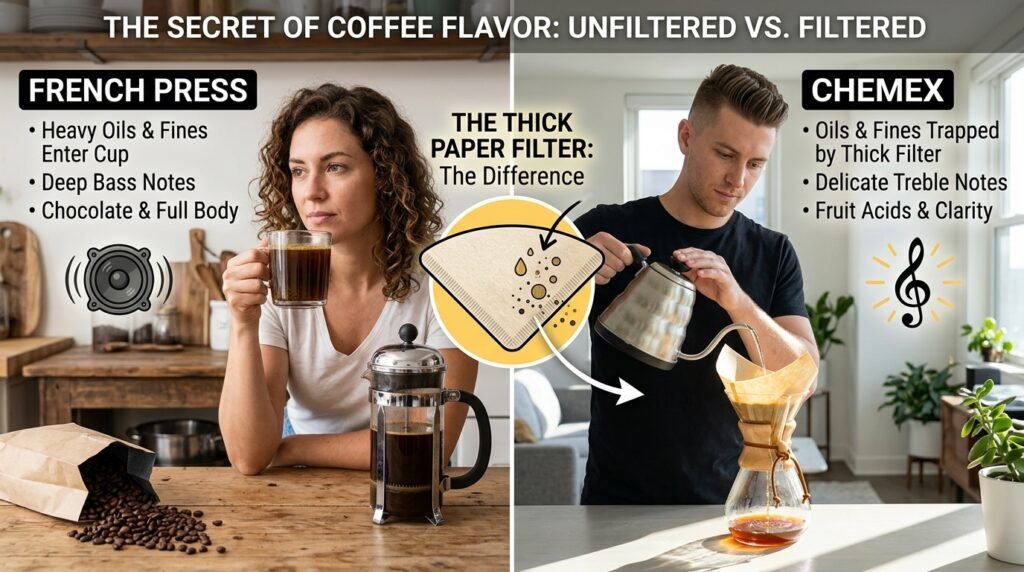
It is a rugged, foolproof method. Because the metal filter has visible holes, it lets a massive amount of microscopic coffee dust and heavy natural oils pass right into the final cup.
My daily coffee was thick. It was heavy. It coated the roof of my mouth. It often had a muddy layer of silt sitting at the absolute bottom of the mug. I loved it. I thought that heavy, dark sludge was simply what coffee was supposed to taste like.
I was comfortable. I had no desire to change. But that beautiful glass hourglass sitting on my kitchen counter demanded to be used.
Sourcing the Right Filters
I washed the dusty Chemex in the sink with warm, soapy water. The glass sparkled. But I quickly realized I was missing a crucial component.
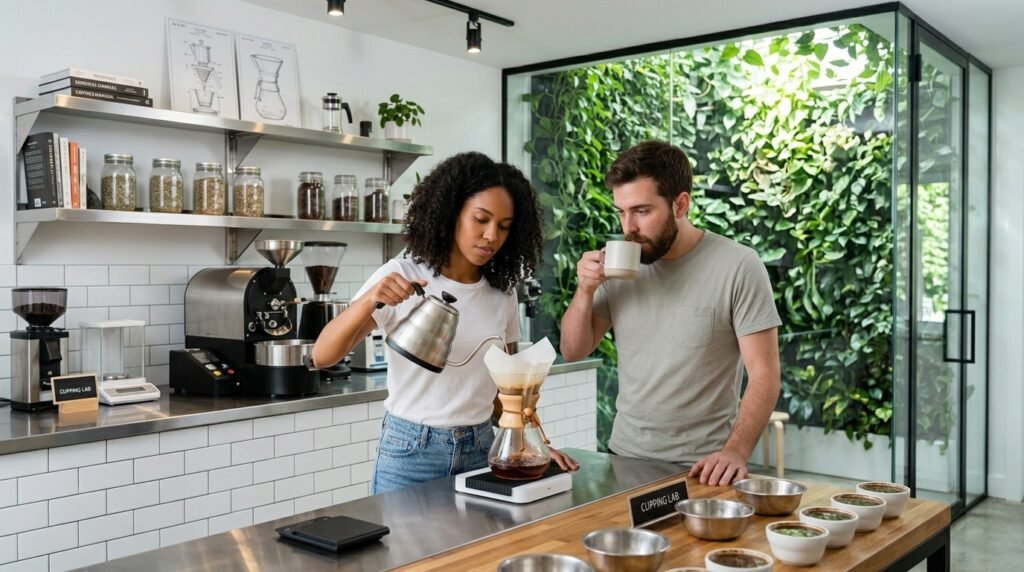
A pour over brewer requires a paper filter. I drove to a local specialty coffee shop and asked the barista for a box of Chemex filters. She handed me a heavy, square cardboard box.
When I opened the box at home, I was completely surprised. These were not the flimsy, thin paper filters you see in cheap automatic drip machines. These filters were massive. The paper felt incredibly thick, almost like light cardboard.
I unfolded the thick square into a cone shape and placed it into the top of the glass hourglass. I boiled a kettle of water. I rinsed the thick paper with hot water to remove any dusty flavor. I poured the rinse water out of the glass spout.
I was officially ready to perform my first chemistry experiment.
The Physical Shift in Routine
I grabbed my bag of freshly roasted beans. They were a single origin from Ethiopia. I ground them up and poured the dry powder into the damp paper cone.
With my old French press, the actual brewing process took about ten seconds of active labor. I would pour the water in and walk away. The brewing happened in the background while I brushed my teeth.
The Chemex demanded my full attention. It is a pour over method. Gravity does the work, but you have to control the gravity.
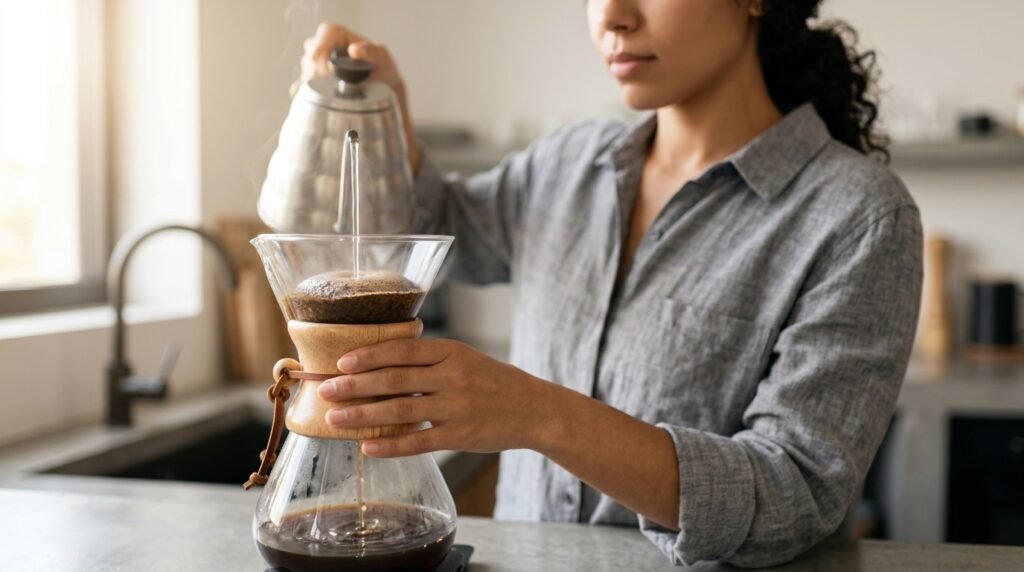
I stood in my kitchen and slowly poured the hot water over the coffee bed. I watched the grounds swell and bubble. I had to pour in slow, deliberate circles. I had to stop and wait for the water level to drop before pouring again. I had to physically stand there for four uninterrupted minutes.
Initially, this felt like an annoying inconvenience. I was deeply annoyed that a piece of glass was holding me hostage in my own kitchen. I was resisting the change. But pushing through that initial resistance eventually led to a massive breakthrough. I found that embracing the required focus was exactly The Coffee Device That Simplified My Morning by forcing me to stop multitasking and just breathe.
The Shock of the First Sip
The water finally finished dripping through the thick paper cone. I grabbed the wooden collar by the leather cord and lifted the glass vessel.
The liquid sitting in the bottom half of the hourglass looked entirely different from my normal coffee. My French press coffee was pitch black and totally opaque. This new liquid was translucent. It was a glowing, bright ruby red color. I could see light passing completely through it.
I poured a serving into a clean white mug. I did not add any milk. I brought it to my lips and took a sip.
My brain completely stalled.
The flavor was unrecognizable. The heavy, muddy, chocolatey body I was used to was completely gone. The thick, oily coating on my tongue was entirely absent.
Instead, the coffee was incredibly light. It felt like drinking a hot, crisp fruit tea. The flavor was dominated by a massive wave of sweet blueberries and bright, sharp lemon zest. It was delicate. It was clean. It was vibrant.
I looked at the mug in absolute disbelief. This was the exact same bag of Ethiopian coffee beans I had been brewing in my French press all week. But the liquid in this mug tasted like a completely different agricultural product.
The Chemistry of the Filter
I sat down at my kitchen table and tried to understand what had just happened. How could a simple change in the brewing vessel completely alter the fundamental flavor of a roasted seed?
The answer came down to the thick, square paper filter.
Coffee beans contain hundreds of natural, heavy oils. They also produce microscopic particles called fines during the grinding process.
When I used my French press, the metal mesh let all of those heavy oils and fine particles directly into my mug. Those oils are responsible for the heavy body and the dark chocolate flavors. They coat your palate, which mutes your ability to taste delicate fruit acids.
The Chemex filter is chemically designed to be 20 to 30 percent thicker than a standard coffee filter.
That thick paper acts like an impenetrable wall. It traps every single drop of natural oil. It catches every microscopic speck of coffee dust. It only allows the pure, clean, water soluble flavor compounds to pass through into the glass vessel.
By changing my brewing method, I had successfully stripped away the heavy bass notes of the coffee. That removal allowed the bright, delicate treble notes to finally sing loudly.
The Domino Effect on Equipment
Once I tasted that incredible, clean clarity, I was completely hooked. I abandoned my French press entirely. I wanted that bright, tea-like cup every single morning.
But changing a fundamental method creates a massive domino effect. A new brewer demands new tools.
I quickly realized that pouring boiling water out of a standard, wide-mouth cooking kettle was ruining my extraction. The heavy splash of water was creating deep craters in the coffee bed. I needed precision.
I had to buy a specialized stainless steel gooseneck kettle. The thin, curved spout allowed me to pour a delicate, highly controlled stream of water. Learning to control this new variable was a thrilling challenge. Mastering the pour rate was the exact catalyst for How a Small Tool Improved My Home Coffee Experience and elevated my kitchen to a cafe level standard.
I also had to upgrade my hand grinder. The thick paper filter of the Chemex is notoriously unforgiving. If your coffee grounds are not perfectly uniform in size, the water will clog the filter and stall the brew. I had to invest in sharper, more precise ceramic burrs to ensure an even extraction.
Changing My Buying Habits
The most profound shift caused by my new brewing method happened outside of my kitchen. It changed how I shopped.
When I was using the metal French press, I usually bought dark roasted coffees from South America. The immersion method paired perfectly with those heavy, nutty, comforting beans.
But when I tried brewing a dark, oily French roast in the Chemex, the result was terrible.
Because the thick paper filter strips away all the heavy oils and the thick body, a dark roast just tasted thin, hollow, and bitterly empty. The Chemex was aggressively exposing the flaws of the dark beans.
I realized that this specific brewing method was engineered for a very specific type of coffee. It thrives on acidity. It thrives on complex fruit notes.
I had to completely change my buying habits. I stopped looking at dark roasts. I started hunting for lightly roasted, high altitude coffees from African nations like Kenya, Rwanda, and Ethiopia. I started looking for beans that promised tasting notes of citrus, berries, and floral tea. The Chemex unlocked the potential of these delicate beans in a way my old metal press never could.
The Loss of Forgiveness
It is important to note that changing my brewing method was not a purely positive, flawless transition. There was a very steep, very frustrating learning curve.
The French press is an incredibly forgiving brewer. You can guess your water measurements. You can walk away for five minutes. You can use cheap, unevenly ground coffee. It will still produce a highly drinkable, comforting mug of heavy liquid.
The Chemex offers absolutely zero forgiveness.
If my water was slightly too hot, the coffee tasted horribly bitter. If I poured the water too fast, the coffee tasted sour and weak. If I forgot to rinse the paper filter, the entire batch tasted like wet cardboard.
For the first few weeks, I made a lot of terrible coffee. I poured a lot of expensive beans down the kitchen sink.
The method demanded precision. It required a digital scale. It required a timer. It forced me to actually understand the science of what I was doing. I had to stop guessing and start measuring.
The Reward of the Ritual
Eventually, the strict, unforgiving nature of the pour over method stopped feeling like a chore. It started feeling like a highly rewarding ritual.
I actually looked forward to the tactile process. I loved the feeling of the wooden collar in my hand. I loved watching the coffee grounds swell and bloom when the hot water hit them. I loved the bright, clean amber color of the final liquid sitting in the glass.
The manual labor required to produce the cup made the final product taste significantly better. You appreciate things more when you have to work for them.
The sheer joy of the physical process was incredibly fulfilling. Adding the visual beauty of the hourglass to my counter was exactly The Coffee Accessory That Made Brewing Fun Again after years of mindless, boring routine. It turned a daily habit into a daily craft.
A Lesson in Culinary Control
Looking back at that five dollar flea market purchase, I am amazed at how one piece of glass completely changed my perspective on coffee.
Before I found the Chemex, I thought coffee was a static ingredient. I thought a specific bean would always taste a specific way, regardless of how you made it.
I was completely wrong.
The coffee bean is just the raw material. The brewing method is the actual lens through which you experience that material. The tool you choose to use completely rewrites the final flavor profile.
If you want a heavy, comforting, chocolatey blanket of flavor, you choose the metal mesh of a French press. If you want a bright, acidic, incredibly clean fruit tea, you choose the thick paper of a pour over cone.
You are the chef. You have the power to highlight or hide specific chemical compounds purely by changing the physical filter in your kitchen.
An Invitation to Experiment
If you have been using the exact same brewing machine for the last five years, I highly encourage you to step out of your comfort zone.
You do not need to throw your current machine away. But you should absolutely try something new. Go online and buy a cheap plastic V60 dripper or an AeroPress. Buy a small bag of fresh, lightly roasted beans.
Change the physical mechanics of your extraction. Switch from an immersion steep to a gravity drip. Switch from a metal screen to a paper filter.
The very first time you taste the drastic difference in your mug, your eyes will completely open. You will realize that coffee is an infinitely customizable beverage. Changing your brewing method will frustrate you, challenge you, and ultimately force you to pay closer attention. But the pristine, vibrant flavor waiting on the other side of that challenge is absolutely worth the effort.

Hi, I’m the coffee enthusiast behind Coffee Nerd Lab.
Like many people, I started drinking coffee simply because it helped me wake up in the morning. Over time, that daily habit turned into a genuine interest in understanding what makes a great cup of coffee. I began experimenting with different beans, brewing methods, grinders, and coffee gear, learning through trial and error along the way.
This blog is where I document that journey. Every article is inspired by real experiences, discoveries, and lessons I’ve learned while exploring the world of coffee. From brewing guides and equipment reviews to practical tips and coffee basics, my goal is to share useful information in a way that’s easy to understand and enjoyable to read.
Thanks for stopping by, and I hope Coffee Nerd Lab helps you enjoy your next cup a little more than the last.