
It was late Friday morning here in Rio de Janeiro. I was taking a short break from my computer. I had spent the last four hours managing content uploads and fixing broken links across my websites. My eyes needed a rest from the glowing screen.
I walked into my kitchen and opened the refrigerator. I grabbed a handful of fresh red cherries.
I stood by the window, eating the fruit and looking out at the street. I bit into a cherry, ate the sweet flesh, and spit the hard wooden pit into my hand. I stared at the small pit resting in my palm.
I looked over at my kitchen counter. A bag of expensive Ethiopian coffee beans was sitting next to my digital scale.
A massive realization suddenly hit me. The brown coffee beans inside that bag were the exact same botanical structure as the cherry pit in my hand. Coffee is not a nut. It is not a magical brown rock. It is the hard seed of a fleshy tropical fruit.
The first time I thought about how coffee is processed happened right there by the window. I realized somebody had to physically remove the sweet fruit to get to the seed. How they removed that fruit changed the entire chemical reality of my morning beverage. It opened a massive new door in my culinary education.
The Ignorance of the Consumer
Before that Friday morning, I completely ignored the agricultural reality of coffee.
I cared deeply about the country of origin. I knew I loved the high altitude volcanic dirt of Ethiopia. I cared deeply about the roast profile. I knew I loved light roasts that protected the delicate fruit acids.
But I treated the raw ingredient like a manufactured object. I completely skipped the most crucial step of the farmer’s job.
When an Ethiopian farmer picks a ripe coffee cherry off the branch, they cannot just put it in a box and ship it to a roaster. A fresh coffee cherry is full of water and sticky sugar. If you put fresh cherries in a shipping container, they will rot and turn to liquid mush in three days.
The farmer has to extract the seed and dry it out. This extraction is called post harvest processing.

The Botanical Anatomy
To understand the impact of processing, I had to understand the anatomy of the fruit. I opened my laptop and started researching botany instead of updating my websites.
A coffee cherry has multiple layers. The outside is a tough skin. Directly under the skin is a layer of sweet, sticky fruit flesh called the mucilage.
Under the sticky mucilage is a tough, papery hull called the parchment. The actual coffee seed is locked safely inside this parchment layer.
The farmer must navigate these sticky, wet layers. Their ultimate goal is to drop the moisture content of the seed down to exactly eleven percent. At eleven percent moisture, the seed becomes stable. It can survive months inside a burlap sack on a cargo ship without rotting.
How the farmer navigates the sticky fruit completely dictates the final flavor. Fully grasping this agricultural step was exactly What I Learned About Coffee Processing Methods and it forever changed how I read the labels on coffee bags. The processing method is the editor of the origin story.
The Clean Window of the Washed Process
The first processing method I researched was the fully washed process. This is the most common method used in the specialty coffee industry.
In a washed process, the farmer uses heavy machinery and massive amounts of fresh water to violently strip the fruit away from the seed.
Immediately after picking the cherries, the farmers run them through a mechanical depulper. This machine crushes the cherries and tears off the outer skin. The seeds emerge still covered in the sticky, sugary mucilage.
The farmers dump these sticky seeds into massive concrete fermentation tanks filled with water. They leave them there for a few days. Natural enzymes in the water eat away the sticky fruit layer completely.
The farmers drain the tanks and wash the seeds with high pressure water. The seed is left completely bare, protected only by its papery parchment hull. They spread the bare seeds in the sun to dry.
Tasting the Naked Seed
Because the washed process completely removes the fruit immediately, the seed does not absorb any external sugar.
When a roaster applies heat to a washed coffee bean, there is no fermented fruit residue left to burn. The resulting flavor is incredibly clean, crisp, and articulate. It is a completely transparent window directly to the soil and the plant genetics.
If you drink a washed Ethiopian coffee from the Guji zone, you will taste the raw African dirt. You will taste bright lemon zest, crisp green apple, and delicate jasmine flowers. The beverage feels very light and tea like on your palate. There is no heavy, muddy interference.
The Wild Chaos of the Natural Process
The second major method is the complete opposite of the washed process. It is called the natural process, or the dry process.
In the natural process, the farmer does not use depulping machines. They do not use massive water tanks.
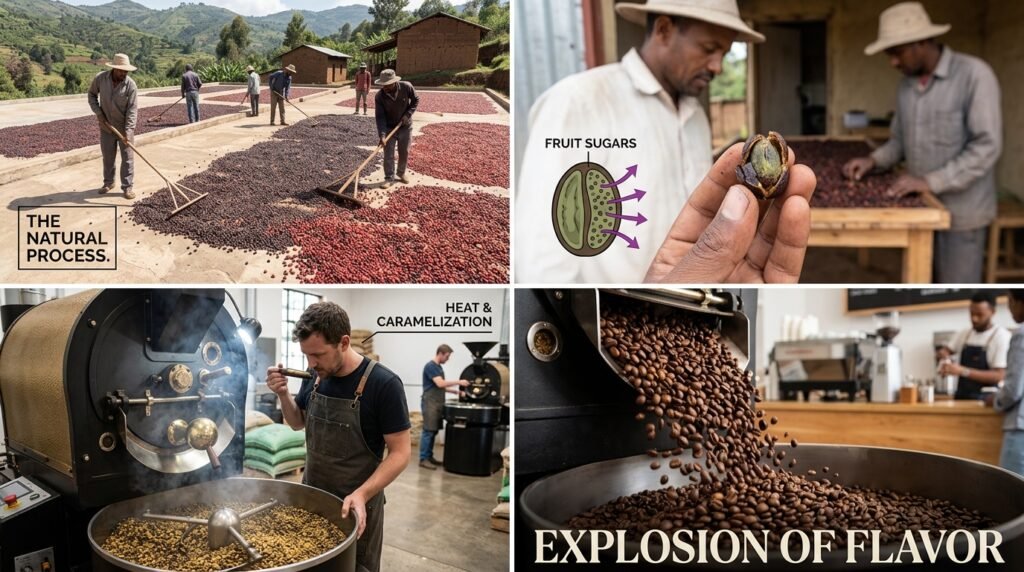
They take the whole, freshly picked coffee cherries and lay them out on raised wooden beds under the hot tropical sun. They leave the skin and the sticky fruit completely intact. The cherries sit in the sun for weeks.
The hot sun slowly bakes the cherries. They shrivel up and turn into dark, hard raisins.
This method requires intense physical labor. The farmers must constantly turn the drying cherries by hand. If the cherries sit still, the damp fruit will grow toxic mold and ruin the entire harvest.
Baking Sugar into the Cell Walls
The natural process is essentially a massive, slow fermentation event.
As the thick fruit dries and rots around the seed, the biology of the seed reacts. The coffee bean is highly porous. It acts like a biological sponge. For three weeks, the seed physically absorbs the heavy, fermented sugars of the rotting fruit directly into its cellular structure.
The sun bakes the strawberry and blueberry notes of the mucilage deep into the core of the bean.
When a roaster applies heat to a natural processed bean, those absorbed fruit sugars violently caramelize inside the drum. The resulting flavor is an absolute explosion of heavy, syrupy fruit.
The Direct Comparison
I needed to taste this chemical difference immediately. Reading about botany was not enough. I needed physical proof in my kitchen.
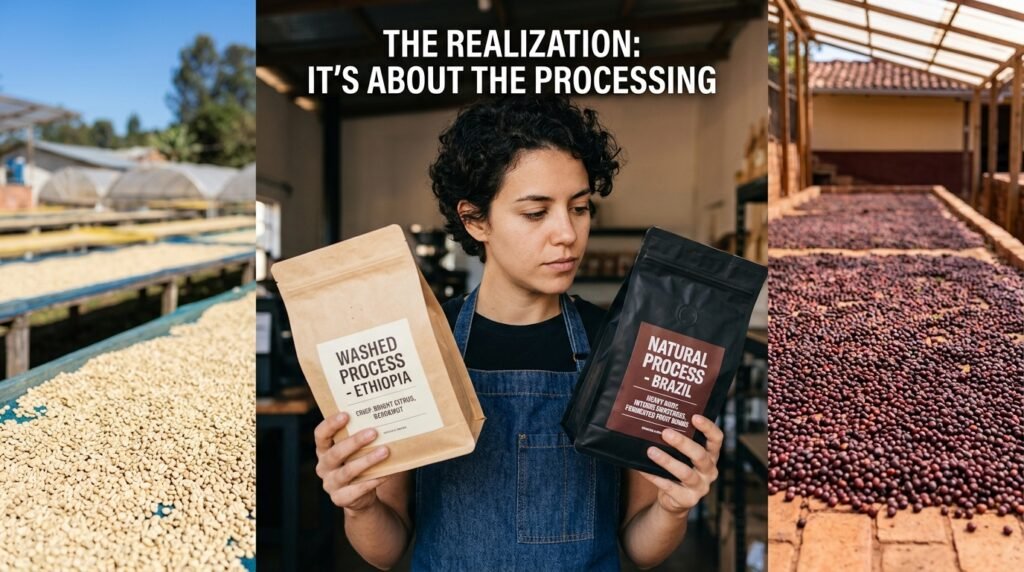
I went to a local specialty coffee roaster in Rio. I bought two bags of coffee. They were both from the exact same farm in Ethiopia. They were both light roasts. One bag was fully washed. The other bag was naturally processed.
Executing this specific physical test was exactly The Day I Compared Two Different Coffee Beans Side by Side because it isolated a single variable. The dirt was identical. The genetics were identical. The roasting oven was identical. The only changing variable was the fruit removal.
The Visual and Aromatic Contrast
I poured both coffees onto a white plate.
The washed beans looked pristine. They were a perfectly uniform, smooth matte tan color. They looked like clean pebbles.
The natural beans looked entirely different. They were slightly darker and uneven. They had tiny patches of brown, dried skin clinging to the center crease of the bean. They looked wild and unrefined.
I ground twenty grams of the washed coffee. The dry grounds smelled exactly like sweet black tea and fresh spring flowers. It was a very sharp, clean aroma.
I wiped the grinder clean and ground twenty grams of the natural coffee. The aroma completely hijacked my kitchen. It smelled aggressively sweet. It smelled exactly like a jar of warm strawberry jam. The fermented fruit sugars were impossible to ignore.
The Grinder Physics
The processing method also changed how the beans reacted to my ceramic burrs.
Because the washed beans were stripped bare before drying, their cellular structure was incredibly tight and dense. They ground cleanly and produced very uniform particles.
The natural beans were different. Because they fermented inside the fruit, their cellular structure was slightly degraded. They felt slightly softer in the hand grinder. They shattered differently.
Natural processed coffees produce significantly more microscopic coffee dust during the grinding phase. This dust is known as fines. Fines sink to the bottom of the paper filter and clog the water flow.
I knew I had to adjust my brewing technique. If I poured the water too fast over the natural coffee, the filter would clog completely. The water would stall, and the coffee would taste harsh and bitter.
The Dual Drawdown
I set up two glass V60 cones on my counter. I boiled my gooseneck kettle.
I poured the hot water over both coffee beds. The washed coffee drained smoothly and predictably. The liquid dripping into the mug was a bright ruby color.
The natural coffee was a struggle. The massive amount of fines clogged the paper filter exactly as I expected. I had to pour the water much slower. I had to keep the water level very low to prevent a massive stall. The liquid dripping into the second mug was significantly darker and thicker.
Tasting the Pure Soil
I picked up the mug containing the washed Ethiopian coffee. I took a slow sip.
The clarity was stunning. It hit my palate with a bright, crisp flash of lemon acidity. The flavor quickly transitioned into a delicate, sweet floral note. It tasted exactly like an expensive cup of Earl Grey tea.
There was zero heaviness. There was no muddy, lingering aftertaste. The coffee was perfectly transparent. I was tasting the exact volcanic composition of the high altitude dirt.
Tasting the Fermented Fruit
I drank a glass of water to clean my palate. I picked up the mug containing the natural Ethiopian coffee.
I took a sip. My brain struggled to process the contrast.
The liquid was incredibly heavy and syrupy. The crisp lemon acidity was completely gone. Instead, a massive, aggressive flavor of ripe blueberries and strawberries coated my entire mouth. It tasted like I was drinking melted fruit candy.
The sweetness was profound. Experiencing that explosive fruit note was precisely The Coffee Flavor That Made Me Want to Learn More and forced me to respect the biology of the fermentation. The farmer had successfully transferred the sticky fruit flesh directly into the hard brown seed.
The Middle Ground
Later that week, I learned there is actually a third major processing method. It sits perfectly between the washed and natural extremes. It is called the honey process.
In a honey process, the farmer uses a machine to strip the outer skin off the cherry. But instead of soaking the seeds in water tanks to remove the sticky mucilage, they leave a specific amount of the sticky fruit attached to the seed. They put these sticky seeds directly into the sun to dry.
The sticky mucilage turns a golden brown color in the sun. It looks exactly like honey.
The honey process produces a coffee that has the clean, crisp acidity of a washed coffee, but retains a hint of the heavy, sweet body of a natural coffee. It is a brilliant, labor intensive compromise.
Changing My Buying Habits
My perspective on the entire coffee industry completely shifted after that Friday morning.
I realized that blindly buying a coffee just because it says “Ethiopia” or “Brazil” on the bag is a massive mistake. The country of origin only dictates fifty percent of the flavor. The processing method dictates the rest.
I now interrogate every single bag of coffee I buy.
If I wake up on a hot morning and want a refreshing, bright, highly acidic beverage, I strictly buy washed coffees. I know the clean processing will deliver that crisp clarity.
If I want a heavy, comforting, intensely sweet dessert beverage after dinner, I specifically hunt for natural processed coffees. I want the fermented fruit bombs.
The Complete Agricultural Picture
We spend massive amounts of money on precision scales, gooseneck kettles, and expensive ceramic grinders. We treat our kitchen counters like sterile chemistry laboratories.
But none of that equipment matters if you do not understand the raw material.
Coffee is not a factory product. It is the hard pit of a tropical fruit. It must be separated from its sweet flesh. The method the farmer chooses to perform that separation completely rewrites the chemical potential of the seed.
Tomorrow morning, look closely at your bag of coffee. Find the word “Washed” or “Natural” on the label. Think about the massive water tanks. Think about the raised wooden beds baking under the African sun. When you understand the physical labor required to process the fruit, your morning cup of coffee stops being a simple caffeinated drink. It becomes a brilliant display of global agricultural science.

Hi, I’m the coffee enthusiast behind Coffee Nerd Lab.
Like many people, I started drinking coffee simply because it helped me wake up in the morning. Over time, that daily habit turned into a genuine interest in understanding what makes a great cup of coffee. I began experimenting with different beans, brewing methods, grinders, and coffee gear, learning through trial and error along the way.
This blog is where I document that journey. Every article is inspired by real experiences, discoveries, and lessons I’ve learned while exploring the world of coffee. From brewing guides and equipment reviews to practical tips and coffee basics, my goal is to share useful information in a way that’s easy to understand and enjoyable to read.
Thanks for stopping by, and I hope Coffee Nerd Lab helps you enjoy your next cup a little more than the last.