I was monitoring a massive spike in web traffic on a Friday morning. One of the sites I manage in Rio de Janeiro was receiving thousands of simultaneous visitors. The server was struggling to handle the sudden, violent flood of data. I had to quickly implement a digital queue to slow the traffic down. The system needed a steady, controlled stream of requests, not a chaotic waterfall.
I successfully stabilized the server. I locked my computer and walked into the kitchen to clear my head.
I set up my glass V60 cone to make a cup of coffee. I weighed my light roasted Ethiopian beans. I ground them perfectly in my manual burr grinder. I grabbed my standard kitchen tea kettle to pour the boiling water.
I tilted the heavy plastic pitcher over the delicate coffee grounds. A massive, uncontrolled wave of water dumped into the glass cone.
I watched the extraction fail instantly. I realized my coffee routine suffered from the exact same problem as my client’s website. I was flooding the system with a chaotic, unpredictable stream of data. The coffee kettle that improved my pour over was a stainless steel gooseneck. It taught me that water delivery is a strict mechanical science, and it completely rescued my morning routine from the chaos of the flood.
The Geometry of the Cone
To understand why a standard kettle fails, you have to understand the shape of the brewer.
I use a V60 pour over cone. It is shaped like a steep funnel. This specific geometry is designed to create a deep coffee bed. The water is forced to travel through a thick layer of grounds before it exits the bottom of the filter.
This deep bed is fantastic for extracting heavy, complex flavors. But it comes with a massive mechanical vulnerability.
If you introduce water too quickly, the cone shape amplifies the violence. The water has nowhere to go. It bounces off the steep walls. It creates massive, chaotic turbulence. The coffee grounds are tossed around blindly.

The Brute Force Attack
My old plastic tea kettle had a wide, short spout. It was designed to fill massive soup pots as fast as possible.
When I tilted it over the V60 cone, I could not control the flow rate. The boiling water fell in a heavy, destructive column. It hit the delicate coffee bed like a physical weapon.
This brute force attack caused two massive chemical failures immediately.
The first failure was channeling. The heavy column of water acted like a drill. It bored a deep, physical crater directly into the center of the coffee grounds. Water is incredibly lazy. It will always take the path of least resistance.
The boiling water rushed straight down that deep crater. It violently over extracted the coffee particles in the center of the cone. It pulled harsh, bitter tannins into the mug.
The Error of the Bypass
The second failure was bypassing.
Because the heavy waterfall drilled a hole in the middle, it violently pushed the rest of the dry coffee grounds up against the steep paper walls. The coffee bed looked like a hollow bowl.
As I continued to pour, the water hit those high, dry grounds and immediately ran down the outside of the paper filter. The water completely bypassed the actual coffee. It fell directly into my mug as plain, unflavored hot water.
The resulting beverage was a confusing disaster. It was overwhelmingly bitter from the center crater, but it was also weak and watery from the bypass.
Identifying this mechanical failure was the foundation of My Experience Making Coffee with a Pour Over Kettle and it forced me to stop blaming the coffee beans for a hardware problem. The hardware was destroying the ingredient.
Seeking the Proper Tool
I realized I needed a tool designed specifically for the geometry of the cone. I needed a tool that restricted the flow of water naturally.
I went online and purchased a specialized gooseneck kettle. It was built from heavy matte black stainless steel. It had a thick, ergonomic handle.
The most important feature was the spout. It originated at the very bottom of the heating chamber. It swept upward in a long, elegant, S shaped curve. The opening at the very tip was incredibly narrow.
It looked strange. It did not look like a traditional kitchen appliance. It looked like a piece of precision laboratory equipment.
Testing the Mechanics
The kettle arrived at my apartment a few days later. I washed it, filled it with filtered water, and placed it on the stove.
I wanted to test the physical mechanics before I wasted any expensive Ethiopian coffee. I took the boiling kettle and tilted it over my kitchen sink.
The difference was immediately obvious. The water did not dump. It did not splash.
The water exited the narrow tip in a perfectly smooth, solid line. It looked like a single, unbreakable rod of clear glass. In fluid dynamics, this is called laminar flow. The long curved neck of the kettle forces the chaotic, boiling water molecules to align perfectly before they exit.
The water fell straight down. It hit the exact spot I aimed for.
The Ergonomic Advantage
I also noticed a massive difference in my physical posture.
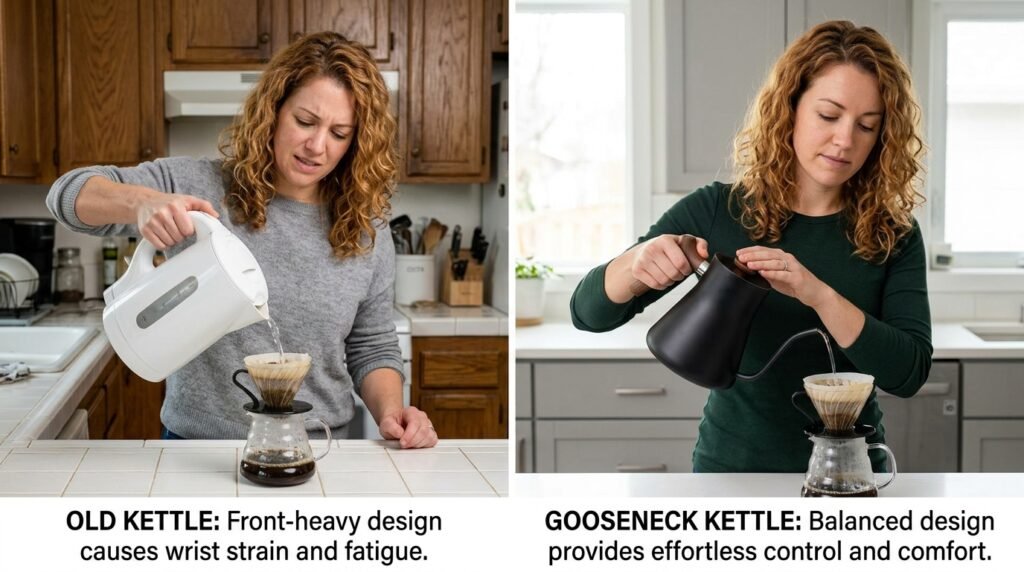
My old plastic kettle was front heavy. When it was full of water, I had to severely strain my wrist to keep it tilted at a shallow angle. My hand would constantly shake. That shaking created more turbulence in the water stream.
The gooseneck kettle was perfectly balanced. The heavy handle sat far back, acting as a counterweight to the long spout. The center of gravity rested directly over my wrist.
I could hold the kettle at a pouring angle for three straight minutes without any physical fatigue. My hand remained perfectly still. Absolute control requires physical comfort.
Mastering the Bloom
I ground twenty grams of my light roasted Ethiopian Guji. I set up my glass V60 cone and placed my mug on the digital scale.
I grabbed the heavy metal gooseneck kettle. I was ready to apply the controlled data stream to the system.
I started the bloom phase. I poured exactly forty grams of hot water. The precision spout allowed me to gently wet the dry grounds without aggressively disturbing the bed. I did not dig a crater. I simply laid a gentle blanket of water over the seeds.
The coffee responded beautifully. The dense African beans swelled upward uniformly. The trapped carbon dioxide gas escaped in a perfectly smooth, even dome.
Mastering this specific chemical release was the core lesson in The Pour Over Technique That Finally Worked for Me and it established the perfect foundation for the rest of the extraction. A gentle bloom guarantees an even brew.
The Science of Agitation
I waited forty five seconds for the gas to dissipate. I resumed pouring.
Because I finally had a laminar flow that fell straight down, I could actively manage the agitation. Agitation is the physical tumbling of the coffee particles in the water. You need a specific amount of agitation to extract the dense sugars, but too much agitation causes bitter astringency.
I started pouring in slow, tight concentric circles.
I started directly in the center of the cone. I slowly spiraled outward toward the edges, and then carefully spiraled back inward. I kept the stream of water incredibly thin and consistent.
The coffee particles tumbled gently inside the glass cone. The water washed every single grain of coffee evenly. Nobody was trapped at the bottom. Nobody was pushed up the sides.
Controlling the Brew Time
The narrow spout also fixed my drawdown times automatically.
With my old kettle, I would dump all the water in thirty seconds. The coffee would finish draining in under two minutes. The extraction was always rushed and underdeveloped.
The gooseneck kettle physically restricts the volume of water leaving the chamber. I simply could not pour too fast, even if I tried.
Focusing on this slow, steady delivery was exactly What I Learned After Brewing Coffee More Carefully and it completely changed my extraction yields. The restricted flow allowed me to stretch the pouring phase out to a full two minutes.
The coffee bed remained fully submerged, but the water level never rose too high. The extraction was perfectly steady and deeply controlled.
The Flat Bed of Success
I watched the scale hit my target weight of three hundred and twenty grams. I tilted the kettle back. The water flow stopped instantly without a single stray drip.
I waited for the ruby red liquid to finish draining into my mug. I looked down into the glass V60 cone.
The spent coffee grounds told the entire story. They formed a perfectly flat, clean bed at the bottom of the paper filter. It looked like a smooth layer of wet sand on a beach. There was no deep crater. There were no dry grounds stuck high on the paper walls.
The flat bed is the ultimate visual proof of a successful pour over. It proves that the hot water traveled through the entire mass of coffee at the exact same rate.
Tasting the Precision
I removed the glass cone and tossed the paper filter in the trash. I carried my ceramic mug to my desk.
I waited three minutes for the liquid to cool. I took a slow sip while looking at my computer monitor.
The flavor was absolutely pristine. The chaotic, muddy confusion of my previous cups was entirely gone. A massive wave of bright lemon acidity hit the front of my palate. It tasted incredibly juicy and vibrant. That bright citrus note instantly melted into a heavy, sweet peach flavor.
As I swallowed, a clean, lingering note of jasmine flowers coated my throat.
There was zero harsh bitterness. There was zero weak sourness. The coffee tasted exactly like the high altitude volcanic dirt it was grown in. The hardware upgrade had successfully removed the mechanical interference.
The Necessity of the Tool
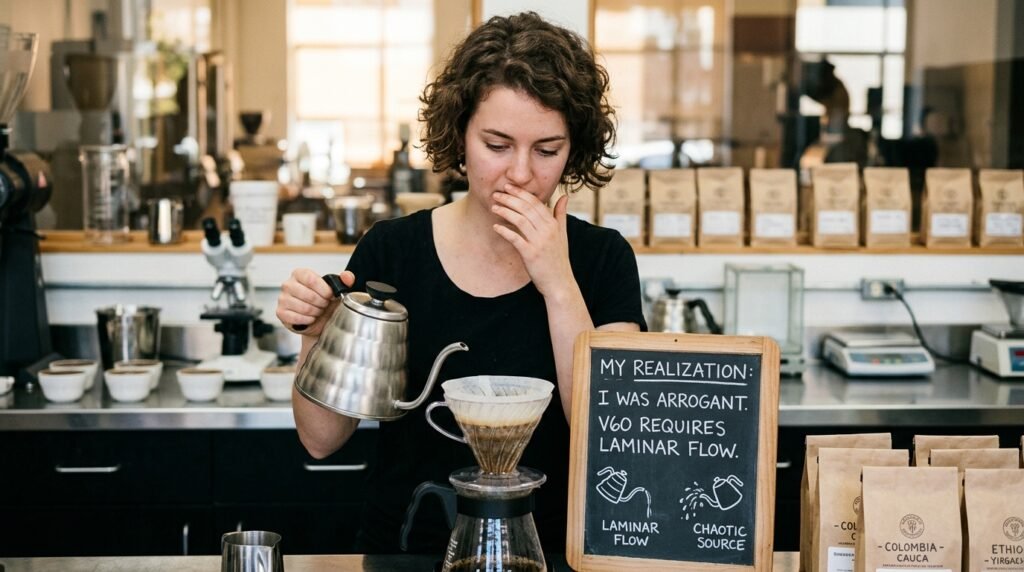
I sat at my desk and realized how arrogant I had been.
I spent months blaming the coffee roasters for bad bags of beans. I blamed the water temperature. I blamed the grind size. I blamed everything except my own pouring technique.
I thought the gooseneck kettle was a pretentious aesthetic choice. I thought it was just a prop for expensive coffee shops. I was entirely wrong. It is a fundamental mechanical requirement for the V60 geometry.
You cannot successfully brew a steep cone filter without laminar flow. If you use a chaotic water source, you will get a chaotic extraction.
The Final Variable
We spend so much time obsessing over the input data. We buy expensive scales to measure our ratios. We buy expensive burr grinders to ensure perfectly uniform particle sizes.
But water is the actual solvent that performs the chemical extraction. If you cannot deliver that solvent with precision, the rest of your expensive equipment is completely useless.
Take a critical look at your kitchen counter tomorrow morning.
If you are using a standard plastic tea kettle or a wide mouth pot to brew a manual pour over, you are actively ruining your expensive coffee beans. You are drilling craters and bypassing the filter.
You need to buy the specialized tool. You need the heavy metal, the perfect balance, and the long curved spout. Once you experience the absolute control of a smooth, glassy stream of water, your morning routine stops being a guessing game. You stop flooding the server, and you finally start extracting the exact flavor the farmer intended.

Hi, I’m the coffee enthusiast behind Coffee Nerd Lab.
Like many people, I started drinking coffee simply because it helped me wake up in the morning. Over time, that daily habit turned into a genuine interest in understanding what makes a great cup of coffee. I began experimenting with different beans, brewing methods, grinders, and coffee gear, learning through trial and error along the way.
This blog is where I document that journey. Every article is inspired by real experiences, discoveries, and lessons I’ve learned while exploring the world of coffee. From brewing guides and equipment reviews to practical tips and coffee basics, my goal is to share useful information in a way that’s easy to understand and enjoyable to read.
Thanks for stopping by, and I hope Coffee Nerd Lab helps you enjoy your next cup a little more than the last.