My phone buzzed on the kitchen counter just as I was finishing my dinner. I glanced at the screen and saw a text message from my friend, Mark.
It wasn’t a question about our weekend plans or a funny internet meme. It was a slightly blurry, poorly lit photograph taken inside the home appliance aisle of a big-box retail store. The photo featured a shiny, aggressively modern-looking espresso machine with a price tag of $450 prominently displayed on the shelf.
Beneath the photo, Mark had sent a single, desperate text message: “I am so tired of drinking terrible office coffee. Should I buy this to make good stuff at home?”
I immediately unlocked my phone and typed my response as fast as my thumbs would allow.
“Put the box down. Step away from the machine. Do not buy that.”
As the resident coffee nerd in my friend group, I get these types of frantic messages at least once a month. Whenever someone finally hits their breaking point with bitter, burnt, or watery morning sludge, their instinct is always the same. They assume that the solution to bad coffee is a massive financial investment in complex machinery. They think a shiny machine with buttons, dials, and a milk frother will magically fix their mornings.
But that is the biggest lie in the coffee industry.
When Mark eventually called me from the parking lot, slightly annoyed that I had talked him out of his impulse purchase, we had a long conversation. I gave him the exact same speech I give to anyone who asks me how to upgrade their morning mug. If you are standing at the edge of the specialty coffee rabbit hole, wondering where to jump in, this is the first thing I will tell you.
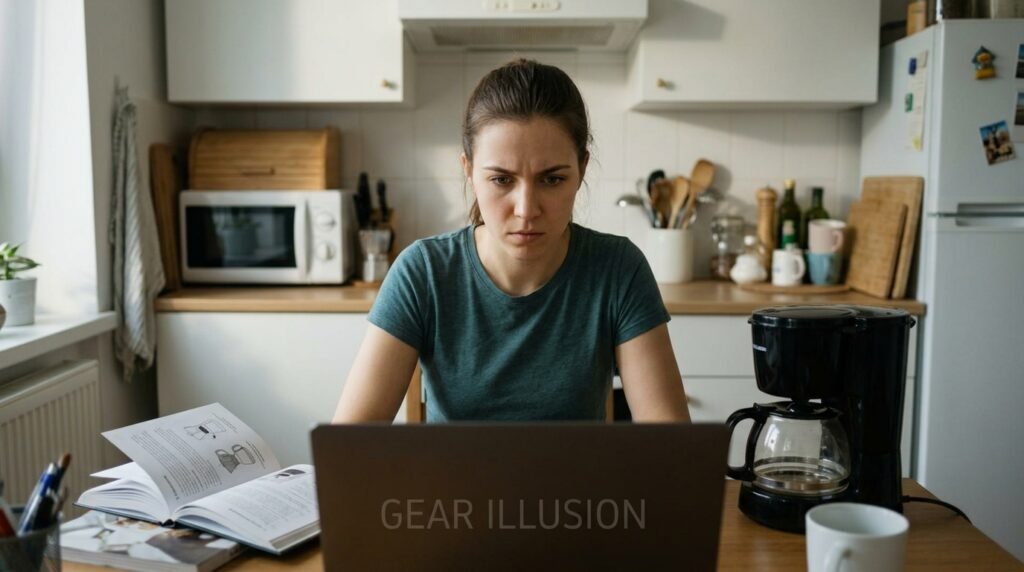
The Gear Illusion
The most common misconception about brewing better coffee is what I like to call the “Gear Illusion.”
We have been conditioned by clever marketing to believe that cafés produce amazing coffee because they have espresso machines that cost as much as a used car. We see the gleaming chrome, the heavy portafilters, and the hissing steam wands, and we logically conclude that the machine is doing all the heavy lifting.
Therefore, if we want café-quality drinks at home, we need to buy a miniature version of that machine.
But here is the harsh reality: A coffee machine does not make coffee. A coffee machine simply heats up water and pushes it over coffee grounds. That is all it does. It is a water delivery system.
If you buy a $500 machine, take it home, and feed it the exact same stale, low-quality, over-roasted supermarket coffee beans you have always been drinking, that machine will not perform miracles. It will simply give you a highly efficient, perfectly heated, incredibly expensive cup of stale, low-quality coffee.
You cannot out-brew bad beans. The machine is completely secondary to the ingredient itself. This is the hardest pill for beginners to swallow because buying a gadget feels like an immediate solution. But buying better beans requires changing your entire perspective on what coffee actually is.
The True First Step: Hunt for the Date
When Mark asked me over the phone what he should buy instead of the espresso machine, I told him to go to the grocery store. Not the appliance aisle, but the coffee aisle.
“I want you to pick up your favorite bag of coffee,” I told him. “And I want you to turn it around and look for a date.”
This is the foundational rule of drinking better coffee. It is the absolute first step. You must stop looking at the artwork on the front of the bag, and you must start relentlessly hunting for a date stamped on the back or the bottom.
However, you are not looking for an expiration date. An expiration date is a useless metric invented by massive corporations to keep their product on the shelf for two years. Coffee is an agricultural product. It is the roasted seed of a tropical fruit. And just like a loaf of bread from a local bakery, it goes stale.
You are looking for a “Roasted On” date.
This simple shift in how you shop is monumental. If a bag of coffee does not proudly tell you the exact day it was roasted, you should not buy it. It means the roaster is prioritizing shelf life over flavor.
When you find a bag of coffee that was roasted within the last two to three weeks, you are holding a product that is alive. It still contains all of its volatile aromatic compounds, delicate natural sugars, and vibrant acids. Discovering this difference is like waking up from a culinary coma, a realization I detailed extensively in The Day I Finally Understood Why Fresh Coffee Beans Matter. Once you taste a bean that is actually fresh, the heavy, bitter ashiness of commercial coffee becomes intolerable.
The “Whole Bean Only” Mandate
Of course, finding a bag of coffee with a recent roast date introduces a new, slightly inconvenient challenge for the absolute beginner.
If you are buying fresh coffee from a reputable specialty roaster, it will almost certainly be sold as whole beans. It will not be pre-ground into a fine powder.
When friends ask me if they can just ask the barista at the local café to grind the whole bag for them before they take it home, I always give them a firm “No.”
Coffee beans are nature’s perfect little storage vaults. The hard, roasted outer shell of the bean protects all the beautiful, complex flavors trapped inside. The enemy of these flavors is oxygen.
The moment you grind a coffee bean, you shatter that protective vault into thousands of microscopic pieces. You expose all of those delicate oils directly to the air. Within fifteen minutes of grinding, a massive percentage of the coffee’s aromatic complexity simply evaporates into the atmosphere.
If you have a café grind an entire bag of fresh coffee for you, it will smell incredible in your car on the drive home. But by Tuesday morning, that coffee will be completely stale. It will have lost its vibrancy. You are basically paying premium prices for specialty coffee and then letting the oxygen rob you of the experience.
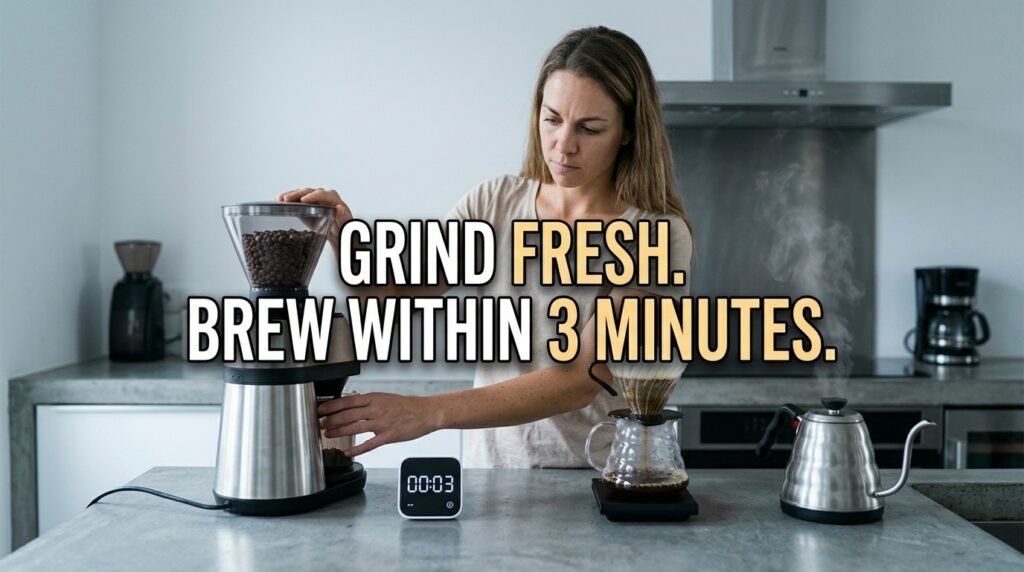
You have to grind the beans yourself, in your own kitchen, exactly three minutes before you pour the hot water over them. There is no shortcut around this rule.
The Only Piece of Gear You Actually Need
This brings us to the only piece of equipment I will ever tell a beginner to buy.
When Mark put the $450 espresso machine back on the shelf, I told him to take a fraction of that money and invest it in the single most important tool in any coffee lover’s kitchen.
A quality burr grinder.
Notice that I specifically said a burr grinder, not a blade grinder. This distinction is crucial.
Many people own those cheap, $20 electric grinders that look like little blenders. They have two metal blades that spin at incredibly high speeds. The problem with a blade grinder is that it doesn’t actually grind your coffee; it aggressively violently chops it.
When you use a blade grinder, you end up with a chaotic mixture of coffee dust and massive, chunky boulders. When you try to brew that uneven mixture, the hot water over-extracts the dust (making your coffee bitter) and under-extracts the boulders (making your coffee sour). You get a terrible, confusing cup of coffee.
A burr grinder, on the other hand, uses two heavy ceramic or steel burrs to crush the coffee beans to a perfectly uniform, exact size. Every single grain of coffee ends up being the exact same dimension.
This uniformity allows the hot water to extract the flavor evenly. Upgrading to a proper grinding mechanism is the biggest leap in quality you can make, and it’s the exact reason Why I Finally Decided to Buy a Coffee Grinder after years of fighting with cheap equipment. It is the ultimate bottleneck of coffee quality. If your grind is uneven, your coffee will be bad, regardless of how much the beans cost.
The $20 Brewing Solution
“Okay,” Mark said over the phone, pacing in the parking lot. “So I buy fresh, whole beans. I buy a good hand grinder. But how do I actually make the coffee without a machine?”
This is the easiest part of the conversation.
You don’t need electricity to make world-class coffee. In fact, some of the best cups of coffee I have ever had in my life were made with pieces of equipment that cost less than twenty dollars.
If you want a heavy, rich, and full-bodied cup of coffee, go to the store and buy a simple glass French Press. It requires zero technique. You put coarse coffee grounds in the bottom, pour hot water over them, wait four minutes, and press the plunger down. It is entirely foolproof.
If you prefer a cleaner, brighter, and more tea-like cup of coffee, buy a plastic V60 pour-over cone. It sits directly on top of your favorite mug. You put a paper filter inside, add medium-ground coffee, and slowly pour hot water over it.
These manual methods are incredibly cheap, they are indestructible, and they give you absolute control over the brewing process. By removing the complicated, expensive machines from the equation, you are forced to focus entirely on the ingredients.
The Shift in Mindset
The final piece of advice I give to my friends doesn’t involve gear, or beans, or water temperature. It involves psychology.
Making the switch from an automatic drip machine with pre-ground supermarket coffee to a manual brewing method with fresh, whole beans requires a fundamental shift in your morning routine.
It requires patience.
You can no longer just hit a button and walk away to take a shower. You have to stand in your kitchen. You have to physically weigh the beans. You have to listen to the crunch of the grinder. You have to boil the water and watch the coffee grounds bloom and bubble as you pour.
Initially, this feels like an inconvenience. It feels like an obstacle standing between you and your caffeine. But if you stick with it, something magical happens. This process transforms from a tedious chore into a deeply calming morning ritual.
It becomes a moment of forced mindfulness before the chaos of the workday begins. Leaning into this slowness is transformative, and it is absolutely The First Coffee Habit I Recommend to Beginners who feel overwhelmed by the technicalities of brewing. The peace of the process is just as rewarding as the taste of the cup.
The Taste Shock Warning
Before I hung up the phone with Mark, I gave him one final warning.
When you follow these steps—when you finally brew a cup of freshly roasted, freshly ground, high-quality specialty coffee—it is going to taste weird.
If you have spent your entire life drinking dark, bitter diner coffee that requires three packets of sugar and a heavy pour of cream to be drinkable, your palate is going to be incredibly confused.
A properly brewed cup of light-roast specialty coffee does not taste like ash or burnt toast. It is naturally sweet. It has a bright, vibrant acidity that resembles fresh fruit. You might taste notes of milk chocolate, caramel, blueberry, or even jasmine flowers. It will feel much lighter on your tongue.
Do not panic. Do not immediately dump a cup of milk into it.
Give your tastebuds a week to adjust to this new reality. Sip it slowly. Pay attention to how the flavor changes as the coffee cools down in the mug. Let yourself experience the natural complexity of the agricultural product you just brewed.
The Journey Begins
Mark didn’t buy the $450 espresso machine that day.
Instead, he ordered a high-quality manual burr grinder online. He drove to a local coffee roaster downtown and bought a small bag of whole beans that had been roasted just two days prior. He pulled an old, dusty French Press out of the back of his kitchen cabinet.
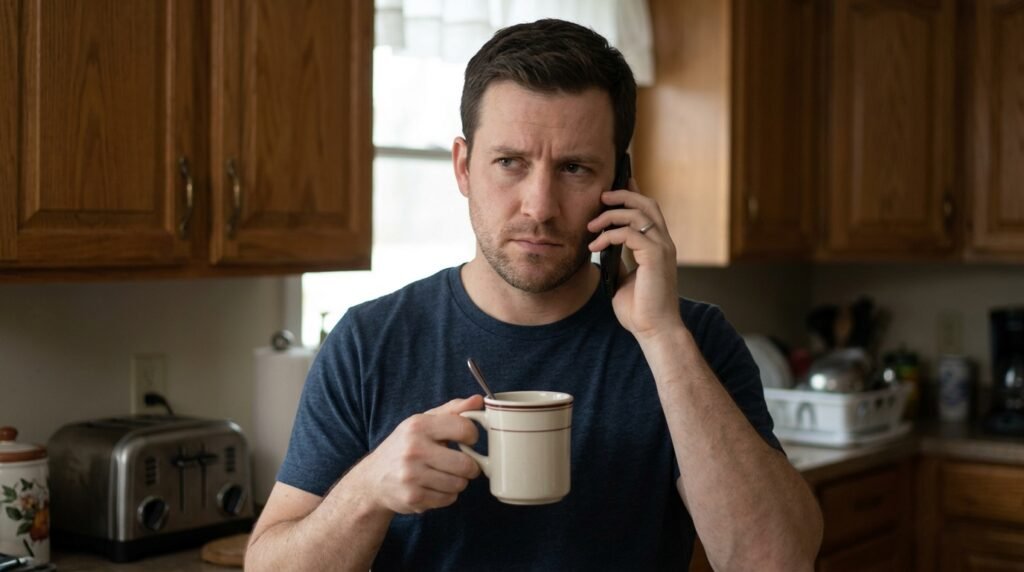
A week later, I got another text message from him. It was a photo of a steaming black cup of coffee sitting on his kitchen table.
There was no frantic question attached this time. The message simply said: “I taste the chocolate. I actually taste it. I am never going back.”
That is the beauty of starting this journey correctly. You don’t need to empty your bank account to drink better coffee. You don’t need a degree in thermodynamics or a kitchen that looks like a science lab. You just need to respect the bean, invest in a decent grinder, and slow down your morning. The rest will naturally fall into place.
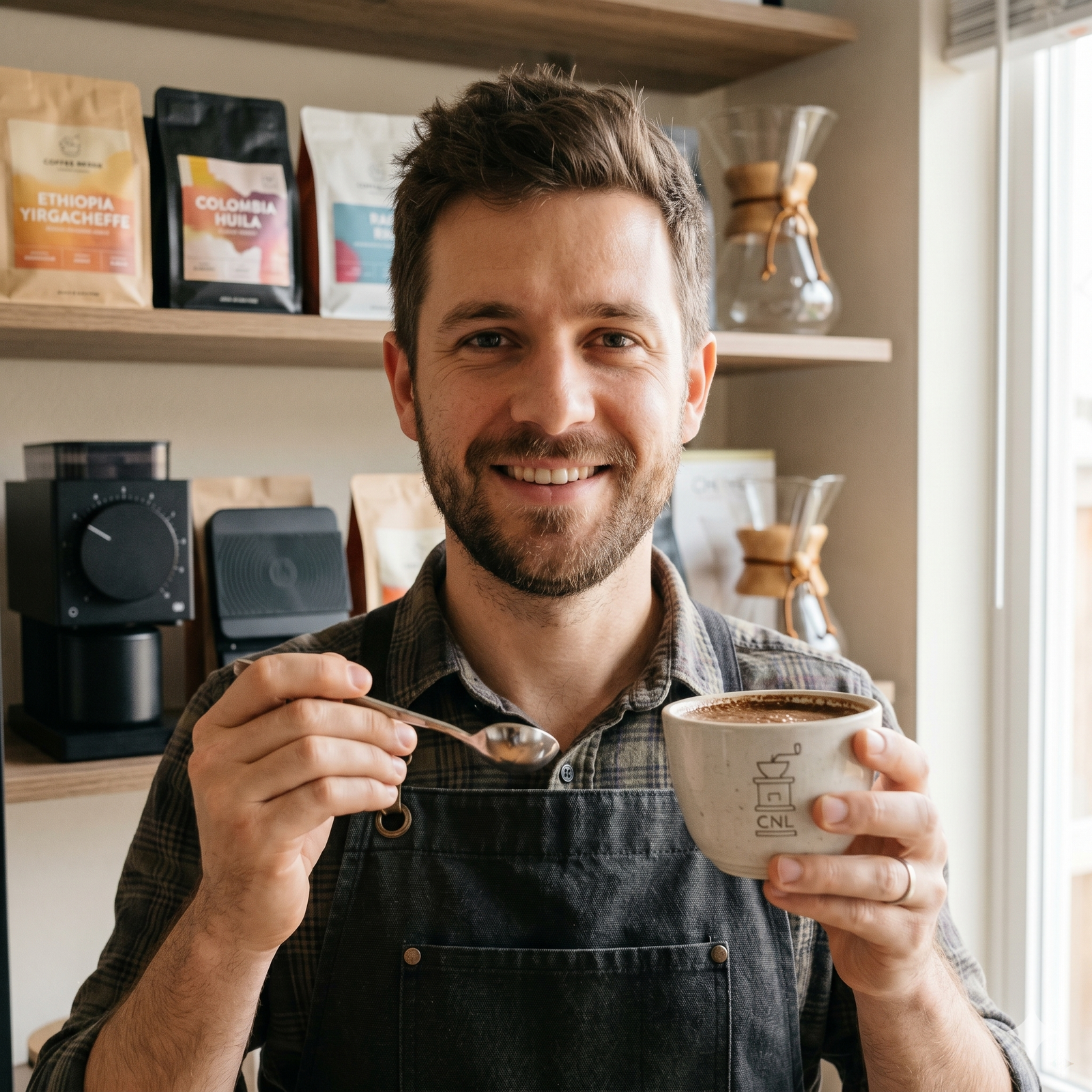
Hi, I’m the coffee enthusiast behind Coffee Nerd Lab.
Like many people, I started drinking coffee simply because it helped me wake up in the morning. Over time, that daily habit turned into a genuine interest in understanding what makes a great cup of coffee. I began experimenting with different beans, brewing methods, grinders, and coffee gear, learning through trial and error along the way.
This blog is where I document that journey. Every article is inspired by real experiences, discoveries, and lessons I’ve learned while exploring the world of coffee. From brewing guides and equipment reviews to practical tips and coffee basics, my goal is to share useful information in a way that’s easy to understand and enjoyable to read.
Thanks for stopping by, and I hope Coffee Nerd Lab helps you enjoy your next cup a little more than the last.