

My partner and I were sitting in our apartment in Rio de Janeiro on a quiet Sunday morning. The laptop was completely shut. There were no website server alerts to fix. There were no urgent database migrations to manage. It was a day dedicated strictly to rest and physical presence.
I walked into the kitchen to prepare our morning coffee.
I had an incredibly precise setup. I used a heavy manual burr grinder. I used a digital scale. I used a variable temperature gooseneck kettle. I was brewing a highly complex, light roasted Ethiopian coffee. My mechanics were flawless. I controlled every single mathematical variable perfectly.
But my physical presentation was terrible.
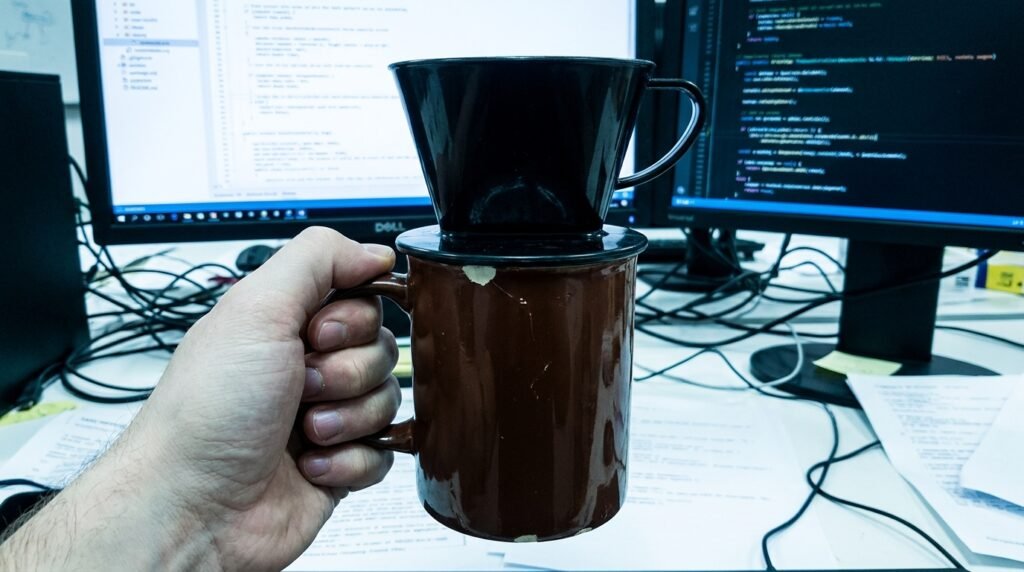
I took my glass V60 cone and placed it directly on top of a massive, heavy, dark ceramic mug. I poured the hot water. The coffee dripped straight down into the black hole of the cup. The coffee tool that made me enjoy brewing more was a simple, clear glass carafe. It completely changed the psychology of my kitchen. It transformed a mechanical routine into a deeply satisfying visual and sensory experience.
The Utilitarian Trap
For a very long time, I viewed coffee purely as a utility. I viewed it as fuel for my digital workload.
When you treat coffee as fuel, you ignore the aesthetics of the process. You just want the caffeine delivered to your desk as fast as possible. Brewing directly into a massive ceramic mug makes perfect sense for this utilitarian mindset. It requires fewer dishes to wash. It feels highly efficient.
But specialty coffee is an expensive agricultural product. It deserves more than raw efficiency.
By brewing straight into an opaque mug, I was actively ignoring the beauty of the extraction. I was hiding the physical result of all my hard work. I bought precision tools, but I refused to look at the data they produced.
The Blind Extraction
Brewing directly into a mug causes a severe visual blind spot.
When you place a plastic or glass cone over a thick ceramic cup, you cannot see the liquid accumulating. You are completely blind to the actual volume inside the vessel. You have to rely entirely on the digital numbers on your scale to know when to stop pouring.
If your scale suddenly breaks or runs out of batteries halfway through the pour, you are in immediate danger of overflowing the mug.
More importantly, you miss the visual feedback of the flow rate. You cannot see how the coffee is actually dripping from the bottom of the filter. You cannot tell if it is falling in a steady stream or choking in slow, heavy drops. You lose critical mechanical data.
The Temperature Prison
The second massive problem with a thick ceramic mug is thermal retention.
Ceramic is a highly effective insulator. When you brew coffee directly into a heavy mug, the liquid enters the vessel at nearly two hundred degrees Fahrenheit. The ceramic walls trap that extreme heat completely.
The coffee remains dangerously hot for twenty minutes. If you try to drink it immediately, you will severely burn your palate.
Extreme heat acts like a heavy blanket over your tongue. It completely masks delicate flavor profiles. You cannot taste the complex peach acidity of an African coffee when the liquid is burning your throat. The heat simply destroys your sensory receptors. You are forced to sit and wait indefinitely for the mug to naturally cool down.
Discovering the Glass Server
I wanted to fix these sensory problems. I looked at professional coffee bars for inspiration.
Professional baristas never brew directly into the customer’s cup. They always brew into a secondary vessel. They use clear glass pitchers. The coffee industry calls these pitchers coffee servers or carafes.
I ordered a high quality borosilicate glass server online. It cost roughly twenty dollars. It looked exactly like a scientific beaker from a chemistry laboratory. It had a wide base, a narrow neck, and a small glass handle.
I washed the clear glass vessel and placed it onto my digital scale.
The Visual Awakening
I set my dark plastic V60 cone directly on top of the glass server. I weighed my Ethiopian beans, ground them, and started my concentric pouring technique.
The immediate visual difference was stunning.
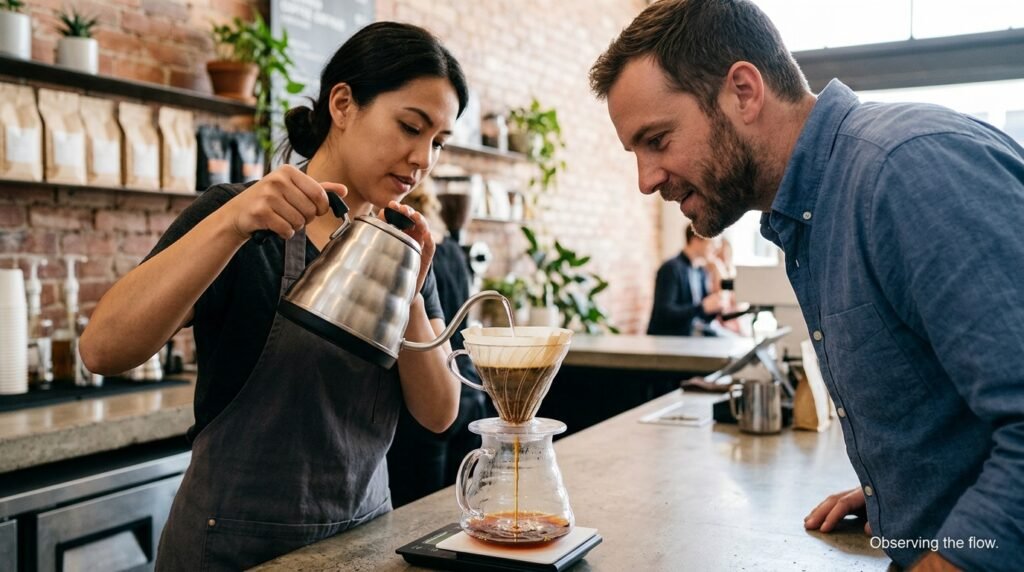
I could finally see the extraction happening. I watched the first drops of dark, heavy syrup fall from the paper filter and hit the bottom of the clean glass. As the extraction progressed, the liquid began to fill the wide base of the carafe.
I could see the exact color of the beverage. Because I was brewing a light roasted African coffee, the liquid was not black. When the bright morning light from my kitchen window passed through the glass carafe, the coffee glowed with a brilliant ruby red hue. It looked like a delicate, highly expensive tea.
The Mechanical Feedback
The clear glass also restored my mechanical data.
I could watch the exact flow rate of the liquid leaving the paper filter. I could see the steady, continuous stream. This visual confirmation proved that my grind size was perfect. The paper was not clogging. The water was passing through the dense coffee bed smoothly and evenly.
I felt incredibly connected to the process. I was no longer brewing blind. I was observing the chemical reaction in real time. The glass server turned my kitchen counter into a highly engaging visual display.
The Physics of Aeration
When the extraction finished, I removed the plastic cone and threw the paper filter in the trash. I picked up the glass server by its small handle.
This is where the true magic of the carafe happens. The wide base and narrow neck are engineered for a highly specific physical action. They are designed for aeration.
I slowly rotated my wrist. The ruby red coffee swirled aggressively around the wide glass base. The liquid climbed the walls of the carafe but could not escape the narrow neck.
By swirling the coffee, you force massive amounts of oxygen into the liquid. This is the exact same technique sommeliers use when they decant a heavy red wine.
Unlocking the Volatile Compounds
Coffee contains hundreds of volatile aromatic compounds. These compounds are responsible for the complex floral and fruit smells we associate with specialty beans.
When you brew coffee, many of these volatile compounds remain trapped inside the hot liquid.
Swirling the glass carafe violently disrupts the surface tension of the liquid. It forces those trapped aromatic compounds to physically detach from the water and launch into the air. The narrow neck of the carafe catches those vapors and funnels them directly upward.
Realizing this specific physical mechanism was the core of How I Learned to Appreciate Coffee Aroma More and it permanently changed my sensory approach. I leaned over the narrow opening and took a deep breath. The explosive smell of sweet peach and blooming jasmine flowers hit my brain instantly. The aroma was ten times stronger than it ever was in the ceramic mug.
The Thermal Drop
The swirling action provides a second massive benefit. It drastically accelerates the cooling process.
When you swirl the hot liquid against the cool glass walls, you expose a massive amount of surface area to the ambient air in the kitchen. The extreme thermal energy bleeds out of the coffee rapidly.
Within thirty seconds of gentle swirling, the temperature of the coffee dropped from dangerously boiling to comfortably warm.
The glass carafe acts as a perfect thermal regulator. It brings the coffee down to the exact temperature required for tasting. When the liquid is warm instead of burning hot, the human palate can finally detect the sweet fruit sugars and the delicate organic acids.
The Act of Decanting
With the coffee perfectly aerated and cooled, I grabbed two small ceramic cups from my cabinet.
I walked into the living room where my partner was sitting. I poured a small amount of the red liquid from the glass carafe into both cups.
This physical act of decanting completely changed the pace of the morning. Internalizing this calm pacing was exactly The Morning I Realized Coffee Could Be a Ritual because it forced me to stop rushing. I was no longer holding a massive, heavy mug of boiling liquid. I was holding a small, elegant tasting cup.
Redefining the Vessel
Because I was no longer brewing directly into the drinking vessel, I was free to change the actual cup I used.
I threw my massive, ugly travel mugs to the back of the cabinet. Finding the perfect vessel was the entire focus of How I Found the Perfect Coffee Mug for My Morning Routine and it led me to beautiful, thick walled ceramic tasting cups.
The small cup feels entirely different in the hand. It feels intentional. It forces you to take small, deliberate sips. You cannot mindlessly gulp the liquid. You have to pay attention to the texture and the flavor.
The Luxury of the Refill
The glass carafe completely elongates the coffee experience.
When you brew a large batch into a single mug, the coffee inevitably gets cold and stale before you finish the bottom half. You are racing against the clock.
When you use a carafe, the bulk of the liquid stays warm inside the glass server. You only pour two or three ounces into your small tasting cup at a time. You drink the small portion while it is perfectly warm. Then, you simply reach for the carafe and pour another fresh, warm dose.
The act of refilling the small cup creates a beautiful rhythm. The morning stretches out comfortably over thirty minutes. You get to enjoy four small, perfect cups instead of one massive, decaying mug.
A Tool for Sharing
The server also turns the coffee routine into a shared experience.
When you brew directly into a mug, the coffee is inherently selfish. It belongs to one person. If your partner wants coffee, you have to execute the entire physical routine a second time. You have to grind more beans, boil more water, and wait another three minutes.
The glass carafe solves this logistical problem instantly.
I can scale my mathematical recipe up. I can use thirty grams of coffee and four hundred and eighty grams of water. I brew a massive batch into the large glass server. I swirl the liquid to mix the extraction evenly. Then I carry the carafe to the living room and split the beverage perfectly between two cups. We get to experience the exact same flavor profile together.
Elevating the Craft
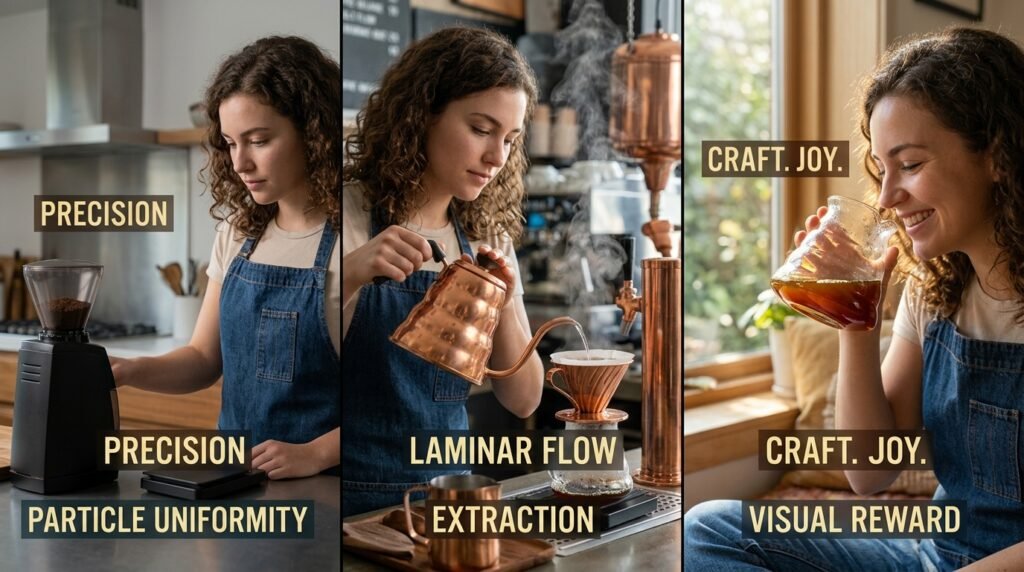
I love my burr grinder because it provides particle uniformity. I love my digital scale because it provides mathematical accuracy. I love my gooseneck kettle because it provides laminar flow.
Those tools manipulate the raw chemistry of the extraction.
The glass server does absolutely nothing to the chemistry. It is completely mechanically passive. Yet it is the tool that brings me the most actual joy. It elevates the coffee from a strict science experiment into a beautiful culinary craft.
It provides the visual reward for all the hard physical work. It captures the light. It captures the aroma. It separates the preparation phase entirely from the consumption phase.
Delete the Utilitarian Mindset
Take a highly critical look at your kitchen counter tomorrow morning.
If you are currently brewing your expensive specialty coffee directly into an opaque ceramic mug or an ugly metal travel thermos, you are actively stealing joy from yourself. You are treating a premium agricultural product like cheap gasoline.
You do not need to spend hundreds of dollars to fix this. You just need to change your psychology.
Go online and buy a clear borosilicate glass coffee server. It is a massive aesthetic upgrade for twenty dollars. When you finally watch the ruby red liquid drip through the filter, when you swirl the glass and smell the explosive floral aroma, and when you finally pour a small, perfect dose into a dedicated tasting cup, you will understand the value of the ritual. You will stop drinking coffee to wake up, and you will start waking up specifically to enjoy the coffee.

Hi, I’m the coffee enthusiast behind Coffee Nerd Lab.
Like many people, I started drinking coffee simply because it helped me wake up in the morning. Over time, that daily habit turned into a genuine interest in understanding what makes a great cup of coffee. I began experimenting with different beans, brewing methods, grinders, and coffee gear, learning through trial and error along the way.
This blog is where I document that journey. Every article is inspired by real experiences, discoveries, and lessons I’ve learned while exploring the world of coffee. From brewing guides and equipment reviews to practical tips and coffee basics, my goal is to share useful information in a way that’s easy to understand and enjoyable to read.
Thanks for stopping by, and I hope Coffee Nerd Lab helps you enjoy your next cup a little more than the last.