
I used to think coffee was just coffee. A dark, bitter liquid meant to jolt me awake before the sun came up. I’d wander into the grocery store, grab whatever bag had the most appealing label or the biggest discount, and toss it into my cart without a second thought. To me, the word “fresh” applied to vegetables, bread, and milk. It never crossed my mind that it should apply to coffee beans.
For years, my morning routine was a mechanical, lifeless process. Scoop, dump, push a button, and wait for the machine to spit out a murky brew that tasted faintly of burnt toast and wet cardboard. I drank it out of necessity, not enjoyment.
But then came a Tuesday afternoon that completely derailed my understanding of this beverage. It was the day I finally understood why fresh coffee beans matter, and honestly, it ruined “bad” coffee for me forever.
The Illusion of the Expiration Date
If you look at a standard bag of supermarket coffee, you’ll usually find an expiration date printed somewhere on the back. For the longest time, that was the only metric I cared about. If the bag said it was good until 2027, I assumed I was golden.
I didn’t realize that coffee is an agricultural product. It’s the seed of a fruit. And like any fruit, it has a peak window of ripeness and vitality. The expiration date on commercial coffee doesn’t tell you when the coffee is at its best; it merely tells you when the company assumes it will be completely devoid of any remaining flavor.
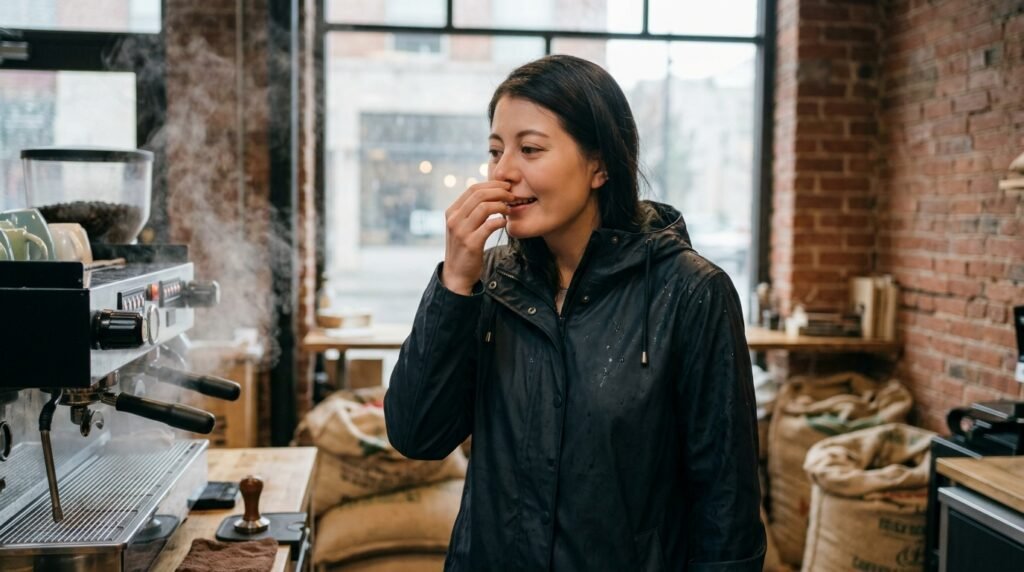
My perspective shifted during a trip to a small, independent coffee roastery downtown. I had stepped inside just to escape a sudden downpour, but the smell that hit me was unlike anything I had ever experienced in a grocery store coffee aisle.
It wasn’t that sharp, acrid scent of burnt beans. It was sweet, complex, and almost intoxicating. It smelled like toasted nuts, dark chocolate, and—oddly enough—berries.
I walked up to the counter, dripping wet, and ordered whatever the barista recommended. He handed me a simple black coffee, brewed with beans from Ethiopia that he had roasted just three days prior.
A Revelation in a Ceramic Mug
I took a cautious sip, expecting the usual punch of bitterness that required a heavy splash of milk to mask. Instead, I tasted something bright. It was vibrant. There was a distinct sweetness to it, followed by a lingering note of blueberry and jasmine.
I looked at the cup, then up at the barista. “Did you put flavor syrup in this?” I asked, genuinely confused.
He laughed. “No, just hot water and fresh Ethiopian beans. That’s what coffee actually tastes like when it hasn’t been sitting in a warehouse for eight months.”
That single sentence was a heavy blow to my entire morning routine. I realized then that I had been drinking a ghost of what coffee was supposed to be. I wanted to recreate that exact experience at home. I wanted my kitchen to smell like that roastery. I wanted to wake up to a drink that tasted alive.
I started doing my homework. That research led me down a rabbit hole of coffee science, and I documented the entire chaotic transition in my article about What Happened When I Stopped Buying Pre-Ground Coffee. It wasn’t an easy switch, but understanding the “why” behind the freshness was the first crucial step.
The Invisible Enemy: Oxidation
To understand why fresh coffee beans matter, you have to understand their biggest enemy: oxygen.
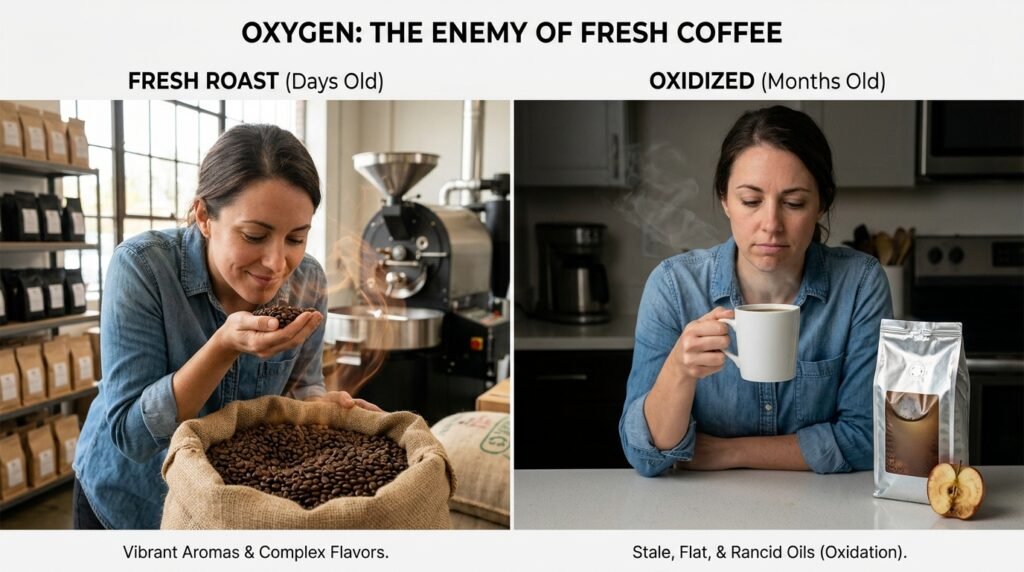
When coffee beans are roasted, they undergo a violent, beautiful chemical transformation. Complex sugars caramelize, amino acids react to create hundreds of distinct aromatic compounds, and moisture is driven out. The resulting roasted bean is a fragile, porous little sponge holding onto a treasure trove of volatile oils and gases.
The moment those beans leave the roaster, the clock starts ticking.
Oxygen in the air immediately begins interacting with the oils and compounds in the coffee. This process, called oxidation, is the exact same thing that causes a sliced apple to turn brown or an avocado to go gray. In coffee, oxidation breaks down the delicate flavors and aromas, leaving behind stale, flat, and often rancid-tasting oils.
Have you ever opened a bag of coffee that smelled vaguely like an old thrift store or cardboard? That’s oxidation. The vibrant life of the bean has literally evaporated into the atmosphere.
If you are buying beans that were roasted six months ago, you are buying oxidized coffee. There is no brewing method, no expensive machine, and no magical technique that can put those vanished flavors back into the bean. You are essentially trying to make a gourmet meal out of expired ingredients.
The Magic of the Bloom
The second scientific phenomenon I learned about was degassing.
During the roasting process, carbon dioxide builds up inside the cellular structure of the coffee bean. For the first few days after roasting, the beans rapidly release this gas. If you try to brew coffee immediately after it comes out of the roaster, the escaping gas repels the water, leading to a weak, uneven extraction.
However, after resting for a few days, the degassing slows down to a sweet spot. When you grind these fresh beans and pour hot water over them, something magical happens.
The coffee actively bubbles and swells up like a science fair volcano. This is called the “bloom.” It is the visual proof that your coffee is fresh. The hot water forces the remaining carbon dioxide out of the grounds, allowing the water to penetrate the coffee and extract the delicious oils.
When I finally brought home a bag of freshly roasted Guatemalan beans—complete with a “roasted on” date stamped proudly on the back—I experienced this bloom in my own kitchen for the very first time.
I poured the hot water over the bed of grounds, and watched in awe as it rose up, releasing a thick, fragrant cloud of aroma that filled the entire room. I leaned in, closing my eyes, just taking in the scent of milk chocolate and sweet citrus.
That morning, drinking that cup, I finally understood the intricacies of the cup. It was a sensory breakthrough, and if you are curious about how that changes your palate, I wrote a detailed breakdown on How I Started Noticing Flavor Notes in Coffee. The freshness was the key that unlocked those hidden flavors.
Roast Date vs. Expiration Date
Once you grasp the importance of freshness, your entire shopping strategy changes. I stopped looking for expiration dates and started hunting for roast dates.
An expiration date is a corporate guess. A roast date is a factual timeline.
Ideally, you want to consume your coffee within two to four weeks of the roast date. This is the golden window. During this time, the coffee has degassed enough to brew properly, but hasn’t yet succumbed to the ravages of oxidation.
This realization drastically changed how I buy coffee. I stopped buying massive, two-pound bags at the wholesale club. Buying in bulk might save a few dollars upfront, but it guarantees that by the time you reach the bottom of the bag, you are drinking stale, lifeless coffee.
Instead, I started buying smaller, 12-ounce bags from local roasters or online specialty shops that roast to order. I began treating coffee like fresh produce. I buy only what I know I will consume in the next couple of weeks. When I run out, I buy more.
This simple shift in logistics transformed my daily cup from a bitter chore into a culinary highlight.
The Ultimate Rule: Whole Bean Only
Of course, understanding the importance of fresh beans leads to an unavoidable, slightly inconvenient truth.
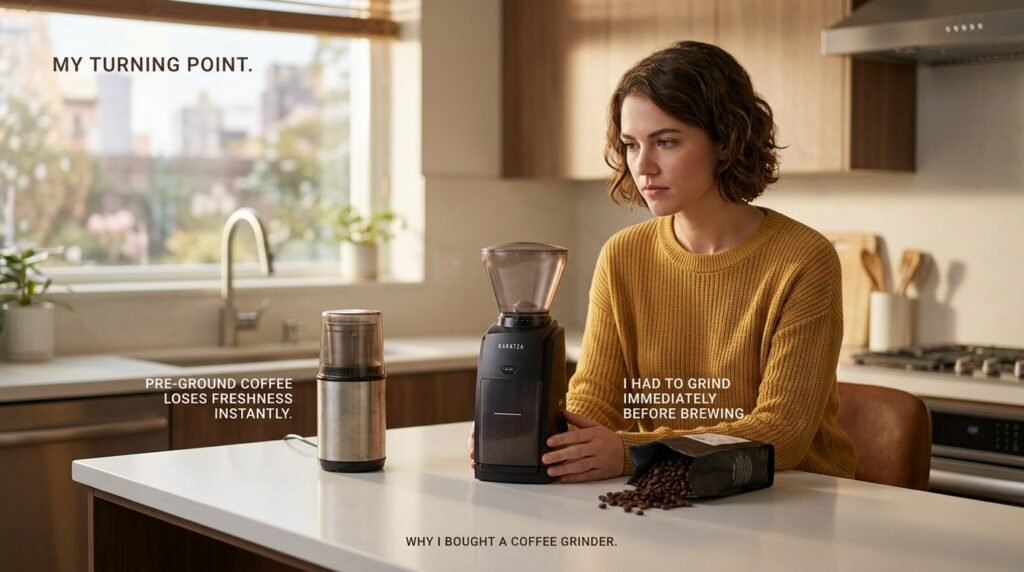
If oxygen is the enemy, then grinding your coffee is like opening the front door and inviting the enemy inside. When you grind a coffee bean, you exponentially increase its surface area. You are exposing all those hidden, delicate oils directly to the air.
Ground coffee loses its aromatic compounds incredibly fast. We are talking minutes and hours, not days and weeks.
If you buy a bag of perfectly fresh, beautifully roasted coffee beans, but you have the roaster grind the whole bag for you before you take it home, you have essentially ruined the freshness by the time you wake up the next morning.
I learned this the hard way. I tried to cheat the system. I bought fresh beans but had them ground at the shop because I didn’t want to invest in more equipment. For the first two days, the coffee was amazing. By day four, it tasted exactly like the sad supermarket coffee I was trying to escape.
It became glaringly obvious that if I wanted to truly respect the freshness of the beans, I had to take control of the final step of the process. I needed to grind the beans myself, right before the water hit them. This realization was a turning point, and it’s the exact reason Why I Finally Decided to Buy a Coffee Grinder. It was the missing piece of the puzzle.
The Ritual of Freshness
Looking back, that rainy Tuesday afternoon at the roastery feels like a distinct dividing line in my life. There is the coffee I drank before that day, and the coffee I have consumed ever since.
Understanding why fresh beans matter isn’t about being a snob. It isn’t about looking down on people who drink instant coffee or use pod machines. It is simply about giving yourself permission to enjoy something fully.
Coffee is an incredibly complex agricultural product that requires the hard work of farmers, pickers, processors, and roasters. Thousands of hours of labor go into producing a single bag of specialty beans. When we let those beans sit on a shelf for a year, we are doing a disservice to that labor, and we are doing a disservice to our own mornings.
Now, my morning routine is completely different. It takes a little more time. It requires a bit more mindfulness.
I wake up. I look at the bag of beans, checking the roast date. I weigh out exactly what I need. I grind the beans, taking a moment to appreciate the dry aroma that erupts from the grinder. I boil the water, I pour it over the fresh grounds, and I watch the bloom rise up.
It is no longer a mechanical process. It is a daily ritual.
Your Next Steps to Better Coffee
If you are reading this while drinking a cup of coffee that tastes a bit flat, a bit too bitter, or just incredibly boring, I challenge you to make one single change this week.
Don’t buy a new coffee machine. Don’t invest in a fancy gooseneck kettle or an expensive digital scale just yet.
Just change your beans.
Find a local coffee roaster in your city. If you don’t have one nearby, go online. There are hundreds of incredible roasters who will roast a bag of coffee on Monday and have it on your doorstep by Wednesday.
Look for a bag that has a specific “Roasted On” date stamped clearly on the label. Buy a small bag, preferably whole bean, and brew it the way you normally do.
Pay attention to the smell when you open the bag. Notice how the coffee reacts when the hot water hits it. And most importantly, take a slow, mindful sip before you add any milk or sugar.
You might just find that coffee doesn’t need to be masked or rushed. You might discover a sweetness and a complexity you never knew existed. And like me, you might finally understand exactly why fresh beans matter. Once you cross that line, I promise you, there is no going back. You will never look at that grocery store aisle the same way again.
