
I create websites and manage digital servers for a living. My entire professional reality is based on absolute, unbreakable permanence. If I write a line of code on Monday, that code behaves exactly the same way on Thursday. A digital file does not age. A database does not suddenly change its structure over the weekend. I control the environment completely.
When I built my manual coffee brewing station in my apartment in Rio de Janeiro, I expected this exact same level of digital permanence.
I bought a precision digital scale. I bought an expensive manual burr grinder. I ordered high quality Ethiopian coffee beans. I established a strict, mathematically perfect recipe. I expected that if I followed the exact same numerical steps every single morning, the resulting beverage would taste absolutely identical.
I was completely wrong. The coffee lesson that took me years to understand completely shattered my digital illusion. I learned that coffee is not a static piece of computer code. It is a highly volatile, actively decaying agricultural product. I had to learn how to stop dictating the recipe and start listening to the physical reality of the seed.
The Frustration of Day Five
My misunderstanding created a massive cycle of frustration in my kitchen.
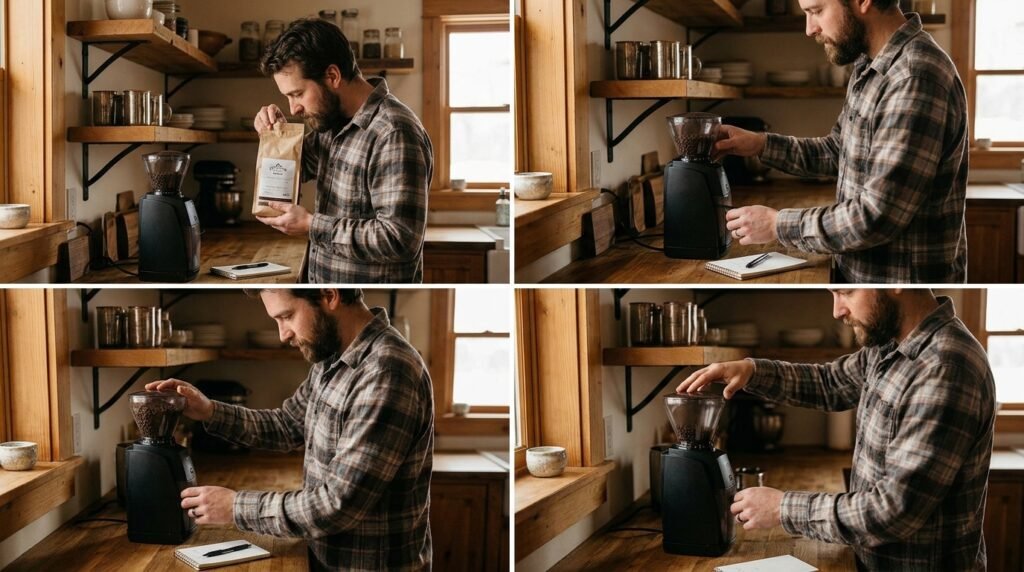
I would open a brand new bag of fresh coffee. I would dial in my grinder. On the second day, I would brew a flawless cup. The liquid would taste incredibly vibrant. The bright lemon acidity and the heavy peach sweetness would balance perfectly. I would write the exact grinder setting down in my notebook.
I would repeat the exact same recipe the next morning. The coffee would taste great.
But by the fifth day, the system would inexplicably crash. I would use the exact same fifteen grams of coffee. I would use the exact same two hundred and forty grams of water. I would keep the grinder on the exact same click. Yet, the coffee would taste sour, thin, and highly astringent.
The Search for Broken Hardware
Because I am trained to look for technical errors, I immediately blamed my equipment.
I assumed my manual burr grinder was broken. I took it apart and scrubbed the ceramic gears violently. I assumed my digital scale was losing its calibration. I bought replacement batteries. I assumed my pouring technique was suddenly flawed. I watched hours of videos trying to correct the angle of my wrist.
None of the hardware was broken. My physical mechanics were perfectly fine.
I was simply ignoring the fundamental biology of the raw ingredient. I was treating the coffee bean like a dead, factory manufactured object. I expected the bean to remain frozen in time.
The Agricultural Reality
Coffee is a piece of fruit. It is the roasted seed of a tropical cherry.
When you buy a bag of coffee from a supermarket, the coffee is usually six months old. It is entirely dead. It has no chemical volatility left. If you brew stale supermarket coffee, it will actually taste consistently bad every single day because there is absolutely no biological activity happening inside the bag.
But when you buy freshly roasted specialty coffee, you are buying a living, breathing organism.
Discovering this profound chemical difference was the core revelation of What I Learned After Buying Coffee from a Small Roastery because it forced me to respect the timeline of the farm. Fresh coffee is packed with massive amounts of trapped carbon dioxide gas.
The Carbon Dioxide Engine
The extreme heat of the roasting drum creates this gas. It gets locked deep inside the tight cellular walls of the seed.
This trapped gas is the engine of the extraction. When you pour hot water over fresh coffee grounds, the water aggressively displaces the carbon dioxide. The gas violently erupts. This creates the massive, swelling dome known as the bloom.
The escaping gas pushes back against the incoming water. It acts as a physical barrier. It slows the water down. It creates massive physical resistance inside the paper filter.
The Fading Resistance
Here is the vital lesson that completely changed my brewing. That carbon dioxide gas does not stay inside the bean permanently.
From the exact moment the coffee leaves the roasting drum, it begins to bleed gas into the atmosphere. This process is called degassing. A coffee bean on day two holds significantly more gas than a coffee bean on day ten.
Because the amount of gas is constantly shrinking, the physical resistance of the coffee bed is constantly shrinking.
The Shifting Fluid Dynamics
If you use the exact same grind size on day two and day ten, the water will behave completely differently.
On day two, the massive amount of escaping gas fights the water. The water drains slowly. It stays in contact with the coffee grounds for a long time. It extracts the heavy fruit sugars perfectly.
On day ten, the gas is mostly gone. The physical barrier has vanished. The hot water faces absolutely zero resistance. It rushes rapidly through the coffee grounds and falls straight into your mug. Because it drains too quickly, it fails to dissolve the heavy sugars. It only washes the sharp, sour acids off the surface.
This shifting fluid dynamic was the exact reason my flawless recipe tasted terrible by the fifth day. The bean had fundamentally changed, but my math had remained completely rigid.
The Environmental Variable
The internal degassing of the bean is only half of the biological problem. The external environment also attacks the seed.
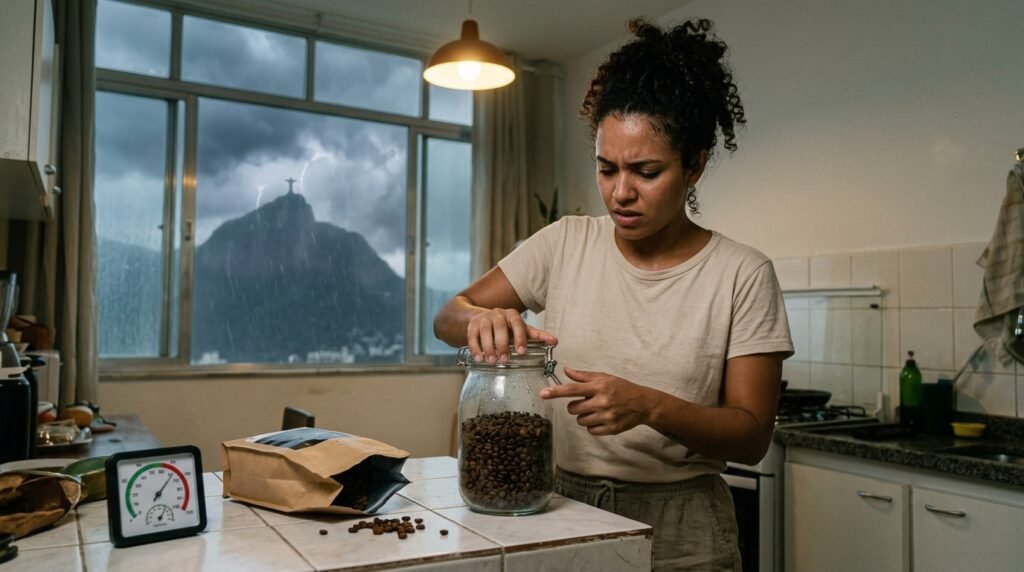
I live in Rio de Janeiro. The climate is highly volatile. We have massive spikes of intense heat and crushing humidity.
Roasted coffee beans are highly hygroscopic. This means they act like microscopic wooden sponges. They actively pull moisture out of the surrounding air. If the ambient humidity in my apartment spikes during a heavy afternoon rainstorm, the coffee beans sitting in my dark pantry absorb that moisture.
The Sponge Effect
When a coffee bean absorbs ambient humidity, its physical structure becomes slightly softer and more pliable.
When you force a soft, humid coffee bean through a set of ceramic burrs, it does not shatter cleanly. It bends slightly. It creates a completely different particle distribution than a hard, dry bean. It produces more fine dust.
This dust instantly clogs the microscopic pores of the paper filter. The hot water stalls. The extraction chokes.
Grasping this deep connection to the physical environment was exactly The Moment I Realized Not All Coffee Beans Are the Same because it proved that origin and altitude are only the beginning of the story. The coffee actively responds to the room it is sitting in.
The Static Recipe Trap
Once I finally understood that the bean was actively changing every single day, the concept of a static, perfect recipe became completely absurd.
You cannot use a permanent mathematical formula on an impermanent object. It is a logical fallacy.
Trying to force a specific drawdown time onto an aging bean is like trying to force a size ten shoe onto a growing foot. It will eventually cause massive pain. I had to completely dismantle my rigid, digital mindset. I had to learn how to adapt.
The Analog Art
I found the perfect mental framework in my living room. I study traditional Japanese Irezumi art. I have massive books filled with intricate tattoo designs.
A master tattoo artist does not apply a rigid stencil blindly to a client. Human skin is not a flat piece of digital paper. It stretches. It curves over muscle and bone. It ages. The skin on an arm takes ink completely differently than the skin on a back.
The master artist understands the core rules of shading and line work, but they constantly adapt the design to fit the living, breathing reality of the canvas in front of them. They bend their technique to the material.
Bending to the Coffee
I needed to start treating my coffee extraction like a Japanese artist treats a canvas.
I kept my core structural rules intact. I locked my input dose at exactly fifteen grams. I locked my water yield at exactly two hundred and forty grams. I locked my water temperature at a rolling boil.
These constants formed my structural framework. But I completely unlocked the master variable. I stopped writing the perfect grind size down in pen. I started treating the grinder dial as a daily steering wheel.
The Daily Diagnosis
Now, I approach the kitchen counter every morning as an active participant, not a passive robot.
I grind my coffee and execute my pour. I watch the physical behavior of the slurry. I do not look at a strict digital stopwatch. I just observe the flow rate.
I carry the ceramic mug to my desk and wait for the temperature to drop. I take my first sip. I ask my palate a very simple diagnostic question. Is the liquid sour and thin, or is the liquid bitter and dry?
The Active Adjustment
If the coffee tastes sour, I know the water moved too fast. I know the coffee bean has lost too much carbon dioxide gas and the physical resistance has dropped.
I do not get angry. I do not blame my kettle. I accept the biological reality of the aging seed.
The next morning, I reach for my manual hand grinder. I turn the adjustment dial one single click finer. This microscopic mechanical shift creates smaller coffee particles. The smaller particles pack together more tightly in the paper filter. They artificially recreate the physical resistance that the fading gas can no longer provide.
Executing this proactive mechanical change was exactly The Simple Coffee Mistake I Made Every Morning for Years because I used to just repeat the exact same failure and hope for a different result. Now, I actively fix the chemistry.
The Reverse Correction
If the coffee tastes harsh, dry, and heavily bitter, I know the water stalled. I know the beans likely absorbed ambient humidity from the Rio de Janeiro air and generated too much clogging dust.
I do not throw the bag of coffee in the trash. I do not buy a new plastic brewer.
The next morning, I turn the grinder dial one click coarser. The larger particles open up the physical pathways inside the coffee bed. The water drains faster. The extraction escapes the bitter tannins. The heavy, sweet peach flavors return to the mug perfectly intact.
The Freedom of Letting Go
This simple realization completely removed the anxiety from my morning routine.
I stopped chasing an impossible digital perfection. I stopped trying to force the coffee to behave like computer code. I learned to respect the fragility and the volatility of the agricultural product.
When you accept that the coffee bean changes every single day, the frustration vanishes. A bad cup of coffee is no longer a personal failure. It is simply a piece of diagnostic data. It is the coffee bean communicating its current physical state to your palate.
The Reward of Attention
When you finally start listening to the coffee, the sensory rewards are massive.
You develop an incredibly sharp palate. You learn to taste the subtle difference between day three of a light roast and day twelve. You learn how to ride the flavor curve of the bean as it slowly ages in your cabinet. You extract every single drop of value from the expensive raw material.
You transform from a blind consumer into an active culinary participant.

Stop Fighting the Bean
If you are currently frustrated with wildly inconsistent results in your kitchen, you must audit your own mindset.
Look at the notebook where you wrote down your perfect recipe. Realize that the ink on that page is permanent, but the coffee beans sitting in your pantry are actively decaying right now.
Stop trying to force yesterday’s math onto today’s agriculture.
Lock your water weight. Lock your temperature. But keep your hand on the grinder dial. Taste your coffee honestly every single morning. Let the sourness or the bitterness tell you exactly what the bean needs. When you finally stop fighting the physical reality of the farm, you will unlock a level of deep, heavy sweetness that no static recipe can ever provide. You will finally learn how to brew the coffee that is actually sitting in front of you.
