
I was deep in the middle of a chaotic spring cleaning session, emptying out the mysterious “junk drawer” in my kitchen. You know the one. It’s the drawer where dead batteries, rubber bands, takeout menus, and random loose screws go to disappear forever.
As I was pulling out a tangled mess of old charging cables, a small, bright red piece of plastic clattered onto the floor.
I picked it up and stared at it. It was my old coffee scoop.
It was stained slightly brown around the edges, with the words “1 Tablespoon” faintly embossed on the handle. Holding that little piece of plastic brought back a flood of memories from a very frustrating era of my life. For years, that tiny red scoop was the undisputed dictator of my morning routine. I relied on it implicitly.
I tossed it into the trash can, feeling a profound sense of relief.
Looking back at my journey from drinking bitter, muddy diner coffee to brewing vibrant, café-quality specialty roasts at home, I realized that my biggest obstacle wasn’t the quality of the beans or the water temperature. My biggest obstacle was that little red scoop.
Relying on volumetric measurement was the single most destructive habit in my kitchen. Breaking that habit and understanding the science of mass completely revolutionized my mornings. It is, without a doubt, the coffee lesson I wish I had learned years earlier.
The Morning Roulette Wheel
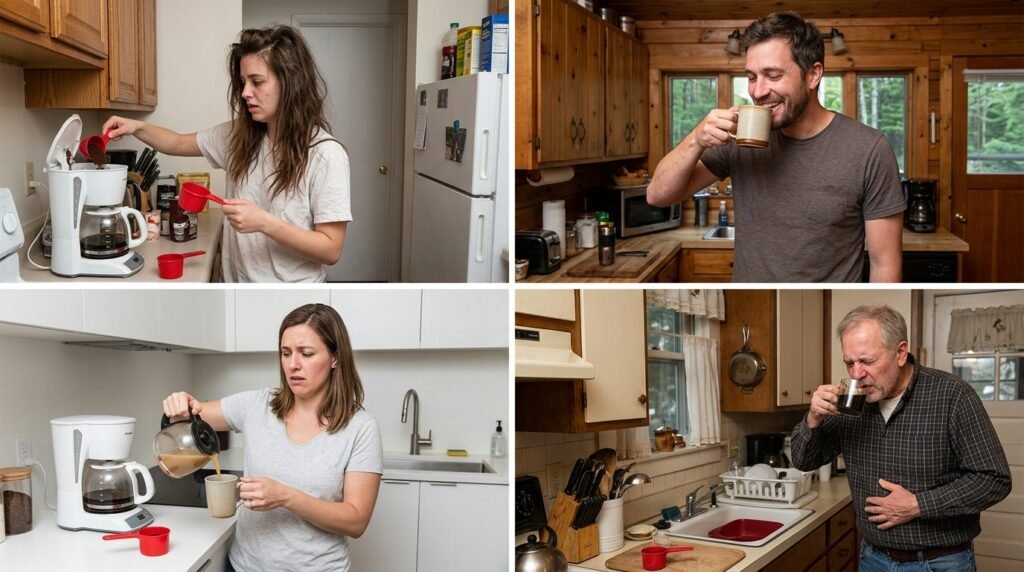
During my “red scoop era,” making coffee was a daily game of Russian roulette.
I would stumble into the kitchen, grab my bag of pre-ground coffee, and start scooping. The “recipe” in my head was incredibly vague: Three scoops for a normal day, four scoops if I am really tired. Then, I would fill my coffee maker with water up to a faded line on the glass carafe, hit the power button, and hope for the best.
The results were maddeningly inconsistent. On Monday, the coffee might taste absolutely perfect—rich, balanced, and smooth. I would mentally pat myself on the back, assuming I had finally mastered the machine.
But on Tuesday, doing what I genuinely believed was the exact same physical motion, the coffee would come out tasting like weak, brown dishwater. On Wednesday, it would be so overwhelmingly strong and bitter that it made my heart race and my stomach churn.
I was doing the same thing every day. Why was the result wildly different every single time?
For years, I blamed everything else. I blamed the coffee brand, assuming they had bad quality control. I blamed my coffee machine, assuming the heating element was breaking. I even blamed the weather. I never once considered that my primary tool for measuring ingredients was fundamentally flawed.
The Illusion of Volume
To understand why the scoop is a liar, you have to understand the difference between volume and mass.
Volume is how much space an object takes up. A tablespoon is a measurement of volume. Mass is how much physical matter is actually there (its weight).
If you are measuring a liquid, like water or milk, volume works perfectly fine. A tablespoon of water is always going to be the exact same amount of water.
But coffee is not a liquid. It is a collection of dry, irregularly shaped particles. And when you try to measure dry, irregular particles by volume, chaos ensues.
Think about it like this: If you dip a plastic scoop into a bag of coffee and pull it out, how is the coffee sitting in the scoop? Is it a perfectly flat, level scoop? Or is it a “heaping” scoop with a little mountain of coffee on top?
Even if you are careful to level off the scoop every time, the coffee grounds themselves are deceiving you. If the bag of coffee has been sitting on the counter for a week, the grounds have settled and compacted together. A scoop of compacted coffee contains significantly more physical coffee than a scoop of fluffy, freshly opened coffee.
Without realizing it, my “three scoops” on Monday might have contained 15 grams of coffee, while my “three scoops” on Tuesday only contained 11 grams. I was blindly changing the recipe every single day by a massive margin, purely by accident.
The Density Problem
The illusion of the scoop becomes even more disastrous when you finally graduate from pre-ground supermarket coffee to buying fresh, whole beans from specialty roasters.
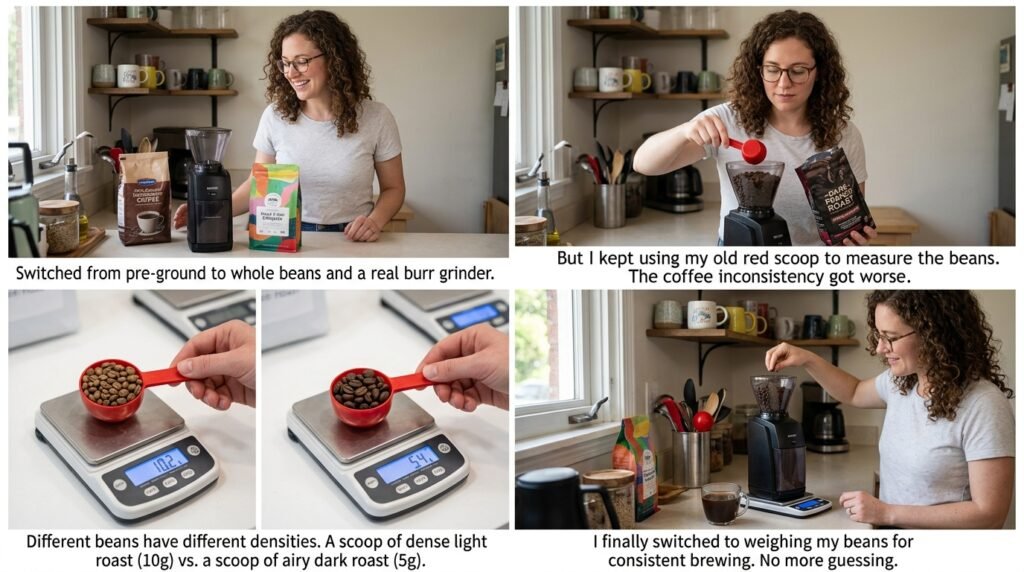
When I first bought a real burr grinder and started buying whole beans, I continued using my trusty red scoop to measure the beans before tossing them into the grinder hopper. The inconsistency immediately got worse.
I soon learned that not all coffee beans are the same physical size.
If you buy a bag of light roast Ethiopian coffee, the beans are incredibly small, hard, and dense. Because they are tiny, you can fit a massive amount of them into a single tablespoon.
Conversely, if you buy a bag of dark roast French or Italian coffee, the beans are massive. The prolonged roasting process causes them to puff up and expand, while simultaneously burning away their internal moisture. They are physically huge, but incredibly light and airy.
If you put one scoop of the dense Ethiopian beans on a scale, it might weigh 10 grams. If you put one scoop of the massive dark roast beans on the scale, it might only weigh 5 grams.
By using a scoop, I was using half as much coffee for my dark roasts as I was for my light roasts. My brewing ratios were completely destroyed, a realization that forced me to completely re-evaluate my kitchen setup. If you want to understand how deeply this messes up your extraction, I wrote an entire breakdown about What I Learned About Coffee Measurement Accuracy. The scoop was literally sabotaging my expensive beans.
The Epiphany of the Kitchen Scale
The solution to all of this madness is incredibly simple, incredibly cheap, and entirely foolproof.
You have to stop measuring your coffee by volume (space) and start measuring it by mass (weight). You need a digital kitchen scale.
I resisted this idea for a long time. I thought using a digital scale to make a simple cup of morning coffee was incredibly pretentious. I pictured scientists in white lab coats holding beakers. I just wanted to wake up and drink caffeine; I didn’t want to do math before the sun came up.
But out of sheer frustration with my inconsistent brews, I finally broke down and bought a cheap, $15 digital kitchen scale online.
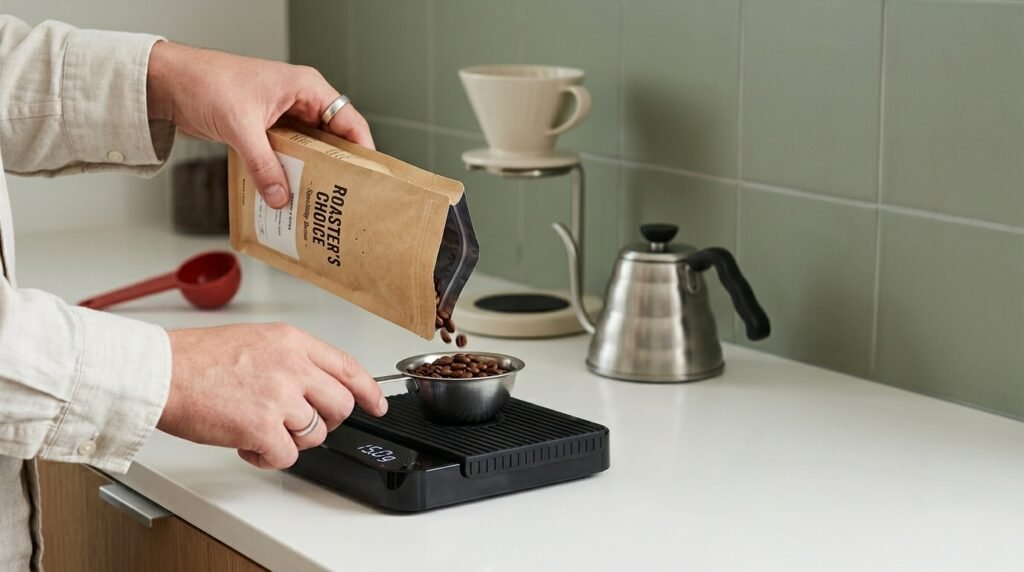
The very first time I used it, I felt a strange sense of control. I placed my empty grinder catch-bin on the scale, pressed the “tare” button to zero it out, and poured in exactly 15.0 grams of coffee beans.
There was no guessing. There was no “heaping” or “flat” assessment. The digital screen gave me an absolute, undeniable fact. I had exactly 15 grams of coffee matter.
The Other Half of the Equation: Water
But the scale didn’t just solve my coffee bean problem; it solved my water problem, too.
Remember the faded line on my glass coffee carafe? Measuring water by looking at a printed line on a glass jug is just as inaccurate as using a plastic scoop. The angle of your head, the shape of the glass, and the simple fact that some water always evaporates or gets trapped in the grounds means you are never using the exact same amount of liquid.
However, water has a beautiful, magical property in the metric system.
One milliliter of water weighs exactly one gram.
This means you can use your new kitchen scale to measure your water with absolute, surgical precision. Instead of looking at the side of a glass carafe, you simply place your mug (or your pour-over brewer, or your French Press) directly on the scale. You zero it out, and you pour the hot water until the scale reads the exact number of grams you want.
For the first time in my life, I knew exactly how much coffee I was using, and exactly how much water I was using. The guessing game was officially over.
Discovering the Golden Ratio
Once you have a scale, you unlock the most powerful tool in the coffee world: The Brew Ratio.
The brew ratio is simply a mathematical formula that dictates how much water you should use for every one gram of coffee. It is the secret language of baristas worldwide.
In the specialty coffee industry, the generally accepted “Golden Ratio” falls somewhere between 1:15 and 1:18.
This means for every 1 gram of coffee, you use 15 to 18 grams of water.
If you like your coffee heavy, rich, and intense, you use a tighter ratio, like 1:15. If you prefer your coffee lighter, brighter, and more tea-like, you stretch it out to a 1:18 ratio.
Let’s do some simple morning math. If I weigh out 15 grams of coffee beans, and I want a standard, perfectly balanced 1:16 ratio, I simply multiply 15 by 16. The answer is 240. Therefore, I need to pour exactly 240 grams of water over my coffee grounds.
It sounds complicated when you read it, but in practice, it takes about four seconds to calculate. Finding the mathematical balance that perfectly suited my palate was a massive turning point, which I documented extensively in How I Discovered the Perfect Brew Ratio for Myself. It was like finding a cheat code for flavor.
The Power of Absolute Consistency
The transition period of using the scale was fascinating. I dedicated an entire post to The First Week I Brewed Coffee with Precision Scales, noting how quickly my morning anxiety vanished.
When you use a scale and a set ratio, the roulette wheel stops spinning.
If I brew a cup of coffee on Monday using 15 grams of coffee and 240 grams of water, and it tastes incredible, I can replicate that exact same experience on Tuesday. And Wednesday. And Thursday.
I can guarantee that the coffee will taste identical because the physical inputs are identical. I have removed human error and visual deception from the equation.
And more importantly, if the coffee tastes bad, the scale gives me the power to fix it intelligently.
If the coffee tastes too weak and watery, I don’t just blindly throw an extra scoop into the machine the next day. I look at my ratio. I realize that 1:18 was too weak for that specific bean, so the next morning, I change the ratio to 1:16. I am making informed, precise adjustments rather than wildly swinging in the dark.
Saving Money and Saving Beans
There is an unexpected secondary benefit to learning this lesson: you stop wasting expensive coffee.
When I was using my red plastic scoop, I was constantly accidentally over-dosing my coffee. I was blowing through bags of expensive specialty beans at an alarming rate because I was throwing 22 or 25 grams of coffee into a cup that only actually needed 15 grams.
By using a scale, you use exactly what you need to achieve the perfect extraction, and not a single gram more.
A $15 digital kitchen scale will literally pay for itself in a matter of months simply by preventing you from burning through your coffee inventory too quickly. It extends the life of your beans and ensures that every single cup you brew is worthy of the price you paid for it.
The Kitchen Scale Mandate
Throwing away that old red plastic scoop felt like closing a frustrating chapter of my life.
It represented an era where I accepted mediocrity because I didn’t understand the mechanics of what I was doing. I thought coffee was a magical, unpredictable substance that just decided to be good or bad depending on the day.
I wish someone had grabbed me by the shoulders years earlier, handed me a cheap digital scale, and explained the concept of mass and ratios. It would have saved me hundreds of dollars in wasted beans, and hundreds of mornings suffering through bitter, over-extracted sludge.
If you are serious about upgrading your morning coffee, do not buy a new, expensive coffee maker. Do not buy a fancy gooseneck kettle. Do not buy expensive, exotic beans from halfway across the world.
If you are still measuring your coffee with a plastic scoop, none of those expensive upgrades will matter. You are building a house on a foundation of quicksand.
Go online or go to your local home goods store. Buy a basic digital kitchen scale that measures in grams. Start weighing your beans, and start weighing your water.
It might feel a little bit like a science experiment the first few times you do it, but I promise you, the absolute, unwavering consistency of the resulting cup will change your mornings forever. Once you taste what a mathematically perfect extraction tastes like, you will never touch a plastic measuring scoop ever again.
