
I audit user interfaces and digital code for clients in Rio de Janeiro. A website button might look incredibly beautiful on a computer screen. It might feature perfect colors and smooth animations. But if the underlying code is broken, clicking the button does absolutely nothing. The surface appearance is completely irrelevant. The functional reality happens entirely in the hidden layers below.
I applied this exact same diagnostic logic to my kitchen counter.
I was brewing manual pour over coffee every single morning. I used a precision digital scale. I used an expensive hand grinder. I bought premium light roasted Ethiopian coffee beans. When I finished pouring the hot water, the coffee bed looked perfectly wet on the surface.
But the final beverage tasted terrible. It was a confusing, muddy disaster. The liquid was aggressively sour on the front of my tongue and harshly bitter in the back of my throat. The sweet, syrupy fruit flavors were completely missing.
The small coffee adjustment that made a big impact required me to stop trusting the visual surface of the coffee bed. I had to investigate the hidden structural layers underneath. I discovered a massive mechanical flaw in my brewing process. I learned how to completely destroy the invisible dry pockets hiding inside the filter. It cost absolutely zero money, and it changed my extraction permanently.
The Illusion of Saturation
The biggest lie in manual coffee brewing happens during the very first ten seconds of the pour.
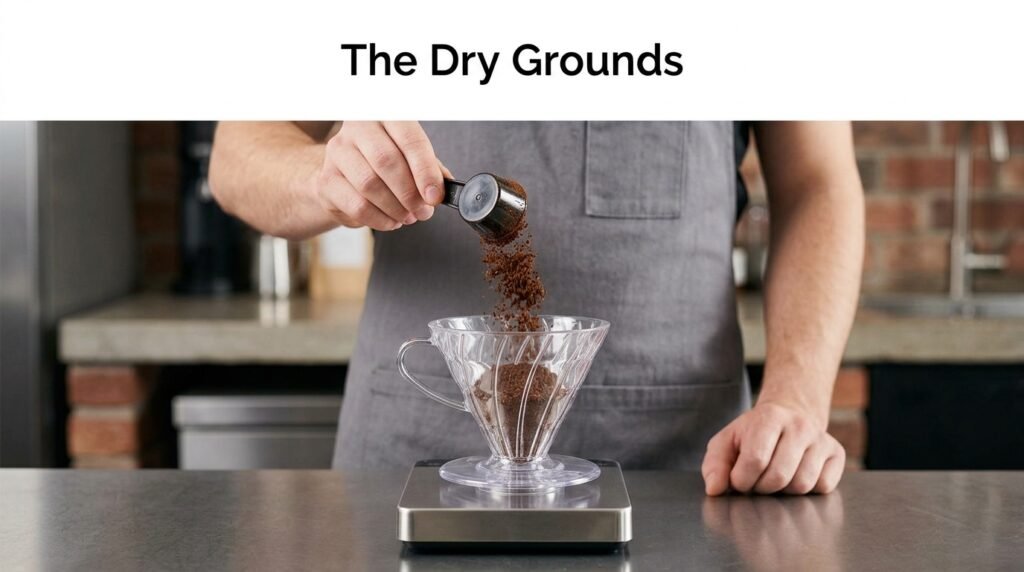
You dump fifteen grams of dry coffee into your plastic V60 cone. You grab your gooseneck kettle. You pour forty grams of hot water gently over the surface of the grounds. The coffee bed immediately swells upward. The surface turns dark brown and looks completely wet.
Your eyes tell you that the water has successfully penetrated the entire mass of coffee. Your eyes are completely wrong.
Freshly roasted specialty coffee is incredibly resistant to water. The intense heat of the roasting drum traps massive amounts of carbon dioxide gas deep inside the tight cellular walls of the seed.
The Chemical Shield
When the hot water hits the dry coffee, a violent physical reaction occurs. The hot solvent forces the trapped carbon dioxide to escape.
This escaping gas actually pushes back against the incoming water. It acts as a powerful, invisible chemical shield. The water wants to flow downward, but the gas violently pushes upward.
Because of this intense resistance, the hot water does not distribute evenly. It finds the path of least resistance and channels straight down. This leaves massive, hidden pockets of completely dry coffee buried under the wet surface.
The Disaster of the Dry Pocket
If you have dry pockets hiding in your coffee bed, your extraction is fundamentally ruined before it even really begins.
The wet coffee surrounding the dry pocket receives too much hot water. Those particles become violently over extracted. They release harsh, dry, aggressive tannins into the mug. This creates the bitter finish I was tasting.
Meanwhile, the dry pocket eventually collapses later in the pouring routine. But it is too late. Those particles do not receive enough contact time with the hot water. They become severely under extracted. They release sharp, unpleasant, acidic flavors into the mug.
This is exactly why my coffee tasted both sour and bitter at the exact same time. The fluid dynamics were entirely chaotic.
The Failed Spoon Technique
I realized I needed to actively intervene. I needed to force the hot water into the dry pockets.
My first attempt at fixing the problem was highly mechanical. I grabbed a small metal spoon from the kitchen drawer. I poured the forty grams of hot water for the bloom phase. I immediately took the spoon and started digging into the wet slurry.
I tried to physically break the dry clumps apart.
This was a massive failure. Wet coffee grounds are incredibly sticky. Massive clumps of coffee immediately glued themselves to the metal spoon. When I pulled the spoon out of the filter, I pulled two full grams of coffee out with it. I had completely ruined my mathematical ratio. I had to throw the wet grounds into the sink and start over.
The Bird Nest Hack
My second attempt involved changing the physical geometry of the dry grounds.
I dumped the fifteen grams of coffee into the filter. I took my index finger and pressed it deeply into the center of the coffee bed. I created a deep crater. The coffee looked like a small bird nest.
The logic was simple. The crater would force the hot water to penetrate the deepest part of the coffee bed immediately.
This trick helped slightly, but it was not enough. The water still channeled around the thick edges of the nest. There were still small dry pockets hiding in the corners of the paper filter. I needed a technique that guaranteed total, absolute saturation.
The Discovery of the Swirl
The ultimate solution required me to stop using external tools and start using the brewer itself.
I found the technique completely by accident. I had poured the hot water for the bloom phase. I accidentally bumped the plastic V60 cone with my hand. The brewer shifted on the digital scale. The wet slurry inside the paper filter shook violently.
I watched a massive dry bubble of coffee immediately burst on the surface.
I realized I did not need to dig with a spoon. I just needed to apply aggressive centrifugal force. I needed to physically spin the entire brewing apparatus.
Executing the Perfect Bloom
The next morning, I integrated this physical movement into my strict workflow.
I weighed the Ethiopian beans. I crushed them in the manual hand grinder. I dumped the grounds into the plastic cone and tapped the sides to create a perfectly flat bed. I zeroed the digital scale.
I grabbed my hot gooseneck kettle. I poured exactly forty grams of water in a tight, fast circle.
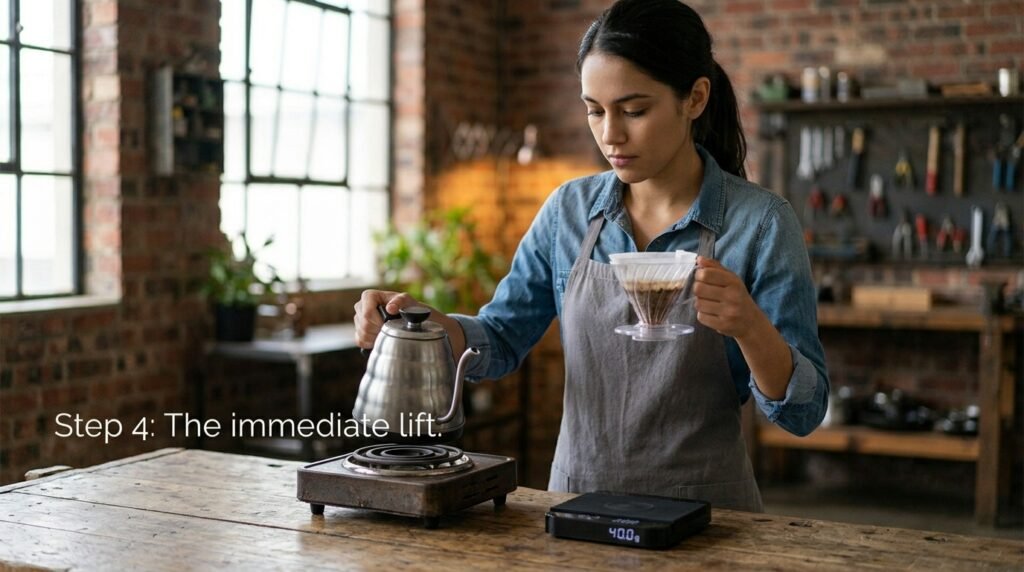
The exact second I finished pouring the forty grams, I set the heavy kettle down on the stove. I immediately grabbed the plastic V60 cone with my right hand. I lifted it slightly off the digital scale.
The Physical Mechanics
The physical motion must be confident and deliberate.
I moved my wrist in a rapid, tight circle. I gave the plastic brewer two aggressive swirls. The wet slurry inside the paper filter spun violently. The centrifugal force threw the heavy water outward against the dry coffee grounds.
The visual transformation was instantaneous.
The messy, clumpy surface completely collapsed. The slurry turned into a uniform, smooth, dark paste. Massive bubbles of trapped carbon dioxide erupted across the entire surface. Every single hidden dry pocket was violently smashed against the hot water.
The Mandatory Window
Timing this physical motion is incredibly critical. You cannot hesitate.
You must execute the swirl within the first five seconds of the bloom phase. If you wait too long, the water begins to drain through the paper filter. The coffee bed becomes too dry and heavy to spin. You just end up shifting wet mud around.
Mastering this specific sequence was exactly How I Learned to Time My Coffee Pour Perfectly because the entire fate of the extraction relies on those first few seconds. The forty five second bloom window is completely useless if the grounds are not fully saturated.
The Return to the Scale
I placed the spinning plastic cone gently back onto the digital scale. I waited the remaining forty seconds for the carbon dioxide to completely dissipate.
The foundation was now perfectly secure.
I picked up the gooseneck kettle and started my main concentric pour. Because every single coffee particle was already wet and activated, the hot water met absolutely zero unnatural resistance. The fluid dynamics were completely stable.
The water drained at a perfectly uniform speed. There was no chaotic channeling. There were no dry walls of coffee repelling the solvent.
The Second Application
Once I realized the massive power of the swirl, I found a second critical application for the technique.
When you finish pouring your target water weight, the extraction is not over. The water still has to drain entirely through the coffee bed. During this final draining phase, a massive mechanical problem usually occurs.
The water level drops, leaving high walls of wet coffee grounds stuck to the sides of the paper filter.
These high-and-dry grounds are a massive liability. Because they are stuck to the paper above the actual water level, they are not actively contributing to the final extraction. They simply sit there, baking in the residual heat and releasing harsh tannins into the final drops of liquid.
Knocking Down the Walls
I needed to get those grounds back into the active extraction zone.
When my digital scale hit exactly two hundred and forty grams, I stopped pouring water. I set the kettle down. I immediately grabbed the plastic V60 cone for the second time.
I lifted it slightly and executed one single, gentle swirl.
The circular motion created a small whirlpool inside the filter. The spinning water violently washed the paper walls. It grabbed all the stuck coffee grounds and pulled them directly back into the flat slurry at the bottom of the cone.
Integrating this final step was the core lesson of The Pour Over Technique That Finally Worked for Me because it completely unified the coffee bed. When the final drops of water drained into the mug, the spent coffee grounds formed a perfectly flat, level puck.
Removing the Astringency
I let the coffee cool down for five minutes in my living room. I took a slow sip.
The confusing, aggressive flavors from yesterday were entirely erased. The sharp sourness was gone because there were no dry pockets. The harsh bitterness was gone because there were no high walls of coffee stuck to the paper.
Eliminating that dry, chalky finish was exactly The Small Change That Made My Coffee Less Bitter because the extraction was finally mathematically even. Every single gram of coffee received the exact same amount of thermal energy and contact time.
The Massive Sweetness
With the sour and bitter defects removed, the true flavor of the African coffee exploded onto my palate.
The liquid was incredibly sweet. It tasted like a heavy, dense peach syrup. The bright lemon acidity acted as a perfectly clean, crisp introduction. The finish was long, smooth, and heavily floral.
I had unlocked the maximum potential of the raw agricultural ingredient simply by moving my wrist twice. I did not buy a better grinder. I did not change my water chemistry. I simply fixed the invisible fluid dynamics inside the filter.
The Confidence of the Routine
This tiny physical adjustment completely changed my psychological approach to the kitchen.
Before I discovered the swirl, I always felt slightly anxious while brewing. I felt like I was fighting the coffee. I was hoping the water would magically find its way into the dry pockets. I was relying entirely on luck.
The swirl eliminates luck. It forces the chemistry to behave.
It puts the brewer in absolute physical control of the raw material. When I pick up the plastic cone and spin the slurry, I know with absolute certainty that the foundation is completely saturated. I can pour the rest of my water with total confidence.
The Portability of the Trick
The greatest advantage of this adjustment is its total portability.
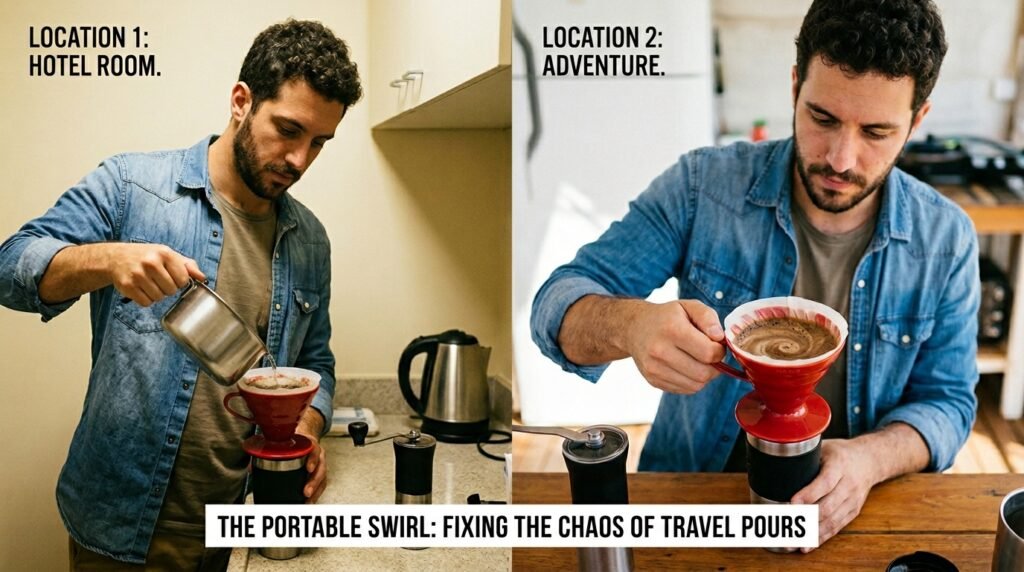
I frequently travel out of Rio de Janeiro. I pack my manual grinder, a small bag of coffee, and my plastic V60 cone. I do not always have access to my precision electric gooseneck kettle. I often have to boil water in a cheap hotel pot and pour it directly into the filter.
A standard kitchen pot pours water with terrible, chaotic turbulence. It destroys the flat coffee bed.
But because I use the swirl technique, I can easily survive the bad pouring mechanics. I splash the hot water roughly over the coffee. Then I pick up the plastic cone and spin it aggressively. The swirl instantly fixes the chaos. It flattens the bed. It forces the saturation. The technique completely covers the flaws of the bad equipment.
Stop Trusting the Surface
You need to audit your own physical mechanics tomorrow morning.
Watch what happens when you pour your very first dose of hot water over the dry coffee grounds. Do you just set the kettle down and stare at the wet surface? Are you hoping the water penetrates the core naturally?
You are actively leaving massive amounts of flavor trapped inside hidden dry clumps. You are guaranteeing a confused, unbalanced extraction.
Stop standing still. Take control of the physical environment.
Pour your forty grams of water. Immediately put the kettle down. Grab the brewer with a firm grip. Lift it slightly and spin your wrist twice. Watch the dark slurry unify. Watch the hidden dry pockets explode to the surface. Give the brewer one final spin when you finish your entire pour.
When you finally eliminate the dry pockets and knock the high grounds off the paper walls, you will completely banish the sour and bitter defects from your mug. You will finally taste the massive, heavy sweetness that the roaster promised on the label. The flavor is already inside your kitchen. You just have to spin the filter to unlock it.
