

A close friend visited my apartment in Rio de Janeiro last weekend. He sat at my kitchen counter and watched me prepare two cups of coffee. He watched me weigh the Ethiopian beans. He watched me use the manual burr grinder. He watched me pour the hot water in slow concentric circles over the plastic V60 cone.
I handed him a small ceramic tasting cup. He took a sip. His eyes went wide.
He told me it was the best cup of coffee he had ever tasted. He immediately pulled out his smartphone and asked me for a shopping list. He wanted to buy the exact same grinder, the exact same scale, and the exact same gooseneck kettle. He assumed that buying the premium hardware would instantly guarantee premium results in his own kitchen.
I told him to put his phone away.
I explained that buying the equipment is only ten percent of the battle. The other ninety percent is strict mental discipline. You can own the most expensive brewing tools on the planet, but if your methodology is broken, you will still brew terrible water. The coffee tip I now share with every beginner is not a piece of hardware. It is a strict rule of logic. You must learn how to isolate your variables.
The IT Troubleshooting Method
I manage digital web servers for a living. When a website crashes, my job is to find the broken line of code and fix it.
There is a golden rule in software debugging. You never change three different things at the exact same time. If a webpage is loading slowly, you do not rewrite the database, change the image sizes, and switch the hosting provider all on the same day.
If you change all three things and the website suddenly works, you have a massive problem. You have absolutely no idea which specific action actually solved the issue.
You must test one single variable at a time. You change the image sizes. You test the page. If it is still broken, you revert the images back to normal and test the database. You isolate the problem systematically.

The Culinary Casino
I apply this strict logic to my kitchen every single morning. Beginners do the exact opposite.
Beginners treat coffee brewing like a chaotic casino. When they brew a bad cup of coffee, they panic. They taste the bitter liquid in their mug and immediately assume everything they did was completely wrong.
The next morning, they decide to fix the problem by changing their entire workflow.
They add an extra scoop of coffee beans. They make the grind size slightly finer. They pour the hot water much faster. They completely alter three massive chemical variables simultaneously.
The Cycle of Frustration
This chaotic approach guarantees total failure.
Maybe the coffee on the second day actually tastes a little bit better. But the beginner has absolutely no idea why. Did the extra coffee fix the flavor? Did the finer grind solve the problem? Was it the pouring speed?
Because they do not know what fixed the issue, they cannot replicate the success. The third day, they guess again. The coffee returns to tasting like bitter ash.
Getting trapped in this cycle of panicked guessing was exactly The Simple Coffee Mistake I Made Every Morning for Years because I refused to approach my kitchen with scientific discipline. I was burning through expensive bags of specialty coffee and getting absolutely nowhere. I was just hoping to get lucky.
The Rule of One
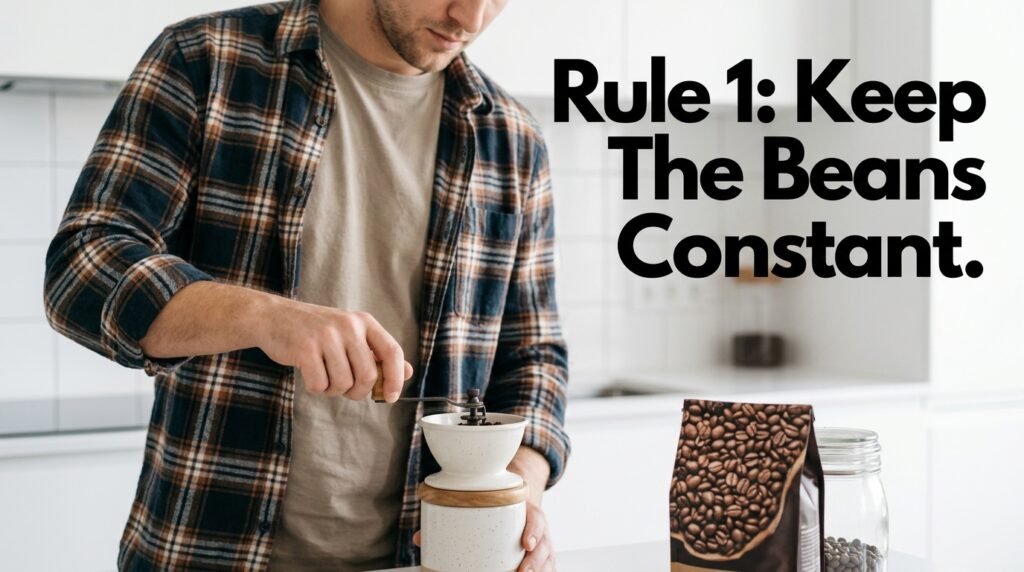
The ultimate secret to mastering manual coffee brewing is the rule of one. You are only allowed to change one single variable per day.
Every other variable must remain completely static. They must be locked into the physical environment. They become the unmoving foundation of your daily experiment.
When you lock the foundation, any change in flavor you experience in the mug can be directly attributed to the one specific variable you manipulated. You remove the mystery. You eliminate the luck. You take absolute control of the chemical extraction.
Establishing the Constants
To use this method, you first have to define your constants. You must establish the variables you refuse to change.
The very first constant is the dose. This is the exact weight of the dry coffee beans. You must pick a number and never deviate from it. I use exactly fifteen grams of coffee for my morning cup. I weigh it on a digital scale. I do not use fourteen grams. I do not use sixteen grams. The dose is locked permanently.
The second constant is the yield. This is the exact weight of the pouring water. I use a one to sixteen ratio. This means I always pour exactly two hundred and forty grams of water over my fifteen grams of coffee. The mathematical ratio is locked permanently.
Securing the Thermal Energy
The third constant you must lock down is the water temperature.
Heat dictates how aggressively the water solvent attacks the cellular walls of the coffee bean. If you constantly change your temperature, your extraction will fluctuate wildly.
I buy light roasted African coffee. Light roasts require high heat. I set my electric gooseneck kettle to exactly two hundred and five degrees Fahrenheit. I use this exact temperature every single morning. If you do not have a variable temperature kettle, just bring the water to a violent boil and use it immediately. Do not guess the heat. Lock the thermal energy into place.
The Master Variable
Now you have a solid foundation. You have fifteen grams of coffee. You have two hundred and forty grams of water. You have two hundred and five degrees of thermal energy.
These numbers will not change for the entire lifespan of the coffee bag.
You are left with only one remaining major variable to manipulate. This is your master control knob. This is the only variable you are allowed to change. It is the grind size.
The physical size of the coffee particles dictates the total surface area exposed to the hot water. It also physically dictates how fast the water drains through the paper filter. It is the steering wheel of the entire extraction process.

The Diagnosis Phase
When you open a brand new bag of expensive specialty coffee, you must assume the first cup will be slightly imperfect. You are introducing a new agricultural product to your static constants.
You grind your fifteen grams at your standard, medium baseline setting. You pour your two hundred and forty grams of water.
You take your ceramic mug to your desk. You wait a few minutes for the liquid to cool down. You take a slow, deliberate sip. Now, you must act like a diagnostic computer. You have to identify the primary flavor defect.
There are only two major directions the extraction can fail. It is either under extracted, or it is over extracted.
Identifying Under Extraction
If your coffee is under extracted, it means the hot water did not pull enough complex sugars out of the bean.
The primary symptom of under extraction is a sharp, highly unpleasant sourness. It does not taste like sweet citrus. It tastes like raw lemon juice or sharp vinegar. The liquid will also feel incredibly thin and watery on your palate. The finish will disappear instantly.
This happens because the hot water moved through the coffee bed too quickly. It dissolved the light, sour acids immediately, but it failed to dissolve the heavy, sweet sugars.
Identifying Over Extraction
If your coffee is over extracted, it means the hot water pulled too much material out of the bean.
The primary symptom of over extraction is a harsh, dry, aggressive bitterness. It tastes like burnt wood or dark ash. The liquid will leave a terrible, rough sensation on the back of your tongue. It feels exactly like chewing on an old, dry tea bag.
This happens because the hot water stalled in the coffee bed. It dissolved all the acids and sugars perfectly, but then it kept extracting. It started pulling the harsh, dry plant fibers and tannins out of the dark core of the seed.
Executing the Adjustment
Let us assume your first cup of the new Ethiopian coffee tastes unpleasantly sour and watery. You have diagnosed an under extraction.
You do not panic. You do not change your coffee dose. You do not increase your water temperature. You simply wait until the next morning.
The next morning, you approach the grinder. You need the water to extract more sugar. You need the water to slow down. You need to expose more surface area to the solvent.
You turn the dial on your manual burr grinder one single click finer. Making this tiny mechanical shift was exactly The Small Coffee Adjustment That Made a Big Impact because it completely altered the fluid dynamics without disrupting the core chemistry. You make the particles slightly smaller.
Testing the New Logic
You brew the coffee using the exact same fifteen grams and the exact same two hundred and forty grams of water.
Because the particles are slightly smaller, they pack together more tightly in the paper filter. The hot water faces more physical resistance. The total drawdown time increases by fifteen seconds. The water stays in contact with the coffee longer.
You sit down and taste the new cup.
The sharp, unpleasant sourness is completely gone. The extra fifteen seconds of contact time allowed the hot water to extract the heavy peach sweetness from the Ethiopian beans. The flavor is incredibly balanced. The logic of the single variable is perfectly validated.
The Danger of Overcorrection
You must be incredibly disciplined with the size of your adjustments.
If your coffee tastes slightly bitter, you need to grind coarser. But you cannot grab the dial and spin it wildly. If you turn the dial five clicks coarser, you will completely overshoot the sweet spot. You will swing violently from bitter over extraction straight into sour under extraction.
You must move one click at a time. It requires patience.
It might take you three mornings to find the absolute perfect grind size for a new bag of coffee. You might have to drink two slightly imperfect cups. But you are moving toward perfection with absolute, mathematical certainty. You are not guessing.
The Value of the Logbook
Because you are running a strict scientific experiment, you must record your data. Human memory is completely unreliable at six o’clock in the morning.
I keep a small paper notebook next to my grinder. Every single day, I write down the name of the coffee, my locked dose, my locked water weight, and the exact click setting on my grinder dial.
If the coffee tastes perfect on Tuesday at fourteen clicks, I have the data written in ink. I do not have to guess on Wednesday. I just replicate the numbers. Internalizing this strict level of documentation was the core lesson of What I Learned After Brewing Coffee More Carefully and it completely removed the morning stress from my kitchen.
Applying the Rule to Upgrades
The rule of one single variable also applies perfectly when you decide to buy new equipment.
If you buy a new glass brewer, do not buy a new brand of coffee beans on the same day. Keep your beans exactly the same. Keep your grinder settings exactly the same. Use the new brewer with your established baseline.
If the flavor changes, you know exactly how the new physical brewer manipulates the fluid dynamics. If you change the beans and the brewer at the same time, you have absolutely no idea what you are actually tasting.
Master the Discipline
Before you tell your friends to buy a two hundred dollar manual grinder, ask them how they approach their mistakes.
If they are blindly adding extra scoops of coffee and randomly pouring hot water out of a plastic kettle, the expensive grinder will not save them. They will just produce highly precise, terrible extractions.
Coffee is a sensitive chemical equation. You must respect the math.
Lock your water temperature. Lock your input dose. Lock your output yield. Use the grind size as your absolute master steering wheel. When you finally stop treating your morning routine like a panicked casino, you will unlock a level of consistency you never thought possible. You will stop fighting the agricultural product and start mastering it.

Hi, I’m the coffee enthusiast behind Coffee Nerd Lab.
Like many people, I started drinking coffee simply because it helped me wake up in the morning. Over time, that daily habit turned into a genuine interest in understanding what makes a great cup of coffee. I began experimenting with different beans, brewing methods, grinders, and coffee gear, learning through trial and error along the way.
This blog is where I document that journey. Every article is inspired by real experiences, discoveries, and lessons I’ve learned while exploring the world of coffee. From brewing guides and equipment reviews to practical tips and coffee basics, my goal is to share useful information in a way that’s easy to understand and enjoyable to read.
Thanks for stopping by, and I hope Coffee Nerd Lab helps you enjoy your next cup a little more than the last.