
I manage digital assets and websites for a living in Rio de Janeiro. My entire calendar is built around strict expiration dates. I track when domain names expire. I monitor when security certificates need to be renewed. I know exactly when a specific server cache must be cleared. If I ignore these digital timelines, a website completely crashes and my clients lose money.
I treat digital expiration with absolute respect. Yet for years, I completely ignored physical expiration in my own kitchen.
I treated coffee like dry pasta or canned soup. I assumed it lived forever on the pantry shelf. I would buy massive bags of pre-ground dirt from the local supermarket and leave them open for months. I completely ignored the biological clock of the agricultural product. What I learned after paying attention to coffee freshness permanently changed how I spend my money. It taught me that coffee is not a nonperishable good. It is highly volatile fresh produce. If you ignore the timeline, the flavor simply dies.
The Illusion of the Supermarket Shelf
The fundamental problem with coffee freshness starts in the grocery store aisle.
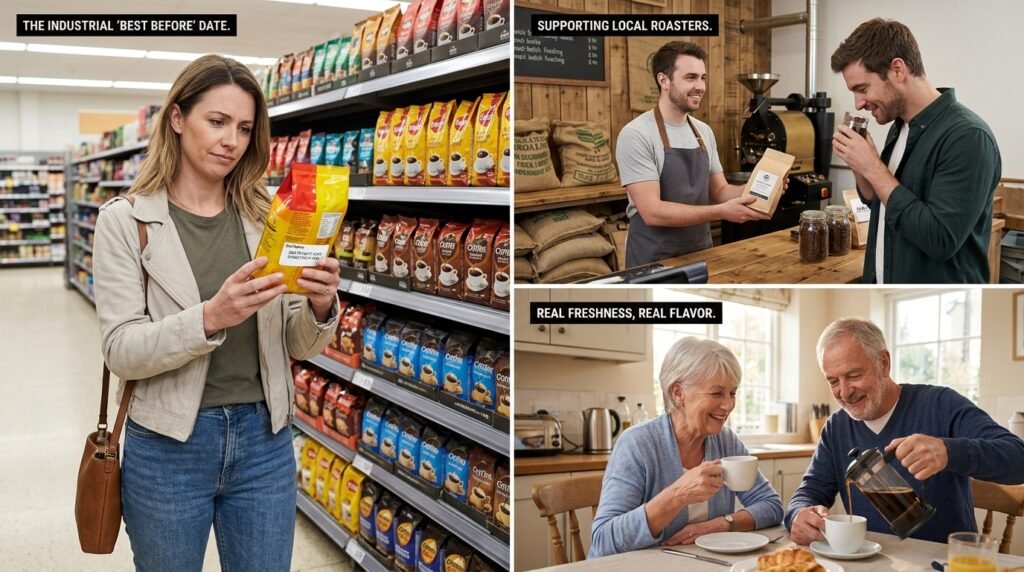
When you walk into a major supermarket, you see rows of shiny, heavy bags of coffee. The bags look premium. They feature beautiful pictures of exotic mountains. If you turn the bag around, you will see a printed date.
The label usually says “Best Before” followed by a date exactly one year from today.
This date is a massive industrial lie. It is a legal food safety requirement. It simply means the dry grounds will not grow dangerous mold or bacteria before that date. It tells you absolutely nothing about the actual culinary quality of the product inside the bag.
Decoding the Corporate Timeline
Understanding the deceptive nature of grocery store packaging was exactly What I Noticed When I Started Paying Attention to Coffee Labels because it revealed a terrifying timeline.
If a bag of commercial coffee expires one year from today, that means it was likely roasted six months ago. It sat in a massive industrial warehouse. It sat on a shipping truck. It sat in the back room of the grocery store.
By the time you put that bag into your shopping cart, the coffee is already a chemical zombie. It is completely dead.
The Chemistry of the Roast
To understand why a six month old coffee bean is dead, you have to look inside the roasting drum.
Raw green coffee smells like dry grass. It has zero culinary value. You have to apply extreme heat to trigger complex chemical reactions. The heat creates hundreds of volatile aromatic compounds. These fragile compounds provide the beautiful smells of dark chocolate, sweet peach, and blooming jasmine.
The heat also creates a massive amount of carbon dioxide gas. This gas gets permanently trapped inside the tight cellular walls of the roasted seed.
The moment the coffee bean drops out of the hot roasting drum, a biological timer starts ticking.
The Two Phases of Decay
The roasted seed immediately begins two distinct chemical processes. Both processes destroy flavor.
The first process is degassing. The trapped carbon dioxide gas slowly escapes from the cellular walls and dissipates into the air. As the heavy gas pushes its way out of the bean, it physically carries the delicate aromatic compounds away with it. The beautiful smell of the coffee literally evaporates into the room.
The second process is oxidation. As the carbon dioxide leaves the bean, oxygen enters.
Oxygen is highly corrosive. When it interacts with the heavy natural lipids and oils inside the coffee bean, it causes them to spoil. The oils go rancid. The complex fruit sugars are completely neutralized.
The Loss of Vitality
When you buy a bag of commercial coffee that is six months old, both of these destructive processes are completely finished.
All of the protective carbon dioxide has evaporated. All of the natural oils have oxidized. The bright organic acids have been completely neutralized.
Witnessing the physical reality of this staleness was exactly The Day I Finally Understood Why Fresh Coffee Beans Matter because the brewing process completely exposed the dead ingredients. When you pour boiling water over stale coffee, nothing happens. The coffee bed just sits there. It looks like flat, wet mud.
The Bloom Proves the Freshness
Fresh coffee behaves entirely differently. It fights back.
When you buy a bag of light roasted Ethiopian coffee directly from a local roaster, it is packed with trapped carbon dioxide. When you pour hot water over fresh grounds, the water aggressively displaces the trapped gas.
The coffee bed instantly erupts. It swells upward into a massive, highly active dome. Massive bubbles form and pop across the surface. This physical reaction is called the bloom.
The bloom is the absolute visual proof of agricultural vitality. It proves that the cellular structure is intact and the volatile aromatics are perfectly preserved. If your coffee does not aggressively bubble when the hot water hits it, your coffee is completely stale.
The Search for the Roast Date
I had to completely change my purchasing habits. I completely stopped buying coffee at the supermarket.
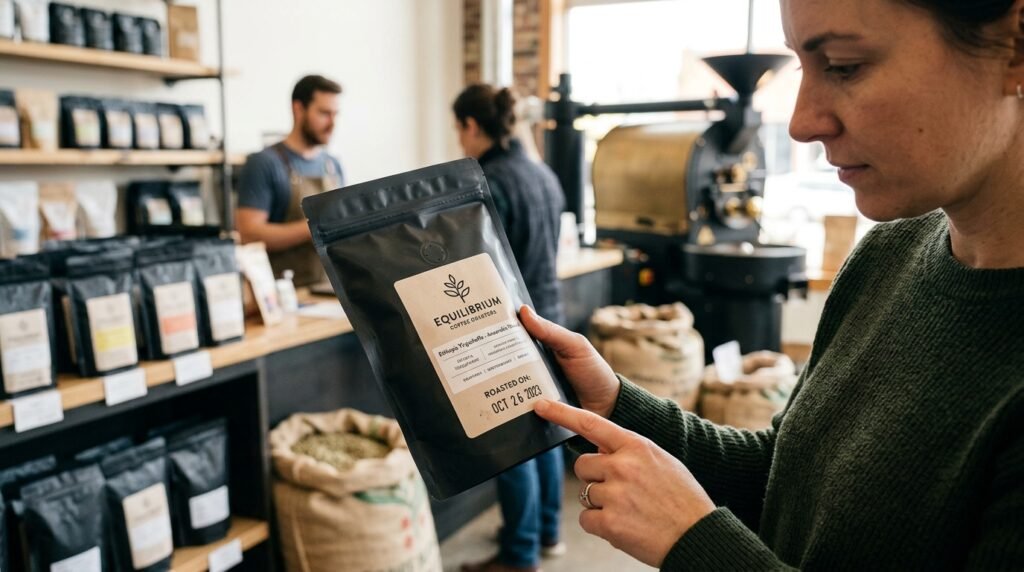
I started ordering my beans directly from independent specialty coffee roasters. I demanded absolute transparency. I refused to look at the “Best Before” date. I only looked for one specific piece of data.
I looked for the “Roasted On” stamp.
This simple ink stamp changes the entire power dynamic. It forces the roaster to be honest. It tells me exactly when the chemical timer started ticking. If a bag of coffee does not have a specific roast date stamped clearly on the label, I refuse to spend my money on it.
The Paradox of Extreme Freshness
When I started buying coffee with a stamped roast date, I made a very common beginner mistake.
A fresh bag of Colombian coffee arrived at my apartment in Rio de Janeiro. The stamp said it was roasted yesterday. I was incredibly excited. I immediately tore the bag open. I weighed my fifteen grams. I ground the beans. I poured my hot water.
The resulting beverage tasted sharp, highly astringent, and slightly metallic. It tasted completely chaotic.
I was highly confused. The coffee was only one day old. I thought absolute freshness guaranteed absolute perfection. I was wrong. I had to learn the paradox of the resting period.
The Necessity of Resting
Coffee beans cannot be consumed immediately after they leave the roasting drum. They are chemically unstable.
The extreme heat of the roaster traps too much carbon dioxide inside the seed. If you try to brew the coffee on day one, the massive volume of escaping gas violently disrupts the hot water. The water cannot properly penetrate the cellular walls. It cannot dissolve the heavy fruit sugars.
The excessive gas acts like a chemical shield. It prevents proper extraction.
You must practice patience. You have to place the sealed bag of coffee in a dark cabinet and completely ignore it. You have to let the beans rest.
Finding the Peak Window
The length of the resting period depends entirely on the roast profile.
If you buy a heavy, dark roasted Brazilian coffee, the cellular walls are highly porous. The gas escapes very quickly. You only need to let a dark roast rest for about five to seven days before it tastes perfect.
I prefer light roasted African coffees. The cellular walls of a light roast are incredibly dense. The gas escapes very slowly. I have to force myself to wait at least fourteen days before I open a fresh bag of Ethiopian coffee.
Tracking this specific flavor curve was exactly How I Realized Freshness Affects Every Sip of Coffee because I documented the changes daily. On day seven, the coffee tasted sharp. On day fourteen, the flavor suddenly opened up. The sharp metallic taste vanished, replaced entirely by heavy peach sweetness and bright lemon acidity.
The Golden Timeline
Once the resting period is over, the coffee enters its peak flavor window.
For light roasts, this golden window usually opens on day fourteen and closes around day thirty five. During these three weeks, the coffee is chemically flawless. The aggressive carbon dioxide has safely dissipated. The destructive oxygen has not yet ruined the oils.
The extraction is smooth. The flavor resolution is absolutely stunning. You can taste the specific dirt of the specific farm.
After day thirty five, the flavor begins a slow, inevitable decline. The bright acids start to dull. The floral aromas begin to fade. By day sixty, the coffee tastes flat and woody.
Managing the Inventory
Understanding this strict biological timeline completely changed how I manage my kitchen inventory.
I treat coffee exactly like I treat fresh fruit or fresh bread. I do not buy massive quantities. I only buy exactly what I can consume during the peak flavor window.
If I consume two hundred and fifty grams of coffee every two weeks, I only order one bag at a time. I time the delivery perfectly. I order the new bag when my current bag is half empty. When the new bag arrives, it rests in the dark cabinet while I finish the old bag.
It is a perfectly optimized supply chain. I never drink stale coffee, and I never waste money throwing dead beans into the garbage.
The Freezer Exception
There is only one valid method to pause this biological timer. You must use extreme cold.
If I find an incredibly rare bag of Panamanian Gesha and I want to save it for a special occasion, I do not leave it in the cabinet. I wait until the resting period is finished. I wait until day fourteen. Then, I tape the valve on the bag. I put the bag inside a sealed plastic freezer bag. I place the entire package deep in my kitchen freezer.
The extreme cold halts the oxidation completely. It suspends the coffee in time.
When I want to drink it three months later, I pull the bag out. I let it sit on the counter for twelve hours to prevent condensation. When I finally open it, the coffee smells and tastes exactly like day fourteen. The timeline is safely preserved.
The Financial Reality
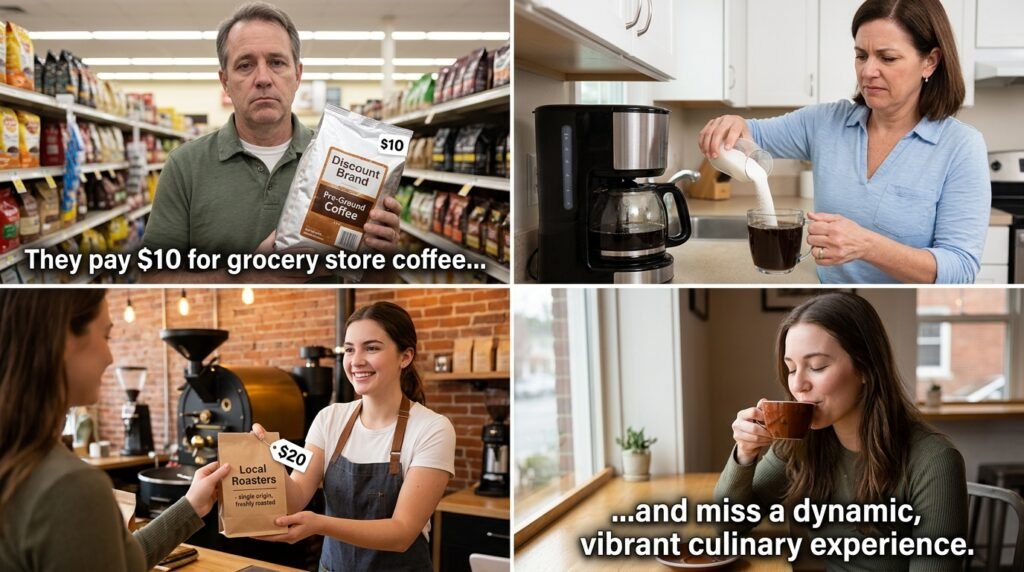
Many people refuse to buy specialty coffee because they think it is too expensive. They would rather pay ten dollars for a massive bag of grocery store coffee than twenty dollars for a small bag of local, freshly roasted beans.
They are fundamentally misunderstanding the value of the product.
When you buy grocery store coffee, you are buying dead organic matter. You are paying for a complete lack of flavor. You have to add heavy milk and massive amounts of white sugar just to mask the bitter ash taste.
When you buy fresh coffee from a local roaster, you are buying a dynamic, vibrant culinary experience. You do not need milk. You do not need sugar. The liquid is naturally sweet and highly complex.
Respect the Biology
Look closely at the coffee sitting on your kitchen counter right now.
If it is sitting in a plastic tub, or if it only has a “Best Before” date printed on the side, you are drinking a ghost. You are missing the entire spectrum of flavor the agricultural product was designed to deliver.
Change your buying habits today. Find a local specialty roaster. Look for the stamped roast date. Buy a single bag.
Let the coffee rest in a dark cabinet. Wait for the peak window to open. When you finally grind those fresh beans, smell the explosive floral aroma, and watch the coffee bed actively bloom under the hot water, you will completely understand the science. You will never spend your hard earned money on dead, stale supermarket inventory again. You will finally drink the coffee exactly when it was meant to be consumed.
