
I kept working late on a massive website migration for a client. I stayed up until three in the morning in my home office in Rio de Janeiro. I left the air conditioning running at maximum capacity all night to keep my computer servers from overheating.
When I finally woke up the next morning, the apartment was freezing cold.
I walked into the kitchen wearing a heavy sweater. I needed a very strong, very perfect cup of coffee to reboot my brain. I had all my premium equipment ready. I weighed my expensive Ethiopian coffee beans. I ground them perfectly in my manual burr grinder. I heated my filtered water in my electric gooseneck kettle to exactly two hundred degrees Fahrenheit.
I executed a flawless concentric pouring technique over my glass V60 cone. The red liquid drained into my heavy ceramic mug. I sat down at my desk and took a large sip.
The coffee was terrible. It tasted incredibly sour. The heavy peach sweetness was entirely missing. The extraction had completely stalled. I was highly confused. I used the right water. I used the right beans. I used the right grind size. The simple coffee tip that improved my morning cup solved this invisible mystery. It taught me that precision data in the kettle means absolutely nothing if you ignore the physical temperature of your brewing environment.
The Invisible Heat Thief
I stood in my freezing kitchen and stared at my equipment. I touched the heavy ceramic mug sitting on my counter. It felt like a block of ice.
I suddenly realized my massive chemical error. I was completely ignoring the laws of thermodynamics.
When two objects with different temperatures touch each other, thermal energy always moves from the hot object to the cold object until they reach equilibrium.
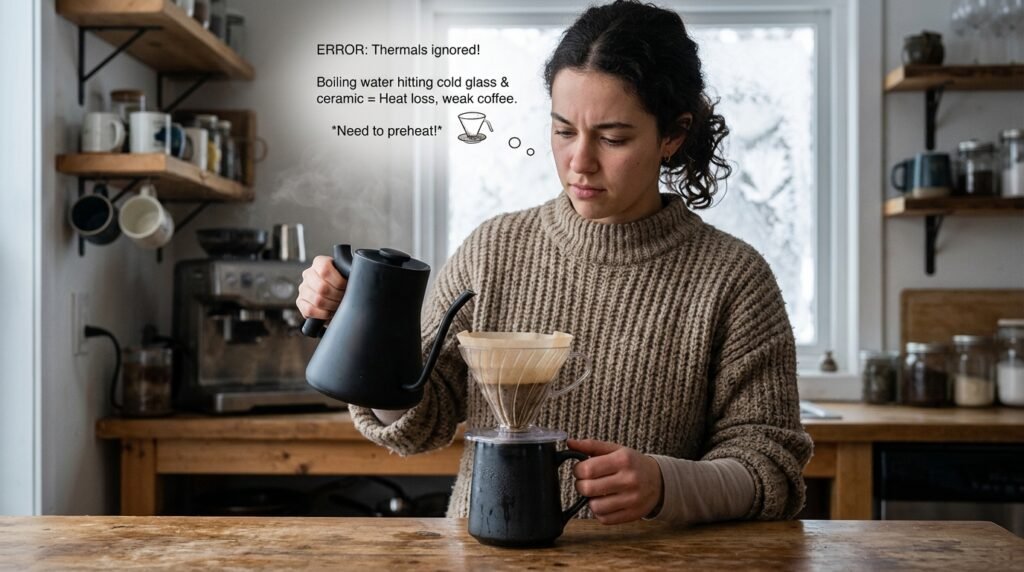
I was pouring two hundred degree water out of my kettle. But that water immediately collided with a freezing cold glass V60 cone and a freezing cold ceramic mug. The heavy glass and the thick ceramic acted like massive thermal sponges. They violently sucked the heat right out of the brewing water before the water could extract the coffee.
The Drop in Extraction Temperature
Understanding this thermal theft is critical for anyone brewing specialty coffee at home.
You might have your kettle set to a perfect boiling point. But the moment that water hits a room temperature brewer, the temperature of the actual coffee slurry drops drastically. A cold ceramic or glass dripper can steal up to fifteen degrees of thermal energy in less than two seconds.
If your extraction temperature drops by fifteen degrees, your chemical reaction completely fails.
Failing to recognize this massive energy loss was exactly The Simple Coffee Mistake I Made Every Morning for Years because I constantly blamed my grinder for sour coffee. I thought my particles were too coarse. In reality, my water was just too cold to dissolve the complex fruit sugars.
The Vulnerability of Light Roasts
This thermal loss is specifically devastating if you drink light roasted specialty coffee.
Dark roasted coffee is highly brittle. The cellular walls are heavily expanded and completely broken down by the intense heat of the roasting drum. You can actually extract dark roasted coffee with relatively cool water because the dark sugars are highly soluble.
Light roasted African coffees are entirely different.
Because the roaster stops the heat very early, the seed remains incredibly dense. The cellular walls are tight. The bright organic acids and the heavy fruit lipids are locked deep inside a hard vault. You absolutely need high, sustained heat to penetrate that vault. If your brewer steals your heat, the light roast will only release sharp, sour acids. The heavy, balancing sweetness will remain permanently trapped inside the grounds.
The Simple Solution
I needed to stop the glass and the ceramic from stealing my thermal energy. I needed to satisfy their capacity for heat before I introduced my expensive coffee beans to the system.
The solution required absolutely no new equipment. It did not require a financial investment. It only required a minor change in my physical workflow.
I needed to aggressively preheat my entire brewing setup. I had to build a warm environment to protect the fragile chemistry of the extraction.
Boiling the Excess Water
The next morning, I changed my kettle routine.
Normally, I only boiled the exact amount of water I needed for my recipe. If my recipe required two hundred and forty grams of water, I put three hundred grams in the kettle.
I stopped doing that. I started filling my electric gooseneck kettle completely to the maximum line every single morning. I boiled a massive excess of filtered water.
I placed my empty glass V60 cone directly on top of my heavy ceramic mug. I inserted a dry paper filter into the cone.
The Aggressive Flush
When the kettle reached a rolling boil, I did not add my coffee grounds.
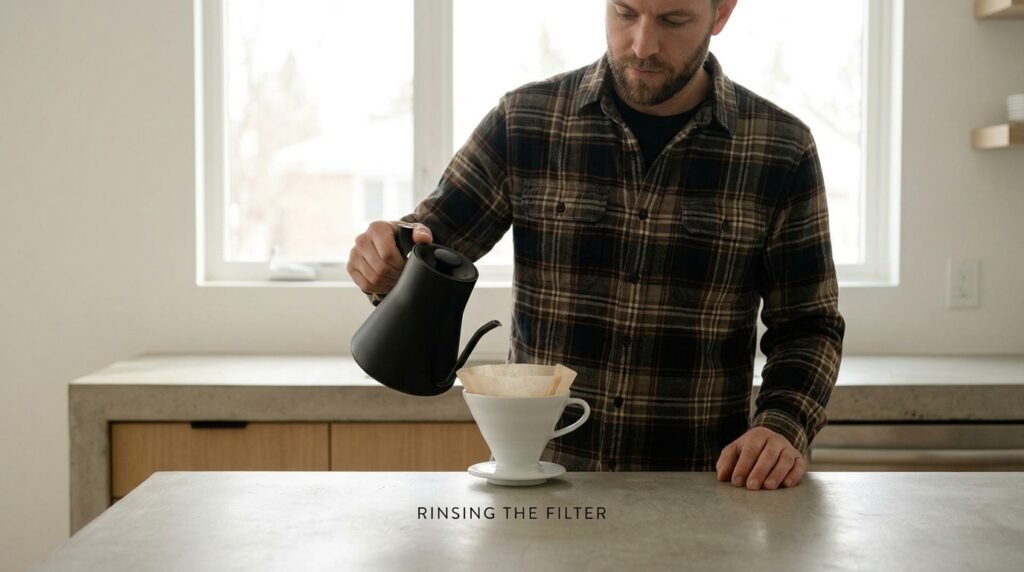
Instead, I poured a massive amount of the violently boiling water directly over the empty paper filter. I poured at least one hundred and fifty grams of water. I made sure to wet every single inch of the white paper.
The boiling water drained rapidly through the paper and crashed into the bottom of the cold ceramic mug.
This simple physical action accomplishes two critical goals simultaneously. First, it completely washes the paper filter. Even high quality bleached paper contains residual dust. If you do not wash the paper, that dust will make your expensive coffee taste like wet cardboard.
Satisfying the Thermal Mass
The second and more important goal is thermal saturation.
As the boiling water washes through the glass cone, the thick glass absorbs the massive thermal energy. The glass becomes incredibly hot to the touch. The water then falls into the heavy ceramic mug. The ceramic absorbs the remaining heat.
I let that hot water sit inside the mug for a full minute while I weigh and grind my coffee beans.
I physically touch the outside of the ceramic mug. When the thick walls feel hot against my palm, I know the thermal mass is completely satisfied. The mug and the glass cone cannot steal any more heat. They are at maximum capacity.
Dumping the Waste
Once the equipment is fully heated, I pick up the ceramic mug. I walk over to the kitchen sink and dump the rinse water down the drain.
This step is incredibly important. You must remember to dump the rinse water. If you forget this step, you will brew your perfect specialty coffee directly into a mug full of papery, hot water. You will completely dilute and ruin the beverage.
I place the hot, empty mug back onto my digital scale. I place the hot glass cone back on top.
The Protected Extraction
Now the environment is perfectly secure.
I dump my fresh Ethiopian coffee grounds into the wet, hot paper filter. I grab my gooseneck kettle. The water inside is still at my target temperature of two hundred and five degrees.
I start the bloom phase. I pour the hot water over the coffee bed.
Because the glass cone is already incredibly hot, it does not steal any thermal energy from the water. The water retains its maximum heat. It attacks the dense cellular walls of the light roasted coffee perfectly.
Witnessing this stable chemical reaction was exactly How I Learned Coffee Temperature Changes Flavor because the results in the cup were instantly completely different. The extraction did not stall. The thermal baseline remained completely flat and perfectly stable for the entire three minute pouring routine.
The Return of the Sweetness
I finished the pour. The red liquid drained through the hot glass cone and fell into the preheated ceramic mug.
I carried the mug to my desk. I waited a few minutes for the extreme heat to bleed off. I took a slow sip.
The sour, sharp, under extracted flavor was completely gone. The heavy, syrupy peach sweetness had returned flawlessly. The bright lemon acidity was perfectly balanced. I had successfully unlocked the high altitude African dirt simply by pouring hot water over empty glass.
The Material Difference
Once I understood the physics of thermal mass, I started looking critically at the materials I used in my kitchen.
Heavy ceramic and thick glass look incredibly beautiful on a kitchen counter. They feel premium and expensive. But from a purely scientific standpoint, they are terrible materials for manual coffee brewing. They require massive amounts of energy to preheat.
If you are using a thick ceramic dripper, you cannot just splash it with a tiny bit of warm water. You have to aggressively blast it with boiling water to actually heat the dense core of the material.
The Advantage of Plastic
This thermal reality changed my hardware preferences entirely.
I eventually retired my beautiful glass V60 cone. I replaced it with a cheap, dark plastic V60 cone. The plastic model cost ten dollars. It looks completely utilitarian.
But plastic is a brilliant thermal insulator. It has very low thermal mass.
When you pour hot water into a plastic cone, the plastic does not steal the heat. It immediately reflects the heat back into the coffee slurry. You still need to rinse the paper filter with hot water to remove the paper taste, but you do not need to spend massive amounts of thermal energy preheating the brewer itself. The plastic protects the extraction temperature naturally.
The Reality of the Cold Mug
Even if you switch to a plastic brewer, you must still aggressively preheat your drinking vessel.
The ceramic mug is the final destination for your beverage. If you brew hot coffee directly into an ice cold, heavy ceramic mug, the liquid will instantly drop by twenty degrees.
This creates a massive sensory problem.
I write frequently about the importance of letting your coffee cool down before you drink it. You want the extreme heat to leave the liquid so you can taste the complex fruit sugars. But you want that cooling process to happen naturally and slowly in the open air.
If a freezing cold mug shocks the hot coffee instantly, it destroys the volatile aromatic compounds. It physically kills the vibrant smell of the beverage. The coffee tastes flat and bruised.
Building the Habit
Preheating your equipment requires absolutely no money, but it does require strict physical discipline.
It is very easy to skip this step when you are tired. When my alarm rings at six in the morning, I just want caffeine. I do not want to boil extra water. I do not want to wait for ceramic walls to heat up.
But I force myself to do it every single day.
Establishing this rigid, nonnegotiable step was exactly The First Coffee Tip That Truly Changed My Brewing because it separated the lazy morning routine from the professional culinary process. It is the cheapest insurance policy you can buy for your expensive coffee beans.

Respect the Laws of Physics
Look at your own morning routine tomorrow.
If you are pulling a heavy ceramic mug out of a cold kitchen cabinet and brewing your expensive coffee directly into it, you are actively sabotaging your own extraction. You are letting the cold porcelain steal the energy that belongs to your coffee beans.
Stop fighting the laws of thermodynamics.
Fill your kettle to the absolute maximum line. Boil the water aggressively. Flush your paper filter heavily. Let the boiling water sit inside your coffee cup until the outside of the cup is hot to the touch. Dump the waste water in the sink.
When you finally brew your coffee into a fully preheated, thermally secure environment, you will instantly taste the massive increase in extraction yield. You will banish the sour, weak flavors from your kitchen, and you will permanently unlock the heavy, sweet potential of the roasted seed.
