

I spend my professional life cleaning up messy digital environments. Clients in Rio de Janeiro hire me to audit their broken websites. The problem is rarely the main structural code. The problem is usually microscopic junk data. It is old image files, abandoned plugins, and redundant server requests. This tiny, invisible debris accumulates over time. It clogs the database. It slows the entire system down to a crawl.
I use strict digital filters to trap and delete this junk.
For a very long time, I completely failed to apply this exact same filtering logic to my kitchen counter. I was brewing expensive, light roasted Ethiopian coffee. I used a premium manual burr grinder. I measured my water perfectly. But my morning cup always had a lingering, harsh defect.
The core flavor was sweet, but the finish was always terribly dry. It left a rough, chalky sensation on the back of my tongue.
I spent months blaming my pouring technique. I blamed my water temperature. I blamed the roaster. The coffee trick that took me years to discover forced me to stop blaming my variables and start looking at the microscopic debris. I learned that my expensive grinder was generating raw junk data. I had to learn how to filter the dust before the water ever touched the beans.
The Illusion of the Premium Grinder
When I bought my heavy stainless steel hand grinder, I thought it was a magic bullet.
The marketing promised perfect particle uniformity. I assumed that when I dropped my hard African seeds into the chamber and turned the crank, the ceramic burrs sliced the beans into perfect, identical cubes.
This is a complete mechanical fantasy.
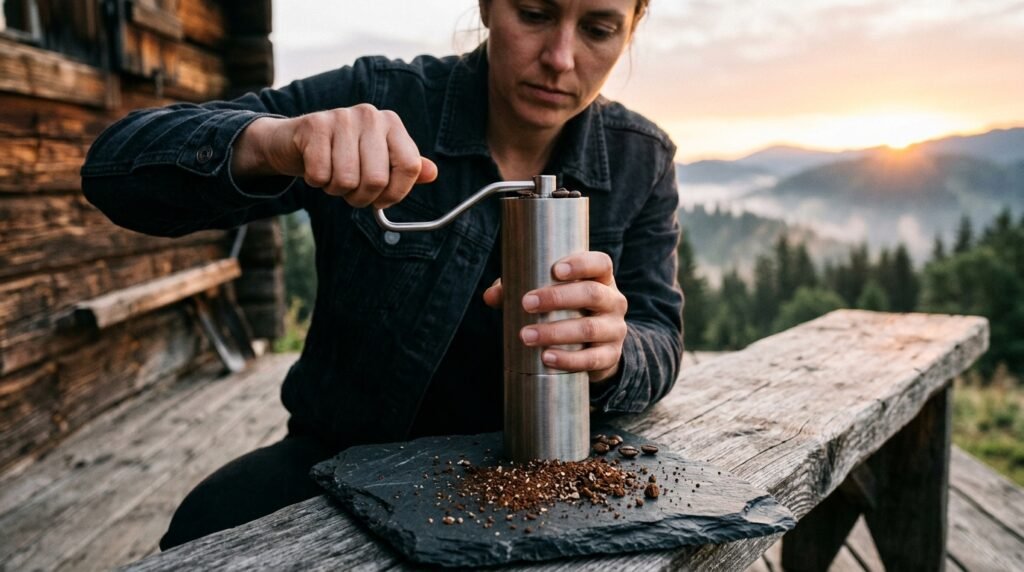
Coffee beans do not slice. They shatter. They are dense, brittle, roasted agricultural products. When a sharp ceramic burr bites into a coffee bean, the bean explodes into hundreds of pieces. The grinder forces those pieces through a specific gap to control the maximum size. But it cannot control the minimum size.
The Problem of the Dust
The shattering process inevitably creates a massive amount of microscopic coffee dust. The specialty coffee industry refers to this fine dust as “fines.”
You cannot see these fines when you look at the pile of grounds in your grinder bin. They hide. They cling to the larger, correctly sized boulders.
These microscopic fines are the absolute enemy of a clean coffee extraction. They are the junk data clogging your culinary database. They are responsible for the harsh, chalky bitterness that ruins an otherwise perfect cup.
The Chemistry of Over Extraction
To understand why this dust is so destructive, you have to look at the physics of surface area.
When you pour hot water over a perfectly sized, coarse coffee particle, it takes the water about three minutes to penetrate the core and dissolve the sweet fruit sugars.
A microscopic coffee fine has almost no physical volume. It is entirely surface area. When boiling water touches a coffee fine, the extraction happens instantaneously. The hot solvent strips the sugars out in less than two seconds.
For the remaining two minutes and fifty eight seconds of your pouring routine, that tiny particle is violently over extracting.
The Tannin Release
When a coffee particle over extracts, it stops releasing sweet sugars. It starts releasing harsh, dry tannins.
Tannins are the exact same bitter plant compounds found in dark chocolate and black tea. If you leave a black tea bag in a mug of hot water for twenty minutes, the tea becomes undrinkable. It aggressively dries your mouth out. The medical term for this dry, chalky sensation is astringency.
Realizing the source of this specific astringency was exactly What I Discovered About Grinding Coffee Too Fine because I finally connected the dry feeling on my tongue to the microscopic dust. The fines were acting like tiny, broken tea bags ruining my extraction.
The Mechanical Failure
The chemical release of bitter tannins is only the first problem. The microscopic dust also causes a massive mechanical failure inside your brewer.
I use a plastic V60 cone with a paper filter. The white paper filter is full of microscopic pores. These pores allow the clean, extracted liquid to flow through while holding the solid coffee grounds back.
During the brewing process, gravity pulls the hot water downward. The flowing water physically carries the tiny coffee fines down to the very bottom of the cone.
The dust violently clogs the microscopic pores of the paper.
The Danger of the Stall
When the pores get clogged, the fluid dynamics completely crash.
The water stops flowing smoothly. It pools up inside the plastic cone. The extraction stalls. A recipe that should take exactly three minutes suddenly takes five minutes to drain.
Understanding this physical blockage was the core of What I Learned After Making Coffee With Filter Papers because it proved that the paper itself is highly vulnerable. You cannot execute a perfect mathematical recipe if the drainage system is completely blocked by microscopic sludge.
The Expensive Industry Solution
I finally understood the problem. My expensive grinder was generating dust, and that dust was clogging my filter and ruining my flavor.
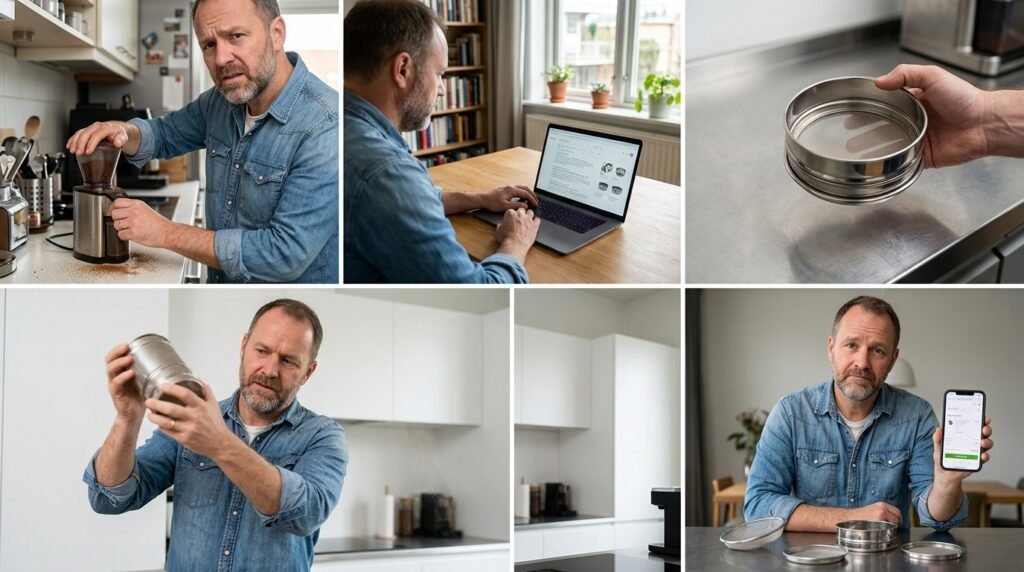
I went online to look for a solution. The specialty coffee industry has recognized this problem for years. They sell specialized metal sieves. You pour your coffee grounds into a metal cylinder, attach a microscopic metal screen, and shake it violently for two minutes.
These commercial sieves cost over one hundred dollars.
I refused to buy one. I was not going to spend another hundred dollars to fix the flaws of a two hundred dollar grinder. I also did not want to add two minutes of violent shaking to my peaceful morning routine. I needed a simpler, faster hack.
The Paper Towel Revelation
I discovered the ultimate hack completely by accident.
I was cleaning my kitchen counter. I had spilled some dry coffee grounds on a standard, cheap paper towel. I picked up the paper towel to throw it in the trash. I noticed that the larger coffee particles immediately rolled off into the garbage can.
But a massive layer of fine, dark brown dust remained glued to the white paper towel.
The paper towel was naturally trapping the microscopic fines. It was a completely free, highly effective sieve. The trick that took me years to discover was sitting right next to my kitchen sink the entire time.
The Physics of the Hack
The paper towel trick works through a combination of physical friction and static electricity.
A standard kitchen paper towel has a highly textured, porous surface. When you rub dry coffee grounds against this textured surface, the massive boulders easily roll over the bumps. But the microscopic fines fall into the tiny crevices of the paper.
Furthermore, the physical friction generates a small amount of static electricity. The weightless dust particles magnetically cling to the dry paper fibers.
Executing the Trick
The next morning, I integrated this trick into my physical workflow.
I placed my manual grinder on the digital scale. I weighed exactly fifteen grams of my dense Ethiopian Yirgacheffe beans. I turned the crank and crushed the seeds.
I tore one single sheet of standard paper towel off the roll. I laid it perfectly flat on my kitchen counter.
I unscrewed the bottom catch bin of my grinder. I dumped the fifteen grams of coffee grounds directly into the center of the white paper towel.
The Tactile Sieve
I took my index finger and gently spread the pile of coffee grounds across the surface of the paper towel. I did not press down hard. I just moved the particles around in a slow, wide circle.
I spent exactly ten seconds gently pushing the grounds across the paper.
Then, I picked up the paper towel. I carefully folded it into a slight U-shape to create a funnel. I held the funnel over my plastic V60 cone. I tilted my hand and let the coffee grounds slide off the paper towel and into the filter.
The Visual Proof
I set the brewer down. I looked at the paper towel in my hand.
The visual evidence was absolutely staggering. The center of the white paper towel was completely stained with a dark, heavy layer of brown dust. The microscopic particles were stuck firmly to the paper fibers.
I gently blew on the paper towel. The dust did not move. It was trapped perfectly.
I had successfully removed at least a full gram of bitter, highly over extracted junk data from my coffee recipe. I threw the dirty paper towel directly into the trash can.
The Immediate Flow Rate Change
I placed the brewer on my digital scale and grabbed my hot gooseneck kettle.
The physical difference was obvious the exact second I started pouring the water. Because I had removed the microscopic dust, the water faced absolutely zero unnatural resistance.
The bloom phase was explosive. The water penetrated the clean boulders instantly. When I started my main concentric pour, the water drained through the coffee bed with incredible, glassy speed.
The flow rate was so fast that I actually had to pour my water much quicker just to keep the coffee bed submerged. There was absolutely no stalling. The paper filter remained completely unclogged for the entire duration of the brew.
The Clear Final Bed
I finished the extraction. The entire process took exactly two minutes and forty five seconds.
I removed the plastic cone and looked at the spent coffee grounds. The bed was perfectly flat and visually pristine.
Before I used the paper towel trick, the top of the spent coffee bed always looked like dark, wet mud. That mud was the microscopic fines floating to the top. Now, there was no mud. I could see the individual, perfectly sized coffee particles resting cleanly against each other. The physical drainage was flawless.
Tasting the Clarity
I carried my ceramic mug to my computer desk. I waited five minutes for the thermal energy to dissipate into the room.
I took my first slow sip of the filtered extraction.
The transformation was absolute. The harsh, dry, chalky astringency was completely gone. The finish was incredibly clean and incredibly long. Because the bitter tannins were no longer overpowering the palate, the sweet fruit sugars stepped aggressively into the foreground.
The coffee tasted like a vibrant, heavy peach tea. The lemon acidity was sharp and perfectly articulated. The flavor resolution was higher than any cup I had ever brewed in my own apartment.
The Zero Cost Upgrade
Implementing this mechanical hack was exactly The Simple Coffee Change That Made Every Cup Better because it required absolutely no financial investment.
I did not have to buy a hundred dollar metal sieve. I did not have to upgrade my burr grinder. I just had to steal a single sheet of paper towel from my kitchen dispenser.
This tiny, ten second physical habit completely revolutionized my relationship with my equipment. It allowed me to push the limits of my extractions without fearing the bitter consequences of the dust.
Pushing the Grinder Further
Once you remove the fines, you unlock a massive new level of control.
Because I knew the paper towel would catch the dust, I realized I could start grinding my coffee much finer. I adjusted the dial on my manual grinder three clicks tighter.
Normally, grinding this fine would completely choke the paper filter and stall the brew. But because I was rubbing the grounds on the paper towel first, the dust was eliminated. The filter stayed open.
By grinding finer and removing the dust, I vastly increased the surface area of the clean boulders. I extracted even more heavy fruit sugars. The body of the coffee became syrupy and rich, but the finish remained perfectly clean. I was hacking the physical limits of my own hardware.
The Hubris of the Brewer
It took me years to discover this trick because of my own stubborn pride.
When you spend two hundred dollars on a coffee grinder, you want to believe it is perfect. You do not want to admit that it produces garbage data. You assume the tool is flawless and your pouring technique is the problem.
You have to drop your ego. Physics is physics. Every grinder on the planet produces microscopic dust. The coffee bean shatters. You cannot stop the shattering, but you can control where the dust ends up.

Audit Your Own Grounds
Tomorrow morning, do not just blindly dump your coffee grinder into your brewer.
Take one single sheet of paper towel. Lay it flat on your counter. Dump your fresh coffee grounds onto the paper. Spread them around gently with your finger. Look closely at the white fibers.
You will see the enemy. You will see the dark, muddy dust that has been secretly ruining your morning routine for years.
Slide the clean boulders into your filter. Throw the dust into the garbage. When you finally pour hot water over a perfectly uniform, completely dust free bed of coffee, you will experience a level of flavor clarity that you previously thought was impossible at home. You will permanently banish the dry, bitter finish, and you will finally taste the sweet, clean reality of the roasted seed.

Hi, I’m the coffee enthusiast behind Coffee Nerd Lab.
Like many people, I started drinking coffee simply because it helped me wake up in the morning. Over time, that daily habit turned into a genuine interest in understanding what makes a great cup of coffee. I began experimenting with different beans, brewing methods, grinders, and coffee gear, learning through trial and error along the way.
This blog is where I document that journey. Every article is inspired by real experiences, discoveries, and lessons I’ve learned while exploring the world of coffee. From brewing guides and equipment reviews to practical tips and coffee basics, my goal is to share useful information in a way that’s easy to understand and enjoyable to read.
Thanks for stopping by, and I hope Coffee Nerd Lab helps you enjoy your next cup a little more than the last.