
I audit digital code for a living. I manage complex websites for clients. My entire professional life is built on absolute precision. If a single line of code is written incorrectly, an entire server can crash. I do not accept sloppy work in my digital environment. I track every metric, I fix every error, and I demand total optimization.
A few years ago, I realized I was living a massive double standard.
My digital life was flawless. My physical life in my kitchen was a complete disaster. I was working long hours in my apartment in Rio de Janeiro. I needed caffeine to stay awake. I would walk into my kitchen, grab a plastic tub of dark, pre-ground commercial coffee, and dump a random amount of it into a cheap plastic drip machine.
I drank muddy, bitter, burnt water every single day. I accepted this terrible quality because I thought coffee was just a functional utility. I thought it was just cheap fuel.
The first time I took coffee brewing seriously completely shattered that illusion. It was a profound psychological shift. I finally stopped treating the roasted seed like dirty gasoline and started treating it like a complex, highly fragile culinary ingredient.
The Hypocrisy of the Kitchen
The realization hit me on a busy Thursday afternoon. I was optimizing an image database for a client. I was compressing files to save milliseconds of loading time.
I walked into the kitchen to grab another cup of coffee from my plastic machine. The liquid had been sitting on the hot metal warming plate for two hours. It smelled like burnt tires. I took a sip and winced. It was acidic, harsh, and heavily astringent.
I looked at the cheap plastic machine. I looked at the old plastic tub of pre-ground dirt.
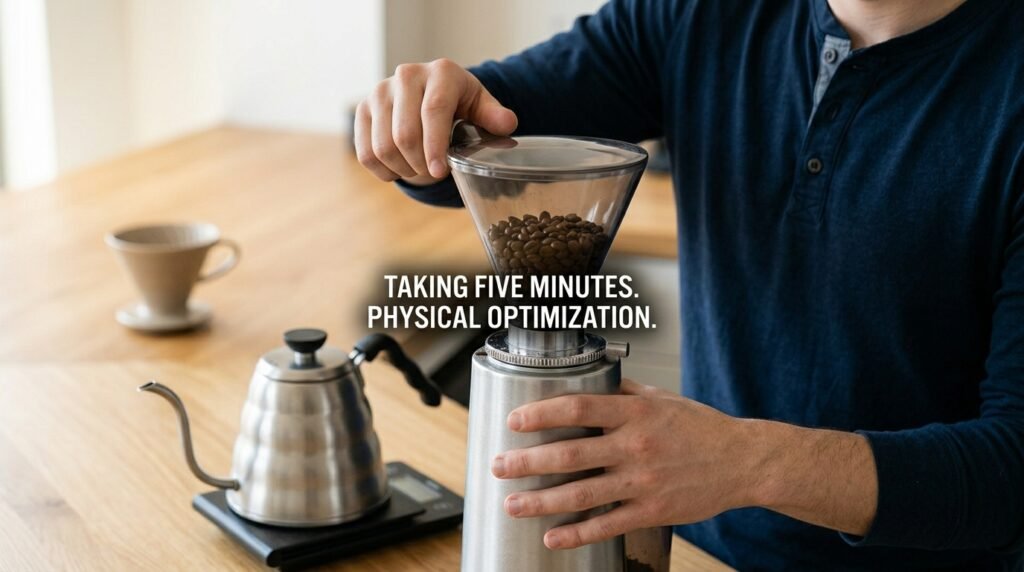
I realized the intense hypocrisy of my daily routine. I was spending eight hours a day optimizing digital images so they looked perfect on a screen. But I was unwilling to spend five minutes optimizing the physical liquid I was putting inside my own body.
The Local Catalyst
I needed to understand what I was missing. I put my laptop to sleep and left my apartment.
I walked to a highly rated specialty coffee shop in my neighborhood. I usually avoided places like this. I thought they were overpriced and pretentious. I walked up to the counter. I did not order a standard espresso or a heavy milk drink. I ordered a manual pour over.
I stood at the end of the wooden bar and watched the barista work.
I expected him to just dump hot water over some grounds. Instead, I watched a highly choreographed, mathematical routine. The barista was not acting like a fast food worker. He was acting like a laboratory technician.
Witnessing the Data
He pulled out a flat digital scale. He placed a glass carafe on top. He weighed the whole coffee beans carefully. He used a massive electric burr grinder to crush the seeds.
He placed a paper filter inside a ceramic cone. He used a specialized kettle with a long, curved spout. When he started pouring the water, he started a digital stopwatch. He watched the numbers on the scale climb. He watched the timer tick.
Seeing this strict adherence to raw data was exactly The Coffee Moment That Made Me Curious About Brewing because it spoke directly to my professional mindset. The barista was not guessing. He was executing a strict chemical formula.
Tasting the Difference
The barista finished the extraction. He handed me a small glass server filled with a ruby red liquid and a clean ceramic tasting cup.
I walked to a table and sat down. I poured a small amount of the coffee. I smelled it first. It did not smell like burnt rubber. It smelled heavily of ripe strawberries and dark chocolate.
I took a slow sip. My brain completely stalled.
The coffee was entirely devoid of the harsh, dry bitterness I was used to. It was incredibly clean. It felt light and juicy on my palate. The strawberry flavor was vibrant and articulate. I could clearly separate the fruit notes from the chocolate finish.
The Decision to Upgrade
I finished the cup and walked back to my apartment. I knew I could never drink the muddy water from my plastic drip machine again.
I had tasted the absolute potential of the agricultural product. I knew the flavor existed. I just needed the right hardware to extract it.
I opened my laptop and started researching specialty coffee equipment. I did not look at massive, expensive automatic machines. I knew automation often hides terrible mechanics. I wanted the manual tools I saw the barista using. I wanted absolute control over the physical data.
Securing the Hardware
I ordered the essential equipment that same afternoon.
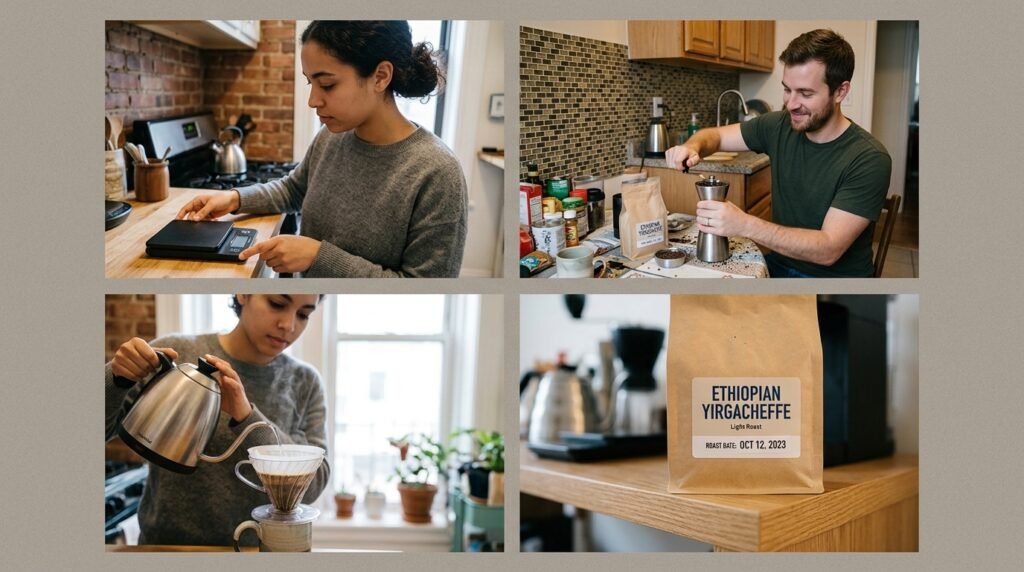
I bought a plastic V60 pour over cone. I bought a heavy manual hand grinder with ceramic burrs. I bought a basic digital kitchen scale that measured in single grams. I bought a stainless steel gooseneck kettle for the stove.
The entire setup cost less than a premium software subscription.
I also ordered a bag of fresh, light roasted Ethiopian Yirgacheffe coffee from a reputable online roaster. I made sure the bag had a specific roast date printed on the label. I was done consuming stale, mystery dirt.
The Arrival of the Tools
The packages arrived a few days later. I cleared a specific corner of my kitchen counter.
I threw the cheap plastic drip machine into the garbage. I threw the plastic tub of pre-ground commercial coffee into the trash right next to it. I wiped the counter clean.
I placed the digital scale, the manual grinder, and the plastic cone in a neat row. I arranged them like a dedicated analog workstation.
Executing this physical reset was exactly My First Experience With a Manual Pour Over Setup and it felt incredibly intimidating. I had all the professional tools, but I had absolutely no physical muscle memory. I had to learn how to operate the machinery from scratch.
The First Real Attempt
The next morning, I woke up early. My partner was still asleep. The apartment was completely quiet.
I walked to my new workstation. I opened the bag of Ethiopian coffee. The explosive aroma of sweet peach and blooming jasmine flowers filled the kitchen instantly. I placed the manual grinder on the digital scale. I poured the dense seeds until the screen read exactly fifteen grams.
I attached the metal handle and started grinding. The physical friction was intense. The hard African seeds fought back against the ceramic burrs. I had to use real physical effort to crush them.
Managing the Variables
I boiled filtered water in my new gooseneck kettle. I placed the plastic V60 cone on the digital scale and inserted the paper filter.
I dumped the uniform coffee grounds into the filter. I reset the scale to zero. I grabbed my smartphone and opened the stopwatch application.
I was suddenly managing four different variables at the exact same time. I had to watch the weight of the water. I had to watch the clock. I had to control the physical flow rate from the kettle. I had to aim the stream of water precisely to ensure I did not ruin the coffee bed.
The Panic of the Pour
I started the timer and began pouring the hot water.
My hand was shaking slightly. The heavy metal kettle felt awkward in my grip. I poured the water too fast. A massive wave of liquid hit the coffee grounds and splashed up the sides of the paper filter.
I panicked and stopped pouring. I watched the digital scale. I had accidentally poured sixty grams of water for the bloom phase instead of my target of forty grams. I had already broken my mathematical ratio.
I waited for the gas to escape. The coffee bed bubbled and swelled. I took a deep breath and tried to steady my wrist.
Recovering the Extraction
I resumed pouring. I tried to move my hand in slow, tight concentric circles just like the professional barista.
It was highly difficult. I kept pouring too heavily in the center, digging a deep crater into the grounds. I had to consciously force myself to slow down. I watched the numbers climb on the digital scale. One hundred and fifty. Two hundred.
When the screen hit exactly two hundred and forty grams, I tilted the kettle back immediately. I stopped the timer. The entire process took three minutes and twenty seconds.
The Visual Evidence
I set the heavy kettle down on the stove. I removed the plastic cone and looked inside the paper filter.
The coffee bed was a mess. It was not flat and smooth like wet sand. It was highly uneven. There was a deep crater in the middle and dry grounds pushed high up against the paper walls.
I knew my fluid dynamics were terrible. I knew the water had channeled through the center. I knew the extraction was not perfectly mathematically uniform.
But I had still used fresh beans. I had still used a precise ratio. I had still used clean filtered water.
The Sensory Reward
I picked up the ceramic mug. I walked to my desk and sat down. I waited a few minutes for the extreme heat to bleed out into the room.
I took my first sip of my very first manual extraction.
My eyes widened. The coffee was not perfect. It had a slight dry finish from the uneven pouring technique. But the core flavor was absolutely stunning.
Discovering this lack of heavy bitterness was exactly The First Time I Realized Coffee Could Taste Sweet and it completely changed my paradigm. The liquid was bright, vibrant, and juicy. A massive wave of lemon acidity hit my palate, followed instantly by a heavy peach sweetness.
The Motivation to Improve
I drank the entire mug. I was heavily caffeinated, but I was not jittery. I was incredibly focused.
That single, imperfect cup of Ethiopian coffee was better than any beverage I had ever made in my entire life. It was better than the expensive drinks at the corporate cafes.
I realized that if I could make coffee this good with terrible pouring technique, the ceiling for quality was incredibly high. I just needed to practice. I needed to refine my physical mechanics. I needed to learn how to control the variables with absolute precision.
The Shift in Psychology
That morning permanently changed how I view my kitchen.
Coffee is no longer a utility. It is no longer cheap fuel for my digital workload. It is a highly demanding, highly rewarding culinary craft.
When you take the brewing process seriously, you force yourself to slow down. You force yourself to pay attention to the physical world. You cannot write computer code while managing fluid dynamics. You have to be entirely present. The act of brewing becomes a daily meditation.
Building the System
Over the next few weeks, I practiced relentlessly.
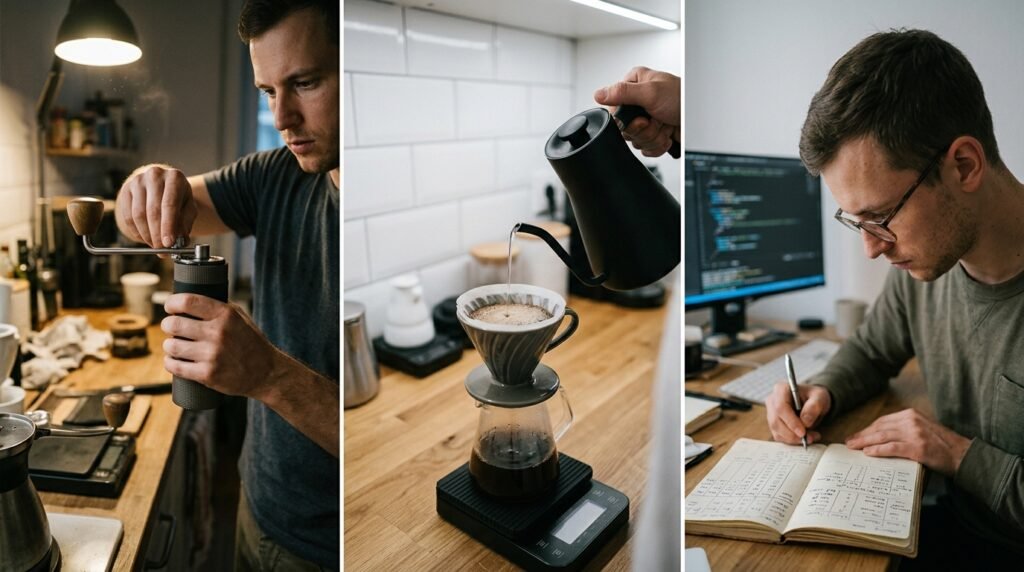
I learned how to hold the gooseneck kettle to ensure perfect laminar flow. I learned how to adjust my manual grinder by microscopic clicks to dial in the exact drawdown time. I started writing my recipes down in a paper notebook to track my successes and failures.
I applied the exact same rigorous system optimization to my coffee that I apply to my web servers.
Respect the Raw Material
If you are currently drinking bad coffee every morning, you have to make a choice.
You can continue to accept mediocrity. You can continue to dump mystery powder into a plastic machine and drink bitter sludge.
Or, you can decide to take the process seriously. You can buy a scale. You can buy a grinder. You can buy fresh beans from a local roaster.
It takes effort. It takes physical friction. You will make mistakes. You will pour water too fast. You will ruin a few extractions. But when you finally master the mechanics, and you finally taste the pristine, sweet clarity of a perfectly extracted bean, you will never accept garbage in your kitchen again. You will finally give the raw agricultural product the exact respect it deserves.
