
I was staring down at my favorite ceramic mug, feeling an overwhelming sense of defeat.
I had done absolutely everything by the book. I had spent the last three months slowly upgrading my entire kitchen setup. I owned a high-quality burr grinder. I had a beautiful, temperature-controlled gooseneck kettle. I was buying expensive, freshly roasted, single-origin beans from a highly respected local roaster. I was meticulously weighing my coffee grounds down to the tenth of a gram.
By all logical metrics, the dark liquid in my mug should have been spectacular. It should have been a vibrant, complex masterpiece of morning brewing.
But it wasn’t.
It was just… okay. It wasn’t necessarily bad, but it was incredibly boring. It tasted flat. It had a strange, slightly chalky finish that coated the back of my throat, and the delicate fruity notes promised on the coffee bag were completely missing in action.
I had hit a frustrating plateau. I felt like I was spending premium money for a mediocre experience, and I couldn’t figure out where I was going wrong. I spent weeks blaming the roaster, assuming I was just buying “bad batches.” I blamed my pouring technique. I even considered returning my expensive new grinder, convinced that the machine was somehow defective.
It took a casual, five-minute conversation with a barista on a quiet Tuesday afternoon to realize that my gear was perfectly fine. My beans were exceptional. My technique was solid.
I was simply ruining my coffee with the most obvious, overlooked ingredient in my entire kitchen. Making one small, incredibly cheap change completely transformed my mornings and finally unlocked the flavors I had been chasing for months.
The Invisible Ingredient
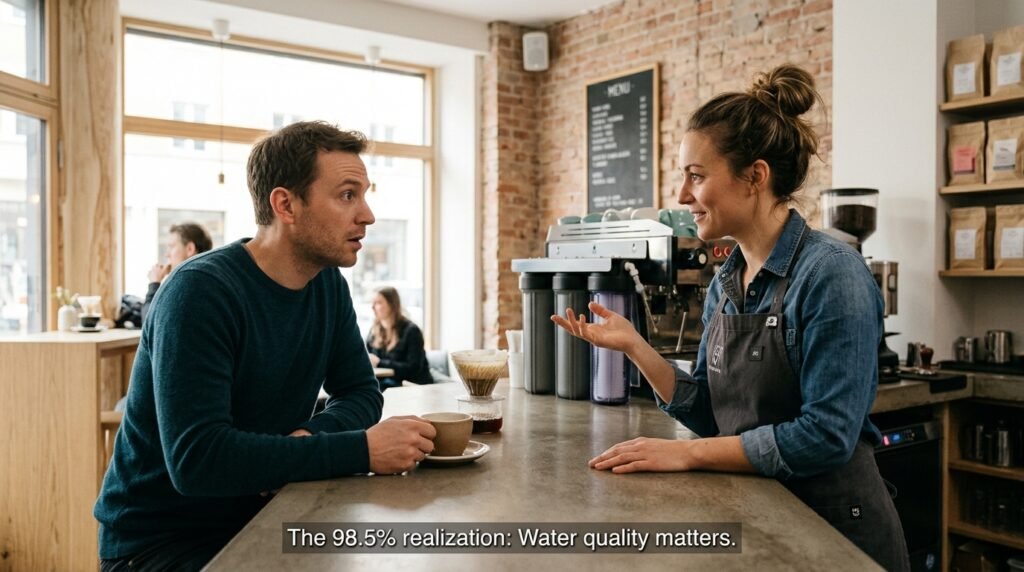
I was sitting at the bar of my favorite specialty coffee shop, nursing an absolutely brilliant pour-over of an Ethiopian washed coffee. It tasted like jasmine and ripe peaches. I couldn’t help but voice my frustration to the barista wiping down the counter across from me.
I rattled off my list of equipment, hoping he would give me some secret, highly technical pouring method that would fix my home brews.
He listened patiently, nodded, and then asked me a question that completely caught me off guard.
“What does your tap water taste like?”
I blinked. I had no idea how to answer that. “It tastes like… water?” I replied, feeling a bit foolish. “I mean, I just fill my kettle from the kitchen sink. It’s safe to drink.”
The barista smiled, leaning against the espresso machine. “Safe to drink doesn’t mean it’s good for brewing. You have to remember something fundamental. A cup of coffee is about 98.5% water. The actual coffee material only makes up about 1.5% of the beverage. If your water tastes heavy, metallic, or chemically treated, your coffee is going to taste heavy, metallic, and chemically treated. You can’t hide it.”
It was a profound, almost embarrassing realization. I had been obsessing over the 1.5% of the equation, entirely ignoring the other 98.5%.
The Chlorine Mask
That afternoon, I went home and did something I hadn’t done in years: I poured a glass of cold water straight from my kitchen tap and actually paid attention to how it tasted.
Without the distraction of food or ice, the reality of my municipal water supply became glaringly obvious.
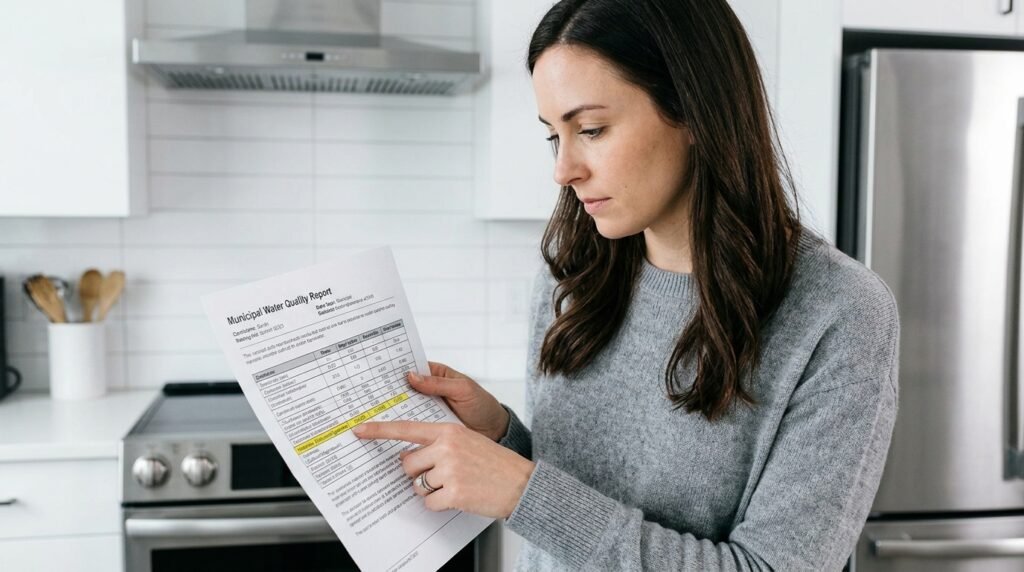
It tasted heavily of chlorine. It had a faint, astringent chemical smell, like a very diluted public swimming pool. There was also a heavy, almost chalky minerality to it that left my mouth feeling slightly dry.
Municipal water treatment facilities do an incredible job of keeping our water safe from dangerous bacteria. They use chlorine and chloramines to sanitize the water as it travels through miles of underground pipes to reach our homes. This is fantastic for public health, but it is an absolute disaster for specialty coffee.
Chlorine is a highly reactive chemical. When you heat up chlorinated water and pour it over delicate, freshly ground coffee, the chlorine violently attacks and destroys the fragile aromatic compounds in the beans.
The delicate floral notes, the bright berry acidity, and the subtle sweetness are completely masked by the chemical taste of the water. It was the exact reason why I couldn’t taste any nuance in my expensive beans. I was essentially bleaching the flavor out of my coffee every single morning.
The Hard Truth About Hard Water
But chlorine was only half of the problem. As I fell down the rabbit hole of coffee water chemistry, I learned about “water hardness.”
Water hardness refers to the amount of dissolved minerals—specifically calcium and magnesium—floating around invisibly in your tap water.
You actually need some of these minerals to make good coffee. Think of magnesium and calcium as microscopic magnets. When hot water hits the coffee grounds, these mineral “magnets” attach themselves to the flavor compounds in the coffee and pull them out into the liquid.
However, my city was notorious for having extremely “hard” water, meaning the mineral content was incredibly high.
When your water is too hard, it is already oversaturated. The water is so full of calcium and magnesium that there is literally no room left for the coffee flavors to dissolve into it. The water hits the coffee grounds like a solid brick wall, resulting in an under-extracted, weak, and chalky-tasting beverage.
The $2 Experiment
I needed to know if this was actually the root of my problem, or if I was just making excuses for my lack of brewing skills. I decided to conduct a highly controlled, incredibly cheap experiment.
I went to the local grocery store and bought a $2 plastic gallon of simple, filtered spring water.
The next morning, I set up two identical pour-over stations side by side. I used the exact same coffee beans, weighed out to the exact same gram. I used the exact same grind size.
For Cup A, I boiled water straight from my kitchen sink. For Cup B, I boiled the filtered spring water I had bought the night before.
I brewed both cups simultaneously, using the same pouring technique. I let them cool for a few minutes to ensure the heat wouldn’t numb my palate. Then, I took a sip of Cup A—my standard daily brew.
It was exactly what I was used to. Flat, slightly bitter, heavy, and dull.
Then, I took a sip of Cup B.
The Flavor Breakthrough
The difference was so dramatic and so instantaneous that it felt like a magic trick.
Cup B did not taste like the coffee I had been drinking for the past three months. It was vibrantly alive. The muddy, chalky finish was completely gone, replaced by a crystal-clear, clean feeling on the palate.
More importantly, the promised tasting notes on the bag had miraculously appeared. I could clearly identify a punch of bright, juicy raspberry acidity, followed by a long, lingering sweetness that tasted exactly like milk chocolate.
It was a revelation. By simply removing the chlorine and the excess heavy minerals from the water, the coffee was finally allowed to speak for itself.
It was the first time I truly understood the depth of the beverage, a sensory awakening that I detailed heavily in my article about How I Learned Coffee Profiles Are Like Wine Notes. I realized that identifying distinct flavors wasn’t a pretentious myth; it was just a matter of removing the chemical interference blocking those flavors.
The Distilled Water Trap
My immediate instinct after this successful experiment was to take it to the extreme. If filtered spring water was good, then 100% pure, perfectly clean distilled water must be even better, right?
Wrong. I learned this lesson the hard way a few days later.
I bought a jug of distilled water—water that has been boiled into steam and condensed back into liquid, removing absolutely 100% of all minerals, chemicals, and impurities. It is completely empty water.
I brewed a cup of coffee with it, expecting the most pristine cup of my life. Instead, it was one of the worst things I have ever tasted. It was incredibly sour, overwhelmingly harsh, and completely lacked any sweetness or body.
Remember those microscopic mineral “magnets” I mentioned earlier? Because distilled water has zero minerals, it has zero ability to properly extract the good flavors from the coffee beans. It pulls out the harsh, aggressive acids, but leaves the complex sugars behind.
It proved a vital lesson: coffee needs water, but it needs the right kind of water. It needs a delicate balance of cleanliness and mineral content.
Finding a Permanent Solution
While the $2 gallon of spring water proved my theory, I knew I couldn’t rely on buying heavy, single-use plastic jugs from the supermarket for the rest of my life. I needed a sustainable, permanent solution for my kitchen.
I ended up investing in a high-quality water filtration pitcher. I didn’t buy the cheapest one on the shelf; I specifically looked for a filter designed to remove chlorine, odor, and heavy metals, while leaving a balanced amount of trace minerals behind.
This simple plastic pitcher became the absolute foundation of my morning coffee.
Every night before I go to bed, I fill the pitcher from the tap and place it in the fridge. By morning, the water is perfectly filtered, clean, and ready to be boiled. Incorporating this tiny act into my evening has become a grounding, anticipatory habit, an idea I expanded on in The Simple Routine That Makes My Coffee Taste Better. It ensures that when I wake up groggy and tired, the most important ingredient for my coffee is already prepped and pristine.
The Hidden Benefit: Saving Your Gear
Upgrading my water didn’t just revolutionize the flavor in my mug; it also solved a massive, unseen problem building up inside my expensive equipment.
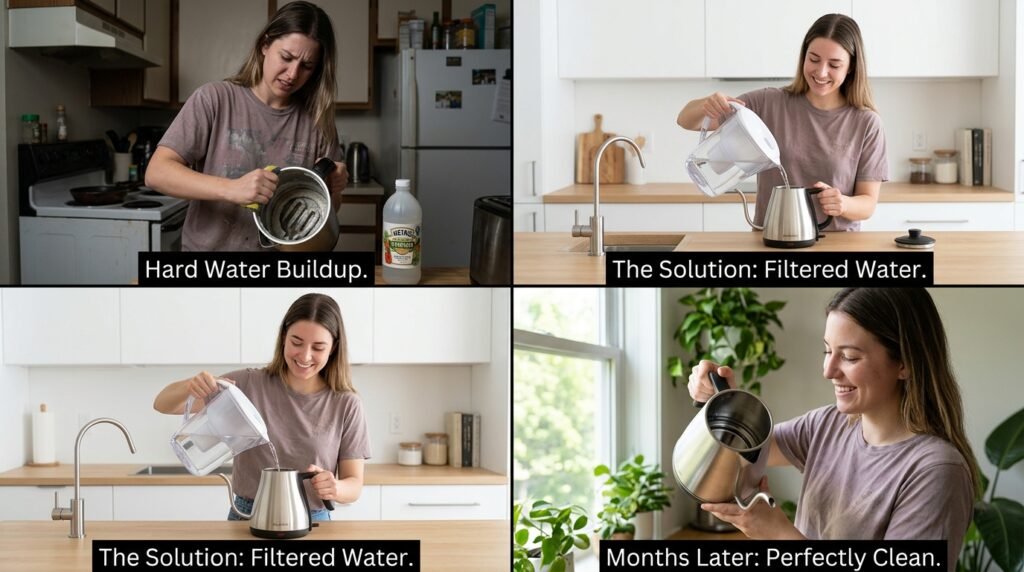
When you boil hard, unfiltered tap water, the excess calcium and magnesium don’t just disappear. As the water evaporates into steam, those heavy minerals are left behind, baking onto the heating elements and internal walls of your kettle or coffee machine.
This is called limescale. It looks like a hard, chalky, white crust.
Over time, this crust acts as an insulator, preventing your kettle from heating water accurately. Even worse, flakes of this nasty mineral buildup will eventually break off and fall directly into your coffee grounds.
I used to have to scrub the inside of my kettle with harsh vinegar solutions every single month to remove the stubborn white film. It was a tedious, terrible chore, much like the process I had to adopt when cleaning stale oils from my grinder, an ordeal I wrote about in The Morning I Learned the Importance of Clean Equipment.
But once I switched to filtered water, the limescale problem completely vanished. The inside of my stainless steel kettle remained spotless, shiny, and perfectly clean for months on end. The filtered water wasn’t just extracting better flavor; it was actively extending the lifespan of my expensive brewing gear.
Don’t Ignore the 98%
It is incredibly easy to get distracted by the shiny, glamorous aspects of the coffee world.
We love to obsess over the country of origin. We love to debate the merits of a washed Ethiopian versus a natural Colombian. We love to watch endless videos comparing burr grinders, pour-over drippers, and digital scales. We treat the coffee bean as the ultimate, singular variable in our morning routine.
But none of that matters—absolutely none of it—if you are pouring chemical-laden, highly chlorinated, aggressively hard tap water over your expensive beans.
If you are currently feeling stuck in a coffee plateau, wondering why your home brews never taste as vibrant, clean, and sweet as the ones you buy at your local specialty café, I urge you to look at your kitchen sink.
You might not need to buy a new grinder. You might not need to change your brewing method, or buy more expensive beans, or watch another tutorial on how to pour water in perfect concentric circles.
You might just need to fix your water.
Buy a simple filtration pitcher, or grab a bottle of filtered spring water from the store just for a single morning experiment. Make that one small change. Taste the difference side-by-side.
I guarantee that once you remove the chlorine mask and let the true, unhindered flavor of the coffee shine through, you will never look at your tap water the same way again. It is the cheapest, most effective upgrade you will ever make to your morning routine.
