

I was sitting on my couch in Rio de Janeiro testing a new habit tracking application on my phone. I love automating repetitive tasks. I build digital workflows that remove human error from complex systems. If a software program requires me to remember ten different steps to function correctly, I consider the software broken. I want tools that make my life completely frictionless.
I put my phone down and walked into the kitchen to make my morning coffee.
I had a great setup. I owned a heavy manual burr grinder. I used a precision digital scale. I bought incredible Ethiopian coffee beans. But my physical brewing routine still contained a massive point of friction.
Every time I poured hot water over my coffee grounds, I felt a spike of anxiety. I had to pour the water perfectly to ensure every single grain of coffee became wet. If my pouring hand shook, or if I poured too fast, the water would completely miss sections of the coffee bed. The coffee accessory that made brewing easier completely eliminated this anxiety. It is a strange looking, highly specific tool that removes human error from the extraction process entirely.
The Hidden Enemy in the Filter
For months, I suffered from a severe extraction problem. I would finish brewing my glass V60 pour over. I would drink the coffee, and it would taste slightly sharp and unbalanced.
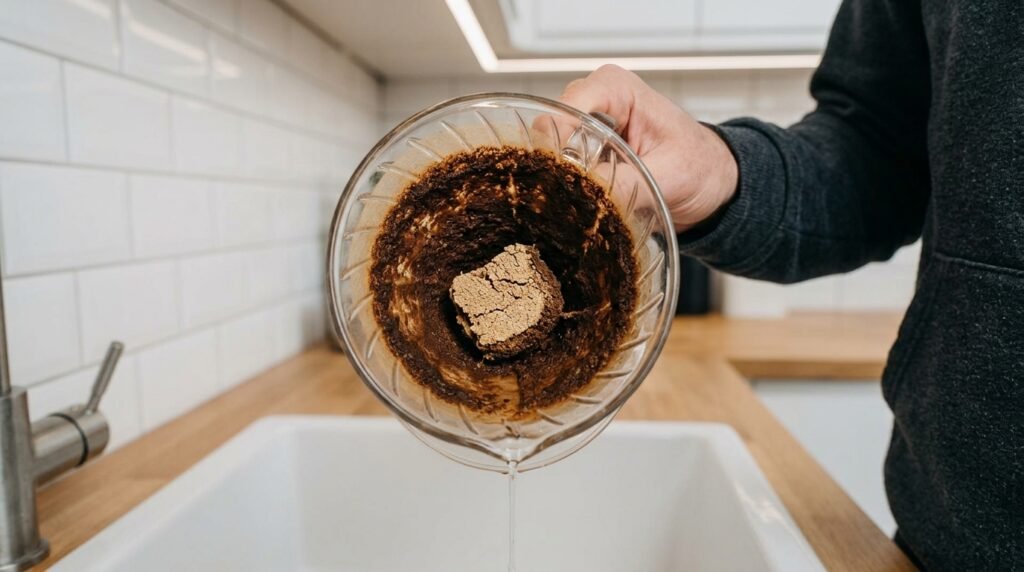
I would go to the kitchen to throw the paper filter in the trash. I would look closely at the spent coffee grounds. Deep inside the wet mud, I would find a massive, completely dry clump of coffee.
The boiling water never touched those seeds.
This is a catastrophic failure. If a clump of coffee remains dry, those specific particles contribute absolutely zero flavor to the final mug. Worse, the water that was supposed to extract those dry seeds was forced to flow somewhere else. That redirected water violently over extracted the surrounding wet grounds. The resulting beverage was a confusing mix of weak water and bitter ash.
The Physics of the Clump
I had to understand why these dry pockets formed.
Rio de Janeiro is an incredibly humid city. There is massive moisture in the air. When you take dense, light roasted African coffee beans and crush them through ceramic burrs, you create friction. That friction generates microscopic coffee dust.
The ambient humidity causes that microscopic dust to act like glue.
The fine particles bind the larger coffee particles together. They form dense, tightly packed boulders. These tiny boulders drop into your paper filter and sit there like waterproof rocks. When you pour the hot water, the fluid simply washes over the outside of the rock and flows straight down to the bottom. The core of the clump remains completely bone dry.
The Failed Workarounds
I tried several manual techniques to fix this clumping problem. None of them worked.
First, I tried aggressively shaking the glass V60 cone before I poured the water. I thought physical force would break the clumps apart. It did not work. Shaking the brewer only caused the microscopic dust to sink directly to the bottom of the paper filter.
Experiencing this clogged filter was exactly What I Discovered About Grinding Coffee Too Fine and it completely stalled the water flow. The extraction took seven minutes, and the coffee tasted terribly bitter.
Next, I tried using a small metal spoon to dig into the wet slurry and physically smash the dry pockets. This was also a terrible idea. The metal spoon violently disrupted the coffee bed. It pushed dry grounds high up the walls of the paper filter. The extraction became entirely uneven.
The Discovery of the Needles
I realized I needed a specialized tool. I could not fix this structural problem with brute force or a kitchen spoon.
I started reading professional coffee forums. I looked at what espresso baristas used to prepare their coffee. Espresso relies on intense pressure. If there is a single clump inside an espresso machine, the pressurized water will violently blast a hole straight through the coffee bed.
To prevent this, professional baristas use a tool called a WDT distributor. WDT stands for Weiss Distribution Technique.
I looked at pictures of the tool online. It looked completely absurd. It was a small metal handle holding several long, extremely thin acupuncture needles. It looked like a miniature metal whisk.
Adapting the Espresso Tool
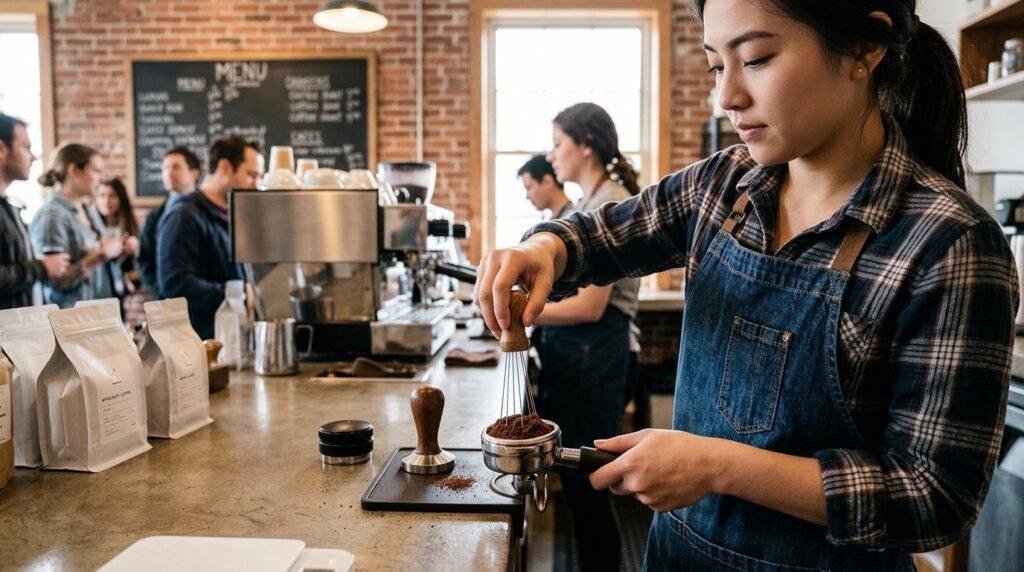
The WDT tool was designed strictly for espresso. The baristas use the tiny needles to stir the dry coffee grounds inside the metal portafilter before they apply pressure.
I decided to adapt this specific tool for my manual pour over routine.
I ordered a basic WDT tool online. It cost less than fifteen dollars. It arrived a few days later. It featured an aluminum handle and six flexible stainless steel needles. The needles were incredibly thin. They were just 0.3 millimeters wide.
I took the tool out of the box and walked into my kitchen. I was ready to completely rewrite my morning workflow.
The First Needle Test
I placed my digital scale on the counter. Buying this precision weight tracker was exactly The Tool That Helped Me Measure Coffee Like a Pro and it secured my baseline data. I weighed exactly fifteen grams of my Ethiopian Guji beans.
I ground the beans in my heavy manual burr grinder. I poured the dry grounds into my glass V60 cone.
I looked closely at the coffee bed. Just as I suspected, the humid air had caused several dense clumps to form. The coffee looked uneven and rocky.
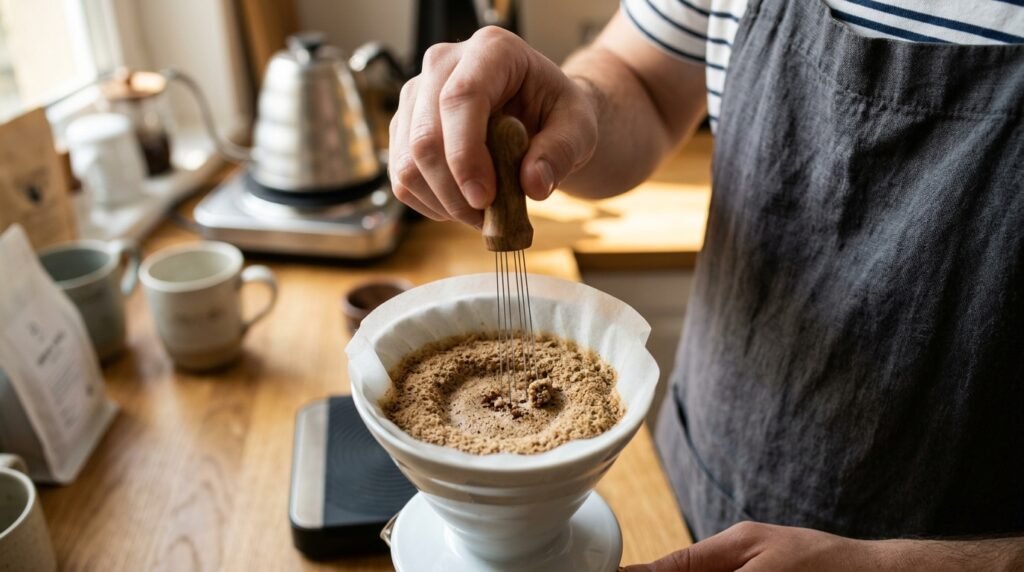
I grabbed the small aluminum handle of the WDT tool. I lowered the six flexible needles directly into the dry coffee bed.
The Fluffy Texture
I moved the needles in slow, deep circles. I made sure the tips of the needles touched the very bottom of the paper filter.
The physical transformation of the coffee was absolutely stunning.
Because the needles were incredibly thin, they did not compress the coffee. They did not push the grounds around. They sliced straight through the dense boulders. The clumps shattered instantly. The microscopic dust separated from the larger particles.
Within five seconds of gentle stirring, the rocky, uneven landscape disappeared. The coffee grounds became incredibly fluffy. They looked like light, airy sand. The entire volume of the coffee bed actually expanded because the dense clumps were finally broken apart.
The Foolproof Bloom
I pulled the needles out and placed the tool on the counter. The coffee bed was perfectly level and completely uniform.
I grabbed my boiling gooseneck kettle. I started the bloom phase. I poured forty grams of hot water gently over the surface of the fluffy grounds.
Before I bought the WDT tool, the bloom phase was always stressful. I had to pour the water perfectly to ensure it penetrated the dense clumps. I had to constantly worry about leaving dry pockets behind.
With the fluffy, uncompressed coffee bed, the water saturation was completely automatic. The hot water sank instantly and evenly into the grounds. There was absolutely no resistance. Every single particle of coffee became perfectly wet in less than two seconds.
Watching the Gas Escape
Because every single particle of coffee was fully saturated, the chemical reaction was completely uniform.
The trapped carbon dioxide gas released perfectly. The entire coffee bed swelled upward into a massive, smooth dome. There were no violent bubbles erupting from hidden dry pockets. There were no sinkholes in the middle of the filter.
I did not have to touch the brewer. I did not have to use a spoon to dig for dry spots. The tiny needles had completely solved the problem before the water even entered the system.
The Smooth Drawdown
I waited forty five seconds for the gas to dissipate. I resumed pouring the boiling water in slow concentric circles.
The fluffy texture of the coffee grounds radically improved the fluid dynamics of the extraction. The water flowed through the coffee bed with perfect, steady resistance. It did not stall. It did not rush.
I watched the digital scale hit my target weight of two hundred and forty grams. I stopped pouring.
I watched the red liquid drain into my ceramic mug. When the extraction finished, I looked inside the glass cone. The spent coffee grounds formed a flawless, flat bed. There was absolutely no mud clogging the paper filter. The extraction was mathematically perfect.
Tasting the Uniformity
I carried the ceramic mug to my living room and sat down. I waited a few minutes for the temperature to drop. I took a slow sip.
The flavor profile was brilliant. The harsh, sharp bitterness caused by over extracted channels was completely gone. The weak, watery flavor caused by dry pockets was entirely eliminated.
A massive, vibrant wave of sweet peach acidity hit my palate. The floral jasmine aroma was perfectly articulate. The liquid felt incredibly crisp and clean on my tongue. I was finally tasting the absolute potential of the Ethiopian dirt. The flavor matched the premium price of the raw ingredient.
Eliminating the Anxiety
The flavor upgrade was spectacular, but the true value of the tool was psychological.
Finding this specific instrument was exactly The Coffee Accessory That Made Brewing Fun Again because it completely removed the performance anxiety from my morning routine.
I no longer have to worry about my pouring technique. I no longer have to stress about the ambient humidity in Rio de Janeiro ruining my particle distribution. The tiny needles do all the heavy lifting. They provide a perfect, uniform foundation every single time.
I can pour the water with confidence. I know the fluid will behave exactly the same way on a rainy Tuesday as it does on a dry Sunday.
A Tool for Every Method
The beauty of the WDT tool is its absolute versatility.
It is not just for espresso machines. It is not just for pour over cones. You can use it to improve any brewing method in your kitchen.
If you use a French press, the coffee grounds often float to the very top and form a hard crust. You can use the long needles to gently break that crust and ensure all the grounds sink evenly into the hot water.
If you use an AeroPress, the narrow plastic cylinder often causes the grounds to pack tightly at the bottom. A quick stir with the needles fluffs the bed and ensures the pressurized water extracts the heavy sugars perfectly.
The Cheap Automation
I love building automated systems on my computer. I love software that fixes bad data before the user even realizes there is a problem.
The WDT tool is the physical equivalent of a data validation script.
It takes chaotic, clumped input data and perfectly sanitizes it. It forces the coffee particles to behave rationally. It prepares the environment so the hot water solvent can execute its chemical task without any errors.
It automates the uniformity of the coffee bed for fifteen dollars. You do not plug it into the wall. You do not charge a battery. It relies entirely on the simple geometry of thin metal wires.
Upgrade Your Own Workflow
Look critically at your own coffee routine tomorrow morning.
If you grind your beans and dump them directly into your filter, look closely at the texture. Do you see small, dense rocks of coffee? Do you see an uneven, rocky landscape?
If you see clumps, you are actively ruining your extraction. You are leaving dry pockets behind. You are causing the water to channel. You are leaving flavor inside the filter and pulling harsh bitterness into your mug.
Do not try to fix this problem by changing your pouring kettle. Do not try to fix it by buying a different brand of coffee beans.
Go online and buy a simple WDT tool. Take five seconds to stir the dry grounds before you pour the water. Watch the clumps shatter. Watch the coffee fluff up like light sand. When you experience the effortless, flawless water saturation of a perfectly prepared coffee bed, your morning routine will finally become a frictionless system. You will permanently stop fighting the water and start enjoying the perfect clarity of the extraction.

Hi, I’m the coffee enthusiast behind Coffee Nerd Lab.
Like many people, I started drinking coffee simply because it helped me wake up in the morning. Over time, that daily habit turned into a genuine interest in understanding what makes a great cup of coffee. I began experimenting with different beans, brewing methods, grinders, and coffee gear, learning through trial and error along the way.
This blog is where I document that journey. Every article is inspired by real experiences, discoveries, and lessons I’ve learned while exploring the world of coffee. From brewing guides and equipment reviews to practical tips and coffee basics, my goal is to share useful information in a way that’s easy to understand and enjoyable to read.
Thanks for stopping by, and I hope Coffee Nerd Lab helps you enjoy your next cup a little more than the last.