
I spend my days designing websites and staring at flat glass screens in Rio de Janeiro. I manage digital servers and optimize online content. Everything I touch is perfectly smooth and completely frictionless. If I want to move a massive block of data, I simply tap a plastic key. My professional life requires intense mental focus, but absolutely zero physical effort.
One Saturday morning, I was sitting on my couch researching traditional Japanese tattoo motifs. I was studying highly detailed images of sharp Kitsune masks and winding Hebi serpent designs on my tablet.
The Japanese Irezumi art form requires intense physical dedication from the artist. Every single line is permanent. Every scale on the snake requires absolute mechanical focus. You cannot simply push a button and print a traditional tattoo.
My eyes were tired from staring at the bright pixels. I realized my own daily routines lacked this kind of deliberate physical dedication. I needed a physical anchor to pull me away from the digital world. I walked into the kitchen to brew coffee. What I learned after trying a manual coffee grinder completely shifted my perspective on physical labor. It proved that convenience is often the enemy of true quality.
The Screaming Plastic Motor
For a very long time, my morning coffee routine relied entirely on a loud electric grinder. I prioritized speed over everything else.
My old electric grinder was a terrible machine. It had a cheap plastic body and a high speed internal motor. Every morning at six o’clock, I would push the power button. The machine would scream like a power tool cutting through metal. The noise was aggressive, sharp, and highly unpleasant.
It frequently woke my partner up in the other bedroom. It was a horrible, chaotic way to start a peaceful morning.
Worse than the noise was the complete lack of connection to the process. I pushed a button and waited ten seconds. I had no physical relationship with the agricultural product inside the plastic hopper. I was completely removed from the chemical extraction.

Abandoning the Convenience
I decided to abandon the electric convenience entirely. I wanted to build a morning setup that functioned like an analog workshop.
I went online and ordered a premium manual hand grinder. I specifically avoided anything with a plug or a battery.
The package arrived a few days later. I opened the cardboard box and pulled the tool out. The physical presence of the object was immediately striking. It was built from solid stainless steel and heavy matte aluminum. It felt like a serious piece of industrial aerospace machinery.
There were no power cords. There were no plastic buttons. There was just a heavy metal cylinder, a set of incredibly sharp ceramic burrs, and a long metal crank handle.
The First Physical Test
I wanted to test the mechanics immediately. I grabbed a bag of my favorite light roasted Ethiopian Guji coffee beans.
I set up my digital kitchen scale and weighed exactly fifteen grams of the pale brown seeds. I poured them into the top chamber of the heavy grinder. I attached the metal handle to the central axle. I gripped the steel cylinder tightly with my left hand and grabbed the wooden knob with my right hand.
I started turning the crank. I immediately hit a massive physical wall.
The Extreme Density of the Seed
I severely underestimated the physical effort required to crush a coffee bean.
If you buy dark roasted commercial coffee, the beans are heavily processed. The extreme heat of the roasting drum causes them to puff up and become completely hollow. They are highly brittle. They shatter effortlessly.
But I drink high altitude, light roasted African coffee. The roaster stops the heat very early to preserve the delicate floral notes. The cellular structure of the seed remains incredibly tight. They are essentially dry, hard rocks.
Grinding fifteen grams of dense Ethiopian coffee by hand requires genuine physical strength. The metal handle jerked violently in my grip. I had to brace my feet on the kitchen tile. I had to use my shoulder and my back to force the ceramic burrs through the hard seeds.
The Value of Friction
At first, this intense physical resistance was shocking. I was used to a frictionless digital life. Now I was actually sweating in my kitchen just to make a morning beverage.
But as I continued turning the heavy handle, my perspective changed completely. I started to appreciate the intense physical feedback. The mechanical resistance told me exactly what kind of coffee I was brewing. I could physically feel the high altitude density of the African soil. I could feel the light roast profile in my shoulders.
This tactile connection was the core reason behind The Coffee Routine That Helped Me Slow Down because it forced me to remain entirely present in the moment. I could not check my emails on my phone while grinding. I had to focus entirely on the physical task.
The Reward of Silence
As I turned the metal crank, I noticed something else entirely. The kitchen was incredibly quiet.
There was no screaming electric motor. There was no aggressive vibration shaking the counter. The only sound in the room was the heavy, satisfying crunch of the sharp ceramic burrs slicing through the dense coffee beans.
It was a peaceful, deeply meditative sound. I could hear the city traffic moving slowly outside my window. I did not wake my partner up. The manual tool completely erased the violent noise pollution from my morning workflow. It set a calm foundation for the entire day.

Inspecting the Output Data
I finally finished grinding the fifteen grams. My right arm was actually tired. I set the heavy cylinder on the counter and carefully unscrewed the metal catch bin at the bottom.
The explosive aroma of sweet peach and jasmine flowers immediately filled the kitchen. I poured the dry coffee grounds onto a white ceramic plate and spread them out evenly with my finger. I leaned in close to inspect the particles under the bright ceiling light.
The visual data was absolutely perfect.
The Power of Absolute Uniformity
My old electric blade grinder produced a chaotic, muddy mess. It chopped the beans randomly, creating massive boulders mixed with microscopic dust.
The manual burr grinder produced flawless uniformity. Every single particle of coffee looked exactly like the piece next to it. They looked like perfectly uniform grains of coarse sea salt. The sharp ceramic gears had sliced the hard seeds with absolute surgical precision.
This specific uniformity is the ultimate key to a perfect chemical extraction.
If you have chaotic particles, the hot water extracts them unevenly. Grasping this specific chemical failure was exactly What I Discovered About Grinding Coffee Too Fine because the powdery dust clogs the paper filter and releases harsh, dry, bitter tannins. The manual grinder completely eliminated that microscopic dust.
Dialing in the Mechanics
The manual grinder also gave me complete control over the exact size of the particles.
At the bottom of the grinding chamber, there was a small metal dial. By turning the dial, I physically moved the ceramic burrs closer together or further apart. This click system allowed me to adjust the grind size by microscopic fractions of a millimeter.
If I wanted to brew a fast AeroPress, I turned the dial tight for a fine grind. If I wanted to brew a slow glass V60 pour over, I opened the dial for a medium coarse grind. I had absolute authority over the fluid dynamics of my kitchen.
The Even Extraction
I poured the perfectly uniform Ethiopian grounds into my glass pour over cone. I boiled my gooseneck kettle and started the bloom phase.
Because there was no microscopic dust clogging the microscopic gaps between the coffee particles, the hot water behaved perfectly. The fluid dynamics were entirely stable. The water saturated the coffee bed instantly and evenly. The trapped carbon dioxide gas escaped in a smooth, controlled dome.
I finished pouring the boiling water in slow concentric circles. The red liquid drained steadily. The spent grounds formed a perfectly flat, clean bed at the bottom of the paper filter. The uniform input data guaranteed a uniform output result.
Tasting the Pristine Clarity
I carried my ceramic mug to my living room desk. I looked at the digital Japanese tattoo designs on my tablet while I waited for the coffee temperature to drop.
I took a slow, deliberate sip. The flavor was spectacular.
The heavy, muddy bitterness of my old morning cups was entirely gone. The sharp, aggressive sourness was completely erased. The liquid felt crisp and clean on my palate. A massive wave of bright lemon acidity hit my tongue instantly. It melted perfectly into a sweet, heavy peach flavor. The floral jasmine finish was highly articulate.
I could taste the exact potential of the raw agricultural ingredient. The mechanical precision of the manual grinder had successfully unlocked the absolute clarity of the Ethiopian dirt.
The Daily Ritual Established
I never plugged my screaming electric grinder back into the wall. I threw it in the trash. The heavy metal hand grinder became a permanent fixture on my kitchen counter.
It requires forty five seconds of intense physical labor every single morning. I have to work for my beverage. But that specific physical investment makes the final result taste significantly better. I earn the clarity in my mug.
Embracing this specific physical tool was precisely The Coffee Gear That Made My Routine More Enjoyable because it transformed a passive, boring chore into an active, engaging craft. I am no longer a bystander pushing a plastic button. I am the physical engine of the extraction.
A Tool for the Journey
The manual grinder also offers a massive logistical advantage for my lifestyle. It is completely portable.
Because it does not require an electrical outlet or a power cord, I can take it absolutely anywhere. I can pack the heavy metal cylinder in a small travel bag. I can brew perfect specialty coffee in a hotel room or at a rural campsite. The quality of my morning beverage is no longer tied to the municipal electrical grid.
It is a completely self contained, highly efficient mechanical system. It relies entirely on human geometry and sharp steel.
The Economics of Quality Engineering
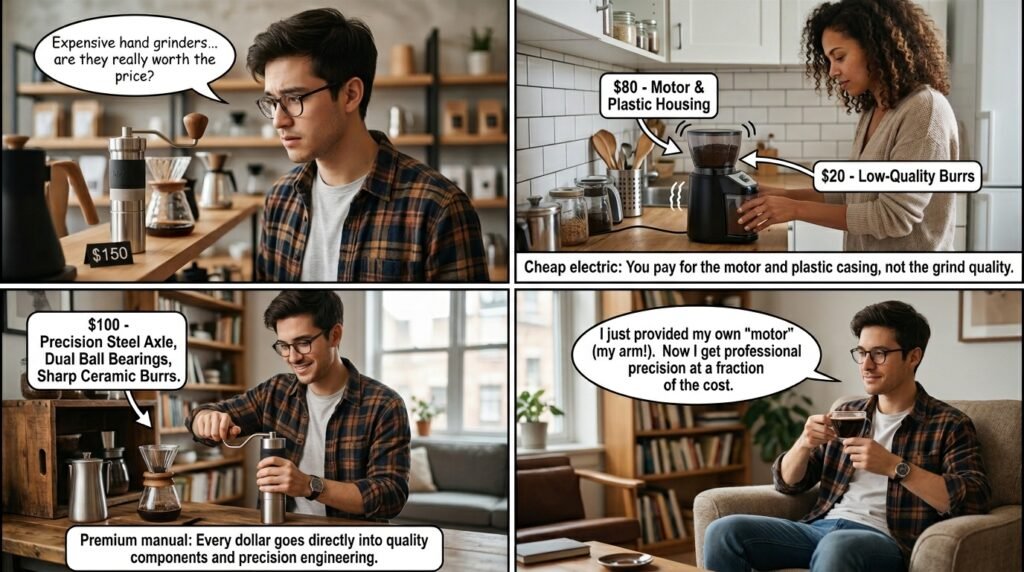
Many people hesitate to buy a premium manual grinder because of the high initial price. Good hand grinders are expensive.
But you have to consider the basic economics of the engineering. If you spend one hundred dollars on a cheap electric grinder, eighty dollars of that budget goes directly into the motor, the internal wiring, and the fragile plastic housing. Only twenty dollars goes into the actual grinding burrs. The result is a cheap, wobbly gear that produces terrible coffee.
If you spend one hundred dollars on a manual grinder, the entire budget goes directly into the quality of the steel axle, the dual ball bearings, and the sharp ceramic burrs. You get absolute professional level precision at a fraction of the cost simply by providing your own motor.
Reclaim Your Kitchen Workflow
Look closely at your own morning routine tomorrow.
Are you waking up to a screaming plastic machine? Are you drinking muddy, bitter coffee because your automatic grinder chops the beans blindly into dust and boulders? You are actively ruining your expensive coffee beans before the water even touches them.
You need to embrace the physical effort. You need to buy a high quality manual burr grinder.
The transition will shock your muscles at first. You will have to fight the dense, light roasted seeds. You will have to grip the metal cylinder tightly. But when you experience the peaceful silence of the kitchen, and when you finally taste the pristine clarity of a perfectly uniform extraction, you will never want to push a plastic button again. The physical friction is the exact price you must pay for absolute culinary perfection.
