
I was sitting in my living room in Rio de Janeiro on a Sunday afternoon. A Flamengo football match was playing loudly on the television. The game was incredibly chaotic. The players were rushing. The passes were sloppy. The entire system lacked control and precision.
I turned the volume down and walked into my kitchen. I needed a break from the noise. I wanted to build a calm, highly structured cup of coffee.
I had all the right ingredients. I had a bag of beautiful, light roasted Ethiopian Guji beans. I had my manual stainless steel burr grinder. I had my precision digital scale. I had my glass V60 pour over cone.
But my water delivery system was fundamentally broken. I was using a cheap, wide mouth plastic tea kettle to boil my water. The first time I used a gooseneck kettle completely changed my understanding of fluid dynamics. It taught me that you cannot execute a precise chemical extraction with a chaotic tool. It forced me to respect the physical mechanics of water.
The Brute Force Method
Before I upgraded my hardware, my morning routine was a stressful guessing game.
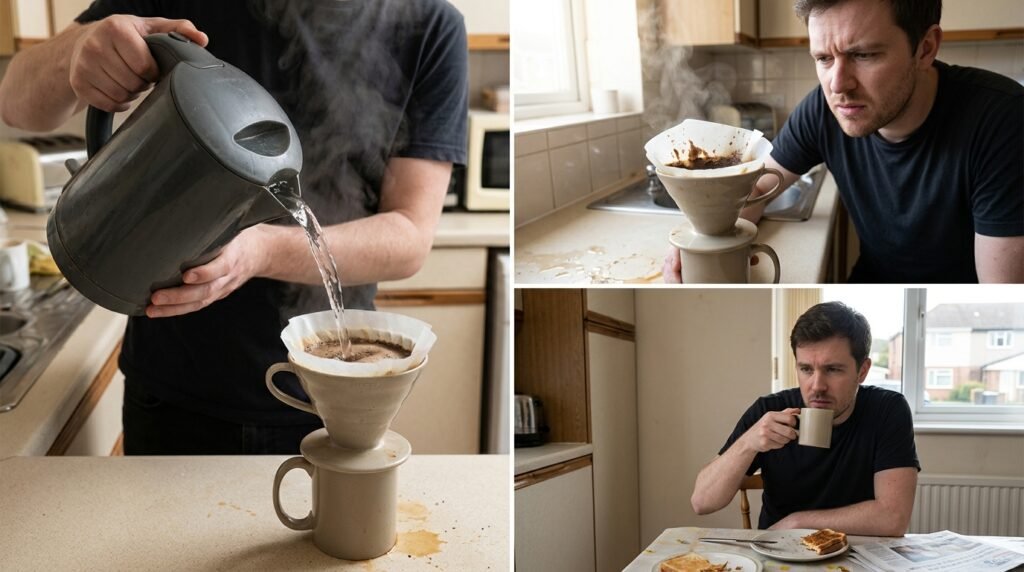
I would grind my expensive African coffee and place the uniform particles into the paper filter. Then, I would grab the heavy plastic kettle off the stove. The water was violently boiling.
I would tilt the heavy pitcher over the delicate glass cone. A massive, thick wave of boiling water would dump out of the wide plastic spout. I had absolutely zero control over the flow rate. The water fell like a heavy, destructive waterfall.
It crashed into the coffee bed with extreme prejudice. It splashed dark liquid up the sides of the paper walls.
The Destruction of the Bed
This violent pouring action physically destroyed the brewing environment.
The heavy stream of water acted like a high pressure drill. It immediately bored a massive crater into the dead center of the coffee grounds. It physically pushed the dry coffee particles up and out of the way.
The geometry of the V60 cone relies entirely on an even, flat bed of coffee. You want the water to travel through the entire mass of grounds at the exact same speed.
By drilling a deep crater in the middle, I created a path of least resistance. Water is incredibly lazy. It rushed straight down that deep hole. It completely ignored the coffee grounds pushed up against the sides of the filter.
The Bitter and Sour Confusion
The resulting extraction was always a chemical disaster.
The coffee grounds trapped in the center crater were violently over extracted. The boiling water hammered them relentlessly. They released harsh, dry, aggressive bitter tannins.
The coffee grounds pushed to the outer edges were severely under extracted. The water barely touched them. They released sharp, highly unpleasant sour acids.
When I drank the final beverage, my palate was completely confused. The coffee was somehow intensely bitter and painfully sour at the exact same time. The sweet, delicate peach notes of the Ethiopian dirt were entirely erased by the chaotic delivery method.
Recognizing the Hardware Flaw
I stood in my kitchen and realized I was blaming the wrong variables.
I kept adjusting my grinder. I kept changing my water temperature. I kept buying different bags of expensive coffee. But the core problem remained exactly the same.
Relying on a cheap plastic pitcher was exactly The Equipment Mistake I Made When I Started Brewing Coffee and it actively ruined my financial investment in the raw ingredients. You cannot paint a delicate, detailed portrait using a massive house painting brush. The tool simply does not match the required precision of the task.
I needed a surgical instrument.
The Design of the Spout
I went online and ordered a heavy stainless steel gooseneck kettle.
When it arrived at my apartment, I pulled it out of the box and examined the engineering. It did not look like a normal kitchen appliance. It looked like a piece of scientific laboratory equipment.
The most prominent feature was the spout. It originated at the very bottom of the heating chamber. It swept upward in a long, elegant curve. The opening at the very tip was incredibly narrow.
The handle was thick and counterbalanced. It was specifically designed to sit perfectly in the hand, moving the center of gravity away from the heavy water and directly over the wrist.
The Test of Laminar Flow
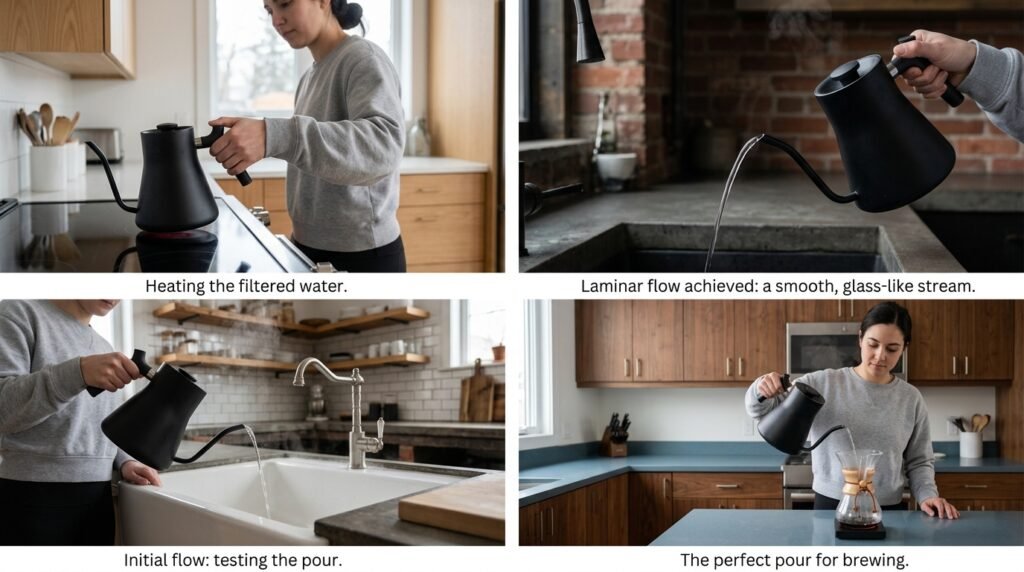
I washed the heavy metal kettle and filled it with filtered water. I placed it on the stove and turned on the heat.
I wanted to see exactly how the fluid dynamics worked before I wasted any expensive coffee beans. I picked the boiling kettle up and tilted it over my kitchen sink.
The physical difference was absolutely staggering.
The water did not dump. It did not splash. It did not waver. The water exited the narrow tip in a perfectly smooth, solid, unbroken line. It looked exactly like a solid rod of clear glass.
In physics, this is called laminar flow. The long, curved S shape of the spout forces the chaotic, boiling water molecules to align perfectly before they exit the metal tip. The turbulence is entirely erased inside the neck.
Approaching the Brewer
I was ready to test the tool on the actual coffee.
I ground fifteen grams of my dense Ethiopian Guji beans. I placed my glass V60 cone on the digital scale and zeroed the numbers out.
I grabbed the heavy metal handle of the gooseneck kettle. My hand felt incredibly stable. Because the handle was properly counterbalanced, I did not have to strain my wrist to keep the kettle tilted. My arm did not shake.
I moved the narrow tip directly over the dry coffee bed. I was only one inch above the grounds.
Executing the Perfect Bloom
I tilted my wrist slightly. A tiny, perfectly controlled stream of boiling water fell straight down.
I gently painted the surface of the dry coffee. I distributed exactly forty grams of water in five seconds. I did not dig a crater. I did not splash the paper walls. I just laid a smooth, even blanket of thermal energy over the seeds.
The visual reaction was spectacular.
Because the water was delivered so gently, the coffee bed remained entirely intact. The fresh grounds absorbed the heat immediately. The trapped carbon dioxide gas released evenly across the entire surface. The dark slurry swelled upward into a massive, perfect dome.
This gentle saturation was the exact moment The First Time I Brewed Coffee Slowly Instead of Rushing and it set a flawless, calm foundation for the rest of the extraction.
The Concentric Technique
I waited forty five seconds for the gas to dissipate. The dome slowly deflated. I resumed pouring.
Because I finally had a tool that provided absolute laminar flow, I could execute professional pouring techniques. I started dead in the center of the coffee bed. I poured a thin, glassy stream of water.
I slowly moved my wrist in tight, concentric circles. I spiraled outward toward the edge of the paper filter, and then I slowly spiraled back inward toward the center.
The gentle circular motion created perfect, controlled agitation. The coffee particles tumbled smoothly in the hot water. Every single grain of coffee was washed evenly. The heavy sugars dissolved uniformly.
Managing the Digital Scale
The long spout also gave me absolute control over my digital data.
With my old plastic kettle, I would try to pour two hundred and forty grams of water. I would overshoot the target constantly. I would dump heavy waves of water and accidentally hit two hundred and sixty grams, completely ruining my chemical ratio.
The gooseneck kettle acts like a physical restrictor plate. It physically prevents you from pouring too fast.
Mastering this slow flow rate was exactly How I Learned to Time My Coffee Pour Perfectly and it allowed me to stretch the brewing process out. I could watch the digital numbers on the scale climb slowly and steadily.
When the screen hit exactly two hundred and thirty eight grams, I tilted my wrist back. The water flow stopped instantly. There was no dripping. There was no mess. The scale settled perfectly on two hundred and forty grams.
The Visual Evidence
I set the heavy metal kettle back on the stove. I watched the dark red liquid finish draining through the paper filter into my ceramic mug.
I removed the glass cone and looked inside. The spent coffee grounds provided the ultimate visual proof of a successful extraction.
There was no deep crater in the middle. There were no dry, unextracted boulders pushed up high against the paper walls. The coffee bed was completely flat. It looked like a smooth, even layer of wet sand on a calm beach.
The flat bed proved that the hot water traveled through the entire mass of coffee at the exact same speed. The extraction was mathematically uniform.
The Sensory Reward
I picked up my ceramic mug and carried it to my living room table. The chaotic football match was still playing on the television, but my mind was entirely focused on the liquid in my hand.
I waited three minutes for the temperature to drop. Extreme heat masks delicate flavor profiles.
I took a slow, deliberate sip. My brain completely stalled.
The harsh, aggressive bitterness was completely gone. The sharp, unpleasant sourness was entirely erased. The liquid felt incredibly crisp and light on my palate. A massive, brilliant wave of sweet peach acidity hit the front of my tongue. It tasted juicy and vibrant.
As I swallowed, a clean, heavy note of jasmine flowers coated the back of my throat. I could clearly separate the citrus from the florals. The resolution was flawless.
The Illusion of Skill
I sat on my couch and realized something very important about the coffee industry.
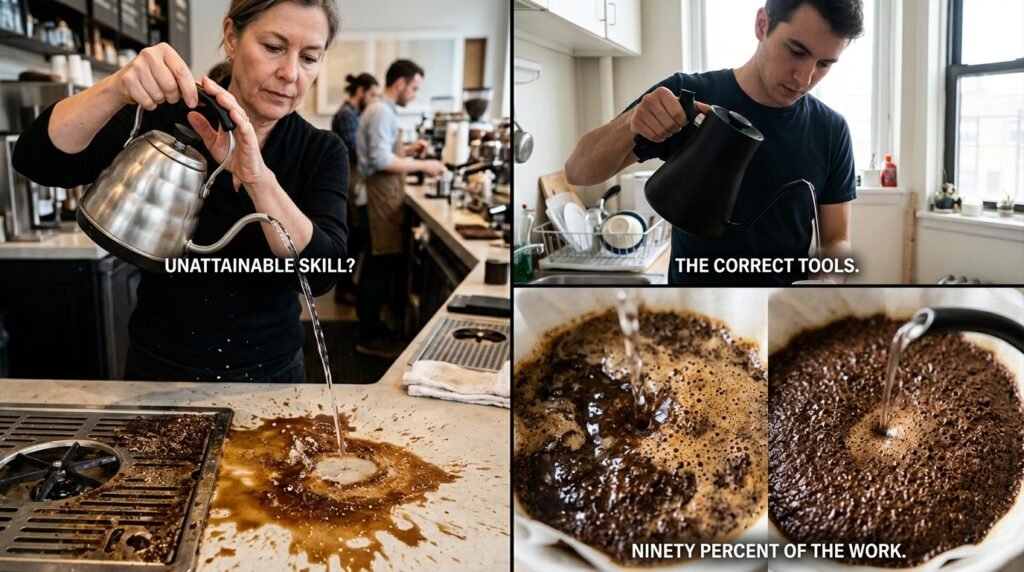
We often watch professional baristas working in high end cafes. We watch them pour water with incredible grace and precision. We assume they possess some kind of magical, unattainable physical skill. We think they have golden hands.
The truth is much more practical.
They do not have magical hands. They simply have the correct tools. The gooseneck kettle does ninety percent of the work for you. It forces the water to behave. It forces the flow rate to slow down. It physically prevents you from ruining the coffee bed.
Eliminate the Chaos
Take a very critical look at your kitchen counter tomorrow morning.
Look at the vessel you use to boil your water. If you are using a wide mouth tea pot, a plastic electric jug, or a standard kitchen measuring cup to brew your manual pour over, you are actively destroying your beverage.
You are bringing chaos into a system that demands strict mechanical order.
You cannot fix a bad pour with better coffee beans. You cannot fix a deep crater by changing your grinder settings. The fluid dynamics will ruin the extraction every single time.
Stop fighting the physics of water. Go online and order a basic stainless steel gooseneck kettle. It does not need to have a digital thermometer or a bluetooth connection. It just needs the long, sweeping curve and the narrow tip.
When you finally experience the smooth, silent control of perfect laminar flow, and when you finally taste the absolute clarity of a uniformly extracted coffee bean, you will never try to brew with a standard kettle again. The proper tool permanently deletes the chaos from your kitchen.
