
It was a humid Friday afternoon in Rio de Janeiro. I was sitting at my desk troubleshooting a severe data loss issue on a client website. A script was supposed to transfer user records from one database to another. I pushed fifteen records into the pipeline. Only fourteen arrived at the destination.
In my profession, missing data is a disaster. If the input does not match the output exactly, the entire digital system breaks down. I spent two hours hunting for that missing piece of information.
I finally fixed the server issue. I needed a break. I walked into my kitchen to brew my afternoon coffee.
I grabbed my bag of light roasted Ethiopian beans. I placed my digital scale on the counter. I weighed exactly fifteen grams of the hard seeds. I poured them into my premium manual burr grinder and turned the heavy metal crank.
I unscrewed the catch bin at the bottom of the grinder. A massive cloud of microscopic coffee dust flew into the air. It stuck to my fingers. It coated the sides of the metal bin. It covered the plastic screen of my digital scale.
I poured the grounds into my glass V60 cone. I placed the cone back on the scale to verify the weight. The scale read fourteen and a half grams.
I lost half a gram of coffee inside the grinder. The exact same data loss problem happening on my computer server was happening in my kitchen. The coffee tool I now use every morning costs exactly two dollars. It completely eliminated my data loss, cured my static electricity problem, and completely streamlined my physical workflow.
The Friction Problem
To understand why I was losing coffee, you have to look at the physics of the manual grinder.
I drink high altitude African coffees. The roaster stops the heat early, leaving the beans incredibly hard and dense. They hold very little internal moisture. They are essentially dry rocks.
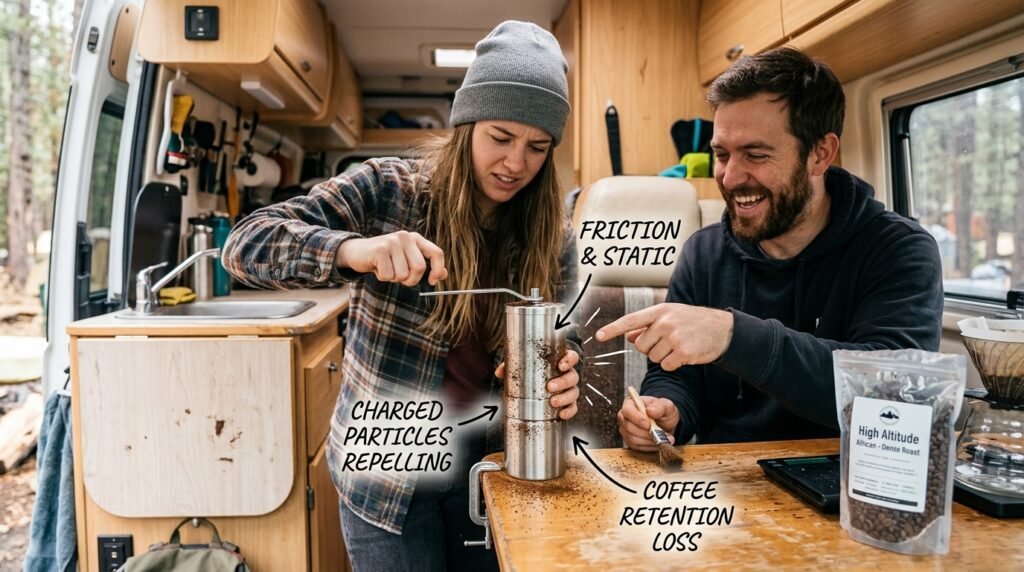
When you force those dry rocks through two sharp ceramic burrs, you create massive amounts of physical friction. Friction generates static electricity.
The coffee particles become highly charged. They act exactly like small magnets. Instead of falling cleanly into the catch bin, the microscopic dust particles violently repel each other. They fly into the air. They stick stubbornly to the metal walls of the grinder. They pack themselves deep into the crevices of the ceramic gears.
The Mathematical Failure
This static cling creates a massive mess on the kitchen counter. You have to wipe away coffee dust every single morning. But the mess is only a minor annoyance. The real issue is the mathematics of the extraction.
Coffee brewing relies entirely on a strict mathematical ratio between the mass of the coffee and the mass of the water.
I calculate my water based on exactly fifteen grams of input coffee. I pour two hundred and forty grams of hot water to achieve a perfect one to sixteen ratio.
If static electricity traps half a gram of coffee inside the grinder, my ratio is instantly broken. I am now pouring two hundred and forty grams of water over fourteen and a half grams of coffee. The balance is ruined. The resulting beverage will taste slightly thin and over extracted.
Realizing this mathematical failure was exactly What I Learned About Coffee Measurement Accuracy because I finally understood that weighing the whole beans is useless if the grounds never make it to the filter. The output weight is the only number that actually matters.
The Frustration of Tapping
Before I found the perfect tool, I tried to fight the static manually.
After grinding my Ethiopian beans, I would hold the heavy metal cylinder over my glass V60 cone. I would aggressively slap the side of the grinder with the palm of my hand. I tried to physically knock the stuck particles loose.
This brute force method was terrible. It was loud. It hurt my hand. Most importantly, it rarely worked.
The static charge was too strong. I would manage to knock a few large boulders loose, but the microscopic fines remained glued to the burrs. I resorted to using a tiny paintbrush to sweep the inside of the grinder every single morning. It was an incredibly tedious, annoying chore. It completely ruined the calm, meditative pace of my morning routine.
The Absurd Solution
I started reading coffee science forums to find a solution. I kept seeing references to something called the Ross Droplet Technique.
The instructions sounded completely absurd. The technique required you to spray a microscopic amount of liquid water directly onto the dry coffee beans immediately before grinding them.
My initial reaction was intense skepticism. I know that water degrades dry coffee beans instantly. I also know that putting water inside a stainless steel and ceramic grinder sounds like a terrible way to cause rust and mechanical failure.
I ignored the advice for weeks. I continued to slap my grinder and sweep up static dust.
Buying the Atomizer
Eventually, the daily mess broke my patience. I decided to try the technique.
I went to a local pharmacy in Rio de Janeiro. I walked to the travel section and bought a tiny, empty glass spray bottle. It was the kind of bottle you use to carry a small amount of perfume on an airplane. It cost less than a cup of coffee.
I took the tiny glass bottle home. I washed it out thoroughly. I filled it with clean, filtered drinking water. I screwed the small plastic pump top back on.
This simple glass atomizer is the single most effective piece of equipment in my entire kitchen.
Testing the Physics
I set up my digital scale. I weighed exactly fifteen grams of my dense Ethiopian Guji beans. I poured them into a small ceramic dosing cup.
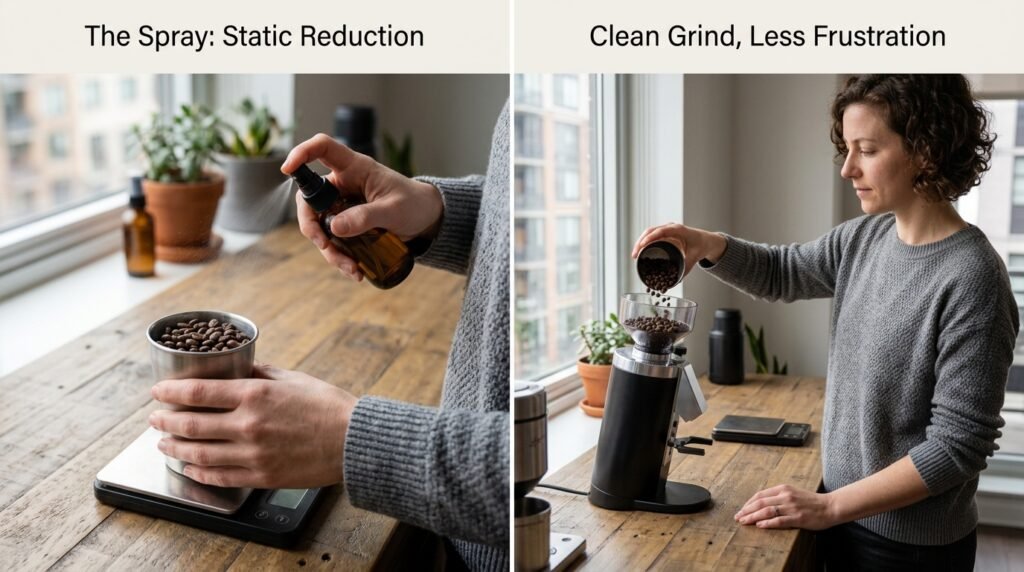
I picked up the tiny glass spray bottle. I held it a few inches above the beans. I pushed the pump exactly one time.
A microscopic mist of filtered water settled over the dry seeds. I covered the top of the ceramic cup with the palm of my hand. I shook the cup aggressively for two seconds. The goal was to distribute that tiny fraction of moisture evenly across the surface of all the beans.
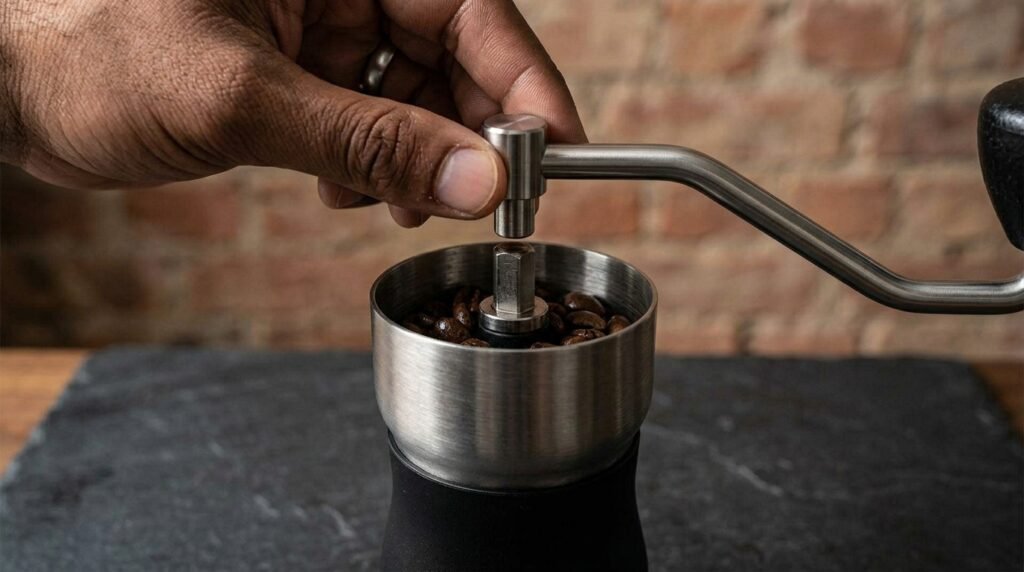
I poured the slightly damp beans into the top chamber of my manual grinder. I attached the metal handle.
The Silence of the Catch Bin
I started turning the crank. The physical resistance felt exactly the same. The ceramic burrs crushed the hard seeds with their usual heavy crunch.
I finished grinding. I set the metal cylinder on the counter. I carefully unscrewed the catch bin at the bottom.
I braced myself for the usual explosion of flying coffee dust. I expected the static cling. I expected the mess.
Nothing happened.
There was absolutely zero static. Not a single particle of coffee flew into the air. The coffee grounds sat perfectly still in the bottom of the catch bin. They looked calm and incredibly uniform.
I looked at the walls of the metal bin. They were completely pristine. I looked up into the bottom of the grinding chamber. The ceramic burrs were completely clean. There was no dust packed into the gear teeth.
Verifying the Output Data
I poured the grounds from the catch bin directly into my paper filter.
Because there was no static cling, the grounds poured out like smooth liquid sand. Nothing stuck to the bottom of the metal cup. I did not have to tap the grinder. I did not have to use my small paintbrush.
I placed the glass V60 cone back on the digital scale. I held my breath and looked at the digital screen.
It read exactly fifteen grams.
The input matched the output perfectly. The data loss was completely cured. Implementing this tiny, cheap solution was exactly The Small Equipment Change That Improved My Coffee and it instantly fixed my mathematical ratios. I finally had absolute control over the extraction variables.
How the Magic Works
The science behind the spray bottle is incredibly simple but highly effective.
Static electricity builds up because the dry beans rub against each other and against the ceramic burrs. It is a massive friction event in a completely dry environment.
By introducing a microscopic mist of water, you fundamentally alter the physical environment. The water acts as a conductive pathway. It creates an invisible, microscopic film over the beans. When the burrs crush the seeds, the friction still occurs, but the moisture instantly dissipates the electrical charge before it can build up.
The static simply grounds out. The coffee particles remain neutral. They obey gravity instead of electromagnetism.
The Myth of the Rust
My initial fear of rusting my expensive manual grinder was completely unfounded.
The key to the Ross Droplet Technique is the volume of water. You are not soaking the beans. You are not pouring a teaspoon of water into the hopper.
One single pump from a high quality atomizer delivers a fraction of a gram of moisture. It is a completely negligible amount of liquid. The intense friction and the physical heat generated by the grinding process cause that tiny amount of moisture to flash evaporate almost instantly.
The burrs remain completely dry. The metal axle remains completely dry. The inside of the grinder is perfectly safe.
The Flavor of Cross Contamination
Solving the static mess improved my workflow, but it also improved the actual flavor in my mug.
Before I bought the spray bottle, a significant amount of coffee dust always remained stuck to the burrs. I could never brush it all away.
If I ground coffee on Monday morning, those stuck particles would stay inside the machine all day long. They would sit there exposed to the open air. They would rapidly oxidize. They would turn stale and bitter.
When I ground fresh coffee on Tuesday morning, the new beans would physically push those old, stale Monday particles out of the machine. The old dust would fall into my fresh coffee bed.
Keeping the Hardware Clean
This cross contamination ruins the clarity of expensive specialty coffee. You are actively mixing stale, oxidized garbage into your fresh, bright extraction.
Because the spray bottle eliminates the static cling, the grinder empties itself completely every single time. There is no old dust left behind to ruin tomorrow’s brew.
Executing this simple moisture trick was exactly The Morning I Learned the Importance of Clean Equipment because it forced me to respect the hygiene of my tools. A clean grinder produces a clean flavor profile. The peach and jasmine notes of my Ethiopian coffee became significantly sharper and more articulate simply because the background noise of stale dust was removed.
A Necessary Workflow Adjustment
Using the spray bottle adds exactly four seconds to my morning routine.
I weigh the beans. I spray the bottle once. I shake the cup. I pour the beans into the hopper.
Those four seconds save me an enormous amount of daily frustration. I no longer have to wipe down my kitchen counter with a damp sponge to remove flying chaff. I no longer have to slap my expensive grinder like a broken television. I no longer have to worry about my mathematical ratios failing.
My physical workflow is now just as reliable as my digital workflow. The input data matches the output data.
Fix Your Own Mess
If you use a burr grinder at home, you already know the frustration of static electricity. You know the annoying mess it makes on your counter. You know the feeling of tapping the machine endlessly to get the last few grams of coffee out.
You do not have to accept that mess. You do not have to buy an expensive, electrically grounded grinder.
Go to a local pharmacy today. Spend two dollars on a tiny glass atomizer. Fill it with filtered water. The next time you weigh your coffee beans, give them one single spray of moisture before you grind them.
Watch what happens to the catch bin. Watch the dust fall smoothly into the filter. When you see the absolute silence of the static charge, and when you finally brew a mathematically perfect ratio without any stale cross contamination, you will never grind a dry coffee bean again. The cheapest tool in your kitchen will instantly become the most valuable.
