
I monitor data all day long. I sit in my apartment in Rio de Janeiro and stare at analytics dashboards for the websites I manage. I know exactly how many visitors click a specific link. I know the exact fraction of a second it takes for a server to load an image.
My professional life relies entirely on strict, unforgiving numbers. If I guess, I lose money.
Yet, for a very long time, I completely abandoned this logic the moment I walked into my kitchen. I would open a bag of expensive specialty coffee and completely surrender to chaos. I used a cheap plastic spoon to measure my beans. I boiled water in a pot and poured it until my ceramic mug looked reasonably full.
I was treating an expensive culinary ingredient like a sloppy science project.
The results were completely unpredictable. One morning, the coffee tasted bright and sweet. The next morning, it tasted like battery acid. I was frustrated and confused. What happened when I bought my first coffee scale completely rewired my brain. It forced me to treat my morning routine with the exact same numerical respect I give to my web servers. It was the absolute end of my kitchen ignorance.
The Frustration of the Guessing Game
The worst part about not having a scale was the false hope.
Occasionally, I would accidentally brew a perfect cup of coffee. I would scoop the beans, pour the water blindly, and the resulting liquid would taste spectacular. The fruit notes would pop. The body would be heavy and rich.
I would go to sleep excited to drink that exact same coffee the next morning.
I would wake up, repeat my sloppy routine, and take a sip. The magic was entirely gone. The coffee would be overwhelmingly bitter or weakly sour. Because I was not measuring anything, I had absolutely no way to replicate my successes. I was trapped in a culinary casino.

The Delusion of the Plastic Spoon
The main culprit of this chaos was the plastic coffee scoop.
When you buy a standard coffee machine, it always comes with a small plastic spoon. We are culturally trained to trust this tool. We think one scoop equals one cup of coffee.
Trusting that little piece of plastic was exactly The Simple Coffee Mistake I Made Every Morning for Years and it cost me a massive amount of wasted money. A scoop is a terrible measuring device.
A scoop only measures volume. It measures physical space. It tells you absolutely nothing about the actual density or the actual mass of the object inside that space. Measuring agricultural products by volume is a fundamental chemical error.
The Problem with Bean Density
To understand why the scoop fails, you have to look at the roasting process.
I prefer to drink light roasted African coffees. I love Ethiopian Guji beans. Because the roaster stops the heat very early to protect the floral notes, these seeds remain incredibly tight and dense. They are very small and very heavy.
If I fill a plastic scoop with light roasted Ethiopian beans, I am packing a massive amount of dense material into that small physical space.
If I switch to a dark roasted commercial coffee, the physics change entirely. Dark roasting uses extreme heat. The beans puff up, expand, and become hollow. They lose massive amounts of water weight. If I fill the exact same plastic scoop with dark roasted beans, I am mostly scooping empty air.
I was using the same scoop, but I was extracting wildly different amounts of actual coffee mass.
The Arrival of the Hardware
I finally got tired of drinking bad coffee. I opened my laptop and ordered a basic digital kitchen scale.
I did not buy a smart scale. I did not need an application on my phone to tell me how to pour water. I just bought a simple, flat plastic rectangle with a clear digital screen. It measured weight in single gram increments. It cost me about twenty dollars.
When it arrived, I placed it on my counter. I grabbed my plastic scoop and a bag of coffee. I wanted to see exactly how bad my human eyes actually were.
Revealing the Terrifying Data
I placed an empty glass bowl on the digital scale. I pressed the tare button to zero out the weight.
I reached into the bag of dense Ethiopian beans and pulled out one level scoop. I dumped the beans into the bowl. The digital screen immediately flashed. It read thirteen grams.
I dumped the bowl out and wiped it clean. I grabbed a bag of old, dark roasted Brazilian coffee from the back of my pantry. I pulled out one level scoop and dumped it onto the scale. The digital screen read eight grams.
My visual estimation system had a margin of error of nearly fifty percent.
Seeing those numbers change on the digital screen was exactly What I Learned About Coffee Measurement Accuracy because it proved my eyes were completely useless. I realized that trusting my vision was actively destroying my morning beverage.
The Logic of the Brew Ratio
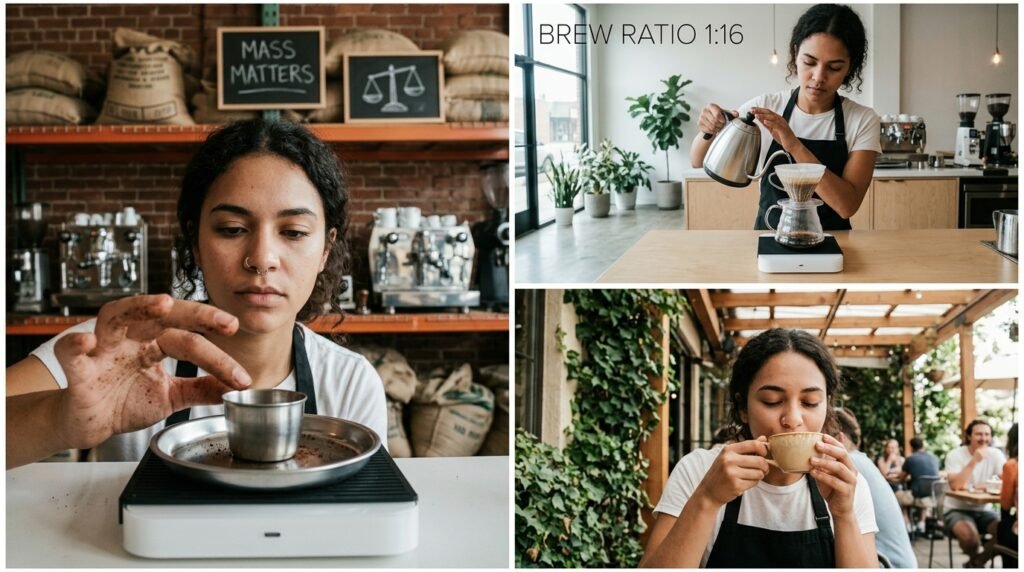
Once I understood that mass was the only metric that mattered, I had to learn how to use it.
Coffee extraction is a chemical reaction between a solvent and an organic material. The hot water is the solvent. The ground coffee is the material. To make a balanced cup, you need a highly specific mathematical relationship between the two.
In the specialty coffee world, this relationship is called a brew ratio.
The global standard for pour over coffee is roughly one to sixteen. This means you use one gram of coffee mass for every sixteen grams of water mass. This specific mathematical balance ensures the water dissolves the sweet fruit sugars without over extracting the harsh, bitter tannins hidden inside the seed.
Locking in the Beans
I decided to test this strict mathematical logic immediately.
I placed my empty manual grinder on the scale and pressed the zero button. I slowly poured my light roasted Ethiopian beans into the top chamber. I kept my eyes entirely on the digital screen. I stopped pouring the exact second the screen hit fifteen grams.
There was no guessing. There were no rounded scoops. I had exactly fifteen grams of solid agricultural mass.
I grabbed the metal handle and ground the dense seeds. I placed a paper filter into my glass V60 cone and poured the uniform grounds inside. The first half of the data equation was securely locked in place.
Calculating the Solvent
Now I had to lock in the solvent. This required basic primary school math.
If my coffee weight was fifteen grams, and my target brew ratio was one to sixteen, I needed to multiply the two numbers. Fifteen multiplied by sixteen is two hundred and forty.
I needed exactly two hundred and forty grams of hot water.
Before I bought the scale, measuring the water was just as sloppy as measuring the beans. I would simply pour hot water into the glass cone until my ceramic mug looked full. I never accounted for the water trapped inside the wet coffee grounds. I never accounted for evaporation.
The First Measured Pour
I placed my heavy ceramic mug and the glass V60 cone directly onto the digital scale. I pressed the zero button. The screen read zero grams.
I grabbed my gooseneck kettle. The water was violently boiling.
I started pouring the hot water over the dry coffee grounds. I completely ignored the visual level of the liquid in the mug. I ignored how high the water sat in the glass cone. I kept my eyes locked exclusively on the digital screen.
The numbers climbed rapidly. Fifty grams. One hundred grams. Two hundred grams.
I slowly pulled the kettle back to restrict the flow rate. The numbers ticked up slowly. Two hundred and thirty. Two hundred and thirty five. When the screen hit exactly two hundred and forty grams, I stopped pouring instantly.
Tasting the Precision
I moved the digital scale aside. I waited for the ruby red liquid to finish draining through the paper filter into my mug.
I removed the glass cone and threw the filter in the trash. I sat down at my kitchen table. I waited three minutes for the liquid to cool down. Extreme heat acts like a blanket on your palate. I wanted to taste everything clearly.
I took a slow sip. My brain completely stalled.
The flavor was absolutely pristine. The chaotic, muddy confusion of my previous morning cups was entirely gone. A massive wave of bright lemon acidity hit the front of my tongue. It melted perfectly into a sweet, heavy peach flavor. The finish was perfectly clean.
There was zero harsh bitterness. There was zero weak sourness. The liquid tasted perfectly balanced.
The End of the Casino
The flavor was incredible, but the real victory happened the very next morning.
I woke up and repeated the exact same process. I weighed exactly fifteen grams of coffee. I poured exactly two hundred and forty grams of water.
I sat down at my table and took a sip. The coffee tasted entirely identical to the day before.
The culinary casino was finally closed. I had successfully removed luck from my kitchen entirely. By strictly controlling the input data, I guaranteed the output result. I built a reliable, repeatable system that produced absolute clarity every single time.
The Power of Manipulation
Once you establish a reliable mathematical baseline, you gain a new superpower. You gain the ability to manipulate the flavor intentionally.
Let us say I brewed my standard one to sixteen ratio, but the resulting coffee tasted slightly too weak for my current mood. Before the scale, I would just blindly throw more beans into the grinder the next day and hope for the best.
With the scale, I just change the math.
Dialing in that specific mathematical balance was exactly How I Discovered the Perfect Brew Ratio for Myself and it permanently removed the guesswork from my kitchen. If I want a stronger cup, I change the ratio to one to fifteen. I use the exact same fifteen grams of coffee, but I only pour two hundred and twenty five grams of water.
The next cup is instantly heavier, richer, and more concentrated. I am in total control.
Validating the Rest of the Equipment
Buying that basic digital scale completely changed how I viewed the rest of my coffee gear.
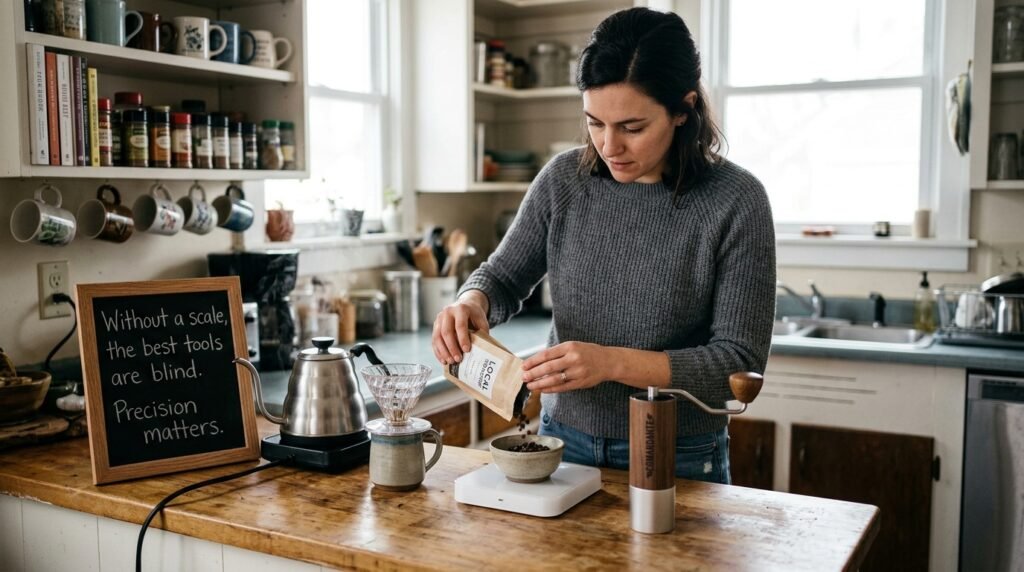
The scale is the foundational bedrock of a good kitchen. It validates every other tool you own.
You can spend hundreds of dollars on a precision manual burr grinder. But if you randomly guess how many coffee beans you are grinding, the perfect uniformity of the particles does not matter. The extraction will still fail.
You can buy a beautiful stainless steel gooseneck kettle. But if you pour a random, unmeasured amount of water over your coffee bed, the controlled pouring speed does not matter. The ratio is broken.
Without a scale, your expensive grinder and your expensive kettle are completely blind. The scale provides the strict mathematical boundaries required for those premium tools to actually do their job.
Stop Fighting the Raw Material
We are heavily conditioned to respect data in our professional lives. We check our bank accounts. We check our website traffic. We measure distances on digital maps.
But we walk into our kitchens and suddenly behave like cavemen. We throw random handfuls of expensive agricultural products into hot water and get angry when the result tastes terrible.
Coffee is a highly sensitive culinary ingredient. It demands respect.
If you are currently frustrated with your morning cup, look at your workflow. If you are using a plastic scoop, throw it away today. You cannot guess your way to a perfect extraction.
Buy a digital kitchen scale. Start weighing your dense African beans. Start weighing your boiling water. Do the basic math. Once you embrace the strict logic of the brew ratio, the mystery of coffee completely disappears. You will stop fighting the raw material, and you will finally start brewing with the precision and clarity of a professional.
