
I spend my entire week looking at digital dashboards. I manage websites and build automated workflows. My professional life is governed entirely by hard data. I track exact page views. I monitor server response times down to the millisecond. I analyze precise conversion rates. If a metric is slightly off, I investigate the code until I find the exact error.
I demand absolute precision from my digital tools.
Yet, for a very long time, my morning coffee routine was a chaotic guessing game. I would walk into my kitchen in Rio de Janeiro, open a bag of coffee, and completely abandon all logic. I used a cheap plastic spoon to scoop beans into a grinder. Sometimes I used two heaping scoops. Sometimes I used three flat scoops.
I poured hot water directly from a pot until my mug looked reasonably full. I was operating entirely on blind luck.
Unsurprisingly, my coffee was incredibly inconsistent. One morning, the beverage would taste spectacular. The next morning, using the exact same bag of beans, the liquid would taste like bitter mud or sour water. I could never replicate my successes. The first coffee equipment upgrade I ever made fixed this chaotic cycle instantly. It was not a fancy machine. It was a simple digital kitchen scale.
The Illusion of the Scoop
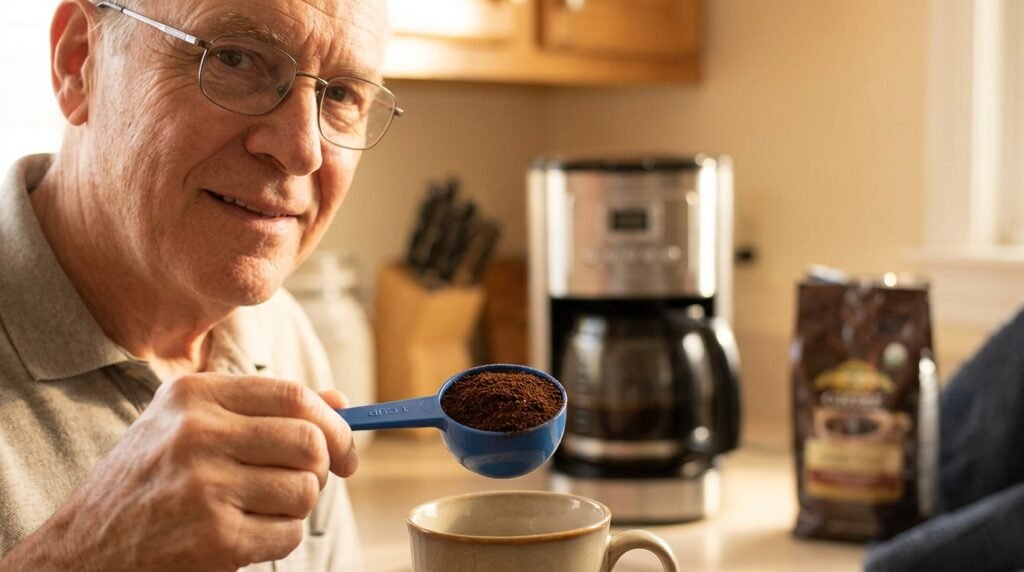
Before I bought the scale, I believed the lie of the plastic scoop.
Every cheap coffee maker you buy at the supermarket comes with a small plastic spoon. The instruction manual usually tells you to use one scoop of coffee for every cup of water. It sounds like a reliable system. It seems like a standardized measurement.
This system is completely broken. It relies on volume instead of mass.
Volume is a terrible way to measure agricultural products. A scoop only measures the physical space an object occupies. It tells you absolutely nothing about the actual density or weight of the material inside that space.
If you fill a plastic scoop with dry feathers, it weighs almost nothing. If you fill that exact same plastic scoop with wet sand, it weighs a tremendous amount. The volume is identical, but the physical reality of the material is entirely different.
The Density Problem
Coffee beans operate on the exact same physical principle as the feathers and the sand.
I frequently buy light roasted Ethiopian coffee beans. These high altitude seeds are incredibly dense. The roaster stops the heat early, leaving the cellular structure tightly packed. The beans are very small and very heavy.
If you scoop light roasted Ethiopian beans with a plastic spoon, you are packing a massive amount of dense agricultural material into that small space.
Conversely, dark roasted commercial coffee is heavily processed. The extreme heat of the roasting drum forces the beans to puff up and expand. The cellular walls shatter. The beans become large, hollow, and incredibly brittle.
If you fill the exact same plastic scoop with dark roasted beans, you are mostly scooping empty air. The physical mass of the coffee is significantly lower, even though the visual volume looks exactly the same.
Failing to Replicate
This density difference ruined my mornings completely.
I would buy a bag of dense Ethiopian coffee and use my standard two plastic scoops. The resulting brew would be incredibly strong and overwhelmingly sour. I would then buy a bag of dark roasted Brazilian coffee and use the exact same two scoops. That brew would be weak, thin, and watery.
I was using the same volume, but I was extracting entirely different amounts of actual coffee.
I tried to compensate by guessing. I tried doing one and a half scoops. I tried doing two highly rounded scoops. I was treating an expensive culinary ingredient like a sloppy science experiment. Learning to abandon this chaotic method was exactly The First Week I Brewed Coffee with Precision Scales and it forced me to respect the laws of physics. You cannot guess your way to a perfect extraction.
The Paradigm Shift
I finally hit my breaking point. I had brewed a terrible cup of expensive coffee before a stressful morning of server migrations. I was angry at the wasted beans.
I opened my laptop and ordered a basic digital kitchen scale.
It was not a specialized piece of specialty coffee equipment. It did not have bluetooth connectivity. It did not have an integrated shot timer. It was just a flat piece of plastic with a digital screen that measured weight down to the single gram.
It cost twenty dollars. It arrived at my apartment a few days later.
Taking the Baseline
I placed the digital scale on my kitchen counter. I grabbed my plastic coffee scoop and decided to test my old assumptions.
I put a small glass bowl on the scale and pressed the tare button to zero the weight. I reached into a bag of light roasted coffee and pulled out one perfectly flat scoop. I dumped it into the bowl. The digital screen read twelve grams.
I dumped the bowl out. I reached into a bag of dark roasted coffee and pulled out one perfectly flat scoop. I dumped it into the bowl. The screen read eight grams.
My visual system had a margin of error of nearly fifty percent.
Seeing that mathematical discrepancy completely changed my perspective. Internalizing this data was exactly What I Learned About Coffee Measurement Accuracy and it proved that human eyes are terrible measurement tools. I was actively ruining my own morning routine by trusting a piece of cheap plastic.
The Mathematics of Brewing
Coffee extraction is not an art. It is chemistry.
You are using a solvent to dissolve organic compounds. In this scenario, hot water is the solvent and the roasted coffee beans are the organic material. To achieve a balanced extraction, you need a highly specific mathematical ratio between the solvent and the material.
In the specialty coffee industry, this is called the brew ratio.
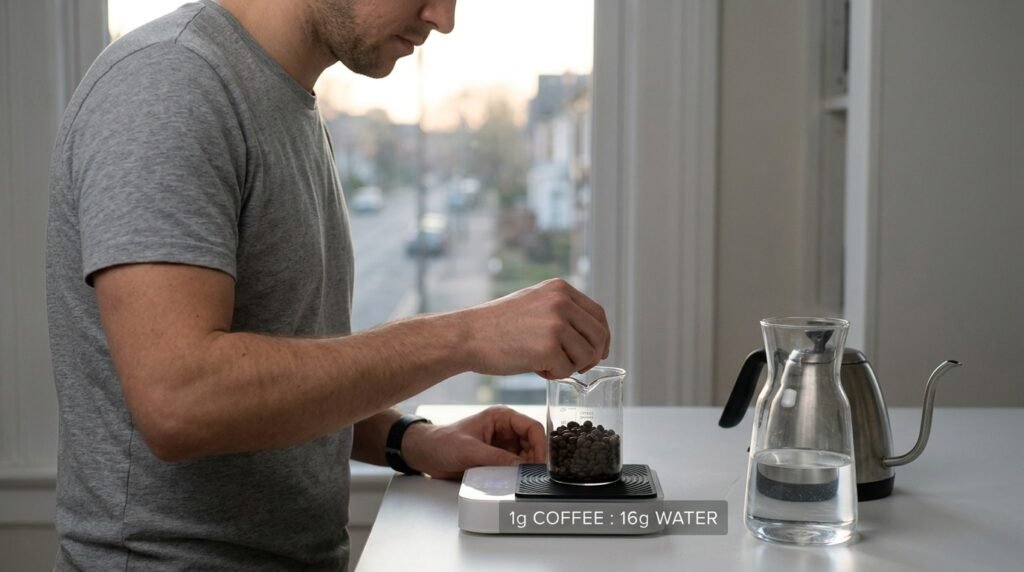
A common starting point is a one to sixteen ratio. This means you use one gram of coffee for every sixteen grams of water. This specific mathematical balance ensures that the water extracts enough sweet sugars without pulling out the harsh, bitter tannins hidden deep inside the seed.
Applying the Logic
I decided to test this mathematical logic immediately. I wanted a medium sized cup of coffee.
I placed my empty grinder catch bin on the digital scale. I pressed the zero button. I slowly poured light roasted Ethiopian beans into the bin until the digital screen read exactly fifteen grams. No more guessing. No more visual estimations. Exactly fifteen grams of solid mass.
I ground the beans and poured them into my glass pour over cone.
Now I needed to calculate the water. If my coffee weight was fifteen grams, and my target ratio was one to sixteen, I needed to do some basic multiplication. Fifteen multiplied by sixteen is two hundred and forty.
I needed exactly two hundred and forty grams of hot water.
Weighing the Water
Measuring the water is just as critical as measuring the beans.
Before I bought the scale, I poured water from my kettle until the mug looked full. I never considered the fact that different mugs have different volumes. I never considered that water evaporates as steam during the boiling process.
I placed my ceramic mug and the glass pour over cone directly onto the digital scale. I pressed the zero button again.
I started pouring the hot water over the coffee grounds. I ignored the visual level of the liquid. I kept my eyes locked entirely on the digital screen of the scale. The numbers climbed rapidly. Fifty grams. One hundred grams. Two hundred grams.
I slowed my pouring speed. When the screen hit exactly two hundred and forty grams, I stopped immediately.
The Resulting Clarity
I moved the scale aside and waited for the liquid to finish draining through the paper filter.
I removed the glass cone and sat down at my kitchen table. I took a slow sip of the coffee.
The flavor was absolutely spectacular. It was perfectly balanced. The bright, juicy peach acidity of the Ethiopian beans was vibrant and clear. It was entirely supported by a heavy, sweet floral body. There was absolutely zero harsh bitterness. There was no weak, sour wateriness.
It tasted exactly like the coffee I purchased from professional baristas at the local specialty cafe. I had successfully replicated a professional extraction in my own kitchen simply by controlling the math.
The Power of Replication
The true value of the digital scale was not just making one good cup of coffee. The true value was making that exact same cup of coffee every single day.
The next morning, I woke up, weighed exactly fifteen grams of coffee, and poured exactly two hundred and forty grams of water. The resulting beverage tasted entirely identical to the day before.
I had successfully removed luck from the equation.
I built a reliable system. Finding this specific mathematical sweet spot was exactly How I Discovered the Perfect Brew Ratio for Myself and it permanently eliminated the frustration from my morning routine. I knew the data going in, so I knew the flavor coming out.
Tweaking the Variables
Once you establish a reliable baseline with a digital scale, you gain the ability to manipulate the flavor profile intentionally.
If I brewed my standard one to sixteen ratio and decided the coffee tasted slightly too weak, I did not have to guess how to fix it. I simply changed the math. The next morning, I used a one to fifteen ratio. I used the same fifteen grams of coffee, but I reduced the water to two hundred and twenty five grams.
The resulting beverage was instantly heavier, richer, and more concentrated.
I could adjust my recipe with surgical precision. I could tweak the numbers to highlight different aspects of different origins. I could make a strong, punchy Brazilian cup or a delicate, tea like Ethiopian cup just by shifting a few grams of water on the digital screen.
The Foundation of Everything Else
The digital scale is the foundational bedrock of all other coffee equipment.
People constantly want to buy expensive burr grinders and premium gooseneck kettles. They want the flashy hardware. But those expensive tools are completely useless if you do not have a scale.
An expensive grinder provides perfectly uniform coffee particles. But if you randomly guess how many particles you are putting into your filter, the uniformity does not matter. The extraction will still fail.
A gooseneck kettle provides perfect, controlled water flow. But if you pour a random, unmeasured amount of water over the coffee bed, the controlled flow does not matter. The ratio will still be broken.
The scale validates every other piece of equipment in your kitchen. It provides the strict boundaries required for the other tools to function correctly.
Fixing the Broken Logic
We are extremely careful with measurements in every other aspect of baking and cooking.
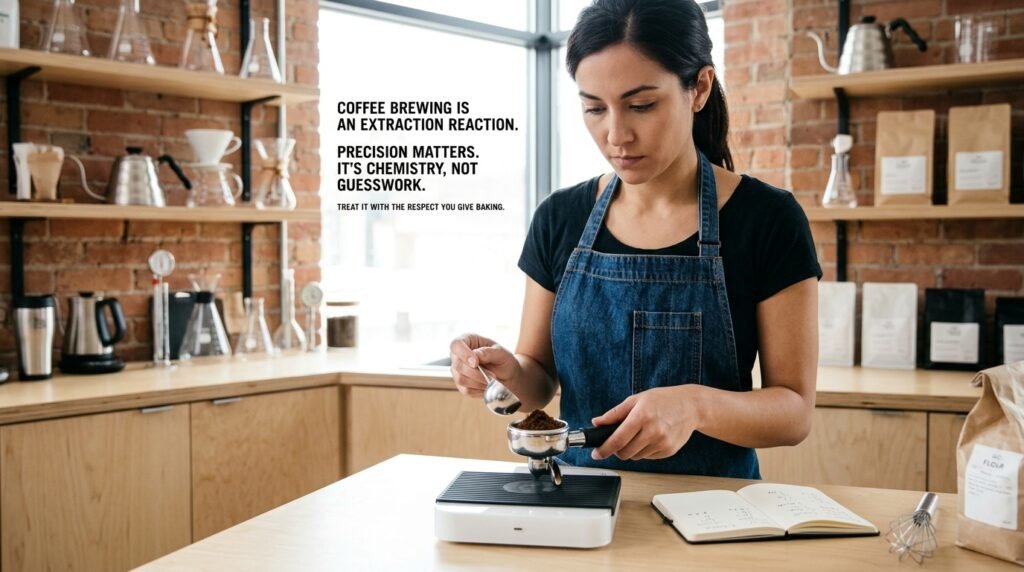
If you bake a cake, you do not just throw random handfuls of flour and sugar into a bowl and hope the oven fixes it. You weigh the ingredients. You follow a strict recipe. You understand that baking relies on precise chemical reactions.
Coffee brewing is an extraction reaction. It requires the exact same level of mathematical respect.
Take Control of Your Kitchen
If you are currently frustrated with your morning coffee, look at your workflow.
If you are using a plastic scoop to measure your beans, throw it in the trash. If you are pouring water directly from a pot until your mug looks full, stop immediately. You are feeding broken data into your brewing system. You are guaranteeing a chaotic result.
You do not need to spend hundreds of dollars to fix this problem. You just need a cheap digital kitchen scale.
Buy a scale that measures in grams. Start weighing your beans. Start weighing your water. Find a mathematical ratio that suits your palate and lock it in. Once you eliminate the visual guessing game, the frustration disappears completely. You stop fighting the raw ingredient, and you finally start brewing with the precision of a professional.
