
I was sitting at my desk in Rio de Janeiro on a busy Wednesday afternoon. I was managing a massive database migration for a new client website. I write code and build digital automations for a living. In my line of work, precision is everything. If I miss a single comma in a string of code, the entire application crashes. There is no room for chaotic, unpredictable inputs.
I decided to take a break from the screen. I walked into my kitchen to brew a fresh cup of coffee.
I looked at my kitchen counter. I was very proud of my coffee setup. I owned a premium manual burr grinder. I owned a fast, accurate digital scale. I used a beautiful glass V60 pour over cone. I bought expensive, light roasted Ethiopian coffee beans.
I had precision tools for every single step of the process, except one.
I was boiling my water in a standard, cheap plastic tea kettle. It had a massive, wide spout designed for filling large soup pots. The coffee tool I didn’t think I needed was a specialized gooseneck kettle. For years, I completely dismissed it as a pretentious, unnecessary aesthetic prop. I thought it was just a silly metal toy for internet videos. I was completely wrong. Upgrading my water delivery system forced me to realize that pouring is an exact science.
The Arrogance of the Beginner
When I first started exploring specialty coffee, I was incredibly stubborn.
I understood why I needed a good grinder. I understood that breaking the beans uniformly was important. I understood why I needed a scale. I knew that measuring my ratios was critical for consistency.
But I completely refused to buy a gooseneck kettle.
I looked at the long, thin, curved metal spout and laughed. I thought the specialty coffee industry was just trying to steal my money. I assumed hot water was just hot water. I figured that as long as the water reached the coffee grounds, the extraction would happen naturally. I completely ignored the physics of fluid dynamics.
The Chaotic Waterfall
I weighed twenty grams of my favorite Ethiopian Guji coffee. I ground the hard seeds in my manual grinder. I placed the grounds into the paper filter.
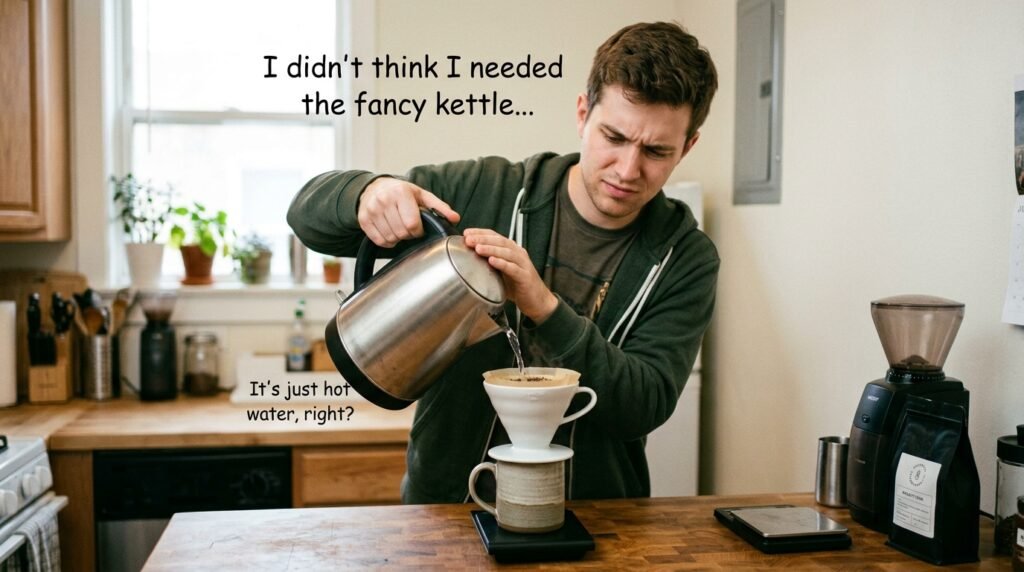
I grabbed my standard plastic tea kettle. The water was violently boiling. I tilted the plastic pitcher over the glass cone.
A massive, heavy wave of boiling water dumped out of the wide spout. I had absolutely zero control over the flow rate. The water fell like a chaotic waterfall. It splashed aggressively against the sides of the glass cone.
This violent pouring action destroyed my carefully prepared coffee bed.
The heavy stream of water drilled a massive crater directly into the center of the grounds. It pushed all the coffee particles up against the paper walls. The water was not gently extracting the flavor. It was aggressively excavating the filter.
The Problem of Bypassing
Because the standard kettle was so difficult to control, I constantly made a critical brewing error.
I frequently spilled hot water directly onto the exposed paper filter above the coffee bed. In the coffee industry, this is called bypassing.
Water is inherently lazy. It will always take the path of least resistance. When you pour water directly onto the paper filter, the water ignores the dense coffee grounds entirely. It flows straight down the outside of the paper and drops into your mug.
You end up diluting your expensive coffee with completely plain, unflavored hot water. You ruin the heavy, syrupy texture of the beverage. The drink becomes weak, thin, and entirely disappointing.
The Mixed Extraction
I finished dumping the water from my plastic kettle. I waited for the liquid to drain. I looked inside the glass cone.
The spent coffee grounds looked terrible. They were not flat. They looked like a muddy, chaotic bowl. The center was dug out completely. The edges were piled high with dry, unextracted grounds.
I picked up the mug and took a sip. The flavor was a confusing disaster.
Because the heavy waterfall drilled a hole in the center, the grounds in the middle were violently over extracted. They released harsh, bitter tannins. Because the grounds on the edges were pushed out of the way, they were severely under extracted. They released sharp, sour acids.
My mug tasted both sour and bitter at the exact same time. The sweet peach and delicate jasmine notes of the Ethiopian dirt were completely lost in the chaos.
Recognizing the Hardware Failure
I sat at my kitchen table and thought about my digital workflow.
If a website script behaves chaotically, I check the input data. I realized my water delivery was fundamentally broken data. I was taking perfectly ground coffee and destroying it with a sloppy, unpredictable variable.
I swallowed my pride. I opened my laptop and ordered a stainless steel gooseneck kettle. Taking this step was exactly My First Experience Using a Gooseneck Kettle and it required me to admit my own ignorance. I finally accepted that specialized tools exist for a valid, physical reason.
The Arrival of the Tool
The new kettle arrived at my apartment a few days later. I pulled it out of the box.
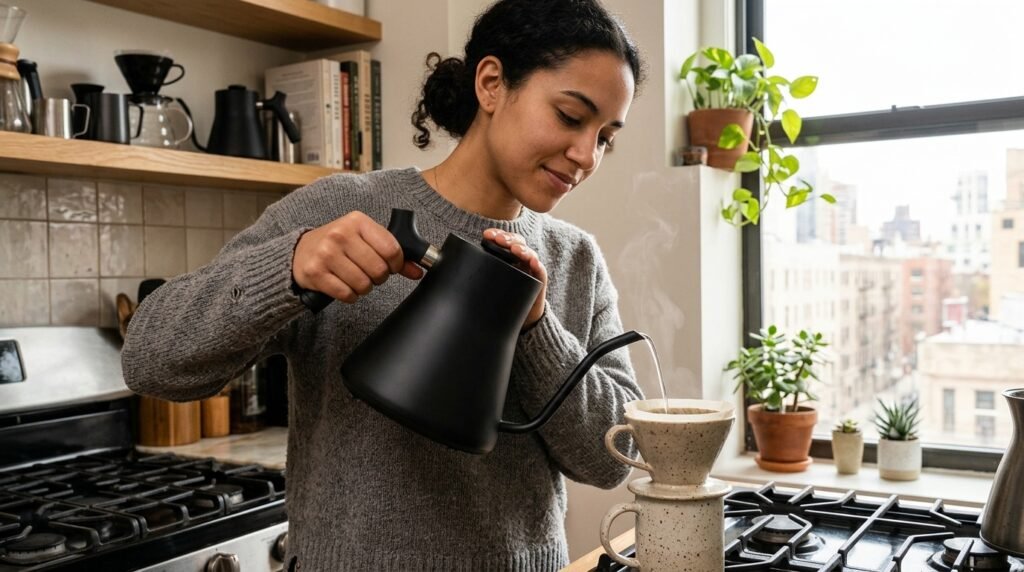
It was a beautiful piece of hardware. It was built from heavy, matte black stainless steel. The handle was ergonomically designed to counterbalance the weight of the water.
But the most important feature was the spout. It grew out of the bottom of the kettle, sweeping upward in a long, elegant curve. The opening at the very tip was incredibly narrow. It looked like a precision surgical instrument.
I washed the kettle, filled it with filtered water, and placed it on my stove.
The Science of Laminar Flow
While the water boiled, I ground another twenty grams of my Ethiopian Guji coffee. I set up my V60 cone.
I took the new gooseneck kettle off the stove. I tilted it over the sink to test the pouring action.
The difference was absolutely staggering. The water did not dump out in a chaotic wave. It exited the narrow spout in a perfectly smooth, solid line. It looked like a solid tube of glass.
In fluid dynamics, this is called laminar flow. The curved shape of the gooseneck spout forces the water molecules to align perfectly before they exit. It eliminates all the chaotic turbulence inside the kettle. The water falls exactly straight down, exactly where you point it.
Taking Absolute Control
I moved the kettle over to my glass V60 cone. I began the bloom phase.
For the first time in my life, I was in total command of the extraction. I directed a tiny, perfectly controlled stream of boiling water exactly where I wanted it. I gently wet the dry grounds without disturbing the coffee bed.
The grounds swelled beautifully. The carbon dioxide gas escaped evenly across the entire surface. There was no splashing. There was no violent cratering.
I waited forty five seconds and resumed pouring. Managing this steady flow was exactly How I Learned to Time My Coffee Pour Perfectly without feeling rushed or out of control. I could stretch the pour out to exactly three minutes easily.
The Concentric Circles
Because the laminar flow fell straight down, I could finally execute professional pouring techniques.
I began pouring in slow, tight concentric circles. I started in the center and slowly spiraled outward toward the edges, and then spiraled back inward.
This circular motion provides perfect, gentle agitation. It forces all the coffee particles to tumble and mix evenly in the hot water. It ensures that every single grain of coffee is extracted at the exact same rate. Nobody gets left behind. Nobody gets overcooked.
I was no longer violently excavating the coffee bed. I was gently washing it.
The Proof in the Filter
I watched the scale hit three hundred and twenty grams. I tilted the kettle back. The water flow stopped instantly. There was no dripping. There was no mess.
I waited for the liquid to finish draining into my ceramic mug. I looked inside the glass cone to examine the spent coffee grounds.
The visual proof was undeniable. The coffee bed was perfectly flat. It looked like a smooth, even layer of wet sand. There were no dry grounds stuck to the high walls of the paper filter. There was no deep crater in the middle.
The flat bed proved that the hot water had passed through the entire mass of coffee evenly. The data was processed perfectly.
Tasting the Precision
I removed the glass cone and threw the paper filter in the trash. I picked up my mug and sat at my kitchen table.
I waited for the extreme heat to dissipate. I took a slow sip.
The flavor profile was entirely transformed. The chaotic, muddy mixture of sour and bitter notes was completely gone. The liquid felt incredibly clean, crisp, and articulate on my palate.
Because the extraction was perfectly uniform, the natural sweetness of the African soil shined through brilliantly. A massive wave of bright lemon acidity melted seamlessly into a heavy, syrupy peach flavor. The finish was delicate and floral. It tasted exactly how the roaster intended.
The Ergonomic Advantage
As I continued to use the gooseneck kettle over the next few weeks, I noticed another massive benefit.
My old plastic tea kettle was exhausting to hold. When it was full of water, all the heavy weight sat at the very front of the spout. I had to severely strain my wrist to keep it tilted.
The gooseneck kettle was designed with human anatomy in mind. The heavy handle sits far back, and the water is pulled from the bottom of the chamber. This shifts the center of gravity directly over your hand.
Finding this balance made it The Coffee Tool That Simplified My Morning Routine and eliminated the physical frustration. I could hold a full kettle of boiling water over my pour over cone for three uninterrupted minutes without my arm shaking. Precision requires physical comfort.
Do Not Ignore the Variables
This single hardware upgrade taught me a profound lesson about culinary mechanics.
You cannot simply buy expensive ingredients and expect a perfect result. You have to control every single variable in the chain.
You can buy the best Ethiopian coffee in the world. You can use an incredibly expensive manual burr grinder to achieve perfect particle uniformity. You can use a highly accurate digital scale. But if you dump your water out of a chaotic plastic pitcher, you ruin all the hard work that came before it.
Water delivery is not an aesthetic choice. It is a fundamental mechanical requirement.
The End of the Plastic Pitcher
If you are currently brewing manual pour over coffee at home, look at your kettle.
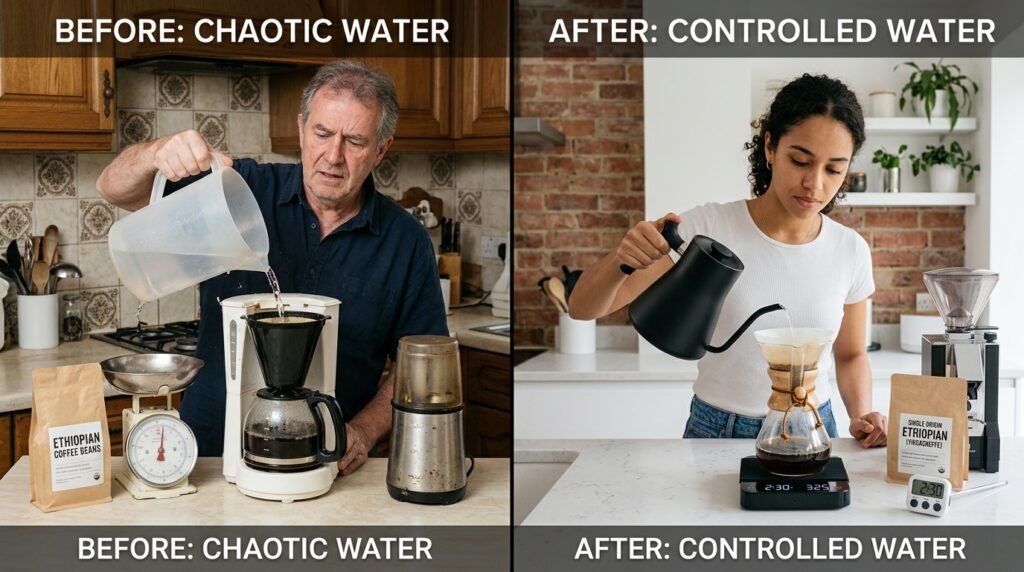
If you are using a wide mouth tea pot, or if you are trying to pour boiling water out of a standard kitchen measuring cup, you are actively destroying your beverage. You are digging craters. You are bypassing the filter. You are creating a chaotic, muddy extraction.
You need to upgrade your tool.
You do not need to buy an expensive electric model with bluetooth temperature controls. A simple, stove top stainless steel gooseneck kettle is relatively cheap and lasts a lifetime.
Do not let your arrogance ruin your morning routine. Acknowledge the physics of water. Buy the strange looking kettle with the long, curved spout. Once you experience the perfect, smooth control of laminar flow, and once you taste the resulting clarity in your mug, you will never try to brew coffee without it again.
