

I spent the first decade of my coffee drinking life trapped in a very comfortable, very dark culinary bubble.
I lived in Brazil, so I drank Brazilian coffee. I loved the classic South American flavor profile. Every morning, I brewed a dark, heavy cup of coffee. It always tasted exactly the same. It tasted like dark cocoa powder, toasted peanuts, and heavy caramel. It was deeply comforting. It was entirely predictable.
I thought that specific flavor was the universal definition of coffee. I assumed that any brown roasted seed extracted into hot water would naturally taste like chocolate and nuts.
I was completely wrong.
My entire perspective on coffee shattered on a random weekday afternoon. I visited a new specialty coffee shop in my city. I asked the barista for a recommendation. I told him I usually drank heavy, dark roasts. He smiled, ignored my preference entirely, and handed me a small bag of light roasted beans from a country thousands of miles away.
That single bag of beans completely rewired my brain. The coffee region that changed my taste in coffee was not in South America. It was the Guji zone in the southern highlands of Ethiopia. Experiencing that region taught me that coffee is not a generic industrial product. It is a highly sensitive agricultural map.
The Aromatic Shock
I brought the bag of Ethiopian coffee back to my apartment. I placed it on my kitchen counter and looked at the label.
The label did not say “Premium Dark Blend.” It was incredibly specific. It listed the Guji region. It listed the altitude of the farm. It listed the processing method as “Natural.” It listed the tasting notes as ripe blueberry, jasmine, and dark honey.
I scoffed at the tasting notes. I thought it was just pretentious marketing. I opened the bag to look at the beans.
The beans looked entirely different from my usual Brazilian roast. They were incredibly tiny and chaotic in shape. They were a pale, matte brown color with absolutely zero oil on their surface.
I poured twenty grams into my manual hand grinder and started turning the crank. As the ceramic burrs crushed the hard seeds, a massive cloud of aroma filled my kitchen. It did not smell like smoke. It did not smell like toasted wood. It smelled intensely of sweet, fresh blueberries and bright spring flowers.
The smell was so vibrant and shocking that I actually stopped grinding and just stared at the catch bin. I could not comprehend how a dry seed could produce such a profound fruit aroma.

The Extraction Process
I knew I had to brew these strange beans carefully. I set up my glass V60 pour over cone. I placed a paper filter inside and rinsed it with hot water.
I poured the fragrant grounds into the damp filter. I boiled my gooseneck kettle. Because these light roasted Ethiopian beans were incredibly dense, they required maximum thermal energy. I poured the water directly off a rolling boil.
I poured forty grams of hot water to start the bloom phase.
The coffee bed swelled upward. The trapped carbon dioxide gas violently escaped. The steam rising from the glass cone amplified the blueberry aroma a hundred times over. My entire kitchen smelled like a fruit bakery.
I finished pouring the water in slow, tight concentric circles. I watched the liquid drain through the paper filter. The coffee dripping into my ceramic mug was not pitch black. It was a bright, translucent ruby red color.
The Palate Awakening
I removed the glass cone and threw the filter in the trash. I carried my ceramic mug to the kitchen table and sat down.
I waited a few minutes for the liquid to cool. Extreme heat masks delicate flavors. I wanted my tongue to experience everything this strange coffee had to offer.
I took a slow sip.
My brain completely stalled. The liquid felt incredibly light and silky on my tongue. There was absolutely zero heavy, oily bitterness. Instead, a massive explosion of bright, juicy fruit acidity hit the front of my palate. It tasted exactly like biting into a handful of fresh, ripe blueberries.
As I swallowed, the bright fruit acidity melted into a smooth, heavy sweetness that tasted like dark honey. A lingering note of jasmine flowers stayed in the back of my throat for a full minute.
It was the most complex, articulate beverage I had ever tasted. Processing that intense flavor profile was exactly The Day I Explored Ethiopian Coffee for the First Time and realized my previous coffee habits were completely completely one dimensional. I had been drinking in black and white. Ethiopia introduced me to color.
The Geography of Guji
I sat at my table in absolute awe. I opened my laptop and started researching the Guji zone. I needed to understand how a coffee bean could possibly taste like a blueberry.
I quickly learned that geography dictates the flavor.
The Guji region sits at an incredibly high elevation, usually over two thousand meters above sea level. The air is thin. The days are warm, but the nights are freezing cold. This extreme temperature swing severely stresses the coffee trees.
To survive the cold nights, the coffee cherries mature very slowly. This extended growth cycle gives the fruit weeks of extra time to pull nutrients from the ancient, mineral rich volcanic soil. The plant packs the seed with dense, complex organic acids and heavy sugars.
The bright blueberry flavor I tasted was a direct, liquid translation of that specific volcanic dirt and that freezing mountain air.
The Concept of Terroir
This realization introduced me to a concept usually reserved for the wine industry.
When you drink a fine wine, you expect to taste the specific valley where the grapes were grown. The soil, the rain, and the sun all physically rewrite the chemistry of the fruit. This is called terroir.
Coffee operates on the exact same biological rules. The coffee tree is a highly sensitive agricultural sponge. It absorbs its environment.
The dense, humid climate of Sumatra creates heavy, earthy coffees. The flat, warm plains of Brazil create sweet, chocolatey coffees. The high, volcanic mountains of Ethiopia create bright, floral coffees. Learning this agricultural science was exactly How I Learned Coffee Profiles Are Like Wine Notes and permanently changed how I evaluate my morning mug. I stopped looking for caffeine and started looking for geography.

The Wild Genetic Soup
The environment of Guji is only half of the story. The other half is raw genetics.
In South America, farmers usually plant organized rows of highly engineered hybrid clones. These hybrids are designed to maximize crop yield and resist diseases. They produce very consistent, predictable flavors.
Ethiopia does not use hybrid clones. Ethiopia is the biological birthplace of the Arabica coffee plant.
The forests in the Guji zone are filled with thousands of wild, undocumented plant mutations. Botanists call these wild varieties Heirloom or Landrace genetics. When an Ethiopian farmer harvests their crop, they are picking a chaotic genetic soup.
This wild genetic diversity is impossible to replicate anywhere else on the planet. It is the exact reason the beans look so tiny and uneven. It is also the exact reason the coffee tastes like jasmine flowers. The flavor is a wild, untamed expression of ancient botany.
The Magic of Natural Processing
The final piece of the Guji puzzle is the processing method. The label on my bag specifically said “Natural Process.”
When a farmer picks a coffee cherry, they have to remove the fruit to get to the seed inside. Most countries use machines and water tanks to wash the fruit off immediately. This creates a very clean, crisp flavor.
In the natural process, the farmer leaves the fruit entirely intact. They lay the whole coffee cherries out on raised beds under the hot African sun. They let the fruit dry around the seed like a raisin.
For weeks, the sweet, sticky fruit ferments and bakes directly into the porous cellular structure of the coffee bean.
This intense fermentation process is exactly what creates the massive, explosive blueberry and strawberry flavors. The seed physically absorbs the sugar of the rotting fruit. When the roaster applies heat to that seed, those heavy fruit sugars caramelize in the drum.
The Death of the Dark Roast
Drinking that naturally processed Guji coffee ruined commercial coffee for me forever.
I tried to go back to my standard dark roasted Brazilian blend a few days later. I brewed it exactly the same way. I took a sip and almost gagged.
It tasted like licking the inside of an ashtray. The heavy, oily bitterness was completely overwhelming. Because my palate had experienced the delicate, bright acidity of the Ethiopian fruit, I was suddenly hyper sensitive to the taste of carbon.
I realized that dark roasting destroys the origin. If a roaster took those beautiful Ethiopian Guji beans and left them in the hot drum until they turned black, the fire would completely incinerate the blueberry sugars. The extreme heat would erase the volcanic soil. The coffee would just taste like the roasting oven.
I permanently abandoned dark roasts. I realized that light roasting is the only way to protect the hard work of the farmer and the unique identity of the soil.
Escaping the Commodity Trap
My obsession with the Guji region fundamentally changed my buying habits.
I stopped buying anonymous blends entirely. When massive commercial companies mix beans from five different countries together into a single bag, they silence the individual environments. You cannot taste the Ethiopian mountains if they are drowned out by cheap filler beans from a lowland commercial farm.
I made a strict rule for my kitchen. Adopting this rigid standard was precisely Why Single-Origin Coffee Changed the Way I Drink Coffee and completely elevated my culinary experience. I only buy coffee that features a single country, a single region, and ideally a single farm.
I want my morning coffee to have a distinct, recognizable identity. I want to read the story of a single harvest.
The Pursuit of Clarity
Today, my coffee routine is highly focused on clarity.
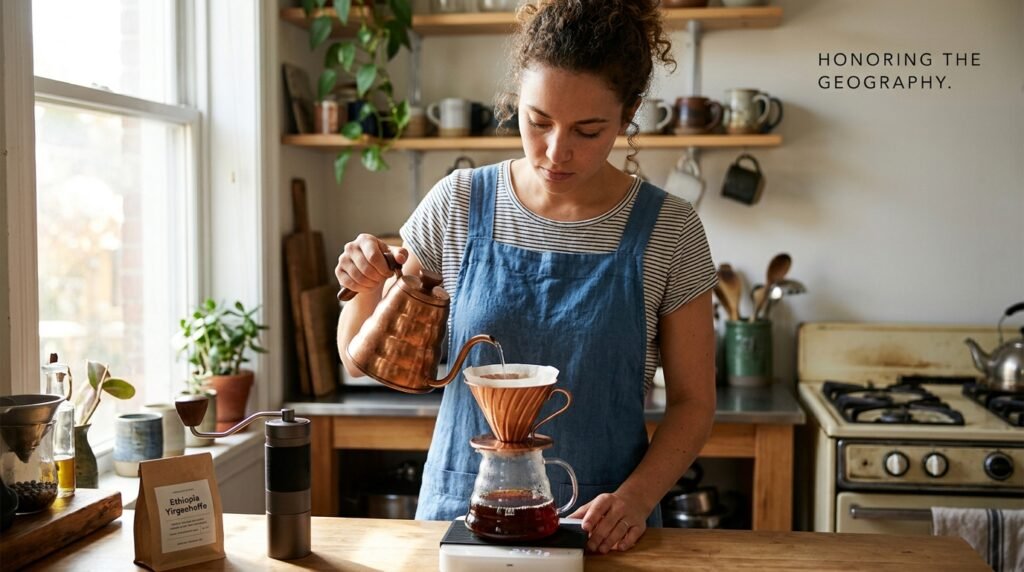
I use a precision hand grinder to ensure my coffee particles are perfectly uniform. I use a digital scale to measure my water down to the exact gram. I use a gooseneck kettle to control the flow rate of the extraction.
I do not do these things to be pretentious. I do these things because the agricultural product demands respect.
If an Ethiopian farmer spends months cultivating a wild coffee tree on a steep volcanic mountain, and a skilled roaster perfectly develops those delicate fruit sugars in a hot drum, it is my absolute responsibility to brew it correctly.
Sloppy brewing destroys the narrative. Careful brewing honors the geography.
Challenge Your Own Palate
We humans are creatures of extreme habit. We find a flavor we like, and we drink it every single day for the rest of our lives. We build comfortable culinary walls around ourselves.
If you are currently drinking the exact same heavy, dark roasted coffee every single morning, you are missing the most exciting aspect of the entire global coffee industry. You are drinking in black and white.
I challenge you to break your own rules this weekend.
Go to an independent specialty coffee roaster in your city. Ask the barista to give you a light roasted, naturally processed African coffee. Look for a bag from the Guji or Sidamo regions of Ethiopia.
Take the bag home. Look at the pale, uneven beans. Smell the intense, sweet aroma when you grind them. Brew them carefully with boiling water.
When you take that first sip, your palate will likely experience a moment of severe shock. The bright fruit acidity will challenge your fundamental definition of the beverage. But if you keep an open mind, that single cup of coffee will completely rewrite your morning routine. You will stop drinking generic caffeine, and you will start exploring the world through your mug.

Hi, I’m the coffee enthusiast behind Coffee Nerd Lab.
Like many people, I started drinking coffee simply because it helped me wake up in the morning. Over time, that daily habit turned into a genuine interest in understanding what makes a great cup of coffee. I began experimenting with different beans, brewing methods, grinders, and coffee gear, learning through trial and error along the way.
This blog is where I document that journey. Every article is inspired by real experiences, discoveries, and lessons I’ve learned while exploring the world of coffee. From brewing guides and equipment reviews to practical tips and coffee basics, my goal is to share useful information in a way that’s easy to understand and enjoyable to read.
Thanks for stopping by, and I hope Coffee Nerd Lab helps you enjoy your next cup a little more than the last.