
I was visiting a different city for a weekend trip. I woke up early and decided to find a local coffee shop. I walked down a quiet side street and found a place that looked more like a science laboratory than a traditional bakery.
The walls were stark white. The counters were brushed stainless steel. There were no massive menus hanging on the wall. There were no flavored syrups visible anywhere.
I walked up to the counter and asked the barista for a large black coffee.
He smiled politely and told me they did not serve batch brewed drip coffee. He pointed to a row of glass pour over cones sitting on digital scales. He said everything was brewed manually by the cup. He recommended a specific single origin bean from the Guji zone of Ethiopia. He said it was their brightest, most interesting offering.
I agreed. I paid and stood at the end of the bar to wait.
A few minutes later, he handed me a clear glass server and a small ceramic tasting cup. I looked down at the liquid inside the glass. My brain immediately rejected what my eyes were seeing.
The liquid was not black. It was a translucent, glowing ruby red color. It looked exactly like a hot cup of cranberry juice or a delicate herbal tea. I actually thought the barista had made a mistake and handed me the wrong order.
I poured the red liquid into the small ceramic cup and took a sip. That single sip completely shattered my entire understanding of the beverage. The first time I tried light roast coffee, I realized I had spent my entire adult life drinking burnt charcoal. It changed my palate forever.
The Dark Roast Illusion
To understand why this clear red liquid shocked me so much, you have to understand my baseline.
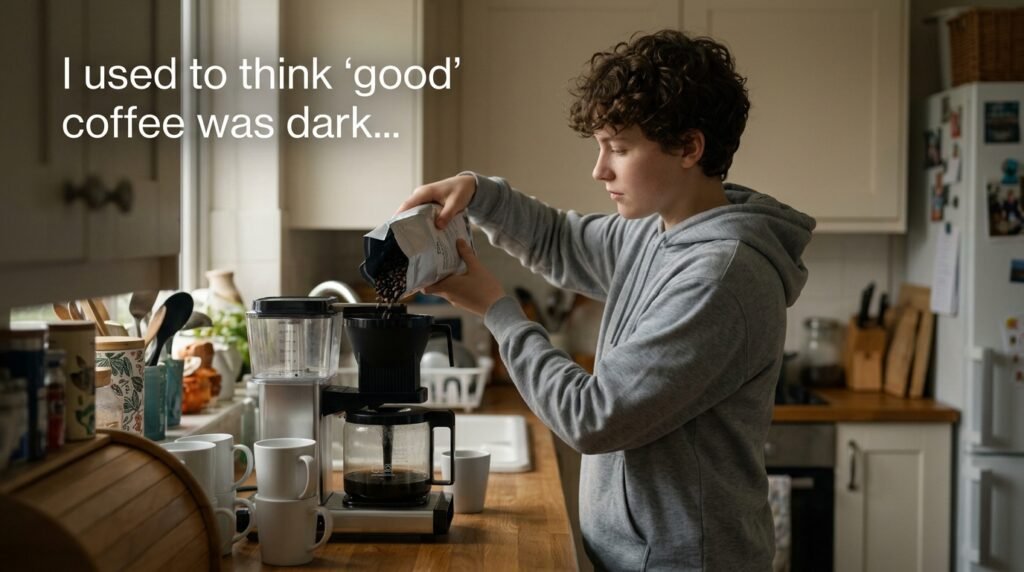
I grew up believing that coffee was supposed to be dark, heavy, and intensely bitter. The commercials on television always showed pitch black liquid pouring into a mug. The coffee I bought at the supermarket was always shiny, oily, and completely black.
I thought that dark color equaled strength. I thought a bitter flavor meant the coffee was doing its job. I assumed that a harsh, burning sensation in the back of my throat was simply the price you paid for morning caffeine.
I added milk and sugar to every single cup I drank. I used dairy to mask the violent bitterness. I never actually tasted the coffee. I only tasted the roast.
I was completely unaware that coffee is the seed of a tropical fruit. I was drinking the agricultural equivalent of burnt toast.
The Explosion of Acidity
Standing in that minimalist cafe, I held the small ceramic cup in my hands. The red liquid smelled incredible. It did not smell like smoke or wood. It smelled intensely of fresh jasmine flowers and ripe peaches.
I took my first proper sip.
There was absolutely zero bitterness. The heavy, muddy, oily coating I was used to was completely absent. The liquid felt incredibly light and crisp on my tongue.
Instead of a harsh bite, I experienced a massive explosion of fruit acidity. It tasted like biting into a perfectly ripe, sweet citrus fruit. The flavor was vibrant, juicy, and incredibly complex. It finished with a lingering sweetness that reminded me of raw honey.
I did not want to add a single drop of milk. Milk would have completely ruined the delicate floral notes.
I stood there in absolute awe. I had no idea coffee could taste like this. Discovering this extreme contrast was exactly The Day I Discovered the Difference Between Light and Dark Roast and permanently changed my buying habits. I realized I had been missing out on the entire spectrum of natural flavor.
Understanding the Roasting Process
I sat down at a small table by the window and finished the glass server. I pulled out my phone and started researching coffee roasting. I needed to understand how the same agricultural product could produce such radically different beverages.
Coffee roasting is essentially a cooking process. You are applying intense thermal energy to a raw, green seed.
When a roaster drops green coffee beans into a hot roasting drum, a massive chemical reaction begins. The heat slowly drives the moisture out of the seed. As the temperature rises, the complex carbohydrates inside the bean begin to break down and caramelize.
If the roaster stops the process early, you get a light roast. The bean reaches a light brown color. The surface remains completely dry and matte.
If the roaster keeps applying heat, the bean gets darker. The internal structure breaks down further. Eventually, the extreme heat forces the natural oils to the surface of the bean. The bean turns shiny, oily, and black.
Roasting Away the Origin
The most critical thing I learned that morning was the concept of origin characteristics.
Every coffee producing region in the world has unique soil, altitude, and climate conditions. A coffee bean grown in the volcanic soil of Ethiopia has a completely different chemical makeup than a coffee bean grown in the lowlands of Brazil.
A light roast preserves those unique chemical differences. The roaster applies just enough heat to make the bean soluble, but stops before the heat destroys the delicate organic acids. A light roast tastes like the farm it came from.
A dark roast destroys those unique characteristics. When you roast a bean until it turns black and oily, you incinerate the delicate fruit acids. You burn the complex sugars. You replace the flavor of the farm with the flavor of the roasting oven.
A dark roasted bean from Ethiopia will taste almost exactly identical to a dark roasted bean from Brazil. They will both just taste like smoke and ash.
The Ethiopian Revelation
The specific coffee I drank in that cafe was a light roasted Ethiopian Guji.
Ethiopia is the birthplace of coffee. The country possesses thousands of wild, undocumented coffee varieties often called Heirloom or Landrace varieties. These specific genetics, combined with the extreme altitude and rich soil, produce a flavor profile that cannot be replicated anywhere else on earth.
Because the roaster treated those beans with extreme care and stopped the roast early, the vibrant jasmine and peach notes survived the oven. The light roast acted as a transparent window directly to the African soil.
Experiencing that transparent window was the direct catalyst for The Day I Explored Ethiopian Coffee for the First Time and sparked my absolute obsession with African varieties. I realized that a light roast honors the farmer, while a dark roast only honors the fire.

The Challenge of Brewing Light Roasts
I walked up to the barista before leaving the cafe. I bought a bag of those exact same Ethiopian beans to take home. I was incredibly excited to brew them in my own kitchen.
The next morning, I set up my usual pour over equipment. I used my standard recipe. I ground the beans, poured the hot water, and waited for the drawdown.
I took a sip. It was terribly disappointing.
The coffee was incredibly weak. It tasted sour and grassy. The beautiful, sweet peach notes I experienced in the cafe were completely missing. It tasted like I had brewed a cup of hot lemon water.
I was highly frustrated. I had the exact same beans. I had a good glass dripper. I could not figure out why my cup tasted so bad.
I quickly learned a harsh physical reality. Light roast coffee is incredibly difficult to brew correctly.
The Density Problem
The problem comes down to physical density.
When a coffee bean is roasted very dark, the extreme heat expands the cellular structure. The bean puffs up. It becomes incredibly brittle and highly porous. Because it is so porous, water can easily enter the bean and dissolve the flavors. Dark roast coffee practically extracts itself.
Light roast coffee is completely different. Because it spends less time in the roasting drum, it retains a massive amount of its original density. The cellular structure remains tightly packed and extremely hard.
When you pour hot water over a light roast, the water has to work much harder to penetrate the dense particles. If your water is not hot enough, or your grind is not fine enough, the water will fail. It will only wash the sharp acids off the surface of the bean and leave the heavy sugars trapped inside.
This results in a violently sour, under extracted cup.
Changing the Kitchen Variables
I had to completely change my brewing habits to unlock the light roast.
First, I had to change my water temperature. I used to let my boiling water sit for two minutes to avoid burning my dark roasts. Light roasts demand extreme heat. They need thermal energy to break down their dense walls. I started pouring the water directly off a rolling boil.
Second, I had to adjust my hand grinder. Turning the crank on a manual grinder with light roast beans requires significantly more physical effort because the beans are so hard. I adjusted the burrs to a much finer setting. I needed to increase the total surface area to give the water a fighting chance.
Third, I had to slow down my pouring speed. I needed to extend the total contact time between the water and the coffee grounds.
Dialing in the Sweetness
I tried the Ethiopian beans again the next day with these new, aggressive parameters.
I used boiling water. I used a finer grind. I poured the water incredibly slowly, keeping the slurry temperature as high as possible.
I watched the bright red liquid drip into my ceramic mug. I let it cool for a few minutes.
I took a sip. The magic was back.
The sharp, grassy sourness was gone. The intense, syrupy sweetness of ripe peaches pushed to the very front of my palate. The floral jasmine aroma lingered in my nose long after I swallowed. The extraction was perfectly balanced.
Learning how to manipulate the variables to pull those specific fruit notes out of the dense bean was a massive victory. Mastering that extraction process completely validated How I Started Noticing Flavor Notes in Coffee without feeling like a pretender. I was actually steering the chemistry in my own kitchen.
The Loss of the Dark Roast
Switching to light roast coffee is a one way street.
Once your palate adjusts to the vibrant, clean, juicy acidity of a properly extracted light roast, you undergo a permanent physiological shift. You become highly sensitive to bitter flavors.
A few months after my cafe experience, I went to a family dinner. A relative offered me a cup of coffee after the meal. It was a standard, dark roasted blend from a massive commercial brand.
I took a polite sip. I almost gagged.
It tasted like licking the inside of an old barbecue grill. The heavy, oily bitterness was completely overwhelming. There was no nuance. There was no sweetness. I could not drink it.
I realized I could never go back. I had ruined commercial coffee for myself forever. I had traded the comforting, heavy blanket of dark roast for the sharp, vibrant clarity of the light roast. It was a trade I was perfectly happy to make.

An Invitation to the Light
If you currently drink dark, heavy coffee every single morning, you are missing the most exciting aspect of the entire coffee industry.
You are drinking a beverage that tastes like a roasting oven. You are not tasting the farm.
I challenge you to step completely out of your comfort zone. Go to a reputable specialty coffee roaster in your city. Ask the barista to recommend their lightest, brightest, most fruit forward single origin coffee. Look for beans from Ethiopia, Kenya, or Colombia.
Take the bag home.
Do not expect it to taste like your normal coffee. Expect it to taste like tea. Expect it to have a vibrant, juicy acidity. Use the hottest water you can safely manage. Grind the beans a little finer than you usually do.
When you take that first sip of clear, ruby red liquid, do not add milk. Do not add sugar. Let your palate process the natural sweetness. Let your brain register the floral aroma.
The first time you try a light roast, it will challenge everything you think you know about coffee. It will shock your tongue. But once you realize that coffee is a delicate fruit, and not a piece of burnt charcoal, your morning routine will transform into an incredible culinary adventure. Embrace the acidity, and discover what coffee is actually supposed to taste like.
