
I had a completely free Saturday afternoon. The house was quiet. I walked into my kitchen and looked at a freshly roasted bag of Ethiopian Yirgacheffe coffee sitting on my counter.
I love Ethiopian coffees. The volcanic soil in that specific region produces beans with an incredibly delicate, tea like floral profile. They are vibrant and complex. But they are also notoriously difficult to brew correctly. If you make a tiny mistake, the delicate jasmine notes disappear entirely.
I usually spent my mornings trying to brew these beans perfectly. I would obsess over the water temperature and the grind size. I would get frustrated if the cup tasted slightly off.
Standing in my kitchen that Saturday, I decided to try a completely different approach.
I was tired of trying to be perfect. I decided I was going to intentionally ruin the coffee. I wanted to push the boundaries of extraction to their absolute limits. I wanted to taste the extreme edges of failure.
I grabbed three identical ceramic mugs and lined them up on the counter. The brewing experiment that taught me the most about coffee was an exercise in deliberate destruction. By forcing the coffee to fail in very specific ways, I finally understood the invisible chemistry happening inside my daily cup.
Setting Up the Extremes
My plan was very simple. I was going to brew the exact same Ethiopian coffee three times. I would use the exact same ratio of twenty grams of coffee to three hundred grams of water for every single mug.
The only things I would change were the physical variables. I wanted to isolate the mistakes.
I labeled the three ceramic mugs with a piece of tape. Mug A was going to be the over extracted nightmare. Mug B was going to be the under extracted disaster. Mug C was going to be the perfect, balanced baseline.
I pulled out my digital scale, my manual hand grinder, and my glass pour over cone. I opened the bag of Ethiopian beans. The dry aroma of sweet peaches and bright citrus filled the room. I was about to subject those beautiful beans to absolute torture.
Creating the Over Extracted Nightmare
I started with Mug A. I wanted to pull every single harsh, bitter compound out of the roasted seed.
To achieve maximum extraction, I needed maximum surface area and maximum thermal energy. I adjusted the ceramic burrs on my hand grinder to the tightest possible setting. I ground twenty grams of the Yirgacheffe beans into a fine, powdery dust. It looked exactly like powdered sugar.
I placed a paper filter in my glass cone. I dumped the fine dust into the filter.
Next, I needed extreme heat. I put my kettle on the stove and let it reach a violent, aggressive, rolling boil. I did not wait a single second for it to cool down. I took the boiling water and dumped it directly onto the fine coffee powder.
The paper filter clogged instantly. The water could not pass through the dense bed of coffee dust. The hot liquid sat in the glass cone, violently attacking the coffee grounds for nearly seven minutes.
It eventually finished dripping. I looked at the liquid in Mug A. It was pitch black and completely opaque.
Tasting the Burn
I brought Mug A to my lips and took a cautious sip.
It was absolutely horrific. The liquid aggressively attacked the back of my throat. It tasted like chewing on a piece of burnt charcoal mixed with crushed aspirin.
The intense heat and the massive surface area had completely destroyed the delicate floral notes of the Ethiopian bean. The water had aggressively stripped the plant fibers, pulling out heavy tannins and harsh alkaloids. The texture was incredibly dry. It sucked all the moisture out of my mouth.
This deliberate failure taught me a vital lesson about roast levels and water temperature. I realized this harsh, ashy flavor was exactly The Day I Discovered the Difference Between Light and Dark Roast when I used boiling water on a delicate bean. Light roasts are dense and require heat, but boiling them into fine dust destroys their soul.
I poured the rest of Mug A down the kitchen sink. I aggressively rinsed my mouth with cold water.
Creating the Under Extracted Disaster
I moved on to Mug B. I wanted to achieve the exact opposite result. I wanted a coffee that was completely hollow and weak.
To prevent extraction, I needed minimal surface area and minimal thermal energy. I opened the burrs on my hand grinder as wide as they could physically go. I ground another twenty grams of coffee. The resulting pieces were massive. They looked like coarse gravel.
I placed a fresh paper filter in the glass cone and added the coarse gravel.
I needed cool water. I heated my kettle until the water was barely steaming. It was roughly one hundred and sixty degrees Fahrenheit. It was entirely too cold for brewing coffee.
I poured the lukewarm water over the coarse gravel.
The water sliced straight through the large coffee pieces. There was zero physical resistance. The entire volume of water drained into the mug in less than forty five seconds.
Tasting the Sour Water
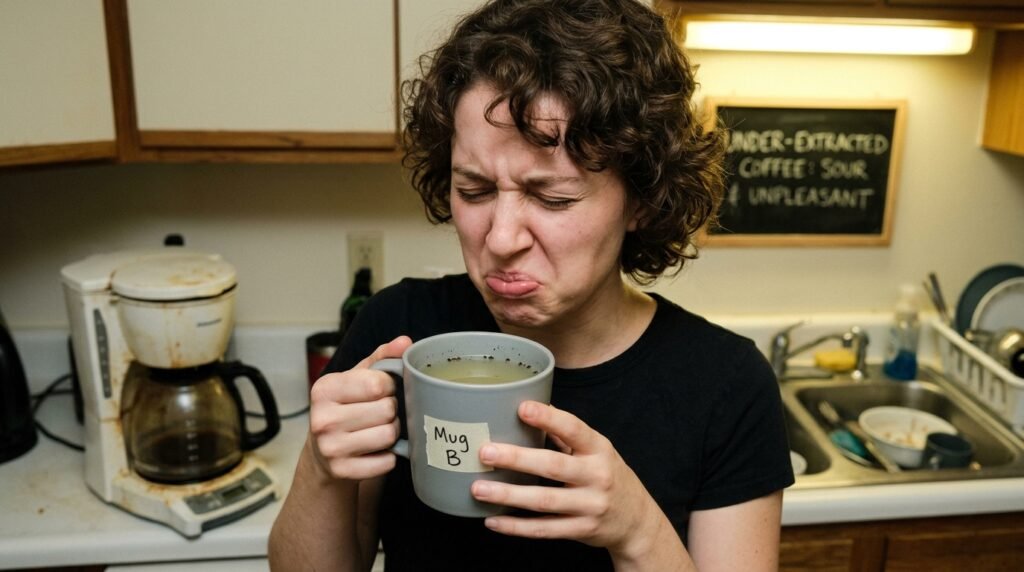
I picked up Mug B. The liquid did not even look like coffee. It was a pale, translucent yellow color. It looked like dirty dishwater.
I took a sip. My face instantly contorted.
The flavor was shockingly sour. It made my lips pucker. It tasted like hot water mixed with raw lemon juice and a handful of grass clippings. There was absolutely zero sweetness. There was no heavy body. The liquid was thin and completely empty.
Because the water was too cold and the coffee pieces were too large, the solvent could not penetrate the beans. It only washed the highly soluble, sharp fruit acids off the very outside surface of the gravel. It completely missed the complex sugars trapped deep inside the seed.
The experiment proved that under extracted coffee is not just weak coffee. It is an entirely different, highly unpleasant chemical profile.
Building the Perfect Baseline
My palate was completely exhausted. I had tasted the extreme edges of bitter and sour. It was finally time to brew Mug C. I wanted to find the middle ground.
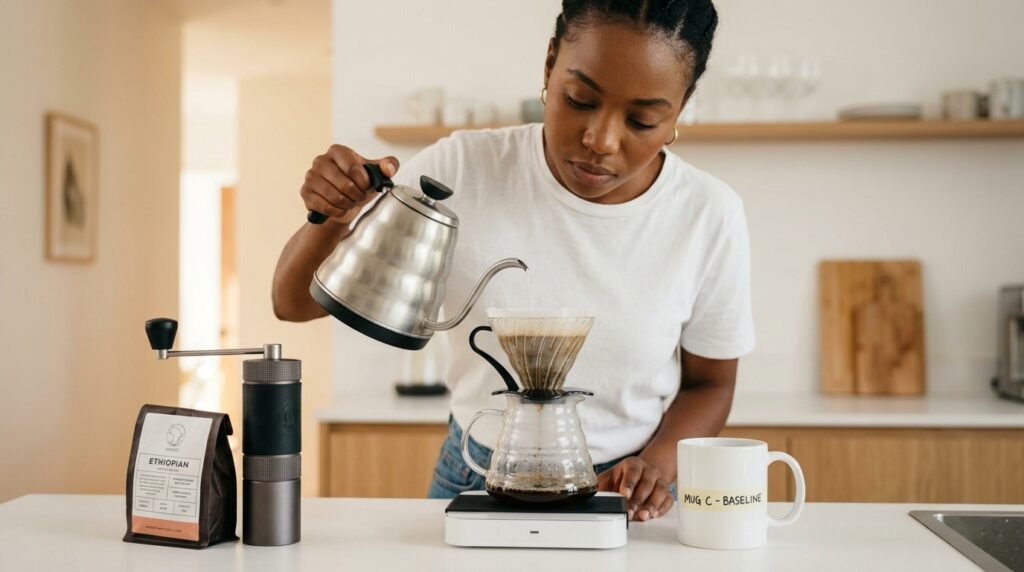
I adjusted my hand grinder back to my standard, medium fine setting. The grounds looked like coarse table salt.
I boiled my kettle again. This time, I turned the stove off and waited exactly sixty seconds. I let the extreme boiling energy dissipate. The water settled to a calm two hundred degrees.
I placed a fresh filter in the glass cone. I poured the hot water slowly and deliberately. I started with a gentle bloom. I poured in tight, concentric circles. I maintained a steady water level. The entire extraction took exactly three minutes.
The liquid dripping into Mug C was a vibrant, glowing amber color.
Tasting the Sweet Middle
I picked up Mug C and took a slow sip.
The contrast was absolutely staggering. After torturing my tongue with burnt ash and sour lemon water, this cup tasted like pure magic.
The harsh bitterness of Mug A was entirely gone. The sharp, grassy sourness of Mug B was entirely gone. Instead, the coffee was incredibly sweet. The delicate notes of jasmine and peach were bright, clear, and perfectly balanced. The texture was soft and syrupy.
I had successfully navigated the extraction timeline. I pulled out the bright acids. I pulled out the heavy sugars. I stopped the water before it could pull out the bitter tannins.
The Ethiopian beans were not inherently bitter or sour. The beans were just a static chemical vault. The physical parameters I chose dictated exactly which flavors escaped that vault.
The Filter Variable
I was feeling incredibly inspired by the results of my three mugs. I wanted to run one final test before cleaning up the kitchen.
I wanted to see how the physical brewing vessel impacted the flavor profile. I had perfectly dialed in my recipe for the glass pour over cone. I decided to take that exact same recipe and apply it to a completely different tool.
I pulled my heavy glass French press out of the cabinet.
I used the exact same twenty grams of coffee. I used the exact same medium grind size from Mug C. I used the exact same two hundred degree water. I let the coffee steep for four minutes and pushed the metal plunger down.
I poured the dark liquid into a fresh mug.
The Heavy Contrast
I tasted the French press coffee. It was a completely different beverage.
The delicate jasmine and peach notes were severely muted. They were buried underneath a massive, heavy, earthy body. The coffee felt incredibly thick on my tongue.
The difference was the filtration material. The pour over cone used a paper filter that trapped the heavy natural oils. The French press used a metal screen that let those heavy oils flow directly into the mug.
This simple comparison completely reshaped my understanding of kitchen equipment. It was the physical proof behind What I Learned After Trying Different Coffee Filters during my brewing journey. You cannot separate the flavor from the physical barrier it passes through. The paper cleans the cup. The metal thickens the cup.
Escaping the Binary Mindset
That Saturday afternoon in my kitchen fundamentally changed my relationship with coffee.
Before that experiment, I viewed coffee in a strict binary. A cup of coffee was either good or bad. If it was bad, I would just get frustrated and blame the roaster. I would assume I bought a defective bag of beans.
The experiment proved that coffee is a spectrum.
Bitterness is not a defect of the bean. It is a symptom of over extraction. Sourness is not a defect of the bean. It is a symptom of under extraction.
When you understand the spectrum, you stop getting frustrated. You start looking at a bad cup of coffee as a simple diagnostic tool. The bad flavor tells you exactly what you did wrong. The bad flavor tells you exactly how to fix it tomorrow.
The Power of Incremental Adjustments
If I brew a cup of coffee tomorrow morning and it tastes slightly too sour, I do not panic. I know I am sitting too close to the under extracted side of the spectrum.
I need to move the needle toward the middle. I have three physical tools to do that. I can grind the coffee slightly finer. I can use slightly hotter water. I can pour the water slower to extend the brew time.
Any of those three changes will increase the extraction.
Applying this logic to my daily routine was The Small Coffee Adjustment That Made a Big Impact and permanently ended my frustrating mornings. I no longer guess. I diagnose the flaw, and I apply the physical correction.
A Necessary Destruction
We often try to learn a new skill by chasing perfection from day one. We follow the rules strictly. We are terrified of making a mistake.
But you cannot truly understand a rule until you intentionally break it.
If you always follow the recipe on the back of the coffee bag, you will never know why that recipe works. You will never know what happens if you add twenty more grams of water. You will never know what happens if you grind the beans like fine sand.
You remain a blind follower of instructions.
Run Your Own Ruined Cup Experiment
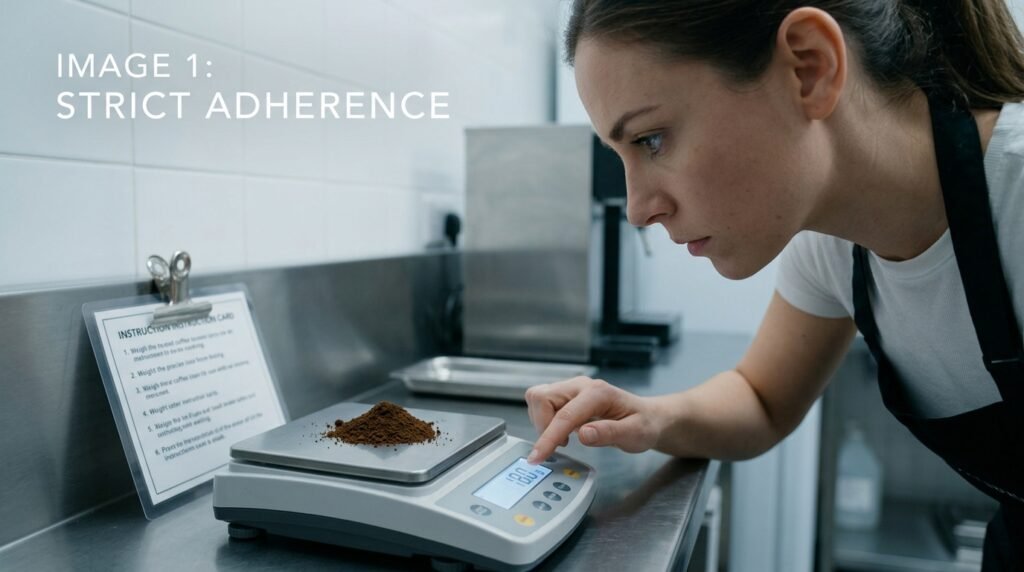
If you have a digital scale and a manual grinder at home, I highly encourage you to waste a little bit of coffee this weekend.
Do not try to brew the perfect cup. Try to brew the absolute worst cup of coffee imaginable.
Grind your beans into a fine powder and use violently boiling water. Taste the harsh, drying bitterness. Let it coat your tongue. Memorize that specific flavor.
Then, grind your beans into massive boulders and use lukewarm water. Taste the hollow, grassy sourness. Memorize that sensation.
Once you isolate these two extreme failures on your own palate, the mystery of coffee extraction disappears entirely. You will clearly see the boundaries of the playing field. You will realize that the perfect, sweet, balanced cup of coffee is just waiting patiently in the exact center of those two mistakes. Break the rules, ruin a cup, and take total control of your kitchen.
