
I grabbed a large cardboard box from my garage and brought it into my kitchen. I opened my cabinets and started pulling things out. I grabbed my heavy French press. I grabbed my immersion drippers. I grabbed my spare digital scales, my assorted paper filters, and my collection of fancy stirring spoons.
I put all of them into the cardboard box. I taped the box shut and carried it to the top shelf of my hallway closet.
I walked back into my kitchen. I looked at the counter. I had left exactly three items sitting there. I left one plastic pour over cone, one gooseneck kettle, and one digital scale. I had intentionally stripped my entire setup down to the absolute bare minimum.
I was about to begin a strict behavioral experiment on myself.
For the previous six months, I had been obsessively tweaking my coffee. I changed my brewing device every single morning. I changed my water temperature constantly. I messed with my grind size daily. I was chasing the perfect cup of coffee, but I was completely lost in a sea of changing variables.
I decided I needed a massive reset. I made a promise to myself. I would brew coffee the exact same way, using the exact same recipe, every single day for an entire month.
I picked a simple baseline. I would use twenty grams of coffee. I would use three hundred grams of water. The water would be two hundred degrees. The brew time would be exactly three minutes.
What I noticed after brewing coffee the same way every day completely shocked me. By refusing to change my physical routine, I accidentally highlighted everything else that was changing around me. Locking my parameters turned my daily coffee into a highly sensitive magnifying glass.
The Agony of the First Week
The first seven days of the experiment were intensely frustrating.
I am a tinkerer by nature. I love fixing things. On Tuesday morning of the first week, my coffee tasted slightly bitter. My immediate instinct was to reach for my grinder and adjust the ceramic burrs. I wanted to grind coarser to fix the bitterness.
I had to physically stop my hand from touching the dial. I had to force myself to leave the grinder alone.
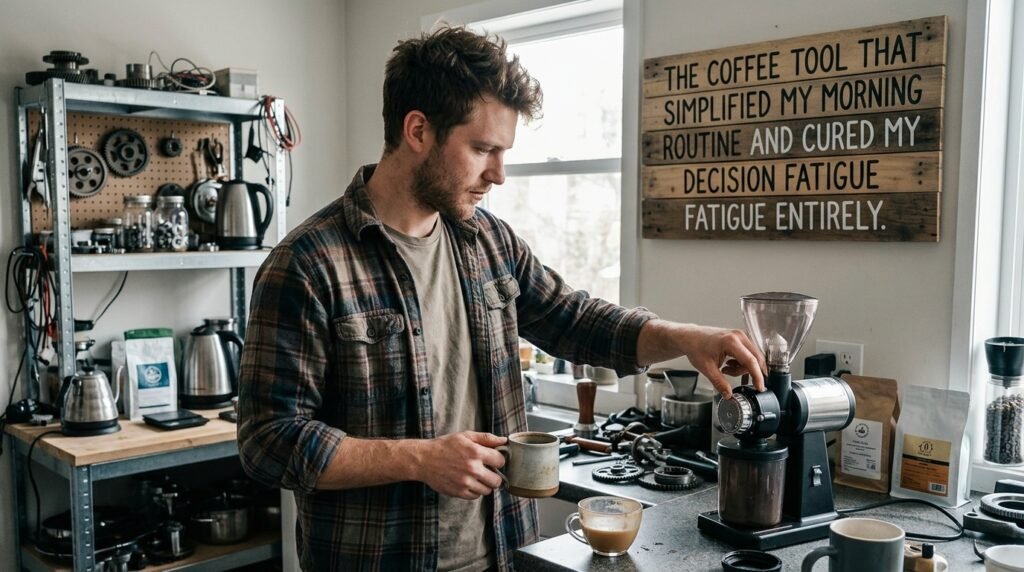
It felt incredibly unnatural to drink a flawed cup of coffee and do absolutely nothing to fix it the next day. I felt like I was surrendering control. But that strict lack of options was the entire point of the project. Eliminating the endless daily choices eventually became The Coffee Tool That Simplified My Morning Routine and cured my decision fatigue entirely. I just had to survive the initial urge to intervene.
Watching the Beans Age
Because I was not changing my recipe, I bought a massive two pound bag of single origin coffee to last the entire month.
By the beginning of the second week, I started noticing a massive visual shift inside my glass dripper.
When you pour hot water over fresh coffee, the grounds swell and bubble. This is the bloom phase. Carbon dioxide gas aggressively escapes the seed. On day one of my experiment, the bloom was massive. It looked like a dark brown muffin rising out of the paper filter.
On day fourteen, the bloom looked entirely different.
I poured the exact same amount of hot water. The water was the exact same temperature. But the coffee grounds barely moved. They produced a few lazy bubbles, but the massive swelling action was completely gone.
The beans were aging. They were slowly losing their trapped carbon dioxide gas to the surrounding air. Because my recipe was locked in place, I could literally watch the biological degradation of the agricultural product in real time.
The Flavor Shift of Stale Coffee
The visual change in the bloom translated directly to the liquid in my mug.
During the first week, the coffee was incredibly vibrant. It had a sharp, bright, green apple acidity. The flavor practically jumped off my palate.
By the end of the second week, that sharp acidity began to round off. The coffee tasted much softer. It tasted heavily of milk chocolate and toasted nuts. The high notes were disappearing.
By the third week, the coffee started tasting flat. It lacked structure. It tasted like cardboard mixed with generic brown water.
I was doing the exact same physical motions every morning, but the flavor was dropping off a cliff. This stark contrast was a profound culinary lesson. It completely informed How I Realized Freshness Affects Every Sip of Coffee in my kitchen. You cannot outsmart old beans. A perfect recipe cannot save a stale ingredient. The raw material dictates everything.
The Invisible Variable of Weather
As the month progressed, I noticed something even stranger than the aging beans. I noticed the weather.
My kitchen does not have perfect climate control. One morning during the third week, a massive rainstorm rolled through my city. The humidity in my apartment spiked dramatically. The air felt heavy and damp.
I went through my locked routine. I weighed my twenty grams of coffee. I turned the handle on my manual grinder.
The grinder behaved completely differently. Normally, the coffee grounds fell cleanly into the catch bin. On this rainy morning, the grounds clumped together into tight, sticky balls. They stuck to the metal sides of the grinder. Static electricity and high humidity were actively changing the physical density of the coffee powder.
When I poured the water over these sticky clumps, the water stalled. The brew time extended by nearly forty five seconds. The resulting coffee tasted muddy and over extracted.
I did absolutely nothing different. The sky outside changed, and it ruined my beverage inside.
The Impact of Dry Air
A few days later, a cold front moved in. The rain stopped entirely. The air in my apartment became incredibly dry and crisp.
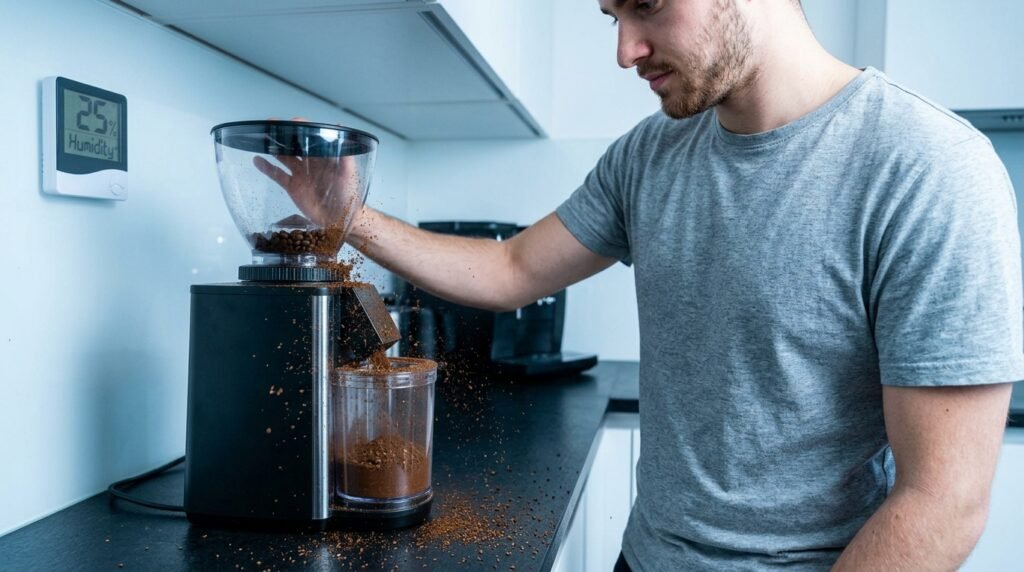
I went back to the grinder. This time, the coffee grounds were totally chaotic. Static electricity caused the fine particles to fly all over my kitchen counter. They refused to stay in the catch bin. They coated the outside of the plastic dripper like a magnetic dust storm.
When I poured the water, it flowed entirely too fast. The dry air allowed the water to slice straight through the coffee bed. The brew time was too short. The coffee tasted weak and sour.
I realized that coffee beans are highly hygroscopic. They absorb and release moisture based on the environment. My strict, unchanging recipe proved that the atmosphere is an active participant in your extraction. If it rains, your coffee will literally brew slower. You have to respect the physical environment.
A Mirror for My Own Biology
The most fascinating observation had nothing to do with the beans or the weather. It had to do with my own body.
Manual coffee brewing requires a human hand holding a kettle. You are the machine. Your physical state directly impacts the flow of water.
One Thursday morning, I woke up incredibly late. I was stressed. I had a massive deadline looming at work. I rushed into the kitchen to execute my locked routine.
I picked up the gooseneck kettle. My hand was shaking slightly from the adrenaline of waking up late. I tried to pour my standard, slow concentric circles. But my pour was erratic. The water slashed aggressively against the sides of the paper filter. I dumped the water in too fast. I disturbed the coffee bed violently.
The coffee tasted chaotic. It was a messy, astringent cup.
The Calm Pour
The very next morning, I woke up early. It was Friday. The massive deadline was finished. I felt completely relaxed and well rested.
I went into the kitchen. I picked up the exact same kettle.
My hand was perfectly steady. I poured the water in a smooth, beautiful, glass like stream. I maintained a flawless circular rhythm. I did not disturb the paper filter once. The water level rose perfectly and drained perfectly.
The coffee tasted immaculate. It was sweet, structured, and deeply comforting.
By keeping the recipe identical, my daily cup of coffee became a biofeedback monitor. The liquid in my mug reflected my own nervous system. The focus required to execute the rigid steps was a direct measurement of my mental state. Acknowledging this connection was the core theme of What I Learned After Brewing Coffee More Carefully later in my journey. If your mind is racing, your hands will ruin the extraction.
The Development of Muscle Memory
By the final week of my thirty day experiment, something magical happened. I completely stopped thinking.
During the first few weeks, I had to stare intensely at my digital scale. I had to consciously monitor the timer. I had to focus all my mental energy on hitting my target numbers perfectly.
By day twenty five, the routine was permanently burned into my muscle memory.
I could pick up the kettle and pour exactly sixty grams of water without even looking at the digital display. I could feel the weight of the water leaving the metal pot. I knew exactly how fast to circle my wrist to maintain a three minute drain time. My body knew the recipe better than my brain did.
The physical mechanics of making coffee became completely subconscious.
The Freedom of Automation
This subconscious mastery provided an incredible sense of freedom.
Because I no longer had to dedicate brain power to the brewing variables, I could actually be present in my kitchen. I could watch the sunrise out the window while my hands perfectly executed the pour. I could listen to the birds outside. I could enjoy the smell of the wet grounds filling the room.
I realized that constantly tweaking your recipe steals your attention. If you are always changing your grind size, you are always worried about the outcome. You treat your morning like a high stakes laboratory test.
When you lock your routine in place, the anxiety disappears entirely. The process becomes a soothing, meditative ritual. You stop worrying about the mechanics and start actually enjoying the quiet moments of your morning.
Knowing the Baseline
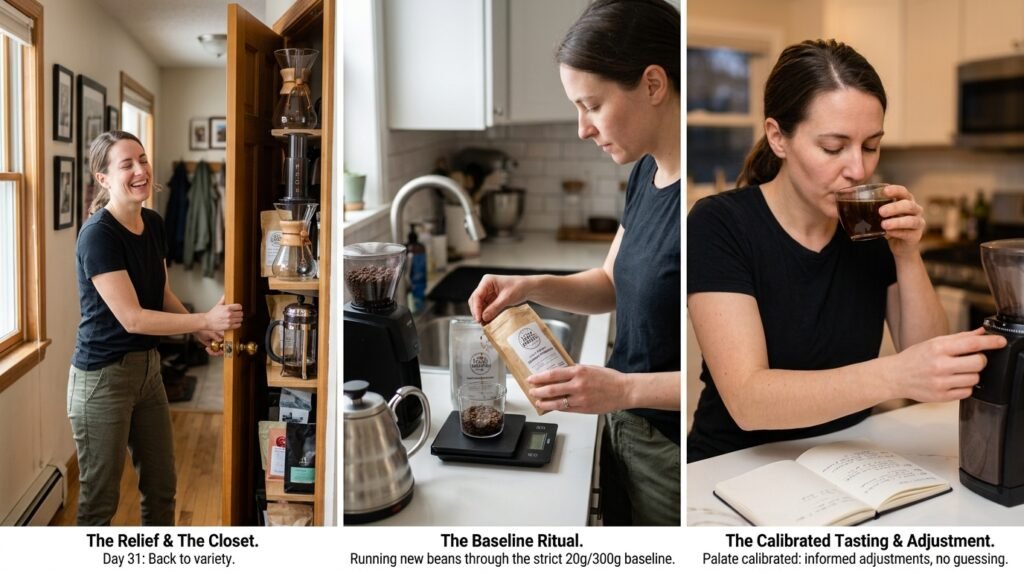
When the thirty day experiment finally ended, I felt a massive sense of relief. I could finally open my hallway closet and bring my other brewing devices back into the kitchen. I could finally adjust my grinder again.
But I did not immediately start tweaking things wildly. The experiment had fundamentally changed my perspective.
I realized the absolute power of a solid baseline. If you do not have a default recipe burned into your brain, you have nothing to compare your experiments against. You are just throwing darts in the dark.
Today, if I buy a brand new bag of coffee from a local roaster, I do not guess. I run it straight through my locked baseline recipe. I use my standard twenty grams of coffee. I use my standard three hundred grams of water.
I taste the resulting cup. Because I know exactly how that baseline recipe behaves, I can immediately identify what the new bean needs. If it tastes a little too heavy, I know I need to grind slightly coarser tomorrow. If it tastes too weak, I know I need hotter water.
The strict routine gave me a permanent calibration tool for my palate.
A Challenge for the Tinkerer
If your coffee station is cluttered with different plastic cones, metal presses, and aftermarket filters, I highly encourage you to pack them away.
Find a cardboard box. Put the unnecessary gear inside. Tape it shut.
Leave one brewer on your counter. Pick one single recipe. Write that recipe on a piece of paper and tape it to your cabinet.
Commit to brewing that exact recipe for fourteen straight days. Do not change the water temperature. Do not touch the dial on your grinder. Do not change your pouring speed.
It will be incredibly difficult at first. You will want to fix the bad cups. You will want to intervene. You must resist the urge.
If you force yourself to stay perfectly consistent, the world around you will start to reveal its impact on your mug. You will taste the biological age of your beans. You will taste the humidity in the air. You will taste the tension in your own hands.
Brewing coffee the same way every day does not make the experience boring. It removes the mechanical noise. It clears the static. Once the static is gone, you can finally appreciate the delicate, invisible variables that truly dictate the flavor in your cup. Embrace the strict routine, and watch your palate expand.
