
I was standing in line at a new, highly rated café downtown, feeling an intense wave of social anxiety.
The shop was aggressively minimalist. There was a lot of exposed brick, raw wood, and matte black metal. There were no massive, sticky bottles of vanilla or caramel syrup lining the back wall. There were no blenders making frozen Frappuccinos. Behind the counter, two baristas were quietly and meticulously weighing hot water on digital scales.
I finally reached the front of the line and looked up at the menu board. I just wanted a regular cup of coffee. But the menu didn’t say “Medium Roast” or “House Blend.”
Instead, it looked like a complex geography exam. It listed strange, foreign-sounding words: Washed Yirgacheffe. Natural Sidamo. Honey Processed Guji. I panicked. I had absolutely no idea what any of those words meant. I didn’t want to look foolish, so I just pointed blindly at the top item on the list—the Washed Yirgacheffe—handed the cashier my credit card, and stepped aside to wait.
I expected the barista to hand me a standard white paper cup with a plastic lid. Instead, a few minutes later, he placed a small, beautiful glass carafe and a ceramic tasting cup on the wooden counter in front of me. The liquid inside the glass wasn’t dark black. It was a translucent, vibrant shade of dark ruby red.
I took the tray to a small table in the corner, poured a little bit of the liquid into the ceramic cup, and took a sip.
My brain completely stalled. It tasted absolutely nothing like the bitter, heavy diner coffee I had consumed for my entire adult life. It tasted like jasmine flowers, Earl Grey tea, and sweet lemons.
That single, confusing, incredibly delicious sip of liquid was the catalyst for everything that followed. It was the coffee discovery that made me curious to learn more, and it sent me tumbling down a fascinating rabbit hole of botanical genetics and manual brewing.
The Illusion of a Single Species
Before that afternoon in the minimalist café, I operated under a very basic, flawed assumption. I thought coffee was just a single, uniform plant. I thought a coffee bean was a coffee bean, and the only difference was how dark the manufacturer decided to burn it in the oven.
But as I sat at that table, furiously googling the word “Yirgacheffe” on my phone, the illusion shattered.
I learned that Yirgacheffe is a highly specific, high-altitude micro-region in southern Ethiopia. I learned that Ethiopia is the literal birthplace of the coffee plant. But the most staggering piece of information I uncovered was about the genetic makeup of the beans in my cup.
If you look at the coffee grown in Central and South America, the vast majority of the trees belong to just a few carefully cultivated, heavily documented botanical varieties, primarily Typica and Bourbon. Farmers have bred these specific plants for decades to ensure high yields and uniform flavor.
Ethiopia, however, is a completely different biological universe.

The Magic of the Landrace
In the dense, high-altitude forests of regions like Yirgacheffe, Sidamo, and Guji, coffee does not just grow on neatly organized, manicured farms. It grows wild.
Because Ethiopia is the genetic epicenter of the Coffea arabica species, the country is home to thousands of undocumented, naturally mutating varieties of coffee trees. The industry refers to these wild, indigenous plants as “Heirloom” or “Landrace” varieties.
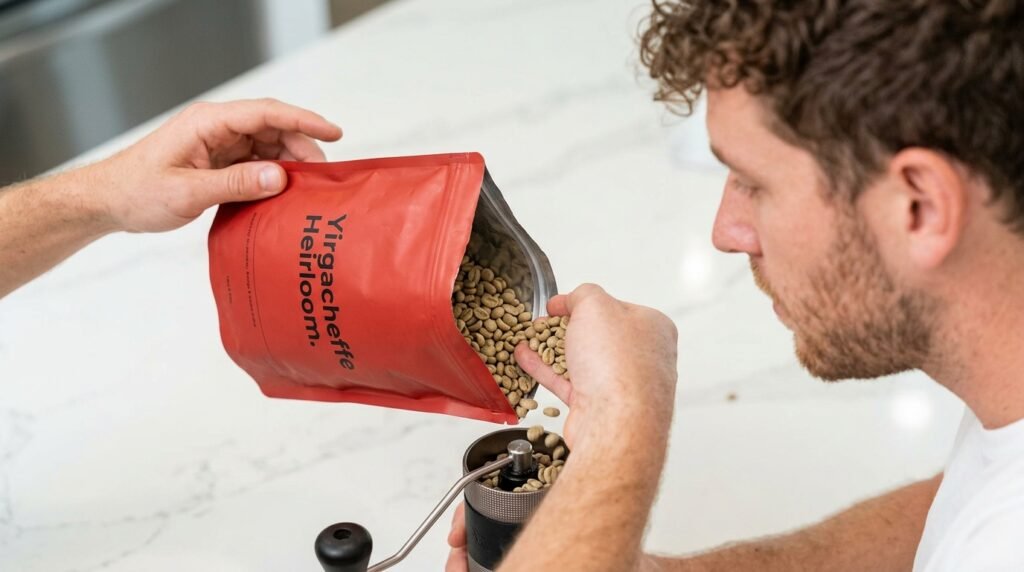
When you buy a bag of coffee from Colombia, the label will usually tell you exactly what genetic variety of plant produced the beans. But when you buy a bag of coffee from Ethiopia, the label almost always just says “Heirloom.”
This is because the farmers themselves often don’t know the exact genetic code of the trees they are harvesting. A single farmer in the Guji zone might have fifty different, naturally occurring genetic mutations of coffee trees growing wildly in the shade of their backyard forest. They harvest all these tiny, diverse cherries together.
This chaotic, wild genetic diversity is exactly what creates the explosive, floral, and incredibly complex flavors I was tasting in my glass carafe. The depth of that specific flavor profile was so shocking to my palate that it became the exact moment I experienced The First Time I Realized Coffee Could Taste Sweet. I realized that the sweetness wasn’t artificial; it was literally baked into the DNA of the wild Ethiopian plants.
The Power of Volcanic Soil
As I continued my research over the next few weeks, I learned that genetics alone don’t tell the whole story. The environment plays a massive, undeniable role in the final cup.
The wild Heirloom trees of Ethiopia thrive because they are planted in ancient, mineral-rich volcanic soil.
This soil is incredibly porous, allowing for perfect water drainage, which forces the roots of the coffee trees to dig deep into the earth. The high altitude of the Ethiopian highlands (often exceeding 2,000 meters above sea level) provides freezing cold nights and warm tropical days.
This extreme climate stress forces the coffee cherries to ripen at an agonizingly slow pace. The slower the cherry ripens, the more time the tree has to pack complex sugars, organic acids, and dense nutrients tightly into the seed.
When you combine wild, ancient genetics with high-altitude volcanic soil, you get a bean that is physically tiny and incredibly dense. When roasted lightly, that dense little seed explodes with the flavors of bergamot, blueberry, and jasmine.
Understanding this geographical miracle was deeply inspiring. It was the driving force behind The Day I Explored Ethiopian Coffee for the First Time in my own kitchen. I stopped buying generic blends and started actively hunting down bags of Ethiopian Heirloom beans from local roasters.
The Brewing Bottleneck
However, my newfound obsession with Ethiopian coffee quickly hit a massive roadblock.
I bought a beautiful, expensive bag of lightly roasted Yirgacheffe beans. I took them home, dumped them into my cheap automatic drip coffee maker, pushed the power button, and waited.
The resulting coffee was terrible. It tasted sour, weak, and completely lifeless. The jasmine and lemon notes I had tasted at the café were completely gone.
I was furious. I thought the roaster had sold me a bad batch.
But as I dove back into my research, I realized the problem wasn’t the beans. The problem was my kitchen equipment.
Dense, high-altitude, lightly roasted African coffees are incredibly stubborn. They do not want to give up their delicate sugars easily. You have to coax the flavor out of them with precise thermal energy and perfectly timed extraction. My automatic drip machine—which violently sprayed lukewarm water over unevenly ground coffee—was completely destroying the complex chemistry of the Heirloom beans.
If I wanted to taste the wild genetics of Ethiopia, I had to abandon the convenience of automation. I had to learn how to brew manually.
The Pour-Over Paradigm
My journey into manual brewing started with a simple, inexpensive piece of plastic: the V60 dripper.
The V60 is a classic pour-over cone. It looks like a simple funnel that sits directly on top of your coffee mug. But mastering it requires extreme patience and precision.
I had to buy a gooseneck kettle so I could control the exact flow rate of the hot water. I had to buy a digital scale so I could measure my coffee grounds and my water to the exact gram. I had to stand in my kitchen for four uninterrupted minutes, slowly pouring water in concentric circles, carefully managing the “bloom” and the drawdown time.
It was intimidating at first. But the V60 forced me to understand the mechanics of extraction.
If my Ethiopian coffee tasted too sour (under-extracted), I learned to grind the beans a little finer or pour the water a little slower to increase the contact time. If the coffee tasted too bitter (over-extracted), I learned to grind coarser or drop the water temperature by a few degrees.
By taking complete manual control of the brewing process, I finally managed to replicate that beautiful, tea-like clarity I had experienced in the café. This hands-on approach forced me to pay attention to the liquid, and it is precisely How I Started Noticing Flavor Notes in Coffee with much more accuracy. I was no longer a passive consumer; I was actively engineering the flavor profile in my own kitchen.
Enter the AeroPress
While the V60 was incredible for highlighting the delicate, floral notes of a washed Yirgacheffe, I quickly realized that manual brewing is not a one-size-fits-all hobby.
A few months later, I bought a bag of naturally processed coffee from the Sidamo region of Ethiopia. Because the fruit had been left to dry on the seed, the flavor profile was much heavier. It promised massive notes of wild berry jam and dark chocolate.
The delicate, paper-filtered clarity of the V60 didn’t seem to do the heavy Sidamo beans justice. I wanted more body. I wanted a thicker, punchier cup.
That is when I discovered the AeroPress.
The AeroPress looks like a giant plastic syringe. It is arguably the strangest, most unconventional coffee brewer on the market, but it is an absolute masterpiece of engineering.
Unlike the V60, which relies entirely on gravity to pull water through the coffee bed, the AeroPress uses full immersion and pneumatic pressure. You mix the coffee and the hot water together in the plastic chamber, let them steep, and then manually plunge a rubber piston down, forcing the liquid through a tiny paper filter.
Because the coffee grounds are fully immersed in the water for a longer period, and because you apply physical pressure at the end, the AeroPress produces a cup of coffee with a massive, heavy body.
The Joy of Trial and Error
Learning to use the AeroPress was a completely different beast than the V60.
There are literally thousands of different AeroPress recipes online. You can brew it normally, or you can use the “inverted” method (flipping the brewer upside down to prevent water from leaking out prematurely). You can use boiling water for a fast extraction, or cooler water for a long, slow extraction.
I spent weeks experimenting with different parameters for my heavy Sidamo beans. Some mornings the coffee was too sludgy. Some mornings it was too intensely concentrated.
But the sheer joy of manual brewing lies in that exact process of trial and error. When I finally figured out the perfect ratio of water to coffee, the perfect water temperature, and the exact plunge time, the result was monumental. It was an incredibly rewarding victory, which I broke down step-by-step in my post about The Morning I Finally Got My AeroPress Recipe Right. The resulting cup was thick, intensely fruity, and perfectly balanced.

An Endless Education
Looking back at that panicked afternoon in the downtown café, I am incredibly grateful for my own ignorance.
If I had just ordered a standard dark roast, or if I had successfully pronounced the words on the menu and pretended I knew what they meant, I would have missed out on a massive, life-changing hobby.
The discovery of Ethiopian Heirloom beans wasn’t just about finding a coffee that tasted like blueberries and jasmine. It was the discovery that coffee is not a generic commodity.
It is a deeply complex agricultural product. It is dictated by wild genetics, ancient volcanic soils, and extreme altitudes. It is a product that completely changes its identity depending on whether you use the gravity of a V60 or the pressure of an AeroPress to extract it.
Coffee is an endless education. There is always a new region to explore, a new processing method to taste, and a new brewing variable to tweak.
If you currently view your morning coffee as nothing more than a bitter necessity to get you out of bed, I highly encourage you to walk into a specialty café. Look for the most confusing, unpronounceable bag of single-origin coffee on their retail shelf. Buy it. Ask the barista how they recommend brewing it.
Take it home, put away the automatic drip machine, and try brewing it manually. The learning curve might be steep, and you might make a few bad cups along the way. But the moment you finally extract that perfect, vibrant, sweet flavor, your curiosity will permanently take over. You will realize that coffee isn’t just a drink; it is an incredibly delicious, endlessly fascinating puzzle.
