
The power went out at exactly 4:15 AM. I know this because the glowing green numbers on my microwave clock suddenly vanished, leaving my kitchen in absolute, impenetrable darkness.
Outside, a brutal spring thunderstorm was rattling the windowpanes. The rain was coming down in heavy, aggressive sheets, and the distant rumble of thunder shook the floorboards. I was wide awake, standing in my pajamas, holding a flashlight that I had desperately dug out of a hallway closet.
I had a massive presentation at work later that morning, and despite the apocalyptic weather, I still needed my morning coffee.
Because my electric burr grinder and my digital coffee maker were now entirely useless plastic paperweights, I had to improvise. I pulled a small butane camping stove out of the garage to boil water, and I grabbed my old manual hand grinder from the back of the pantry.
I stood at my kitchen island, illuminated only by the harsh, single beam of the flashlight propped against a cereal box. I poured a handful of light roast beans into the top of the hand grinder and started turning the crank.
Because I was standing in the dark, and because the humming of the refrigerator and the hum of the HVAC system were completely silenced, my senses were forced to recalibrate. My vision was limited. My hearing was focused only on the rain and the mechanical crunching of the ceramic burrs.
And then, my sense of smell went into absolute overdrive.
In that dark, quiet kitchen, the scent exploding from the bottom of that hand grinder hit me like a physical wave. That stormy morning was the first time I paid attention to coffee aroma, and it fundamentally rewired my brain’s relationship with my morning mug.
The Sensory Deprivation Effect
We are highly visual creatures. In our modern, day-to-day lives, our eyes and our ears do the vast majority of the heavy lifting when it comes to processing the world around us. We are constantly staring at screens, navigating traffic, and listening to podcasts.
Because our visual and auditory channels are constantly overwhelmed, our olfactory system—our sense of smell—gets pushed to the background. It becomes passive. We only really notice smells when they are dangerously offensive (like smoke) or heavily artificial (like a strong perfume).
But when the power went out that morning, my visual distraction was gone. I couldn’t look at my phone. I couldn’t stare at the morning news on the television.
Without those distractions, my brain suddenly had the bandwidth to process the invisible chemical compounds floating through the cold kitchen air.
As I cranked the handle of the grinder, I wasn’t just smelling “coffee.” I was smelling a deeply complex, layered bouquet. The dry fragrance rising from the catch bin smelled intensely of brown sugar, toasted pecans, and a sharp, bright hint of dried strawberries. It was so potent and so specific that I actually stopped grinding, picked up the bottom of the grinder, and buried my nose inside it just to breathe it in.

The Difference Between Fragrance and Aroma
Before that dark morning, I used the words “smell,” “fragrance,” and “aroma” interchangeably. I thought they all meant the exact same thing.
But as my curiosity grew and I began researching the science of the coffee bean, I learned that professional coffee tasters make a very strict, highly scientific distinction between these terms.
Fragrance is the smell of the dry coffee. It is the scent you experience when you open a fresh bag of whole beans, and it is the explosive scent you experience the exact second those beans are shattered in a grinder.
When you physically crush a coffee bean, you are breaking open thousands of microscopic cellular walls, releasing trapped carbon dioxide and highly volatile aromatic oils directly into the air. This violent release is precisely Why I Finally Decided to Buy a Coffee Grinder after years of drinking pre-ground dust. If you don’t grind the beans yourself, you are entirely missing the dry fragrance stage of the coffee experience. The factory workers who ground the beans got to experience it, but you did not.
Aroma, on the other hand, is the smell of the wet coffee. It is the scent that is created the exact moment hot water makes contact with the dry grounds.
The Magic of the Wet Aroma
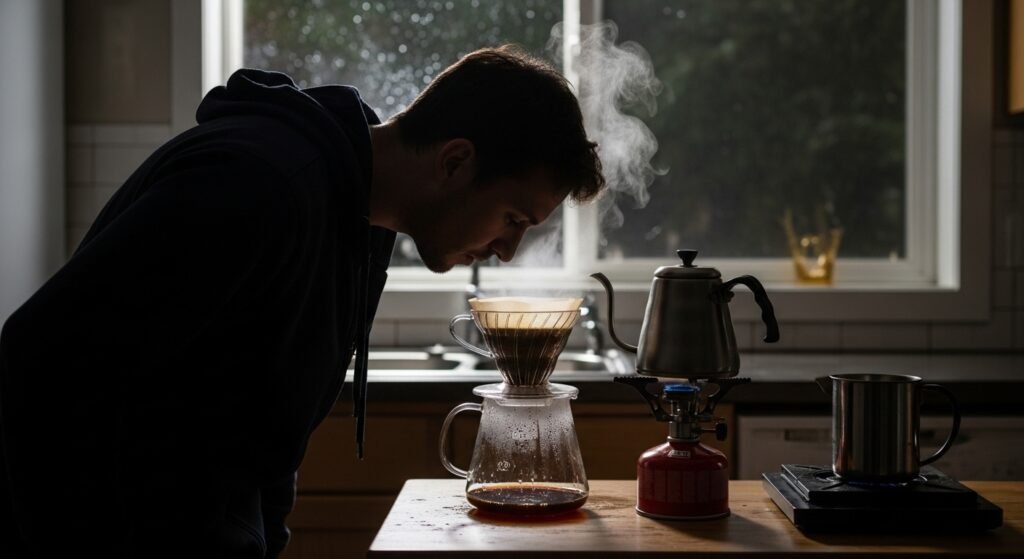
Standing in my dark kitchen, listening to the rain, I finally got my camping stove to ignite. I boiled a small kettle of water and prepared my glass pour-over dripper.
When I poured the hot water over the bed of freshly ground coffee, the transition from dry fragrance to wet aroma was instantaneous.
The hot water acts as a thermal catalyst. It rapidly dissolves the soluble compounds in the coffee and turns the remaining carbon dioxide into steam. As that steam rises from the coffee bed, it carries a completely new set of volatile compounds up into your nasal cavity.
The dry fragrance of pecans and dried strawberries suddenly morphed into something heavier, sweeter, and more comforting. The wet aroma smelled like melted caramel and baked apples.
I leaned over the brewing coffee, closed my eyes, and inhaled deeply. I wasn’t rushing. I couldn’t rush. The slowness of the power outage forced me to be entirely present in the physical world, creating the exact environment that led to The Morning I Realized Coffee Could Be a Ritual. I realized that inhaling the steam was just as satisfying as drinking the liquid.
The Biological Reality of Taste
Why does any of this matter? Why should we care about smelling our coffee before we drink it? Isn’t the taste the only thing that actually counts?
Here is the most mind-bending biological fact I learned during my coffee journey: Your tongue is actually incredibly stupid.
The human tongue is only capable of identifying five basic taste profiles: sweet, salty, sour, bitter, and umami (savory). That is it. If you relied entirely on your tongue, the world would be an incredibly boring culinary landscape.
So, how do we taste complex things like “milk chocolate,” “jasmine flowers,” or “ripe blueberries” in a cup of coffee?
We don’t taste them. We smell them.
Up to 80% of what we perceive as “flavor” is actually generated by our olfactory system. When you take a sip of coffee, the liquid hits your tongue (registering the basic bitter, sweet, or sour notes), but the volatile aromatic compounds travel up the back of your throat and into your nasal cavity. This is called retronasal olfaction.
Your brain takes the basic data from your tongue, combines it with the complex data from your nose, and creates the illusion of a specific flavor.
If you don’t pay attention to the aroma of your coffee, you are literally ignoring 80% of the beverage’s entire flavor profile. You are watching a beautiful, high-definition movie on mute.
Retraining Your Nose
Once the power came back on and life returned to normal, I refused to go back to my old, thoughtless habits. I wanted to experience that deep, complex bouquet every single morning, even with the kitchen lights fully blazing.
But I realized that identifying specific smells is actually a highly developed skill. It is a muscle that must be actively trained.
When I first started trying to identify aromas, my brain would just say, “It smells like coffee.” I had to forcefully break past that generic baseline. I had to start building a mental library of reference scents.
I started paying close attention to the world around me. When I walked through the produce aisle at the grocery store, I would intentionally smell the citrus fruits, the fresh berries, and the dark, leafy greens. When I baked, I would deeply inhale the scent of vanilla extract, cinnamon, and raw sugar.
By actively cataloging these scents in my daily life, I gave my brain a vocabulary to use when I smelled my morning mug.
Instead of saying “It smells like coffee,” I trained my brain to say, “It smells sweet and slightly sharp. It reminds me of the zest of an orange, layered over the smell of a dark chocolate bar.”
The Geography of Scent
As my olfactory vocabulary expanded, the world of coffee sourcing completely exploded for me.
I realized that the aroma of a coffee is the single greatest indicator of its geographical origin. Before you even take a sip, your nose can tell you exactly which continent the bean was grown on.
When I bought a bag of naturally processed Ethiopian beans, I didn’t even need to read the label. The dry fragrance erupting from the grinder was aggressively fruity. It smelled like a jar of wild blueberry jam and dark rum. It was intoxicating and completely wild.
A few weeks later, I bought a bag of washed beans from Guatemala. The aroma was entirely different. It was deeply comforting, smelling of heavy cocoa powder, toasted walnuts, and a hint of warm baking spices.
Learning to identify these regional differences through scent alone was a thrilling breakthrough, an experience I documented deeply in The Coffee Origin That Completely Surprised Me. The aroma became my compass, guiding my expectations before the hot liquid ever touched my palate.
The Scent of Defect
Paying attention to aroma isn’t just about finding the beautiful, sweet notes. It is also the most powerful tool you have for identifying bad coffee.
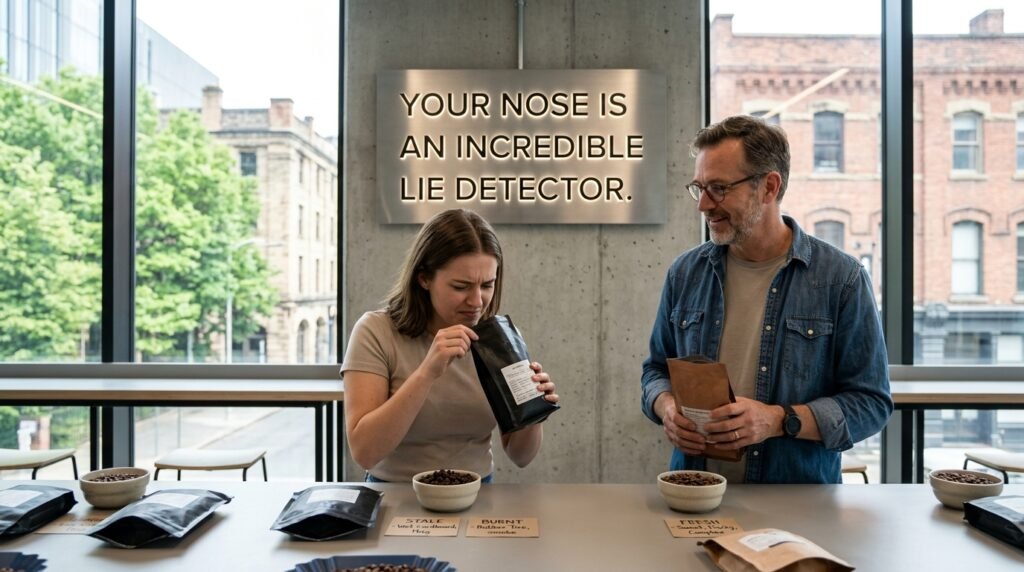
Once your nose wakes up, it becomes an incredibly sensitive lie detector.
If you open a bag of coffee and it smells intensely like an old rubber tire, burning wood, or a dirty ashtray, your nose is telling you that the roaster made a massive mistake. The beans have been incinerated. The delicate agricultural compounds have been entirely destroyed by heat, and the resulting cup will be painfully bitter.
If you open a bag and it smells vaguely like wet cardboard, dusty hay, or a damp basement, your nose is telling you that the coffee is stale. It has severely oxidized. The vibrant life of the bean evaporated months ago while it was sitting on a warehouse shelf.
Your nose will never lie to you. If the coffee smells flat, harsh, or chemical, no amount of precise brewing technique or expensive equipment will be able to save the taste. The aroma is the absolute baseline of quality.
A Challenge for Tomorrow Morning
We spend so much time obsessing over the mechanics of coffee. We buy expensive digital scales, temperature-controlled kettles, and high-end burr grinders. We debate water chemistry and pour-over techniques on internet forums.
But the most sophisticated, powerful, and sensitive piece of coffee-analyzing equipment in the world is already sitting right in the middle of your face.
If you feel like your morning coffee routine has become dull, or if you are struggling to taste the fancy flavor notes printed on the bags of specialty beans you buy, the solution isn’t to buy more gear. The solution is to close your eyes.
Tomorrow morning, I want to challenge you to recreate a fraction of my power-outage experience.
When you measure out your whole beans, don’t just dump them into the grinder. Hold a handful up to your nose and take a slow, deep breath.
When you finish grinding the beans, take the catch bin off the grinder, cup your hand gently over the top to trap the scent, and inhale the dry fragrance. Try to identify one single thing it reminds you of. Is it sweet? Is it earthy? Does it smell like nuts or fruit?
When you pour the hot water over the grounds, lean in closely. Watch the grounds swell and bloom, and let the steam carry the wet aroma directly into your nasal cavity.
Do not take a single sip of the beverage until you have fully experienced its scent.
By simply giving your olfactory system the time and respect it deserves, you will completely unlock the hidden dimensions of your daily cup. You will realize that coffee isn’t just a dark liquid designed to wake up your body; it is a complex, invisible bouquet designed to wake up your mind. And once you finally pay attention to that aroma, you will never drink a blind cup of coffee ever again.
