

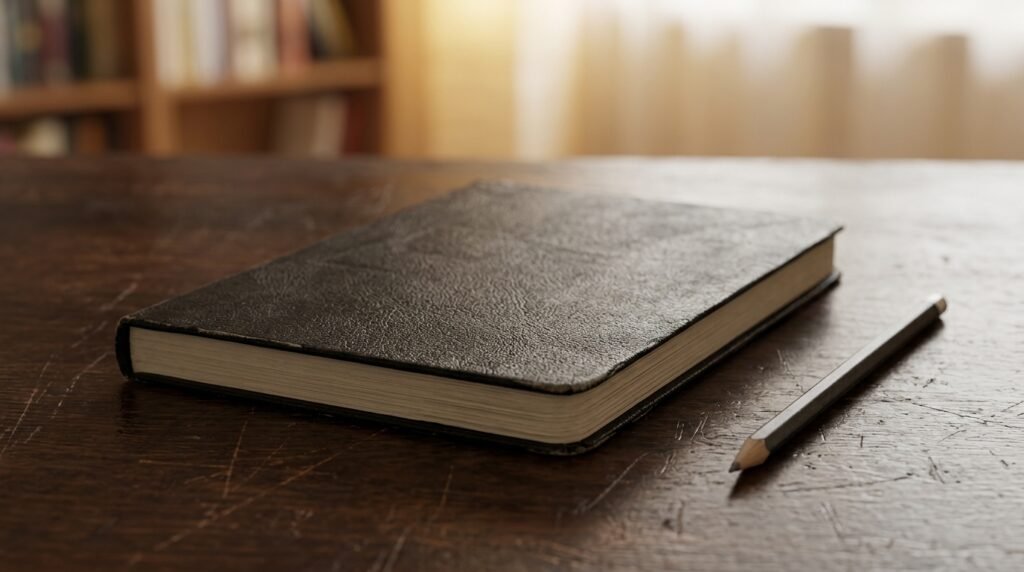
I was cleaning out the bottom drawer of my home office desk yesterday afternoon. I was looking for a spare charging cable. Instead, I found a small, black notebook buried under a pile of old receipts.
The cover was slightly warped. The pages were stiff. I opened it and saw massive brown coffee rings staining the paper.
The pages inside did not contain journal entries or meeting notes. They were completely covered in strange, chaotic math. There were columns of numbers. There were temperatures scribbled in red ink. There were aggressive notes in the margins saying things like “Too Sour” or “Perfect Sweetness.”
It looked like the notebook of a mad scientist.
Finding that notebook brought back a massive wave of memories. I sat at my desk and flipped through the stained pages. Those scribbled numbers represented a massive turning point in my life. They documented a specific block of seven days.
That notebook contains the exact records of the first week I started experimenting with coffee recipes. Before that week, I was stuck in a boring, repetitive rut. I drank the same cup of coffee every single morning. That week completely broke my routine. It taught me that coffee is not a rigid set of rules. It is a flexible framework. Here is exactly what happened when I turned my kitchen into a testing laboratory.
Breaking the Autopilot Habit
For a long time, I treated my morning coffee like a factory assembly line.
I bought good beans. I owned a good pour over cone. But my brain was operating on pure autopilot. I followed one single recipe that I had read on a random internet forum. I never changed it. I never questioned it.
I would grind twenty grams of coffee. I would pour three hundred grams of boiling water over it. I would drink it.
The coffee was fine. It was totally acceptable. But it was incredibly boring. I realized I was spending premium money on single origin beans from places like Colombia and Ethiopia, but they all tasted exactly the same in my mug. My rigid recipe was masking the unique flavors of the farms.
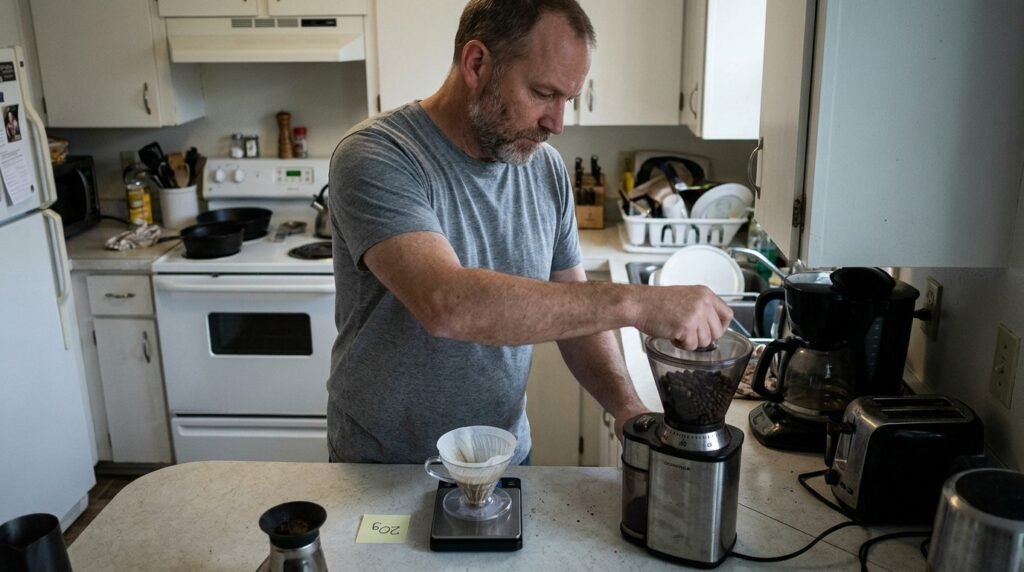
I decided to stop accepting “fine.” I wanted to see what else the beans could do. I bought a cheap black notebook. I placed it on my kitchen counter next to my digital scale. I decided to change one single variable every day for a week.
Monday: Manipulating the Ratio
On Monday morning, I tackled the most fundamental rule of coffee brewing. I changed the ratio of coffee to water.
My standard autopilot recipe used a ratio of 1 to 15. That means for every one gram of coffee, I used fifteen grams of water. It produced a balanced, middle of the road beverage.
I wanted to push the boundaries. I grabbed a bag of washed Kenyan coffee. I decided to dramatically tighten the ratio. I wanted a heavy, intense experience. I weighed out twenty grams of coffee, but I only poured two hundred and forty grams of water. This created a highly concentrated 1 to 12 ratio.
I took a sip of the dark liquid. The physical texture completely shocked my palate.
It was incredibly heavy. It felt like drinking a melted fruit syrup. The acidity of the Kenyan beans was aggressively sharp and punchy. It was almost too intense for a casual morning cup. But it proved a massive point. Changing the math completely changed the physical weight of the drink.
This dramatic shift is exactly How I Discovered the Perfect Brew Ratio for Myself after months of settling for watery mugs. I learned that if I want a heavier body, I just need to hold back the water.
Tuesday: The Thermal Drop
On Tuesday, I left the ratio alone. I went back to my standard recipe measurements. I decided to target the thermal energy.
I had always used water directly off a rolling boil. I assumed hotter water meant better extraction. But I had read an article suggesting that extreme heat destroys delicate flavor compounds.
I boiled my gooseneck kettle. Instead of pouring immediately, I took the kettle off the stove and started a timer. I forced myself to wait exactly two full minutes. The water temperature dropped significantly. It was hot, but it was no longer bubbling violently.
I poured the cooler water over the coffee grounds.
The resulting mug was an absolute revelation. It was the best cup of coffee I had ever made in my life up to that point.
The harsh, slightly burnt bitterness that usually lingered in the back of my throat was entirely gone. Because the water was cooler, it did not extract the dark, bitter tannins from the beans. It only pulled out the sweet sugars. The coffee tasted like sweet caramel and milk chocolate. It went down incredibly smooth. I immediately grabbed my pen and wrote “WAIT TWO MINUTES” in massive letters in my notebook.
Wednesday: The Grind Size Extremes
Wednesday was a highly frustrating day. I decided to experiment with grind size.
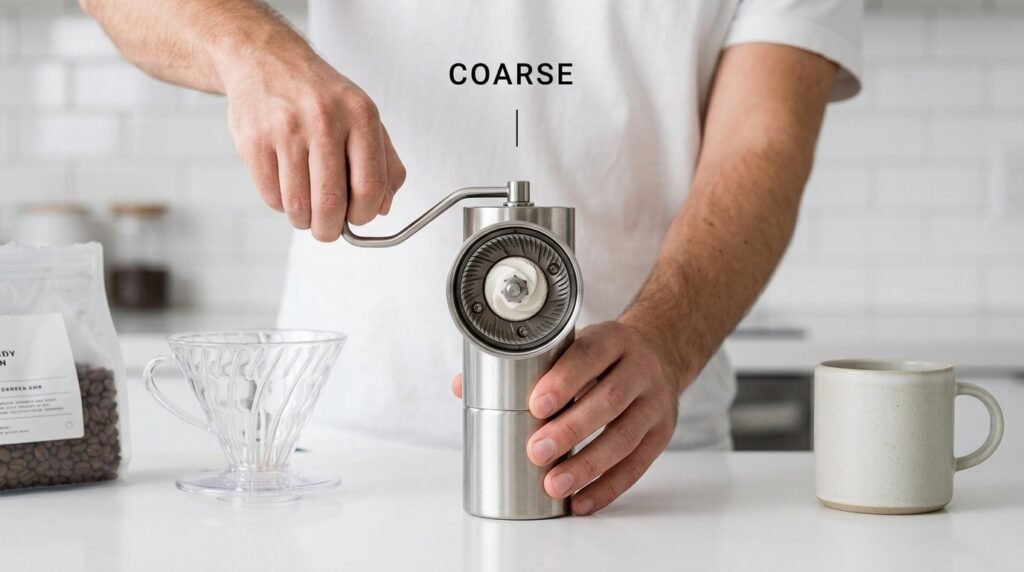
I wanted to know what would happen if I pushed my hand grinder to its absolute limits. First, I adjusted the ceramic burrs to a very coarse setting. The grounds looked like thick gravel. I brewed a cup.
It was absolutely terrible. The water drained through the coarse gravel in less than ninety seconds. The liquid was pale and weak. It tasted violently sour, like biting into an unripe green apple. The water simply did not have enough surface area to extract the sweet sugars.
I dumped it in the sink. I cleaned my gear and tried the opposite extreme.
I adjusted the burrs to a very fine, powdery setting. The grounds looked like powdered sugar. I poured the hot water.
The paper filter clogged almost instantly. The water refused to drain. It sat in the glass cone for nearly six minutes. When it finally finished dripping, I took a sip. It was horrifically bitter. It tasted like ash and dry dirt. The massive amount of surface area caused the water to severely over extract the coffee.
I dumped that cup in the sink too. Wednesday involved drinking terrible coffee, but it taught me a vital lesson. Grind size controls the speed of the extraction. You have to find the perfect middle ground between sour gravel and bitter dust.
Thursday: The Power of Agitation
By Thursday, I was starting to feel like a proper scientist. I had a good understanding of ratio, temperature, and grind size. I decided to experiment with physical movement.
Normally, I poured the water very gently. I refused to touch the coffee bed.
I decided to break that habit. I poured my initial splash of hot water to start the blooming process. The coffee swelled and bubbled. Instead of just staring at it, I grabbed a wooden stirring spoon from a drawer.
I forcefully dug the spoon into the wet coffee grounds. I stirred the slurry aggressively in a tight circle. I made sure every single dry pocket of coffee was completely saturated.
I finished the brew and tasted the coffee.
The sweetness was incredibly vibrant. The flavor felt significantly more uniform. By stirring the bloom, I forced the water to interact with every single particle of coffee equally. I eliminated the hidden dry spots that usually caused uneven extraction. The physical kinetic energy actively pulled more sugar out of the beans.
Friday: Managing the Pour Rate
Friday morning was entirely focused on the clock.
I realized that my pouring technique was wildly inconsistent. Sometimes I poured the water very fast. Sometimes I poured it very slowly. I decided to see how much that speed actually mattered.
I prepared my standard setup. I grabbed my gooseneck kettle. Instead of pouring gently, I dumped all the water into the filter as fast as I could. I flooded the glass cone immediately.
The heavy weight of the water pushed the coffee grounds flat against the bottom of the paper filter. The water drained very slowly because the heavy pressure compacted the coffee bed. The resulting cup was slightly bitter and muddy.
I cleaned the gear and tried again. This time, I poured incredibly slowly. I poured in tiny pulses. I waited for the water to drain completely before adding more.
This slow method extended the brew time significantly. But the flavor was vastly different. It was much cleaner. The individual notes of fruit and chocolate were separated and distinct. Controlling the flow rate was the exact premise of How I Learned to Time My Coffee Pour Perfectly and it became a permanent part of my morning routine.
Saturday: The Importance of the Baseline
Saturday was the final day of my dedicated experiment week. I did not test a new variable on Saturday. I simply sat at my kitchen table and reviewed the ink stains in my black notebook.
I looked at the notes from Monday through Friday. I realized something incredibly important.
None of these experiments would have been possible without my digital scale.
If I was measuring my coffee with a plastic scoop, my baseline would have shifted every single day. If my baseline shifted, I would never know if the changing flavor was caused by the new variable or by a random mistake in measurement.
You cannot run a science experiment if you are guessing your measurements. You have to lock your ingredients in place. Securing that absolute baseline was the crucial lesson from The First Week I Brewed Coffee with Precision Scales in my kitchen. The scale gave me the freedom to fail accurately.
Combining the Discoveries
On Sunday morning, I took everything I learned during the week and combined it into one master recipe.
I used the tighter ratio from Monday to give the coffee a heavy body. I used the cooler water from Tuesday to eliminate the harsh bitterness. I used the medium grind size from Wednesday to balance the extraction. I used the aggressive wooden spoon from Thursday to saturate the bloom. I used the slow pouring speed from Friday to keep the flavor clean.
I followed my new, customized steps meticulously. I poured the final drops into my mug.
I took a sip. It was spectacular. It did not taste like the boring, acceptable coffee I had been drinking for months. It tasted like a beverage crafted by a professional barista.
I had engineered a recipe perfectly suited to my own personal palate. I did not rely on a random internet forum. I relied on my own physical testing.
The Freedom of the Notebook
I closed the black notebook and placed it in my desk drawer. It sat there for years until I found it yesterday.
Looking at those pages reminded me of a profound truth. Coffee brewing is not a rigid doctrine. It is a playground.
Many people buy expensive equipment and become terrified of making a mistake. They follow instruction manuals blindly. They become paralyzed by the fear of ruining a cup.
You should absolutely ruin a few cups. You should make a cup that is horribly sour. You should make a cup that is violently bitter. You should push the variables to their absolute breaking points.
You cannot understand what makes a cup of coffee perfect until you understand what makes a cup of coffee terrible.
An Invitation to Play
If your morning coffee routine feels like a boring chore, you need to disrupt it. You need to stop operating on autopilot.
Go to a local store and buy a cheap notebook. Buy a pen. Put them on your kitchen counter right next to your coffee beans.
Tomorrow morning, change one single variable. Only change one.
If you normally use boiling water, wait two minutes before you pour. Write down the results. If you normally pour fast, pour slowly. Write down the results. If you normally use a specific amount of coffee, add three more grams. Write down the results.
Taste the liquid critically. Ask yourself if it tastes sweeter, heavier, or cleaner than yesterday.
Documenting your morning routine turns a mindless habit into a highly engaging hobby. It connects you directly to the culinary process. You will stop accepting average coffee. You will start designing your own perfect cup. Grab a notebook and start breaking your own rules.

Hi, I’m the coffee enthusiast behind Coffee Nerd Lab.
Like many people, I started drinking coffee simply because it helped me wake up in the morning. Over time, that daily habit turned into a genuine interest in understanding what makes a great cup of coffee. I began experimenting with different beans, brewing methods, grinders, and coffee gear, learning through trial and error along the way.
This blog is where I document that journey. Every article is inspired by real experiences, discoveries, and lessons I’ve learned while exploring the world of coffee. From brewing guides and equipment reviews to practical tips and coffee basics, my goal is to share useful information in a way that’s easy to understand and enjoyable to read.
Thanks for stopping by, and I hope Coffee Nerd Lab helps you enjoy your next cup a little more than the last.